How Russia’s Drawdown Will Affect War and Peace in Syria
The announcement by Russian President Vladimir Putin that the “main part” of his country’s military forces that have intervened in Syria since late September 2015 will begin withdrawing soon may prove less dramatic in practice than many hope or suspect. The announcement and its overall context do not indicate a major Russian policy shift. Putin...
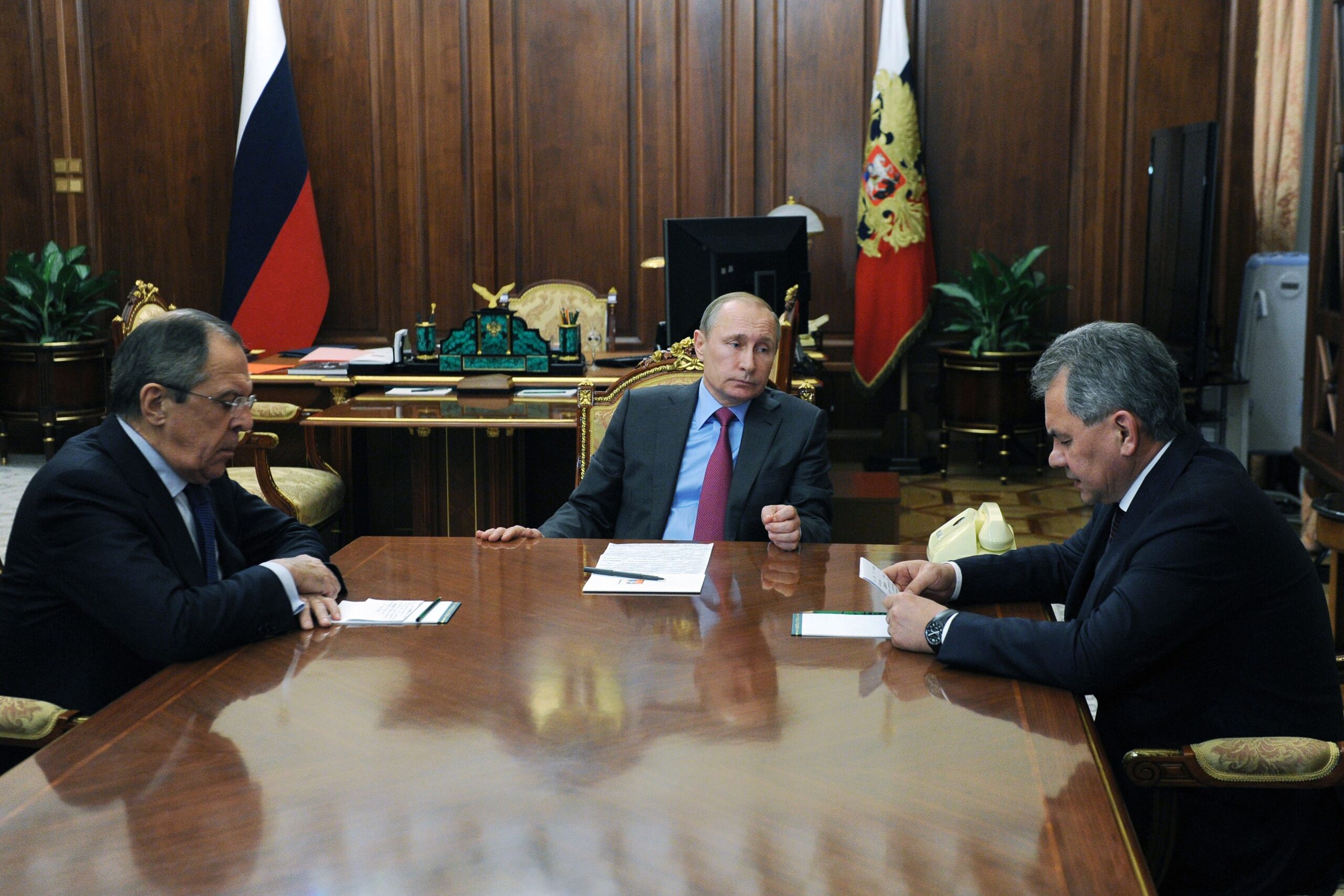
Russian President Vladimir Putin (C) meets with Defence Minister Sergei Shoigu (R) and Foreign Minister Sergei Lavrov (L) at the Kremlin in Moscow on March 14, 2016.
Russian President Vladimir Putin on March 14 ordered the defence ministry to begin the withdrawal of Russian forces from Syria on March 15. / AFP / SPUTNIK / MIKHAIL KLIMENTYEV (Photo credit should read MIKHAIL KLIMENTYEV/AFP/Getty Images)
The announcement by Russian President Vladimir Putin that the “main part” of his country’s military forces that have intervened in Syria since late September 2015 will begin withdrawing soon may prove less dramatic in practice than many hope or suspect. The announcement and its overall context do not indicate a major Russian policy shift. Putin has insisted that Russian operations at military bases in Tartus and Latakia – the only significant manned Russian military installations outside the former Soviet Union – will continue as usual. This means that Russia will maintain significant airpower in Syria, although where it will conduct operations remains to be seen. The precise number of air forces is not yet available, and may never be fully public. However, Russia had a major military presence in Syria before the offensive, and there is every reason to believe that, even after the drawdown, Russia’s role there will still be significantly greater than it was before September. So the idea that Russia is leaving Syria, or even ending its military engagement, appears to be contradicted by Moscow’s own announcement.
Moreover, the official Russian statements show continued support for Syrian President Bashar al-Assad. The readout of a telephone conversation between Putin and Assad on March 14 indicates that, while Russia may not have fully consulted its Syrian clients about this move, it is hardly abandoning them either. Why would Russia suddenly abandon a regime it has spent the past six months shoring up? Moscow has shown signs of irritation with Assad but remains fundamentally committed to regime maintenance, at least until a transition can be arranged that secures Russia’s interests. Until that can be accomplished, there does not appear to be any practical reason for Russia to suddenly turn its back on a regime it has worked so hard to shore up over the past six months.
However, the Russian drawdown may be partly designed to send a message to Assad, encouraging him to be more cooperative at the negotiations in Geneva. It comes in the context of a cease-fire largely secured by U.S. and Russian pressure that is linked to humanitarian relief efforts and the peace talks. Diplomacy is useful to both Moscow and Damascus, buying space and time for the regime to secure and consolidate its control over key areas and to perpetuate the status quo in Syria. But Russia appears to want more progress at the negotiating table than the Syrian regime. The timing of the Russian move strongly suggests a message to Assad encouraging cooperation, and a second message to the international community broadly casting Russia in a constructive role and avoiding any hint of being a “spoiler” to negotiations. Putin is also casting himself domestically as a decisive leader who can arrange successful military interventions while avoiding getting sucked in endless quagmires, and internationally as a judicious statesman who recognizes the limitations of the application of force and stays within reasonable constraints.
Putin is also casting Russia as a moderating force on the Syrian regime, although the reality is that without Moscow’s support the Assad dictatorship may not have survived until now. Moscow appeared annoyed by Syrian Foreign Minister Walid Muallem’s recent comments that any questioning of Assad’s future in the country is “a red line” that cannot be discussed at Geneva. Russia also expressed impatience with the regime’s statements that it wishes to keep fighting until it can extend its control over the entire country, an agenda Russia finds overly ambitious and needlessly provocative. So, while it remains generally supportive of Assad politically, Russia may be sending a message to him that he needs to be more flexible and responsive to Russia’s diplomatic and political concerns.
The Russian drawdown appears to be primarily a well-calculated response to the intervention’s mission having been largely successful, as the Kremlin is claiming. The purpose of the intervention, which was reportedly coordinated between Russia and Iran in the summer of 2015, was to reverse what, for them, had been an alarming series of setbacks for the regime at the hands of mainstream opposition groups, such as the Free Syrian Army factions, Ahrar al-Sham and Jund al-Islam, that are supported by Saudi Arabia, Qatar, and Turkey. Many reports indicate that Russia, Iran, Hezbollah, and the other key allies of the Assad regime were increasingly concerned during the first half of 2015 that the Damascus dictatorship might lose so much ground that it would become unsalvageable. This is how the situation appeared to many outside observers as well.
The intervention – in which Russia served as the air cover and technical advisory vanguard for ground forces largely made up of the Syrian military and pro-regime elements backed up by expeditionary forces from Hezbollah, the Islamic Revolutionary Guard Corps, and a number of Iraqi Shia militias – was intended to reverse the momentum on the battlefield in Syria. Several key areas were targeted, including Aleppo, areas comprising the Alawite heartland near the northwestern coast that are also close to Russia’s military bases in Syria, and other strategic areas that had been threatened by rebel advances. Most reports indicate that with Russian support in the air and the intervention of its allies on the ground, the Syrian regime was able to make substantial progress in most, if not all, of the areas of the country it considers most important.
It is possible that the regime would prefer to continue the conflict at its recent escalated phase and try to secure control over additional parts of the country that have been lost to opposition groups in recent years. But the Russian announcement strongly suggests that Moscow’s commitment is limited to securing regime control over what is being called in Arab media “necessary” or “viable” Syria, as opposed to trying to regain much of the rest of the country. This “viable Syria” begins at the Lebanese border, continues north through Qalamoun and into Damascus, up into Homs and Hama and into the coastal areas mentioned. Ideally, from the regime’s point of view, it should also include all or most of Aleppo and its environs. Regime forces have apparently made significant progress in that area, and rebel forces seem to have been dealt crippling blows around Aleppo as a direct result of the Russian-led offensive.
Moscow’s mission has indeed been largely achieved if the point really was to secure “viable Syria” for the regime and its local allies. However, Russia claimed that its intervention was an international counterterrorism effort targeted at the Islamic State in Iraq and the Levant (ISIL). While regime forces have recently been attacking some ISIL positions, most of the intervention was aimed squarely at mainstream rebel groups and had little to do with ISIL. If the purpose was really to crush or greatly degrade ISIL, the notion that the mission has been accomplished by Russia and its allies makes no sense since it has done little to affect ISIL’s standing. But from the point of view of beating back the mainstream rebel groups in “viable Syria,” the claim of relative success is plausible and perhaps even accurate.
Russia and its clients in the Syrian regime will no doubt claim to be greatly enhancing negotiations and the prospects of peace by this redeployment. But, unfortunately, there is no indication that the parties on the ground, on any side, are ready to embrace a formal, or even informal, settlement that ends the conflict. On the contrary, it would appear that all the armed Syrian groups believe that they can strengthen their hands through additional combat, and their regional patrons seem to agree. So, even if global powers such as the United States and Russia would like to see a de jure or de facto understanding to end the conflict, the time may not be ripe yet for talks to proceed much beyond formalities and tenuous cease-fires.
The Assad regime will certainly feel greatly strengthened by the intervention of its allies, even if Russia is drawing the line at how far it is willing to go to impose its will in Syria. Russia, Iran, and Hezbollah together have managed to largely reverse the momentum on the battlefield in favor of the dictatorship, and this isn’t likely to be quickly reversed. If it that eventually did happen, there is nothing preventing Russia from engaging in another “surge” to reverse such a reversal. So while the regime may be on notice that Russia will not be providing air cover for its broader ambitions to regain control of much wider areas, it will nonetheless likely feel that it can continue to build on the successes secured over the past six months. There is no indication that Iran, Hezbollah, and the others have drawn the same line that Russia implicitly has, and Moscow remains a strong supporter of the regime, even if it intends to limit its direct military engagement. Therefore, it’s likely that the Assad regime believes that it can at least secure its gains through additional conflict, and probably even continue to make some limited progress in key areas.
The mainstream rebels will also likely conclude that they can benefit from more fighting. Russia’s “withdrawal” can only be a source of relief for them, and it suggests that they can bring the recent spate of setbacks they have suffered to an end. Looking back on the first half of 2015, they will remember that before the Russian-Iranian surge, they enjoyed a series of significant successes, which is what prompted the intervention in the first place. With Russia pulling back, and indicating that its commitment in Syria is limited as well as raising the prospect that it could be exhausted either now or in the future, the idea that opposition forces could at least return to the positions they held only a few months ago must be deeply tempting.
The opposition continues to receive substantial political, diplomatic, financial, and military support from regional powers such as Turkey, Saudi Arabia, and Qatar. Opposition forces remain in control of significant parts of the country. And, most importantly, the mainstream opposition strongly believes it represents the interests and wishes of the Sunni Arab majority in Syria. The opposition is convinced that because it is comprised of the Sunni majority, over the long run, its victory will be assured. As a consequence, the opposition will see Russia’s implicit admission of a limitation to its aims in Syria as confirmation of its own reading of the long-term trajectory in the country. Because these opposition groups remain convinced that a strong Sunni Arab majority in Syria and in the broader region will not accept control over Syria, certainly including its most important areas within “viable Syria,” by a minority Alawite dictatorship and its patrons in Iran, they believe time is on their side and that they will eventually prevail.
The forces on the ground in Syria also don’t appear to be under much pressure from regional patrons to seek an early end to the fighting. The Assad regime may be disappointed by the Russian drawdown. But it can console itself that Iran and Hezbollah don’t seem to share Moscow’s interest in serious diplomacy (although Russia’s enthusiasm may be based on a sense that the United States appears to have gradually adopted a policy stance that accommodates all of their fundamental concerns, possibly including the survival of the Assad regime in the areas currently under its control). The main supporters of the armed opposition, Saudi Arabia, Qatar, and Turkey, also don’t seem to believe that a political solution is plausible, or even perhaps desirable under the present circumstances. On the contrary, the regional rivalry between these power blocs, which is playing out in Syria, would seem to be as aggressive as ever. In neighboring Lebanon, for instance, proxy confrontation between Iranian and Saudi allies is only intensifying. The war in Yemen also continues to rage.
Both Turkey and Saudi Arabia have threatened to intervene with ground forces in Syria, although ostensibly under the rubric of the anti-ISIL coalition that is led by the United States. Because Washington doesn’t seem open to such a dramatic military initiative, particularly one that also involves confronting the Assad dictatorship, direct intervention by Riyadh or Ankara doesn’t seem likely in the near term. However, there also does not seem to be any imperative for these regional powers, or their Iranian rivals, to urge their local clients in Syria to come to a political solution, particularly given that the armed Syrian groups are not disposed to do that anyway and would resist, if not reject, such pressure.
All of this means that the Russian announcement will probably be a great deal less dramatic in practice than it might initially seem. Nothing in Syria is likely to change in the short or medium terms given the balance of power on the ground, the ongoing Russian commitment to regime control of “viable Syria,” and the potential for an additional Russian-Iranian “surge” should there be some dramatic reversal of fortunes. Diplomacy in Geneva is shaped by realities in Syria. If the military balance of power remains essentially unchanged, the prospects for a political breakthrough – even if Moscow and Washington favor that – are limited. In the long run, Russia’s drawdown might be seen as significant because it defined the limitations of Moscow’s military commitment to the Assad regime. But in the short and medium terms its impact on the strategic equation in Syria, and hence the likelihood of an agreement or understanding to end the conflict, will probably be quite limited.
The views represented herein are the author's or speaker's own and do not necessarily reflect the views of AGSI, its staff, or its board of directors.
President Trump has led the United States into an impossible dilemma in which resuming and intensifying the war presents one set of alarming consequences while ending it under current circumstances offers at least as many disasters for Washington.
The Trump administration has positioned the United States at a crossroads between a new regime of containment against Iran or a historic drawdown of U.S. influence in the Gulf and broader Middle East.
Riyadh and Abu Dhabi urged President Trump not to attack Iran, but now that the war is into its second month, leaving the current situation in place would be an unthinkable fiasco for them.
Though they were unsuccessful in preventing the current conflict, and, as expected, have been dragged into the U.S.-Israeli confrontation with Iran, Gulf Arab countries remain crucial to hopes for limiting the war and bringing it to a quick resolution.
Syria hopes to use the Iran war to deepen its connection to its Gulf Arab partners. Can it compete for inclusion within the regional security order and emerging trade corridors?
The imperative for Gulf states to unify their position has grown since the onset of Iranian attacks on their countries. Yet under conditions of uncertainty about the U.S. position and the war's outcome, Gulf states are demonstrating differing regional alignments and preferences for managing the crisis.
Caught between Iranian strikes and U.S.-Israeli pressure to join the fight, Gulf Arab states strive to maintain their autonomy over decision making, playing defense and preserving the space to maneuver when the war ends.