When regional actors or great powers ask these days what determines the success or failure of their strategies in the region, they are increasingly discovering that developments in Syria heavily shape the outcome.
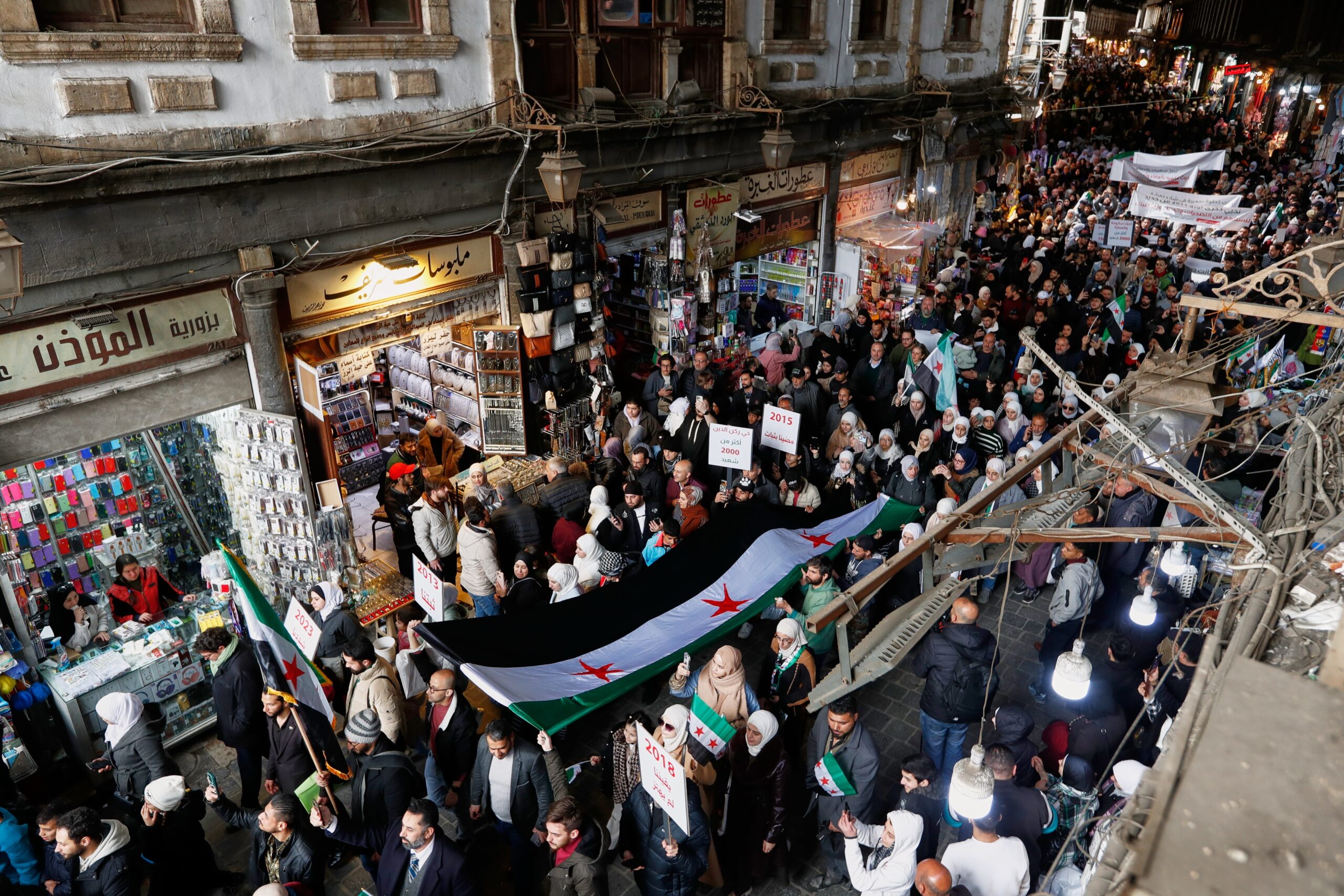
Demonstrators carry a Syrian flag during a march marking the 15th anniversary of the start of the Syrian revolution against the Bashar al-Assad regime in the Old City of Damascus, Syria, March 15. (AP Photo/Omar Sanadiki)
In reviewing the geostrategic landscape of the “post”-Iran conflict, one perception keeps hammering itself home, with an attractive simplicity: Syria is the answer. Increasingly, the success or failure of regional strategies depends in significant ways on developments in Syria. The examples populate that mental mapping exercise with alacrity: Washington’s need to contain Iran without another major military conflict: Syria is the answer, as it is for Washington’s need to continue its counter-ISIS legacy effort in the Levant. Regarding the Saudi and Gulf Arab effort to contain an apparently resurgent Iran: Syria, again is the answer, or a key part of it.
Before addressing Iran, considering additional examples for a moment helps underscore the increasing prominence of Syria on the region’s geostrategic map. Regarding Iraq’s search for export alternatives and for reducing the depth of Iranian influence over its economic and political space: Syria is the answer, as it is as well for Turkey’s challenges with regional security issues on its southern border and its large refugee problem. Syria also holds promise as the locus for a number of different regional connectivity projects, ranging from the high narrative of the barely nascent Four Seas project to the rusting debris of the old Kirkuk to Baniyas pipeline. The United States even sees Syria – bizarrely perhaps, and against all Syrian-focused interests – as the solution to Hezbollah in Lebanon that will short-circuit the Israeli intervention that is bedeviling implementation of the Iran memorandum of understanding and related agreements.
Why Is Syria the Answer in This Post-Iran Conflict Moment?
A few of Syria’s defining characteristics help explain why Syria is emerging as a pivotal element at this post-Iran conflict moment. First is geography: Syria is the Gulf’s gateway to the Levant and the Mediterranean. Second is demography: Syria shares with the Gulf prominent Sunni, Arab, and Islamic accents, although with significantly stronger minorities’ features, both ethnic and sectarian, as well. And finally, Syria is emerging from 15 years of bloody military conflict, with a nearly destroyed infrastructure and economy and a new, almost accidental, government that assumed its place as the 60-year-old Assad regime crumbled. In short, Syria is nearly tabula rasa or, at least, an inviting geostrategic canvas on which neighbors, other regional powers, and great power rivals feel inspired to paint their aspirations, unencumbered by a long-entrenched regime or political party bent on thwarting such external plans. A rapidly developing, unexpectedly positive relationship with the United States perhaps also helps explain Syria’s burgeoning importance.
Is Syria the Gulf’s Answer to Iran?
Of the provocative examples offered at the outset, the ones connected to Iran are perhaps the most intriguing. How does Syria represent the answer for Gulf states focused on pushing back against a resurgent Iran?
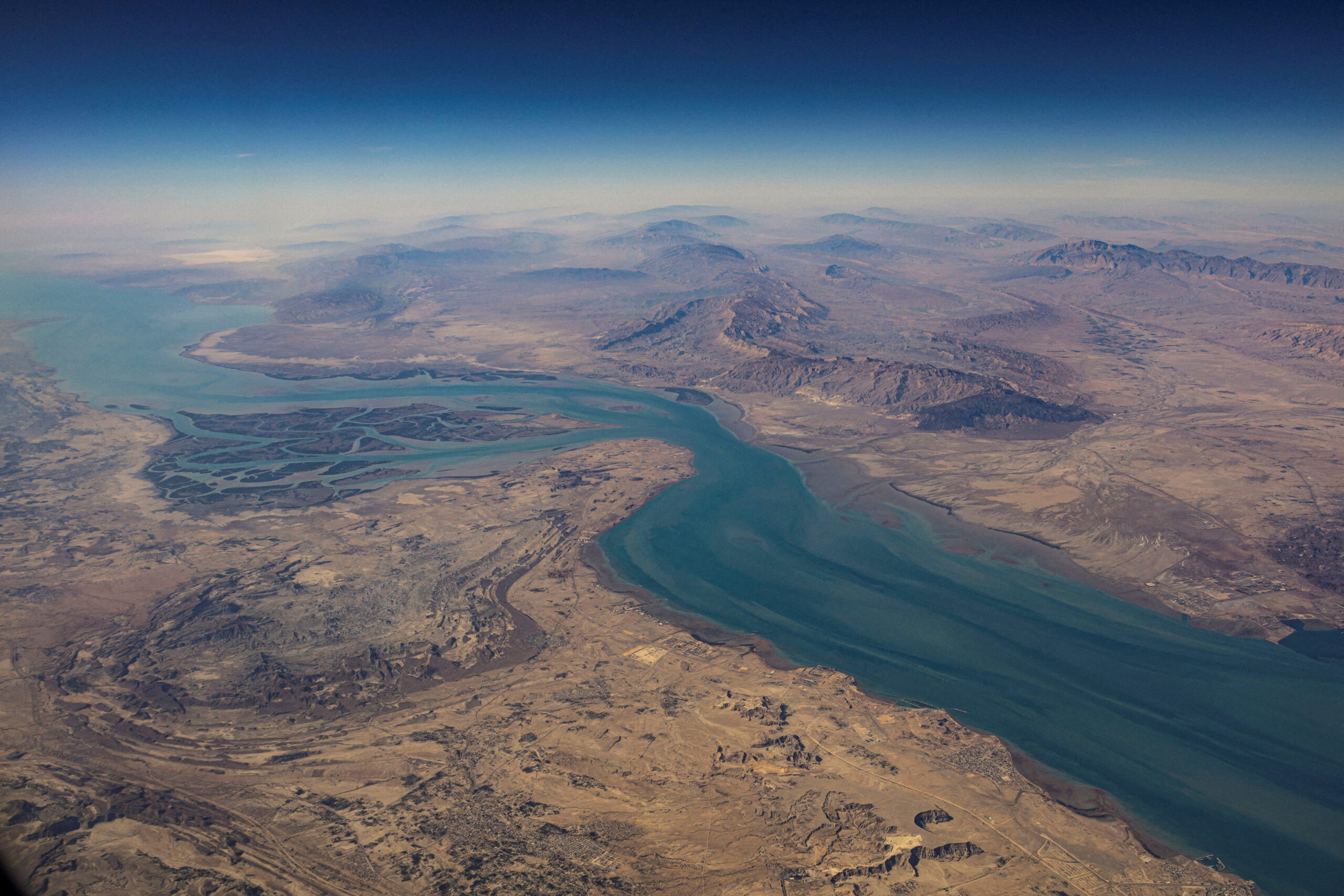
For decades Syria was the linchpin of Iran’s regional axis. It connected Tehran to Hezbollah in Lebanon and gave Iran strategic reach into the Levant. Syria was the operational infrastructure for Iran’s proxy network and the keystone to Tehran’s westward security arc that traced from Iran, Iraq, Syria, and Lebanon to the Mediterranean. Over all those decades that Iran exercised sway in Syria – and particularly during the years it had troops in Syria defending the regime of Bashar al-Assad – the Gulf, and especially Saudi Arabia, was boxed out of the Levant in significant ways. Syria – and the broader Levant – became a playground for decision making, calculations, and arrangements that left out the Gulf Arab states, and other Arab states more generally, whether regarding Russia-Iran deals over force posture, Russia-Israel de-confliction, Iran-Turkey de-confliction, or U.S.-Russia understandings over airspace.
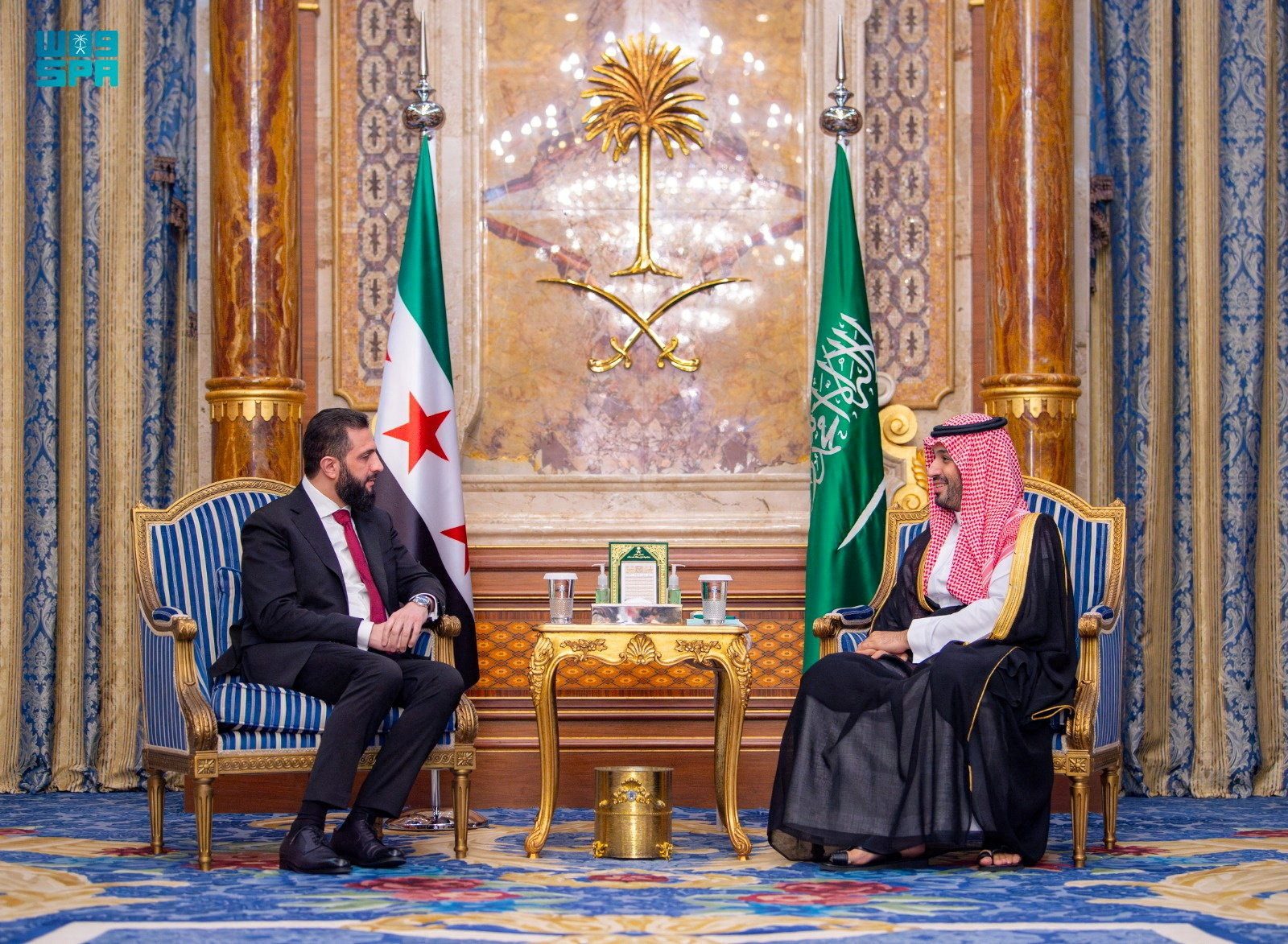
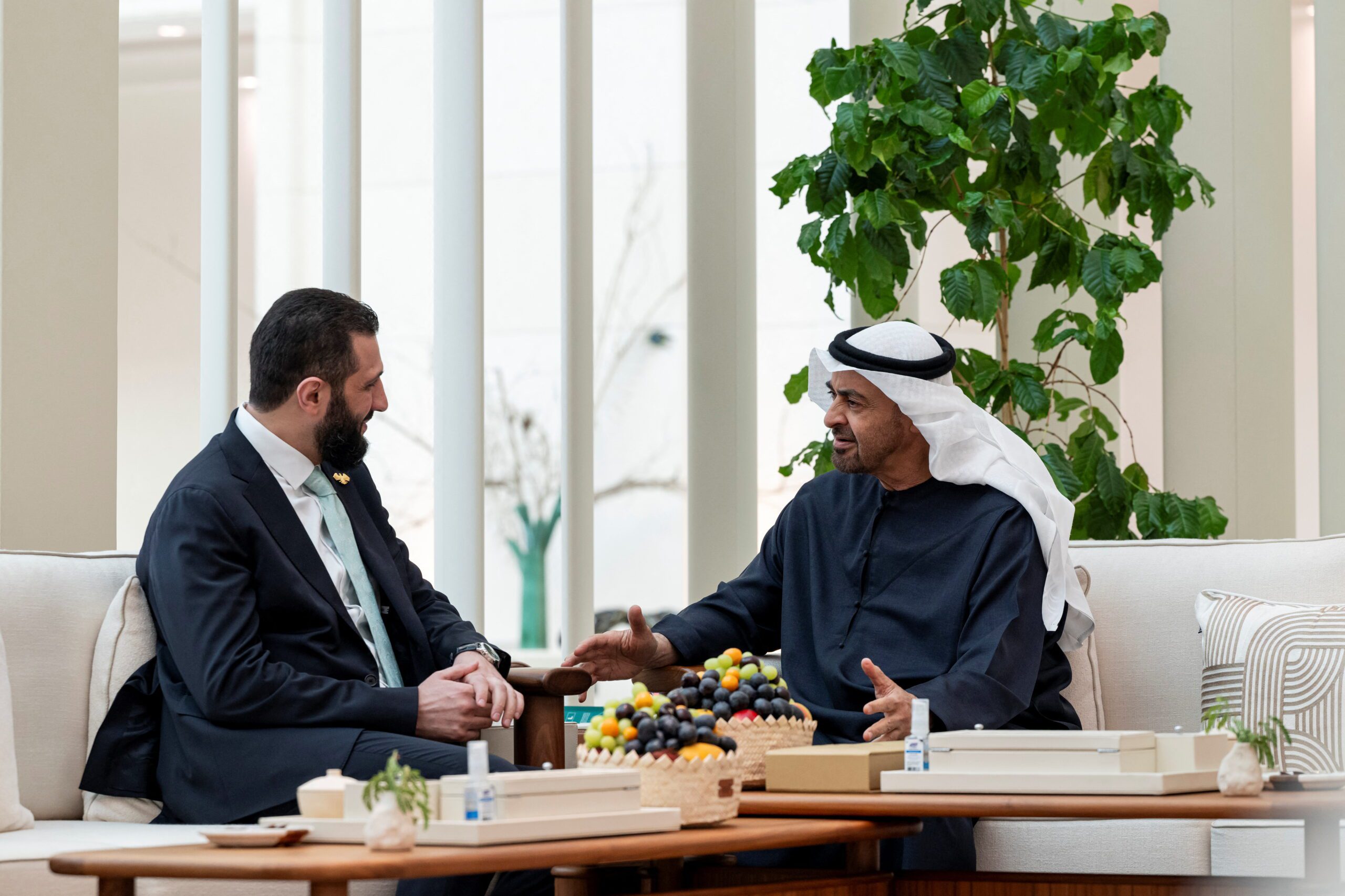
For Saudi Arabia and the United Arab Emirates, in particular, weakening that corridor has long been a central objective, and it has taken on renewed importance in this post-Iran war moment. Gulf states, and fellow Arab states in the Levant, can once again view Syria as an Arab-bounded state, especially in terms of alignment options, with significantly greater incentives to coordinate on security, in diplomacy, and through regional mechanisms that link the Gulf and the Levant. Gulf states can likewise help create the incentives (and disincentives) to ensure that Syria does not again become a permissive logistics zone for a foreign power like Iran, particularly one whose regional ambitions sought to encircle and counter Gulf Arab regional influence.
These realities are likely to help shape and inform the Gulf’s ambitious investment aspirations for Syria. Syria of course has its own aspirations for attracting foreign investment. But in all the above-mentioned dynamics, Gulf Arab states are exceedingly well positioned to respond to Syria’s urgent need to rebuild its country and develop its shattered economy. Gulf states are similarly well positioned to encourage an already well-disposed Damascus to see its interests connected closely with the Gulf.
These provocative examples illustrate that Syria sits at the intersection of a number of regional and foreign power fault lines. When regional actors or great powers ask these days what determines the success or failure of their strategies in the region, they are increasingly discovering that developments in Syria heavily shape the outcome.
From Being Important to Being Successful
A few key issues emerge from this centrality: Most importantly, how can Syria convert being important into being successful? To do that, Syria needs to be a balancer; Syria needs to give states in the region and more broadly a stake in Syria’s stability and success but avoid allowing any state to “own Syria” or control it. Syria will also need to avoid the smothering embrace of another state’s consuming interest: The United States’ urgent request for Syrian intervention in Lebanon, for example, stands as a cautionary tale underscoring the need for Syria not to get carried away with all the attention it is receiving. To be successful, Syria must in significant instances agree not to play an overly important role that could distract it from its critical need to rebuild its country and regional influence. This is a version, perhaps, of avoiding becoming a pawn in others’ conflicts and agendas.
A related question turns on whether Syria can checkmate determined spoilers, most prominently, Israel. This will be a challenge, but the best answer probably lies in multiplying the number of key stakeholders for Syria’s success (Saudi Arabia, the UAE, Qatar, other Gulf states, Turkey, Jordan, Iraq, France, the United States, and others); the goal would be to make obstruction lonely for any potential spoilers.
It’s also important to note that Syria isn’t just a geopolitical asset, an arena for regional and great power competition, or a locus for a swirl of diplomatic activity, nor is it merely a corridor for trade. One must also ask: Is Syria the answer for Syrians? Syrians are likely focused on many things: jobs, reliable electricity, functioning schools, housing, health care, security, a government that works and provides services, as well as broader national dignity issues. So, Syria isn’t just an arena for externally focused strategies; it is also a state with internal narratives that will help shape how far external strategies can go and still be successful, particularly in terms of investment and support for reconstruction efforts. A key question to ask is how can that strategic importance for Syria improve the lives of ordinary Syrians. Citizens need to become participants in the reconstruction project of Syria and not just spectators. Vital institutions – chambers of commerce as well as trade, professional, civic, and diaspora organizations – all these and others can help give agency to Syrians in this process.
Externally, regionally, and even for great powers, Syria is increasingly being viewed as the answer, or a key piece of it. Internally, Syria is the question: Can Syrians reconcile identity, grievance, national dignity issues related to sovereignty and territorial integrity, economic hardship, the urgency of reconstruction, and aspirations to shape their own future? External actors cannot be fully invested in Syria without confronting these internal political realities – and the narratives they generate.
The views represented herein are the author's or speaker's own and do not necessarily reflect the views of AGSI, its staff, or its board of directors.
Syria hopes to use the Iran war to deepen its connection to its Gulf Arab partners. Can it compete for inclusion within the regional security order and emerging trade corridors?
Gulf capitals are facing immediate policy choices around how to restore order in a regional setting that is greatly changed – for the worse – as a result of the Iran war.
New investment deals, mainly from the Gulf states and Turkey, are opening a path for Syrian reconstruction. But the fragile security situation and financial environment remain hurdles for foreign investment.
The blockade, artfully deployed, and a focus on coalition building, international law, and interests-based negotiations can help the United States and its Gulf allies extricate themselves from the current impasse.
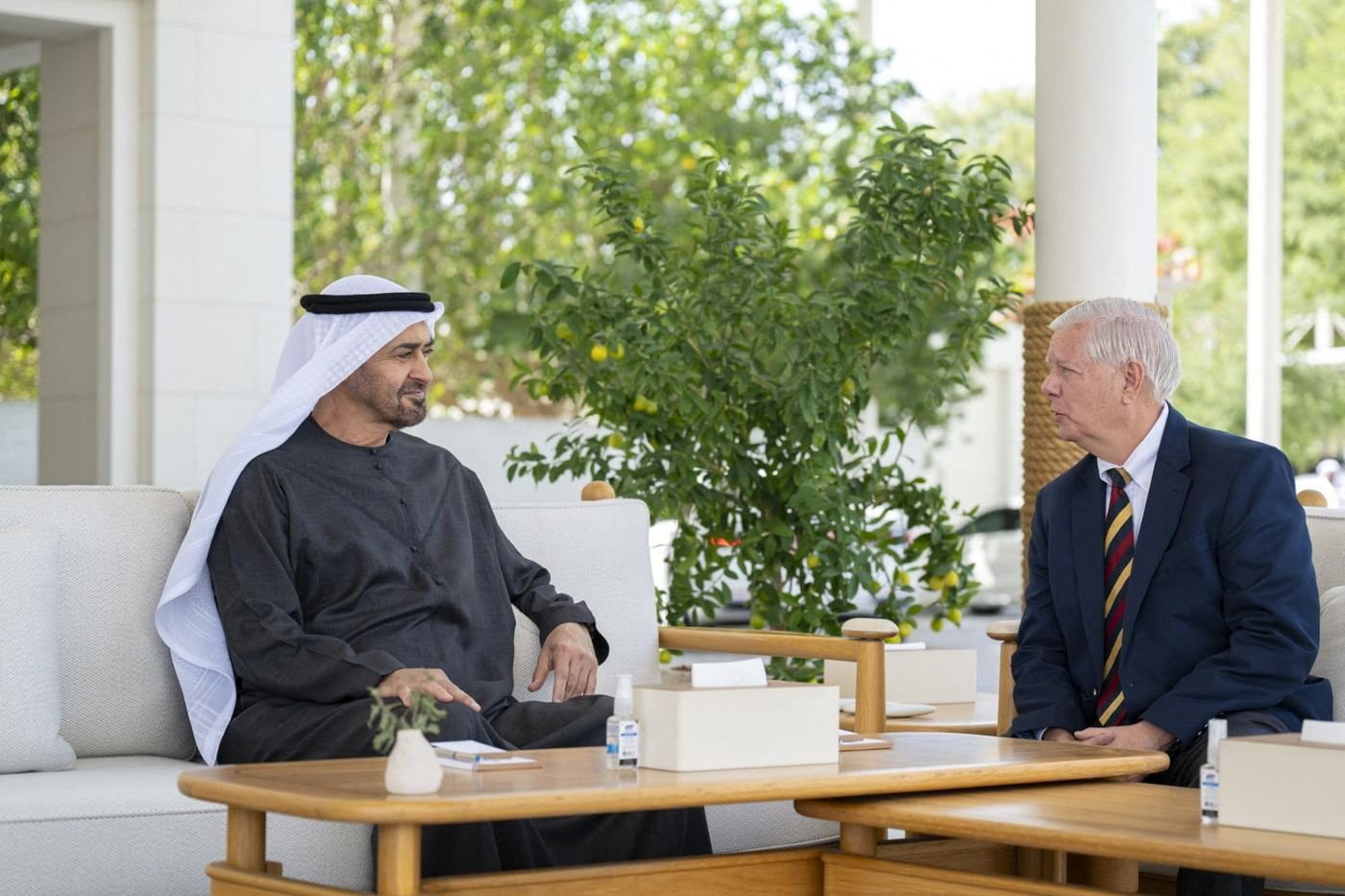
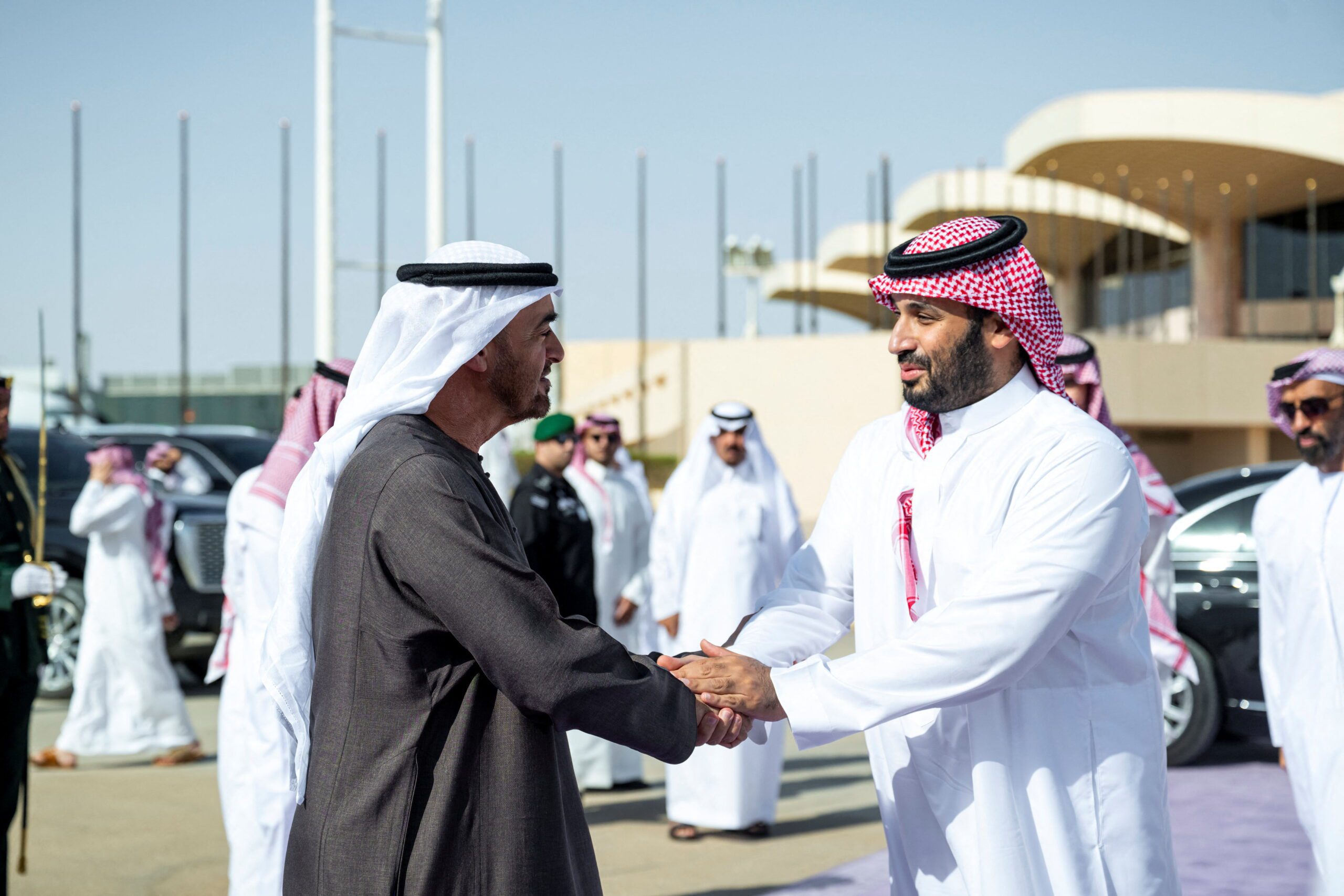
To respond to harsh Saudi criticisms, the Emiratis have sought to reframe, deflect, and calibrate, avoiding escalation while also benefitting from powerful advocates, including Senator Lindsey Graham.
Disputes in the Gulf tend to be structurally constrained by dense interdependence, established patterns of dispute management, and various shades of elite empathy among leaderships.
Syria’s challenge moving ahead will be the difficult effort to develop a political system that will empower Syria’s people to embrace the more pedestrian but necessary political compromises upon which inclusion and representative government are based.