The Rung Bell and the Crooked Strait: Decoding the Conflict With Iran
The blockade, artfully deployed, and a focus on coalition building, international law, and interests-based negotiations can help the United States and its Gulf allies extricate themselves from the current impasse.
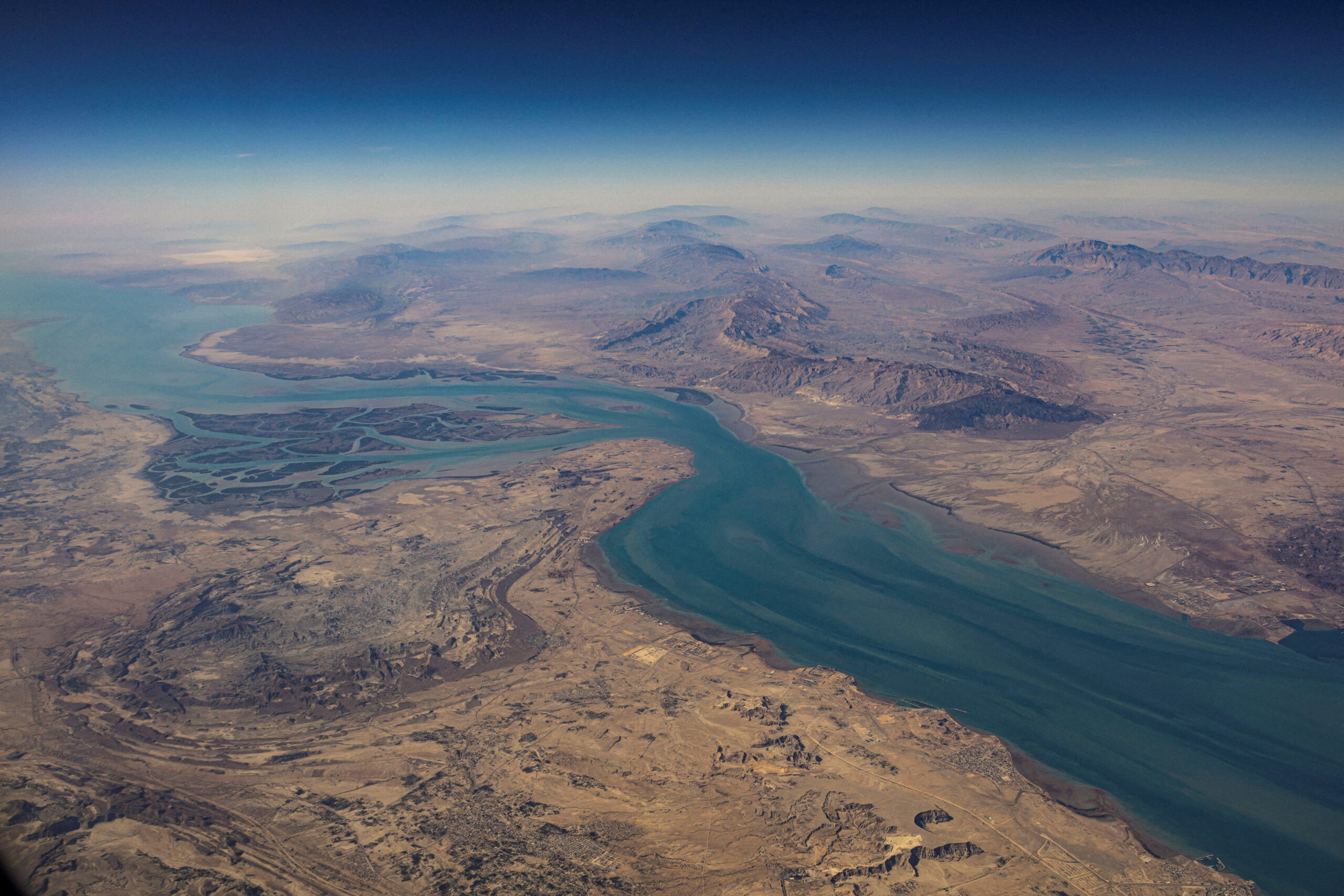
An aerial view of the Strait of Hormuz, December 10, 2023. (REUTERS/Stringer/File Photo)
As the U.S.-Israeli confrontation with Iran approaches the two-month mark, the conflict seems to have settled into a messy stalemate punctuated with blips of diplomatic activity and barrages of countervailing messaging. The latest negotiations stalled before getting underway April 25, when President Donald J. Trump canceled plans for U.S. officials to travel to Islamabad, notably after Iranian Foreign Minister Abbas Araghchi flew into and departed the Pakistani capital before the U.S. representatives could launch. A flurry of Iran-centric regional diplomacy continued over the weekend as Araghchi met the sultan of Oman, Haitham bin Tariq al-Said, in Muscat and returned to Islamabad for a follow-up meeting. He also spoke by phone with Saudi Foreign Minister Faisal bin Farhan (the second publicly reported foreign minister-level Iranian-Saudi contact since the war erupted) and with Qatari Prime Minister and Foreign Minister Mohammed bin Abdulrahman al-Thani. All these conversations were said to focus on latest developments and diplomatic efforts to reduce tensions and end the war. Iranian President Masoud Pezeshkian in an April 25 phone call with Pakistani Prime Minister Shehbaz Sharif elaborated that Tehran would not enter “imposed negotiations” under threats or blockade, according to a statement from the Iranian government. There are reports April 27 the Iranians have given the United States a new proposal, offering to reopen the Strait of Hormuz and end the war while postponing negotiations on nuclear issues.
Meanwhile the U.S. blockade of Iranian ports, effectively reinforcing Iran’s closure of the Strait of Hormuz, remains in place, and the price of Brent crude stands near $107 per barrel.
The Impossibility of Unringing the Bell
In the meantime, this conflict continues to be defined by two fundamental descriptive realities. The first is that the bell of Iranian control over the Strait of Hormuz cannot be unrung. It continues to echo and shape the parameters of the current conflict and the aftermath to come. This is the classic impact of the rung bell: It cannot be unrung. With a mix of threats and limited kinetic activity, Iran has exerted physical control over the strait – a body of water that has been shaped by 100 years of modern navigational practice, reinforcing its status as an international waterway with freedom of navigation for all ships, and underscored over the last five decades of that century by international law and convention, enshrined most importantly in the 1982 United Nations Convention on the Law of the Sea. During its closure, Iran also for a period effectively imposed tolls on ships passing through the strait and has continued to insist it has the right to police enforcement and passage. The economic and energy consequences of the closure are still accumulating, ranging from bloated oil prices to spiking fertilizer costs (“a structural supply shock” amounting to a 47% increase), and also including aviation fuel shortages, a liquefied natural gas squeeze, an investment chill, and an insurance shock, among other costs.
Beyond the economic impact, there are psychological effects and the impact of precedent. Iran has done something in the war that it would never have dared to do before it broke out. Feeling cornered, with its existence threatened, the Iranian regime fundamentally changed its calculations. Radical regime actions previously viewed as too risky came quickly to seem reasonable and feasible amid early-war U.S. signaling – possibly misunderstood or recklessly transmitted and walked back belatedly – that it was ready to support regime change efforts.
The strait has been effectively closed since February 28 – two full months. An unthinkable act six months ago or even two months and one day ago has come to be seen as normal, however viciously objectionable.
In international relations theory, there are concepts that help explain this rung bell effect. One is called norm erosion or collapse. Theorists such as Martha Finnemore and Kathryn Sikkink argue that once a taboo in international relations is broken – or once such behavior is demonstrated and tolerated – it can be spread and become normalized faster. This concept blends with the concept of deterrence breakdown – if a redline is crossed without consequence, it can’t simply be restored by rhetoric. Thomas Schelling argues that once a party takes an action that is costly and difficult to undo or crosses a previously unthinkable threshold, it forces others to respond to that new strategic reality rather than to the previous status quo. It establishes a new precedent that becomes a constraint on everyone’s expectations. That in turn reshapes future bargaining space and the interactions among the various parties.
The rung bell also reshapes, per Joseph Overton, the structure of discourse in a conflict. The rung bell effect – once precedent is set and cannot be unseen – shifts what’s known as Overton’s window, the range of ideas considered politically acceptable, by making previously unthinkable actions part of the live set of options.
A Rung Bell Effect Is Not Irreversible – But the Process Is Costly, Slow, and Difficult
In international relations theory, the past – the rung bell – is not irreversible. But to reverse this complex shift of norms, strategic reality, and structure of discourse is costly, slow, and can require a second-order shock. In short, a rung bell effect can be reversed by re-ringing the bell, so to speak. In concrete terms, it requires sustained effort and enforcement of a counter norm, repeated cost signaling, extensive coalition building to help in reestablishing the taboo, and reliance on international law and convention (which help restore the previous baseline, create reputational risk, and legitimize the extensive coalition pushback effort).
The Crooked Strait Effect
The second fundamental descriptive reality evident in this conflict is that the strait has proved to be crooked. What seems like a straightforward conflict has turned out to be a messy war situation with a hundred sudden shifts in direction and mood, each that seemed obvious for a day or a few hours, until the trajectory suddenly shifted in another direction. A range of distortions seem to cloud one’s ability to size up and predict this conflict – things don’t seem physically straight; and they seem subject to other distortions, whether cognitive or temporal. Small events trigger disproportionate reactions or interpretive shifts. The strait produces moments of clarity, but the clarity is episodic. The crooked strait, as a descriptor of the conflict, looks navigable but perceptions, direction, and stability constantly misalign. Actors need to regularly reassess escalation thresholds.
Two concepts in international relations theory help illuminate this notion of the crooked strait. First is “the fog of war.” In crisis and security studies, uncertainty is not just informative – it is structural and interactive. Actors – and the states they represent – are not only uncertain about facts; they are uncertain about each other’s thresholds, intentions, and interpretations of events. A second concept emerges in conflict studies and escalation studies. A system can sit in a condition of instability that still looks like a structure. It is sometimes described as a crisis instability or an unstable deterrence environment. Stability exists, but it is continually misread as directional certainty. The solution – to remove ambiguity entirely – is an impossible task; the key is to try to reduce the volatility in the system.
There are various methods that have proved useful in past conflicts to reduce this volatility. One involves establishing and strengthening crisis communications channels, such as mil-mil and maritime incident deconfliction channels and reliable diplomatic backchannels. The key objective is to reduce interpretive lag in crisis episodes and reduce the sudden bends in the crooked strait caused by misunderstanding, misperception, and unreliable mapping of the conflict. Related objectives involve keeping responses proportional and seeking to establish recognizable thresholds. Another key in dealing with the crooked strait effect is to avoid zero-sum logic. In an unstable, crisis environment, it increases volatility.
Re-Ringing the Bell
Leaving aside for now the strategic missteps that put the United States in this situation – and the United States’ Gulf partners along with it – this is now a new strategic environment. Once a bell is rung in a conflict system – when precedent shifts expectation and redraws what actors believe is possible – it cannot be unheard, and it resets the baseline against which all future actions are interpreted.
But it is possible for the Gulf states, with the United States and with allies, to extricate themselves from this strategic impasse. It requires in a manner of speaking to re-ring the bell, not to go backward but to move forward. In a way, the imposition of the U.S. naval blockade started this process. Officials will need to consider the right moment to sheath that weapon and allow the threat of reimposition to facilitate negotiations. This re-ringing will also require sustained effort, aggressive coalition building, and vigorous resort to international law, convention, and legitimacy; it will as well require a move in negotiations toward reducing volatility. The key will be shifting those negotiations away from zero-sum reflexes toward a clearer recognition of interests and limits on both sides – something that requires actually seeing the other side’s constraints, not just one’s own. Questions of internal legitimacy focused on the Iranian side, however consequential, cannot substitute for that clarity, and are ultimately for others to resolve. Without that clarity – the negotiations are unlikely to succeed.
The views represented herein are the author's or speaker's own and do not necessarily reflect the views of AGSI, its staff, or its board of directors.
In the future landscape of Gulf security, the United States may remain an essential arms supplier but wield less influence over force structure and military doctrine.
As Iranian drones and missiles have rained down on the Gulf, the targeted states have found unexpected allies globally but little support from their Arab neighbors.
Operation Epic Fury has delivered tactical gains without a viable strategic end state. The Strait of Hormuz remains effectively closed, Iran’s leadership has reorganized, and the diplomatic track has fractured.
When regional actors or great powers ask these days what determines the success or failure of their strategies in the region, they are increasingly discovering that developments in Syria heavily shape the outcome.
To respond to harsh Saudi criticisms, the Emiratis have sought to reframe, deflect, and calibrate, avoiding escalation while also benefitting from powerful advocates, including Senator Lindsey Graham.
Disputes in the Gulf tend to be structurally constrained by dense interdependence, established patterns of dispute management, and various shades of elite empathy among leaderships.
Syria’s challenge moving ahead will be the difficult effort to develop a political system that will empower Syria’s people to embrace the more pedestrian but necessary political compromises upon which inclusion and representative government are based.