Operation Epic Fury has delivered tactical gains without a viable strategic end state. The Strait of Hormuz remains effectively closed, Iran’s leadership has reorganized, and the diplomatic track has fractured.
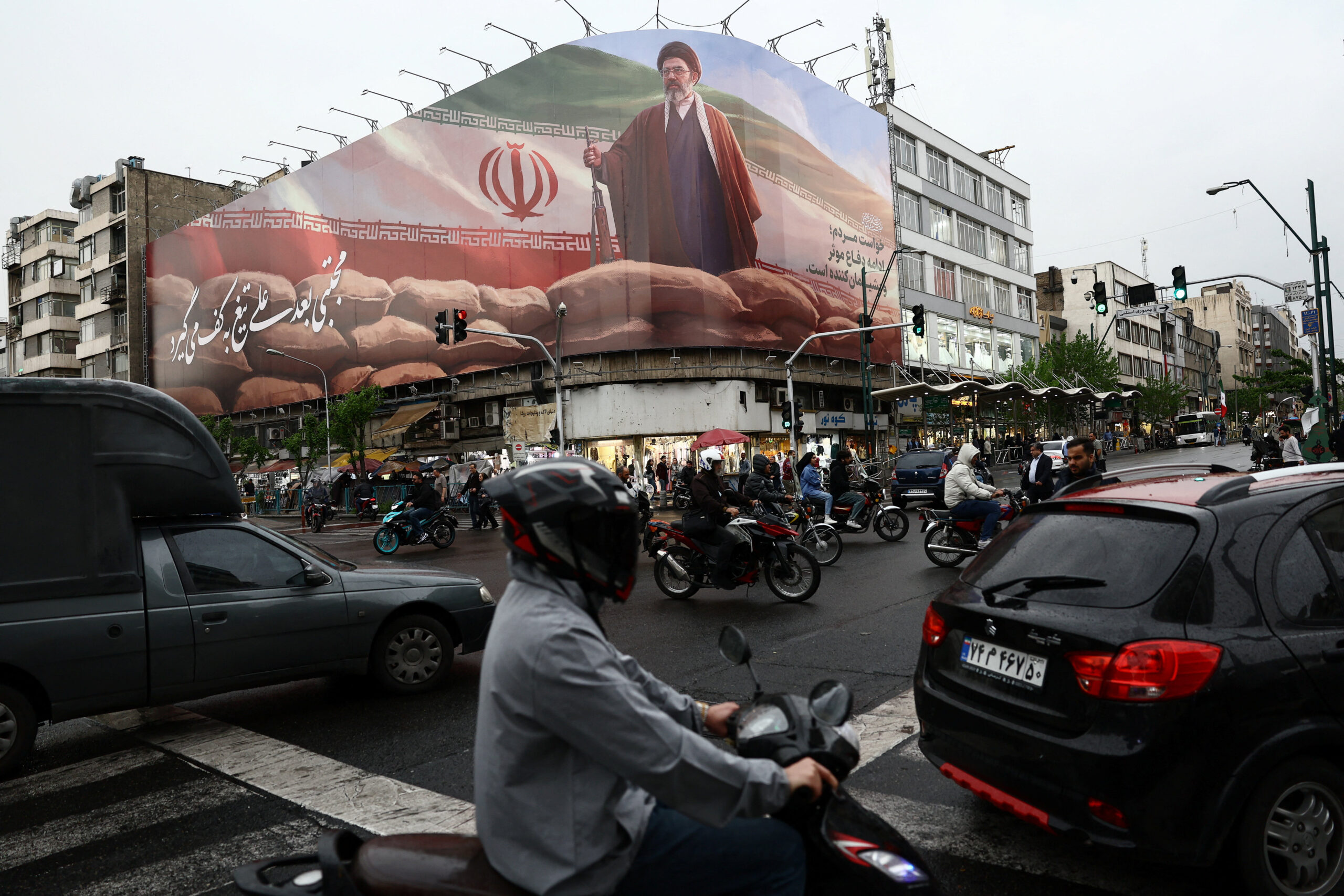
People ride motorcycles near a billboard featuring an image of Iran's new Supreme Leader Mojtaba Khamenei, amid a cease-fire between the United States and Iran, in Tehran, Iran, April 20. (Majid Asgaripour/West Asia News Agency via REUTERS)
On April 21, as President Donald J. Trump announced the United States was extending its cease-fire with Iran, a new round of peace talks in Pakistan was put on hold. While a narrow window for reviving diplomacy remains, the risk of renewed escalation is significant, as the Islamic Revolutionary Guard Corps attacked three cargo ships in the Strait of Hormuz April 22.
For the Gulf Arab states, which have for weeks been absorbing Iranian retaliation, there is a structural contradiction with the war. A campaign intended to weaken Iran is instead producing a more disruptive, more militarized, and less controllable one with widening spillover effects across maritime security and regional alignment.
The war is not ending the Iran problem; it is redefining it on less favorable terms. That redefinition rests on two underappreciated dynamics: the resilience of Iran’s institutional and military architecture under decapitation and the nuclear incentive logic the campaign has reinforced. Together, they point to an Iran that will emerge harder to deter, harder to negotiate with, and harder to constrain once the guns fall silent.
The Decapitation Problem
The removal of senior Iranian leadership has not unraveled the system. Supreme Leader Ayatollah Ali Khamenei is dead, along with potentially scores of senior IRGC commanders. Yet the Islamic Republic has demonstrated continuity, not fragmentation. The system has elevated a successor in Mojtaba Khamenei and reactivated its institutional machinery with notable efficiency. Iran is not a personalist system where eliminating the leader produces collapse. It is a layered political order – ideological, bureaucratic, and military – designed to survive precisely this kind of shock. The apparatus is wounded, but it is not headless.
That resilience is not only institutional; it is operational. The IRGC has continued to function despite sustained leadership attrition. Its decentralized “mosaic defense” model enables local commanders to act with autonomy, ensuring continuity under pressure – a design built precisely for the scenario the campaign has created. Senior commanders are replaced not through improvisation but through preestablished succession protocols. The organization has not paused; it has adapted. The U.S. naval blockade targeting Iranian ports announced April 12, in this context, is more likely to reinforce than disrupt this adaptive capacity by validating the IRGC’s expectation of prolonged confrontation.
The most consequential proof of that resilience is not internal succession but the effective closure of the Strait of Hormuz. An organization that has just lost its supreme leader remains capable of disrupting a critical artery of the global economy. It demonstrates that Iran’s ability to coerce has not been eliminated; it has been exercised under extreme external pressure and leadership attrition. Its willingness to do so at this level of cost and risk signals something important about the political and institutional cohesion that survives decapitation. It also signals the perils of cornering an extremist regime and threatening its existence.
What is taking shape is not a postregime Iran but a reconstituted, more militarized, and more risk-acceptant state. External pressure – including the airstrikes and naval blockade – is consolidating rather than fragmenting the political space, while reinforcing nationalist cohesion by reframing the conflict as an assault on sovereignty. The result is a compression, not expansion, of the space for behavioral transformation. The current moment preemptively undercuts the legitimacy of any organization or group willing to criticize the regime or question its right to exercise power. At the same time, no organized domestic force exists capable of converting systemic disruption into an alternative governing order. Exiled opposition lacks internal legitimacy, and reformist currents have been systematically marginalized over the past decade. Any regime collapse would therefore yield not an aligned successor but uncertainty at scale.
Understanding what decapitation has and has not achieved is essential because the campaign’s theory of success rests implicitly on one of three mechanisms: that leadership removal would trigger institutional collapse; that sustained military pressure would force behavioral change; or that the credible threat of these outcomes would produce negotiated concessions. All three mechanisms are now impaired. The IRGC’s demonstrated continuity forecloses the first. Nationalist consolidation is narrowing the space for the second. And the fractured diplomatic track, combined with the visible limits of U.S. leverage, has undermined the third.
The Nuclear Incentive Problem
The campaign’s most consequential unintended effect is that a postwar Iran – whatever its political character – faces a stronger incentive to accelerate nuclear development, not abandon it.
The logic is well established in the record of states that have faced U.S. military pressure. Iraq was invaded after abandoning its weapons program. Libyan leader Muammar Qaddafi surrendered his nuclear program in 2003 and was overthrown and killed eight years later, an outcome Iranian leaders explicitly cited as a cautionary lesson. North Korea drew the opposite conclusion, pursuing nuclear capability as a guarantor of regime survival. The lesson these cases encode is simple: States that surrendered their programs were destroyed; states that retained them were not.
The sequence in the current campaign makes this logic more acute, not less. A near agreement was bypassed, followed by decapitation without deterrence. That sequence transforms nuclear acquisition from a strategic option into a political necessity. Iranian officials had already signaled that attacks on nuclear facilities could trigger a reassessment of doctrine. Now that threshold has been crossed. A successor Iranian government – even a pragmatic one – will have watched the Islamic Republic absorb leadership decapitation without possessing a nuclear deterrent and will have seen a potential diplomatic settlement set aside before it could be tested.
While the campaign may have set back Iran’s nuclear timeline by years, it has simultaneously made the eventual resumption of that program more politically legitimate, more strategically rational, and harder to negotiate away. The credible assurance problem is now acute: Any negotiated settlement requires Iran to believe that restraint will not produce vulnerability. That belief is harder to sustain after a war that appears to confirm the opposite. Any future Iranian leadership that considers a nuclear deal will do so knowing that one was already within reach and was not honored. The barrier is not technical; it is political and structural, and the campaign has raised it.
The stalled U.S.-Iranian negotiation process in Islamabad underscores this dynamic. The breakdown of the first round of talks, reportedly over maximalist demands, reinforces Tehran’s assessment that diplomacy is either tactically instrumentalized or structurally unreliable. In this context, nuclear advancement becomes not only a deterrent but a hedge against diplomatic volatility.
What this means concretely is that the postwar nuclear negotiating environment will be categorically more difficult than before Operation Epic Fury. Iranian demands for security guarantees will be more extensive and less flexible. The international coalition willing to sustain sanctions pressure is already fracturing. And Iran’s domestic political constituency for engagement with the West – always limited – will have been further eroded by a war that reformists and hard-liners alike can now frame as vindicating strategic autonomy. The window for behavioral change has narrowed further.
The Gulf’s Structural Bind
No actors face a more contradictory set of pressures than the Gulf Arab states. Iran’s decision to strike Saudi Arabia, Qatar, the United Arab Emirates, Bahrain, Oman, and Kuwait – all of which had refused to permit their territory to be used offensively – forced the Gulf governments into rhetorical alignment with the campaign. But solidarity in condemnation is not alignment in objectives.
At the center of the Gulf’s bind is the Strait of Hormuz. The effective closure of the waterway is not a peripheral consequence of the campaign; it is its central strategic failure. For states whose economic models depend on uninterrupted maritime connectivity, the disruption is existential. The UAE’s economy – built on trade, logistics, and global connectivity – loses more from prolonged disruption than it gains from higher oil prices. Saudi Arabia faces renewed proxy risks, particularly in Yemen. Qatar’s position is uniquely complex, combining exposure as host to a major U.S. military base with leverage as a diplomatic intermediary. Oman remains a critical channel for de-escalation.
If sustained, the strait’s closure would mark a structural shift rather than a temporary disruption. The waterway would no longer function as an open global commons but as a contested and increasingly managed corridor where access is conditioned, monitored, and potentially priced. That transformation would extend Iran’s influence beyond episodic disruption toward a more durable form of leverage – with long-term implications for global energy markets and for the sovereignty of the Gulf states whose economic models depend on unimpeded transit.
The U.S. decision to blockade Iranian ports introduces a further layer of risk. Rather than restoring freedom of navigation, such a move risks transforming the strait into an overtly contested enforcement zone, raising the likelihood of escalation, fragmenting international support, and placing Gulf states at the intersection of great-power coercion and Iranian retaliation. For regional actors, this is not a solution to the disruption but a potential amplification of it.
The most consequential diplomatic channel now runs through Oman, where discussions with Iran on managing transit through the strait are underway. That channel reflects the Gulf’s preferred outcome – behavioral constraint without systemic collapse – but it is being defined on terms that increasingly favor Tehran. Pakistan has emerged as an additional intermediary, reinforcing a diplomatic track that operates largely outside U.S. control. These channels offer the most realistic path to partial stabilization, but they also underscore a central shift: The management of the crisis is moving away from Washington and toward a more fragmented, regionally mediated process – as long as Washington accepts the terms. The faltering of direct U.S.-Iranian engagement further reinforces this shift, accelerating the movement of crisis management into regional and non-Western channels.
Gulf states are no longer shaping the trajectory of the crisis; they are adapting to one set increasingly by others. The U.S.-Gulf relationship has also come under strain.
The most likely response to these dynamics is not alignment but hedging. Gulf states will continue to rely on U.S. security guarantees but with less confidence in their reliability and greater urgency to diversify their options. That will mean deeper investment in regional diplomatic channels, particularly those mediated by Oman and Qatar, as well as a cautious expansion of ties with actors able to influence Tehran, including Pakistan and, behind the scenes, China. Economically, the shock will accelerate efforts to build redundancy into trade and energy infrastructure – from alternative export routes to greater logistical resilience. The result is a more fragmented but also more strategically autonomous Gulf posture, designed to reduce exposure both to Iranian disruption and the unpredictability of U.S. decision making and now, increasingly, to the risks generated by U.S. escalation itself.
An Outcome Already Underway
The campaign’s central flaw is not operational but strategic. It has applied sustained military pressure without a coherent theory of how that pressure produces a stable political outcome. Tactical successes have not translated into strategic outcomes; instead, objectives have shifted, narrowed, or been implicitly abandoned. The initial lack of urgency to reopen the Strait of Hormuz, despite its centrality to regional and global stability, underscores the extent to which the campaign’s ends and means have diverged.
The most probable outcome is already becoming visible. The campaign has degraded elements of Iran’s military capacity but not in ways that produce decisive strategic change. The IRGC is reconstituting under a leadership shaped by both institutional continuity and the lessons of the conflict. Proxy networks are likely to rebuild. The region is moving toward a new equilibrium defined by managed instability.
At the center of that equilibrium is the Strait of Hormuz. The apparent willingness of the United States to channel military operations into a blockade without reopening the waterway signals a redefinition of priorities. Iran, meanwhile, is positioned to use the strait as a sustained instrument of leverage. Legislative and operational moves to formalize control over transit suggest that the disruption is strategic, not just tactical. The bargaining process is already underway, and its terms are increasingly shaped by Tehran.
International responses remain fragmented. Efforts to coordinate action have produced diverging approaches, reflecting differing assessments of both the risks and the means required to address them. This lack of coherence reinforces the broader pattern: a crisis that is diffusing across multiple actors without a unifying framework for resolution.
For the Gulf Arab states, the implications are immediate and enduring. Their preference for a stable but constrained Iran is increasingly difficult to realize. The closure of the Strait of Hormuz stands as both the campaign’s most concrete failure and its most durable consequence. Even if notionally resolved through artful diplomacy, it is likely to leave behind a new framework in which Iran exercises greater influence over a critical global chokepoint.
The views represented herein are the author's or speaker's own and do not necessarily reflect the views of AGSI, its staff, or its board of directors.
In the future landscape of Gulf security, the United States may remain an essential arms supplier but wield less influence over force structure and military doctrine.
Regardless of the outcome of ongoing U.S.-Iranian negotiations, Gulf states are likely to speed up the diversification of their defense partnerships, including with each other, though many hurdles have yet to be overcome.
Iran may still call itself an Islamic Republic. In practice, however, it increasingly resembles a state in which the military governs from behind clerical robes.
Gulf states are combining military modernization, diplomacy, diversified external partnerships, and domestic resilience into a new framework for regional security.
February talks between Saudi Arabia and Turkey signaled the emergence of a pragmatic regional order grounded in economic complementarity, defense cooperation, and shared anxieties about instability.
The durability of recent peace gestures, energy deals, and revenue-sharing agreements will hinge on political consensus and restraint, both within Kurdistan and across Iraq’s fractured national landscape.