Growing Saudi-Egyptian Ties Face Challenges of Economic Reforms
Saudi Crown Prince Mohammed bin Salman’s November trip to Egypt highlighted the important regional alliance between Riyadh and Cairo, but collaboration over megaprojects may strain Riyadh’s fiscal capacity.
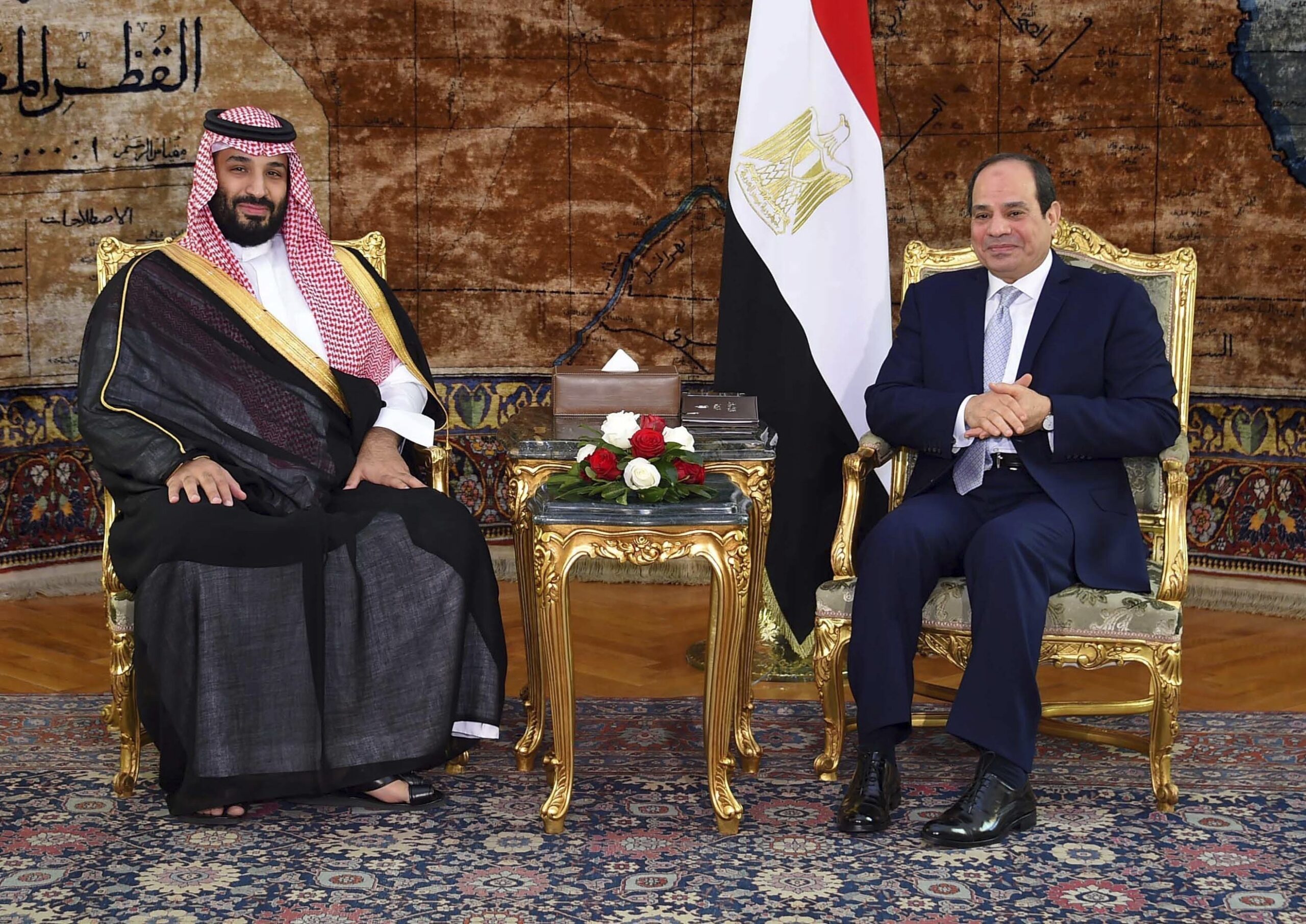
Saudi Arabia's Crown Prince Mohammed bin Salman, left, poses with Egyptian President Abdel Fateh al-Sisi in Cairo, Nov. 27. (Egyptian Presidency via AP)
Saudi Crown Prince Mohammed bin Salman’s November 26 trip to Egypt during his two-week tour of the Middle East and North Africa highlighted the important regional alliance between Riyadh and Cairo. The bilateral relationship, which strengthened substantially following the removal of the Muslim Brotherhood-led government from power in 2013, benefits from a shared vision of the threats facing the region and involves collaboration over the Saudi-led boycott of Qatar. The parameters of Saudi-Egyptian relations, however, are increasingly shaped by growing economic ties and joint development projects.
Current Saudi investments in Egypt are valued at $27 billion, spread across 2,900 projects, while approximately 5,000 Saudi companies operate in the country. Trade between the two countries grew from $5.8 billion in 2016 to $7.3 billion in 2017, and Saudi Arabia is Egypt’s second-largest foreign direct investment partner in the region behind the United Arab Emirates. Although annual direct investment inflows from Saudi Arabia decreased by nearly 50 percent following the collapse of global oil prices in late 2014, the two countries continued to plan large-scale joint development initiatives.
However, Saudi-Egyptian collaboration over megaprojects may strain Riyadh’s fiscal capacity. The Neom project encompasses Egyptian and Jordanian territories – including the two controversial islands of Tiran and Sanafir. This requires Saudi Arabia to manage the expectations of various external stakeholders in addition to sourcing an estimated $500 billion in project financing. Moreover, Neom must progress alongside other megaprojects envisioned in Saudi Vision 2030, namely “rehabilitating” the country’s economic cities and restructuring the King Abdullah Financial District as well as new initiatives like the King Salman Energy Park. The overlapping timelines of these ambitious initiatives will stretch Saudi Arabia’s bandwidth.
New variables are likely to emerge as the scope of development initiatives extends beyond Saudi Arabia’s borders. For example, a planned King Salman Causeway would link Saudi Arabia’s Ras Alsheikh Hamid with Egypt’s Sharm el Sheikh via Tiran Island. The bridge is expected to raise $200 billion in annual trade revenue for Saudi Arabia and create a new overland route for hajj pilgrims. Persistent instability in Sinai will increase the risk associated with this $4 billion initiative, potentially limiting Saudi Arabia’s return on investment. Although much of the violence is concentrated in northern Sinai, popular destinations in southern Sinai, such as the Red Sea resort Sharm el Sheikh, have been the targets of deadly terrorist attacks in recent years.
Then there is the question of shared funding. In March, the two countries established a $16 billion Saudi-Egyptian Investment Fund. The head of the Saudi-Egyptian Business Council, Abdullah bin Mahfouz, expects the Public Investment Fund, Saudi Arabia’s sovereign wealth fund, to announce a flurry of additional investments in Egypt. Yet the fund has struggled to generate the capital needed for new investment deals. The delayed initial public offering of Aramco dashed prospects for raising a quick $100 billion, and economic policymakers in Saudi Arabia now hope that selling the Public Investment Fund’s stake in Saudi Basic Industries Corporation to Aramco will generate $70 billion.
Commercial agreements between state-owned enterprises have tested the strength of the bilateral partnership. In June, Aramco agreed to continue supplying Egypt with 500,000 barrels of crude oil per month at a favorable interest rate, payable over 15 years. The original agreement entailed a five-year, $23 billion deal wherein Aramco would provide the Egyptian General Petroleum Corporation with 700,000 metric tons of petroleum products each month. However, Egypt struggled to find new import partners for crude oil when Aramco abruptly halted shipments in October 2016. This patchy agreement overlaps with the Saudi government’s efforts to utilize domestic energy resources more efficiently. The country’s slow, but nevertheless progressing, energy subsidy reforms suggest fuel and energy price increases for Saudi businesses and residents over the next few years. Egypt should prepare for similar adjustments to commercial arrangements.
Even tourism promotion is a tricky business. A private-sector delegation from the Saudi and Egyptian Chambers of Commerce met in Cairo during the crown prince’s latest visit, ultimately agreeing on a joint strategy to boost Saudi tourism in Egypt. The number of Saudi tourists has steadily risen in the past couple of years: Approximately 600,000 Saudis visited Egypt in 2017 and a million tourists are expected in 2018. It is unclear how much room for growth remains in the sector. Moreover, sending additional tourists to Egypt directly contradicts Saudi Arabia’s concerted effort to promote domestic tourism and capture a greater share of cultural, entertainment, and leisure expenditures from its citizenry. For example, Vision 2030 aims to increase household spending on cultural and entertainment activities within Saudi Arabia from 2.9 to 6 percent by 2030.
The label of “too big to fail” is regularly applied to both Saudi Arabia and Egypt. Any perception of increasing economic interdependence between the two countries seemingly bolsters these claims. Even if true, however, it does not mean that all joint development initiatives will proceed precisely as planned. Rather, the scope of economic cooperation between Saudi Arabia and Egypt is likely to face increased scrutiny as domestic expenditures and reform agendas weigh heavily on economic policymakers and investors alike.
The views represented herein are the author's or speaker's own and do not necessarily reflect the views of AGSI, its staff, or its board of directors.
Despite billions of dollars in infrastructure damage and economic loss, Gulf sovereign wealth funds are still investing in clean energy projects as a pathway to resilience.
The announcement of a new defense-focused free zone in Abu Dhabi emerges at a moment of acute national security concern but relies on an established economic development playbook.
One silver lining of the Iran conflict may be the emergence of new, more durable foundations for regional economic integration via more agile trade corridors in the Gulf and beyond.
The Iran conflict reinforces China’s short-term position as one of managing and mitigating risks rather than shaping outcomes that expand Chinese influence in the Middle East.