The Geoeconomics of the UAE’s New Free Zone for Defense
The announcement of a new defense-focused free zone in Abu Dhabi emerges at a moment of acute national security concern but relies on an established economic development playbook.
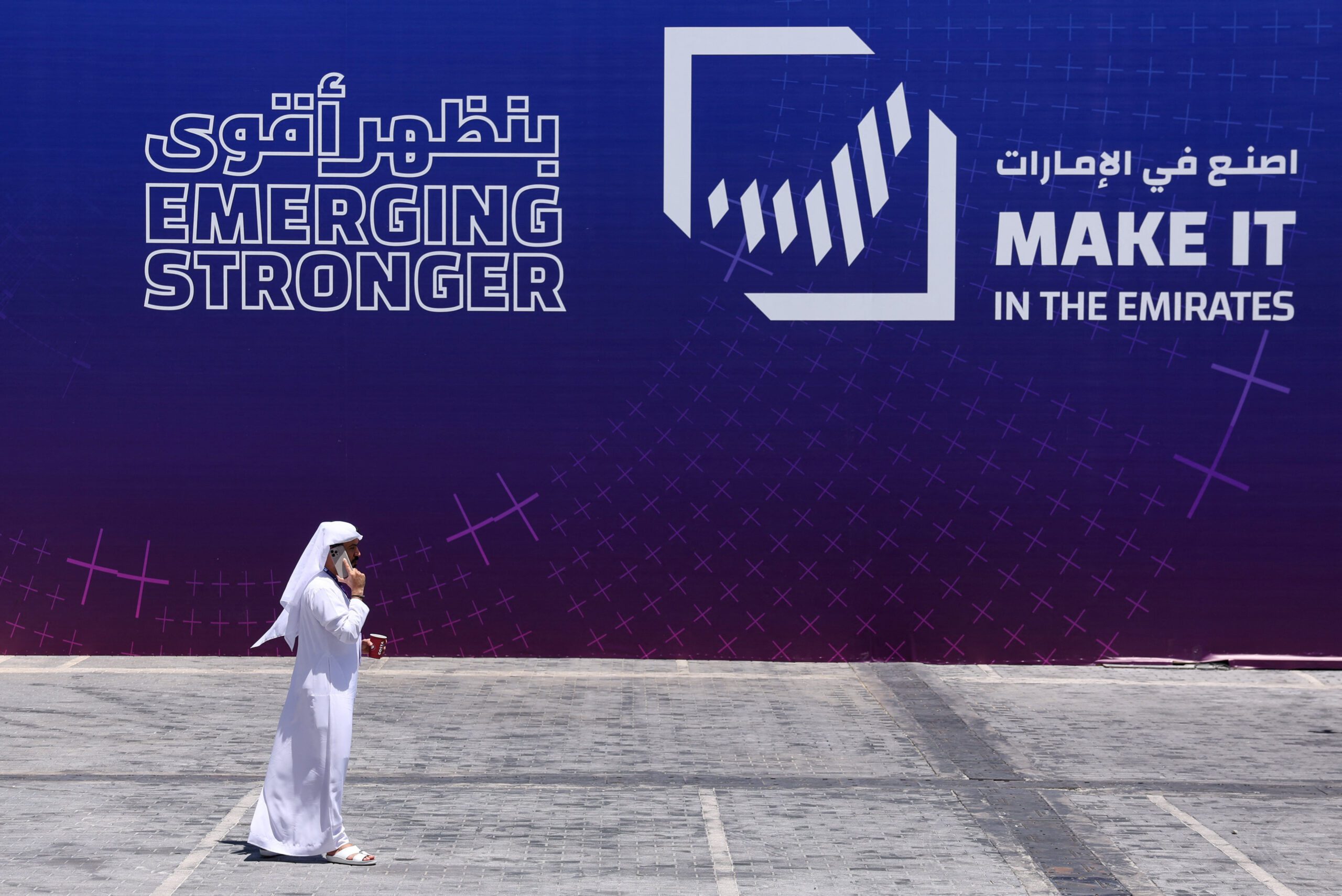
A man speaks on the phone at the Make it in the Emirates conference, in Abu Dhabi, United Arab Emirates, May 4. (REUTERS/Amr Alfiky)
In early May, the United Arab Emirates announced plans to establish a new defense-focused free zone in Abu Dhabi. The Tawazun Council for Defence Enablement and Abu Dhabi Ports Group will jointly develop Al Selmiyyah Defence Industrial Free Zone through a strategic partnership, though a specific project timeline is not yet available. The initiative seeks to attract global defense firms to the country as part of broader efforts to localize defense manufacturing and build an “advanced and sustainable national defence industrial base.”
The ongoing Iran conflict, which continues to be shaped by a fragile and uncertain cease-fire, is surely a motivating factor behind the nascent free zone. A drastic escalation of regional tensions over recent months prompted unprecedented obstructions in the Strait of Hormuz as well as alarming forms of Iranian retaliation targeting Gulf Arab states.
For its part, the UAE has borne the brunt of Iran’s attacks on its Gulf Arab neighbors. Iran and Iran-aligned actors have even continued launching missiles and drones at the UAE despite the cease-fire between the United States and Iran. Going forward, defense and security will be top of mind for Emirati policymakers and crucial for economic resilience-building measures.
The Familiarity of Free Zones
The utilization of the free zone model is a typical Emirati approach for developing and expanding strategic sectors. Indeed, the country has been rolling out successful and creative free zones for decades. Emirati free zones permit 100% foreign ownership – a key incentive for firms and investors that set up in a particular zone. However, these zones offer a range of other benefits, including tax exemptions, customs duty exemptions, full repatriation of capital and profits, and loose labor regulations.
The primary objective of these entities involves facilitating greater trade and investment flows across strategic sectors: logistics, commodities, finance, and technology, among others. The Jebel Ali Free Zone was created in 1985 and currently hosts more than 11,000 companies, accounting for about 24% of Dubai’s foreign direct investments. The majority of the UAE’s more than 40 free zones are in Dubai, but other emirates have been building up their free zone sectors over recent years. Abu Dhabi Global Market has grown quickly and established itself as a leading international financial center, despite stiff competition from the nearby Dubai International Financial Centre.
The new defense-focused zone will naturally be based in the capital emirate of Abu Dhabi, alongside most of the country’s defense and security infrastructure and assets. This initiative should likewise give a commercial boost to AD Ports Group, which, in addition to serving as a strategic partner and advisor for the new zone, oversees an economic cities and free zones cluster within its portfolio. This cluster includes KEZAD Group, an operator of fully integrated economic zones, and ZonesCorp.
The Tawazun Council will take the lead on the new free zone’s regulatory and licensing frameworks, alignment with national priorities, and industrial compliance. The Tawazun Council is the defense and security acquisitions authority in the UAE and has been actively involved in facilitating creative commercial partnerships since its creation in 1992. It oversees an industrial park in Abu Dhabi with 45 firms operating across the defense, security, and advanced manufacturing sectors. In April 2025, the council launched its 2025-28 strategy, which signaled a future focus on developing new industrial parks.
Other government-related entities are likely to shape the trajectory of the nascent defense-focused free zone. A key one is EDGE, an Emirati defense group launched in 2019 that now oversees more than 35 subsidiaries. EDGE and Tawazun have partnered with leading global companies to develop chiplet technology and electronic break control units. EDGE is likewise actively building a global industrial footprint, having recently signed an agreement to acquire a controlling stake in Italy’s engine maker CMD.
UAE officials are also reportedly mulling the creation of a defense-focused investment platform. The emergence of any such funding vehicle for the sector would surely overlap with and support the aims of the Al Selmiyyah Defence Industrial Free Zone. Abu Dhabi has a strong track record of leveraging its deep pools of sovereign wealth to advance its tech ambitions and financial center.
Broader Implications of the Announcement
Free zones can contribute to the localization of industrial activities and other strategic systems. It is unsurprising, then, that plans for the new Al Selmiyyah Defence Industrial Free Zone include “enhancing the participation of national companies and small and medium-sized enterprises (SMEs) within defence supply chains.” The timing of the announcement by the Emirates News Agency coincided with the annual “Make It in the Emirates” event from May 4-7. Ongoing localization efforts extend beyond the defense domain: There are growing calls from industry leaders to prioritize local food brands in the UAE, which tap into long-standing food security concerns.
Other Gulf countries have free zone and special economic zone sectors too. Policymakers and zone officials in neighboring Gulf countries will closely follow how this Emirati free zone materializes. They may opt to establish similar entities or seek to better support domestic defense companies and attract global defense firms within existing economic zone infrastructure. Other initiatives are already underway to enhance global defense investment partnerships, including MASNA Ventures, Saudi Arabia’s first defense-focused venture capital fund.
There is clearly more work ahead to set up the newest free zone in the UAE and demonstrate its commercial viability. A defense-focused economic zone will need to carve out a distinct value proposition and determine how it overlaps with existing commercial infrastructure associated with the defense sector. It will likely be a longer-term play, though there is probably growing pressure from the government to accelerate development. In the meantime, the Emiratis will keep sending strong signals that they are serious about elevating their defense industrial base to the next level.
The views represented herein are the author's or speaker's own and do not necessarily reflect the views of AGSI, its staff, or its board of directors.
The UAE’s move to leave OPEC underscores Abu Dhabi’s effort to widen its room for maneuver beyond Saudi-led frameworks, but the Iran war gives this decision a new meaning.
In the future landscape of Gulf security, the United States may remain an essential arms supplier but wield less influence over force structure and military doctrine.
One silver lining of the Iran conflict may be the emergence of new, more durable foundations for regional economic integration via more agile trade corridors in the Gulf and beyond.
Beijing keeps treading carefully around conflict in the Middle East while seeking opportunities to deepen ties with key country partners through a longer-term regional engagement strategy.
The UAE’s decision to halt trade and commercial ties with Iran reflects an exercise in applying carefully calibrated geoeconomic pressure amid an uncertain and evolving geopolitical context.