Bahrain Cabinet Reshuffle: Crown Prince and His Team Take Center Stage
Bahrainis, Omanis, and Kuwaitis use cabinet reshuffles for different ends: to signal efforts at regime consolidation, consolidation of a new leader’s control, or a royal maneuver to counter parliament.
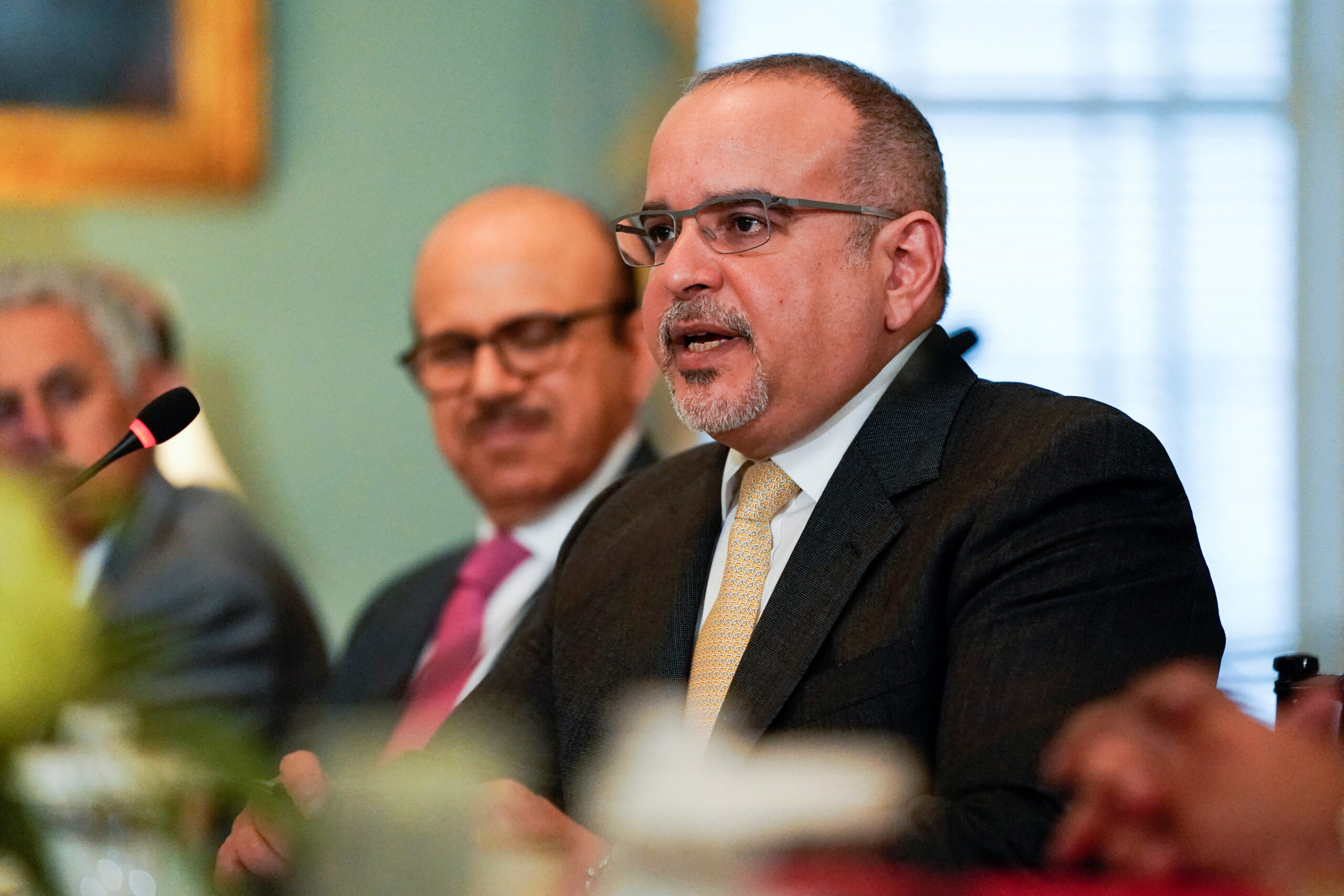
Bahrain's crown prince and prime minister, Salman bin Hamad al-Khalifa, speaks at the State Department in Washington, March 2. (REUTERS/Elizabeth Frantz/Pool)
Bahraini King Hamad bin Isa al-Khalifa ordered a major Cabinet reshuffle June 13, changing 17 out of 22 ministers. A government spokesperson termed it “the largest in the country’s history” introducing a “large proportion of young ministers, including females.” Crown Prince Salman bin Hamad al-Khalifa, who serves as prime minister, said it “will bring new ideas and renewed drive to continue advancing the public sector.” The king’s action included the creation of four new ministries, including tourism and sustainable development. No changes were made in the “sovereign ministries” of Interior, Finance, and Foreign Affairs. Although no sectarian breakdown was offered in any official accounts, nine Shia ministers appear to have been appointed. Only three of the ministers were from the ruling Al Khalifa family, the fewest in the state’s history. The reshuffle comes ahead of Council of Representatives elections expected in November.
Moving in the Crown Prince’s People at Oil and Justice
Among the most significant portfolio changes, the minister of oil was dismissed, and three of four deputy prime ministers were not reappointed. Both of these moves were freighted with potential political significance. The king appointed Mohammed Mubarak Bin Daina, formerly Bahrain’s envoy for climate change, as the new minister of oil and environment. He is viewed as a technocrat and in the camp of Crown Prince Salman bin Hamad. The previous minister of oil was also viewed as a competent technocrat who knew the oil industry well but is also the son of powerful Bahrain Defense Force Commander in Chief Field Marshal Khalifa bin Ahmed al-Khalifa. Although a competent military commander, well respected by U.S. and other foreign military leaders who have dealt with him, the commander hails from the Khawalid branch of the royal family, traditionally viewed as a hard-line, distinct power center in the Al Khalifa family that the crown prince’s father, King Hamad, has retained in key positions in the royal court and military. Members of this branch have long been viewed as rivals for influence with the crown prince and skeptical of his reformist tendencies. At the Ministry of Justice, the hard-line minister Khalid bin Ali bin Abdullah al-Khalifa was moved out in favor of Nawaf Mohammed Al Maawda, the former head of the Office of the Ombudsman of the Ministry of Interior, an office set up in the wake of Arab Spring unrest. Maawda is a former public prosecutor.
Empowering the Crown Prince Amid Status Quo
The consensus among media and analysts is that, while the king has handled the Khawalid branch of the family adroitly over the years, he recognizes that his eldest son, the crown prince, needs to put his own stamp on the government (as he did once before in the years leading up to the Arab Spring unrest) and establish his leadership bona fides to serve effectively as Bahrain’s next king, even though Bahrain has a first-born son (primogeniture) system enshrined in its constitution. The king’s appointment of the new minister of oil and environment seemingly eases out a son of the Khawalid clan for a crown prince-supported technocrat, a move that sends Crown Prince Salman bin Hamad a powerful signal of the king’s support. Powerful members of the Khawalid branch of the family, in addition to the Bahrain Defense Force commander, remain in influential positions, including the commander’s brother as minister of royal court affairs and his nephew as minister for royal court follow-up.
Removing Long-Serving Prime Minister’s Son
Another key casualty of the reshuffle is Deputy Prime Minister Ali bin Khalifa al-Khalifa, the son of the former prime minister; Ali bin Khalifa lost his position as did a third deputy prime minister, a Shia political figure thought to have been aligned with the former prime minister. A fourth deputy prime minister retired. The removal of Ali bin Khalifa seemingly significantly diminishes the residual influence of the former prime minister, who passed away in 2020 after having served for nearly 50 years. Ali bin Khalifa represented part of the long shadow that his father, uncle of the king, cast for decades over the political landscape with his extensive business dealings and maneuvering with well-placed families and tribes. The former prime minister, before he died, and Ali bin Khalifa, to a lesser degree, were considered serious rivals of the crown prince for influence. Crown Prince Salman bin Hamad and even King Hamad seemed to chafe at the influence the long-serving prime minister had been able to accumulate and wield over the years. While Ali bin Khalifa was a far less powerful and influential figure than his father, he represented a legacy the reform-minded crown prince wanted to marginalize.
In the reshuffle, Khalid bin Abdulla al-Khalifa retained his post as deputy prime minister and minister of infrastructure and Zayed bin Rashid Al Zayani kept the role of industry and commerce minister. However, the tourism portfolio, which had fallen under the Ministry of Industry and Commerce, was split off into its own ministry, which will be headed by Fatima bint Jaafar Al-Sairafi. Zayani, already long-serving in his position, is considered a close ally of the crown prince; he hails from a prominent business family with close ties to the royal family, and one of his close relatives is the foreign minister.
Also an Effort to Confront Fiscal Pressures
With the king still solidly in control and no changes in the “sovereign ministries” of Interior, Finance, and Foreign Affairs, this reshuffle does not presage major policy shifts for Bahrain. It instead represents an effort to help the crown prince consolidate his position and a modest attempt to clear out representatives of old guard elements. It could also be an effort to gear up to face sustained fiscal pressures. The reshuffle comes in the context of relatively pessimistic media accounts of Bahrain’s fiscal situation over the past year, with one noting that the small island country was “one of the region’s most indebted countries” and was supported by wealthier neighbors with periodic infusions of capital. Despite that pessimism, higher oil prices in recent months and a relatively positive assessment from the International Monetary Fund in May provide a more positive economic context to support the crown prince’s upcoming governance efforts.
Minor Reshuffle in Oman Completes Earlier Moves
There have been two other recent cabinet reshuffles in the Gulf, although neither was as broad in scope as the change of government in Bahrain. In Oman, Sultan Haitham bin Tariq al-Said replaced long-serving Minister of Energy and Minerals Mohammed bin Hamad Al-Rumhi with Salim Al-Aufi, an undersecretary at the ministry. Rumhi had served as minister for two decades, building up considerable influence and, presumably, autonomy, thanks to those decades of experience under Sultan Qaboos bin Said. Sultan Haitham also appointed a new minister of health and a minister of endowments and religious affairs. While limited in scope, the reshuffle represents one further step in Sultan Haitham’s ambitious efforts to put his stamp on the government after ascending to the throne upon the death of long-serving Sultan Qaboos in 2020.
In Kuwait, Royal Family-Led Government Uses Reshuffle as Maneuver
In Kuwait, a limited Cabinet reshuffle in March was merely one more step in an ongoing crisis between the Parliament and government. The government resigned in early April amid an escalating dispute with the Parliament and ahead of a parliamentary vote of noncooperation, and the leadership reappointed the prime minister at the head of a “caretaker government.” These moves, in the context of the free-wheeling Kuwaiti political system, seem to have been an effort to outmaneuver the Parliament, which had the votes for a no-confidence measure. And on June 22, the crown prince, acting on behalf of the emir, dissolved the Parliament and called for new elections.
The views represented herein are the author's or speaker's own and do not necessarily reflect the views of AGSI, its staff, or its board of directors.
Caught between Iranian strikes and U.S.-Israeli pressure to join the fight, Gulf Arab states strive to maintain their autonomy over decision making, playing defense and preserving the space to maneuver when the war ends.
The early reactions of regional stock markets reflect serious concerns but not full-blown panic despite an unprecedented escalation of the Iran conflict.
To respond to harsh Saudi criticisms, the Emiratis have sought to reframe, deflect, and calibrate, avoiding escalation while also benefitting from powerful advocates, including Senator Lindsey Graham.
Disputes in the Gulf tend to be structurally constrained by dense interdependence, established patterns of dispute management, and various shades of elite empathy among leaderships.
Syria’s challenge moving ahead will be the difficult effort to develop a political system that will empower Syria’s people to embrace the more pedestrian but necessary political compromises upon which inclusion and representative government are based.
The recent visit by the Saudi crown prince to Washington turbocharged prospects for U.S.-led mediation on Sudan, but the case for skepticism remains compelling.
On January 8, AGSI hosted a virtual roundtable with its leadership and scholars as they look ahead and assess trends likely to shape the Gulf region and U.S. foreign policy during the coming year.