Is This Time Different? The Gulf’s Early Economic Policy Response to the Crises of 2020
As Gulf Arab policymakers continue to confront an ambiguous future, they will rely heavily on familiar economic policy measures and avoid straying from the status quo as long as possible.
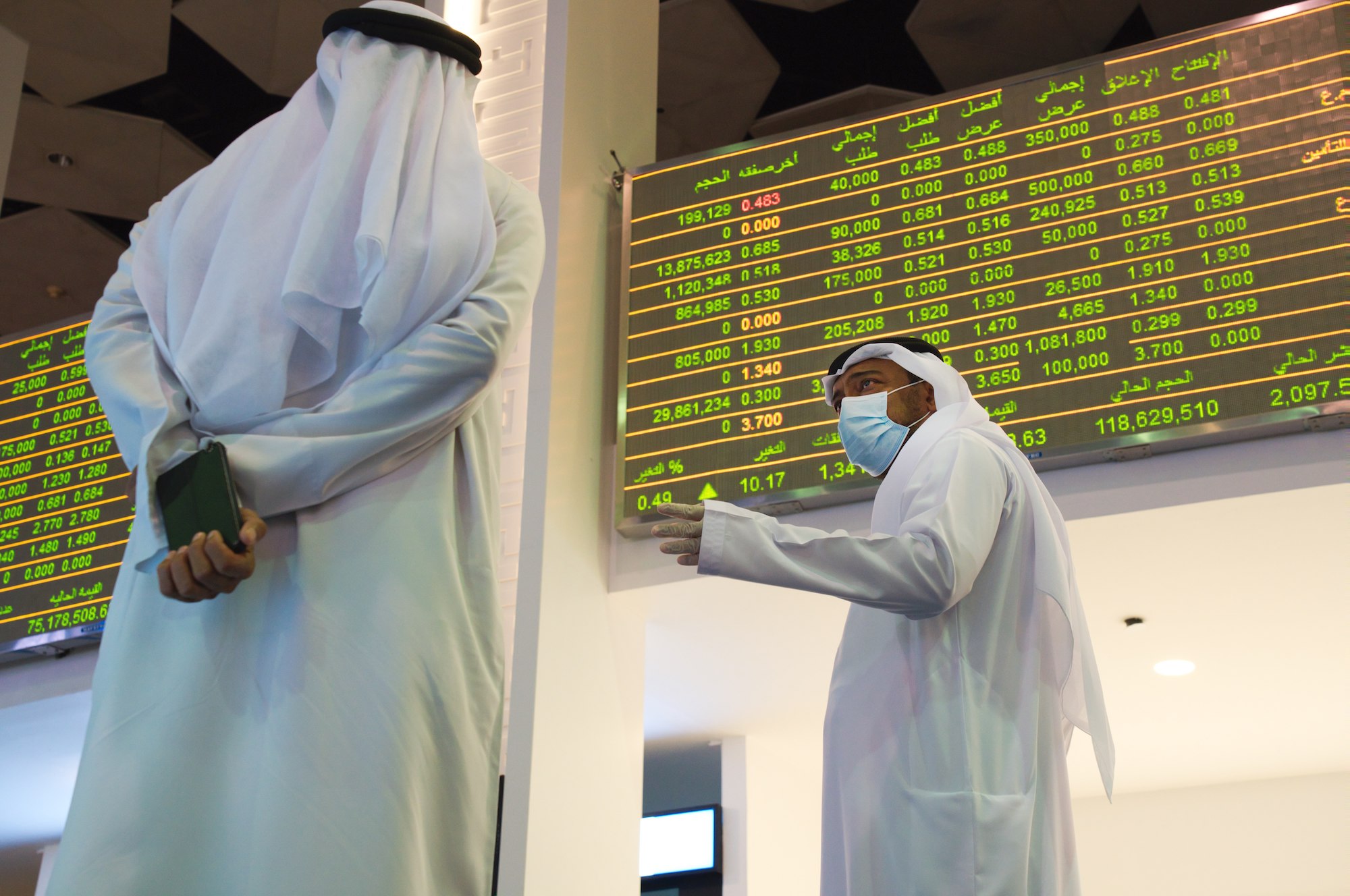
Jamal al-Khadhar, an executive vice president of the Dubai Financial Market, talks to a man on the floor of the exchange in Dubai, United Arab Emirates, July 7. (AP Photo/Jon Gambrell)
Executive Summary
The interrelated crises of the coronavirus outbreak and oil price rout of early 2020 have placed severe economic pressure on Gulf Arab governments and private sectors across the region. These extraordinary and acute shocks to Gulf economies drove regional governments to implement wide-ranging policy responses. The resulting – and indeed ongoing – measures fall into five broad categories: expansive economic support packages, reassessing social safety nets and state benefits, budget cuts and spending reallocation, raising new revenue domestically, and tapping debt markets.
Gulf Arab states have managed a handful of economic shocks, including political crises with economic repercussions, over the past two decades. There are strong parallels with these periods, and Gulf Arab states have leveraged many familiar policy mechanisms while confronting the crises of 2020. The oil price collapse of 2014-15 led to year-on-year budget deficits and soaring government debt across the region. In 2011, Gulf governments addressed labor market pressures through unsustainable or short-term measures, such as public sector employment schemes and entrepreneurship promotion. The global financial crisis revealed the risks of heavily indebted commercial entities as well as the importance of Asian economies in the ability of Gulf states to recover from downturns.
The global and regional developments of early 2020 have highlighted prevailing dynamics and exacerbated existing trends in Gulf economies. Three areas stand out. First, economic diversification in Gulf Arab states continues to progress slowly: Gulf government revenue relies predominantly on the oil and gas sector, and the traditional sectors earmarked for diversification efforts face uphill battles over the coming years. Second, there is renewed political momentum behind workforce nationalization initiatives and other labor market interventions to reduce the supply of expatriate workers. Third, governments are imposing new taxes and fees according to national priorities rather than regional cooperation.
The historical parallels and familiar trends offer no panacea for this economic downturn. In fact, the confluence of substantial sovereign debt levels, unprecedented disruptions to the transnational flow of people and goods, and increased likelihood of significant demand destruction in global oil markets distinguishes the economic turbulence of early 2020 from previous crises. However, the initial economic policy response of the region’s governments has included more familiar measures than radical experimentation. If a fundamentally different political economy of the Gulf region is on the way, then it has not yet arrived.
The region’s digital economy is poised to play a greater role in economic diversification strategies as crisis management measures give way to longer-term planning.
Oman’s precarious reliance on energy exports to China and insufficient Chinese investment in non-oil segments of the Omani economy leave the sultanate in a weak position to address urgent economic challenges.
Petro Diplomacy is a signature annual event in Washington, DC bringing together private and
public sector stakeholders from the United States and the Gulf Arab countries to discuss emerging
trends in energy markets and regional politics.
Beijing keeps treading carefully around conflict in the Middle East while seeking opportunities to deepen ties with key country partners through a longer-term regional engagement strategy.
The UAE’s decision to halt trade and commercial ties with Iran reflects an exercise in applying carefully calibrated geoeconomic pressure amid an uncertain and evolving geopolitical context.