Gulf States Struggle to Achieve Goals in Yemen’s War
March 26 will mark one year since the Saudi-led coalition began launching airstrikes in Yemen at the invitation of the government of President Abd-Rabbu Mansour Hadi. As reports surface of Saudi Arabia holding direct talks with Houthi representatives, the reported suspension of cross border incursions and artillery shelling by Houthi fighters into Saudi Arabia and...
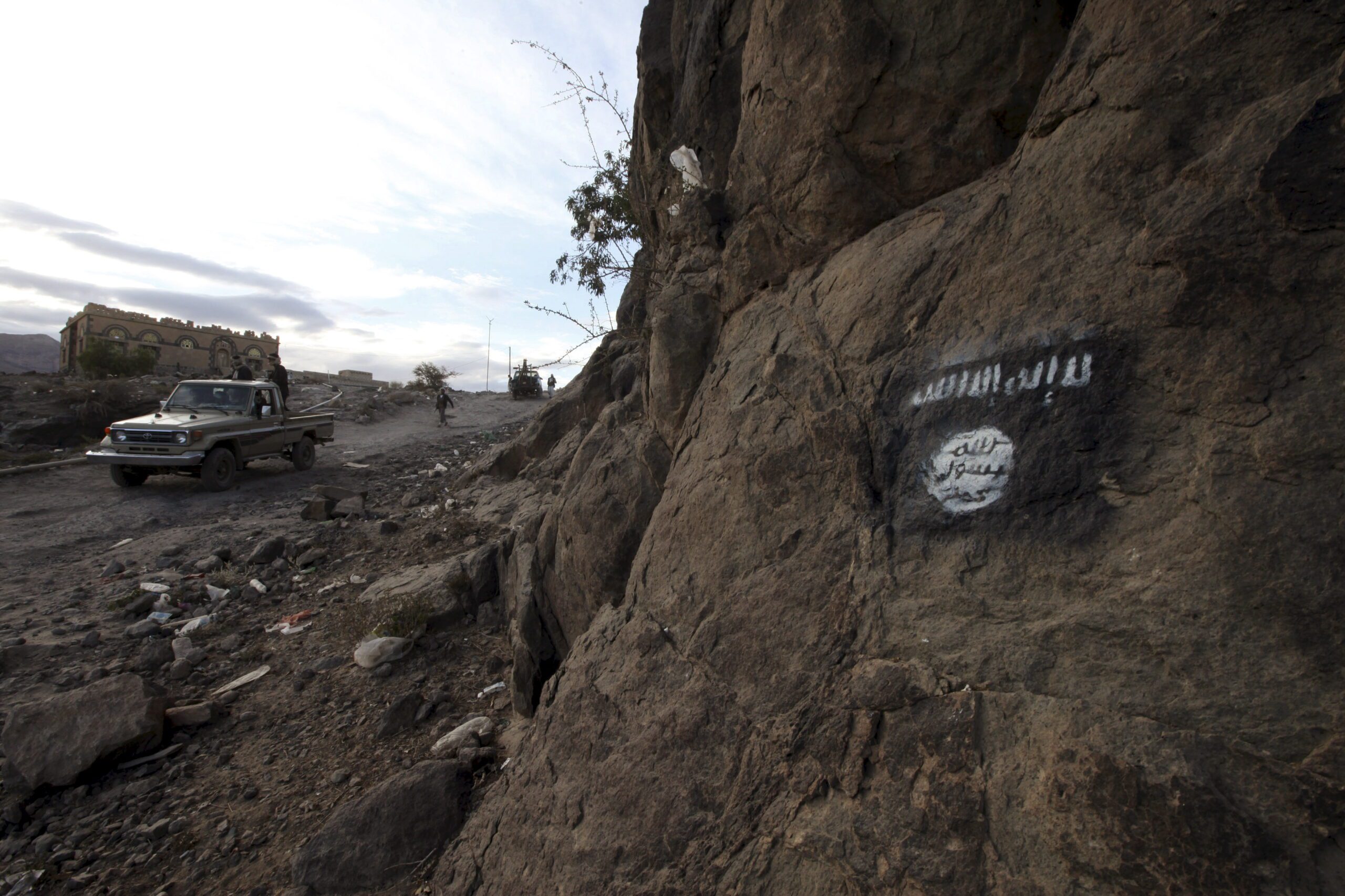
A Yemeni tribesman from the Popular Resistance Committees, supporting forces loyal to Yemen's Saudi-backed President Abedrabbo Mansour Hadi, walks as smoke billows in the background during clashes with Shiite Huthi rebels west of the city of Taez, on March 9, 2016. / AFP / AHMAD AL-BASHA (Photo credit should read AHMAD AL-BASHA/AFP/Getty Images)
March 26 will mark one year since the Saudi-led coalition began launching airstrikes in Yemen at the invitation of the government of President Abd-Rabbu Mansour Hadi. As reports surface of Saudi Arabia holding direct talks with Houthi representatives, the reported suspension of cross border incursions and artillery shelling by Houthi fighters into Saudi Arabia and of coalition airstrikes in Sanaa are building rare hope for diplomatic advances. Still, the barriers to a successful negotiation remain high, due to the complex task of reconciling the divergent interests of multiple warring parties, and perhaps even of the Gulf allies leading the military intervention into Yemen.
The immediate aim of Operation Decisive Storm was clear: to reverse the gains of the Houthi fighters and the allied forces of former President Ali Abdullah Saleh whose lightening offensive across Yemen had left them in control of the capital, Sanaa, the outskirts of the southern city of Aden, and large swaths of territory in between. Yet nearly a year later, the course of the war has revealed subtle differences in the strategic goals of the principal foreign forces supporting the Hadi government: Saudi Arabia and the United Arab Emirates. These divergent outlooks make the ultimate ambitions of the international intervention and acceptable outcome of the multiparty conflict less apparent.
Both geography and ideology separate the two Gulf allies on Yemen, and differentiate their strategic visions. Saudi Arabia has long played the role of external kingmaker in Yemen. The kingdom shares the longest border and deep historical connections with Yemen. Saudi Arabia had previously supported the former Saleh-led government in its 2009-10 offensive in the Saada governorate, Operation Scorched Earth, intervening militarily in Yemen including airstrikes against the Houthis.
Saudi Arabia’s driving objective is to deny Iran a strategic foothold on its southern flank through Iran’s ideological and limited military support for the Houthis. In this, Yemen forms yet another arena for the proxy war between Iran and Saudi Arabia being fought for regional hegemony, albeit in a field very close to home. The Saudis have reported that 375 civilians have been killed in cross border mortar and rocket attacks by the Houthis and forces loyal to Saleh. These military incursions have thoroughly disrupted life in the Saudi border towns of Jizan and Najran, whose airport has remained closed and schools frequently shuttered throughout the hostilities. While the tactical separation of the Houthis from the Iranians is sought, border security will remain of paramount concern, and a key part of any interim settlement.
The strategic goals of the UAE in Yemen are perhaps less obvious. For their citizens at home who are new to the kind of national mobilization undertaken in support of this conflict, the intervention is characterized as a necessary preventative war against Iran and defense of its Gulf ally, Saudi Arabia. Yet in other settings, a different calculus is emerging.
In a keynote address delivered in November 2015 before the Emirates Policy Center’s Abu Dhabi Strategic Debate, Minister of State for Foreign Affairs Anwar Gargash boldly asserted the UAE’s commitment to shaping the outcome of a regional transformation taking place in the broader Arab world. A key component of this strategic vision is the defeat of “extremism,” which in the Emirati view, extends to all independent political Islamist movements. Thus the inclusion of fighters from the Muslim Brotherhood Yemen affiliate, Islah, as local members in the Saudi-led coalition has been a point of friction between the two allies. It has even shaped battlefield responsibilities, with the Emiratis limiting their role in the battle for Taiz, where Islah fighters have played an important role.
Emirati military and political resources have been concentrated in the south, where the liberation by their special forces and allied Yemeni fighters of the southern capital Aden counts as the primary success of the Saudi-led intervention. There are ties that bind the Emirates to south Yemen. Some southerners who escaped Yemen’s civil war of the 1960-70s by migrating to the Arab Gulf countries, including the UAE, were later granted citizenship and occupy prominent positions in business and investment in the UAE. There are Emirati soldiers fighting in the country who have relatives in Yemen.
Conversations held in the UAE in late 2015 provided many indications of a long-term Emirati commitment to Aden. Think tanks in Dubai busied plans for the economic development of Aden centered on the port, offering their expertise and the global reach of the Emirati multinational Dubai Ports World. “Aden is Dubai,” stated one Emirati analyst, matter-of-factly. Another analyst argued that the UAE can play a role in Yemen similar to what it attempted to do in Egypt – using its international contacts and influence to rally international acceptance and economic support for Aden’s redevelopment.
Yet skepticism is warranted in assessing these ambitious plans. A recent report in The Guardian filed from Aden vividly depicted the limited reach of the Yemeni government, as factions once united by their struggle against the Houthis now fight over limited resources and control of the city. A source recently on the ground in Aden described neighborhoods controlled by competing forces – southern separatists, separatist and loyalist Salafis, and neighborhood militias – all with poor coordination and competing political agendas.
The political vacuum has left a wide opening that jihadist groups have exploited. Since its return to Aden, the Hadi-led government has been subject to a dizzying number of attacks, including suicide missions claimed by the Islamic State in Iraq and the Levant against the hotel housing the Yemen government in October 2015 and at the gates of the presidential palace in January. In the past three months top security officials including the governor of Aden, the head of the Aden-based anti-terrorism court, and the commander of the military forces in Abyan governorate have been assassinated, leaving the impression that Aden and its environs have become ungovernable.
The incessant attacks against overstretched Emirati forces and their allies in the Yemen government have tested the UAE commitment in Yemen. Recent stories note the redeployment of Emirati soldiers, who have withdrawn from city streets as well as the airport. There are also concerns that the climate of economic austerity may limit Gulf investments in reconstruction.
As the UAE reassesses its position before the Islamic extremists threatening their development plans for Aden, they may see a more rapid political settlement with the Houthis as desirable. Yet their enthusiasm for the current negotiations and plans for a long-term presence in the south may hinge on the intentions of General Ali Mohsen al-Ahmar as armed forces deputy commander, an appointment the Saudis have supported. His past dealings with Islah are well known, and any elevation of Islah’s influence may temper Emirati commitment to the Yemeni state.
While the UAE has officially backed the goal of reinstating the legitimate government in Yemen,
Emiratis sometimes project a surprising ambivalence about the future political unity of the country. The always voluble Lieutenant General Dhahi Khalfan Tamim of Dubai’s police tweeted in 2015 that the absence of a state in Yemen strengthens the legitimacy of a southern secession, a statement that he followed with an explanation that southerners, especially those from the oil-rich governorate of Hadramout, are creative and poised for economic development. Secessionist leaders such as the exiled former president of the People’s Democratic Republic of Yemen (PDRY), Ali Salem al-Beidh, have enjoyed access to high-level officials in the UAE. A recent report filed from Aden noted the PDRY flag flying proudly next to those of the UAE and Saudi Arabia at militia checkpoints.
The UAE leadership places great importance on its close working relationship with Riyadh, seen as one of the “keystones” upon which regional stability depends. Yet as the war in Yemen drags on at tremendous cost – claiming more than 7,000 lives by recent U.N. estimates and untold damage to Yemen’s already fragile infrastructure – their differences are bound to leave their mark. If the current talks in Saudi Arabia lead quickly to a cessation of hostilities it is possible that the distinctive Yemeni partners and postconflict priorities of Saudi Arabia and the UAE may prove complementary, defining spheres of influence advantageous to Yemen’s redevelopment. Still, the longer the conflict continues without political resolution, the greater the risk that these differences will exacerbate the mounting political fragmentation in the country.
The views represented herein are the author's or speaker's own and do not necessarily reflect the views of AGSI, its staff, or its board of directors.
New investment deals, mainly from the Gulf states and Turkey, are opening a path for Syrian reconstruction. But the fragile security situation and financial environment remain hurdles for foreign investment.
Disputes in the Gulf tend to be structurally constrained by dense interdependence, established patterns of dispute management, and various shades of elite empathy among leaderships.
The Houthis’ expanding partnerships with al-Shabab and Al-Qaeda in the Arabian Peninsula are a growing threat to regional security and international shipping.
When the Saudi crown prince meets President Trump in Washington, the main topics of discussion are likely to be commercial deals, a defense pact, a Saudi civilian nuclear program, and normalization with Israel.
Saudi Arabia’s first Cultural Investment Conference sought to convince domestic and global investors that arts and culture in the kingdom are a value proposition and to entice them to share in this project.
An apology from Israel’s prime minister – delivered under the watchful eye of President Trump in the Oval Office – and a written promise of a U.S. response if Qatar is attacked go a long way toward restoring Qatar's deterrence and bolstering its security and stability following the Israeli attack.
On January 8, AGSI hosted a virtual roundtable with its leadership and scholars as they look ahead and assess trends likely to shape the Gulf region and U.S. foreign policy during the coming year.
While not without risks, Trump’s redesignation of the Houthis as a foreign terrorist organization is a powerful diplomatic tool for Yemen’s government.
A U.N. agreement lifting Central Bank of Yemen economic restrictions may inadvertently embolden the Houthis and bolster their capacity to project military power.
Saudi-Houthi backchannel talks will not succeed in generating a comprehensive political settlement unless the concerns and grievances of all Yemeni factions as well as the region's long-term stability are given due consideration.