Where Does Lebanon Fit in the Emerging Regional Trade Network?
As Gulf countries seek alternative routes beyond the Strait of Hormuz, Lebanon is positioning Tripoli as a complementary Mediterranean gateway alongside Syria, but long-standing political and financial risks could limit serious capital inflows.
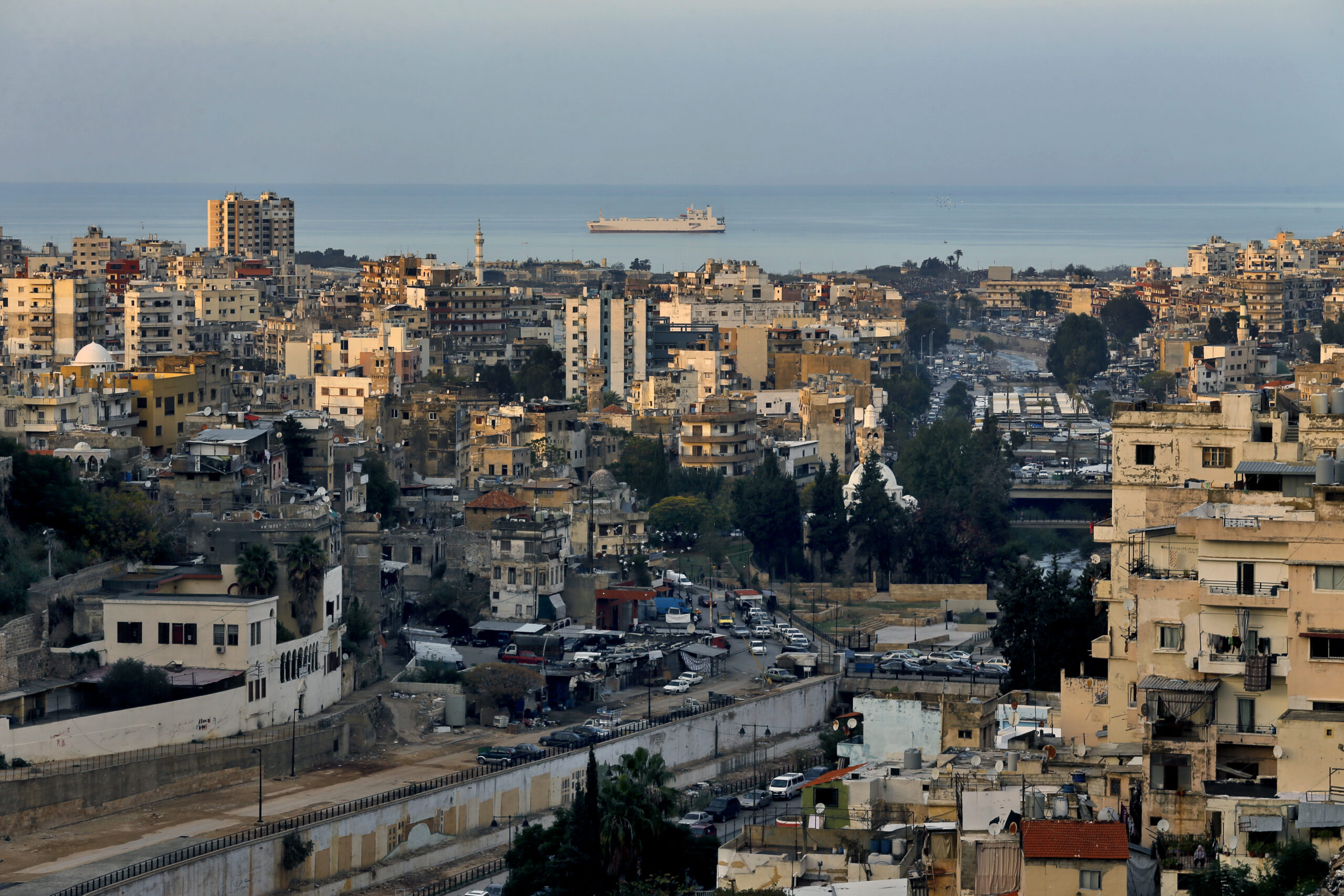
A cargo ship navigates the Mediterranean Sea along the coastline of northern city of Tripoli, Lebanon, December 6, 2021. (AP Photo/Bilal Hussein)
On September 15, Lebanese and Syrian officials met in Beirut to discuss the restoration of a railway that would connect the port of Tripoli in northern Lebanon to the Syrian railway network via Homs. The announcement is part of Lebanon’s recent efforts to position itself within an emerging regional trade network that is taking shape amid the Iran war.
The ongoing war has led Gulf countries to look for alternative trade routes that would reduce dependence on the Strait of Hormuz, making the Levant, particularly Syria, increasingly vital as a land gateway to the eastern Mediterranean. Lebanon is trying to connect Tripoli to this emerging network through rail, port, logistics, and energy projects.
So far, however, Gulf investment commitments have been concentrated only in Syria, raising questions about Lebanon’s place within this network. This may be attributed to Lebanon’s unresolved financial crisis, security risks, and questions surrounding state authority. Beirut’s challenge is therefore to show that extending these regional networks into Tripoli offers enough value to justify the additional costs and risks.
Syria as a Gulf Gateway to the Mediterranean
Since the downfall of the regime of Bashar al-Assad, the new leadership in Damascus has sought to reintegrate Syria into the Arab fold by restoring ties with regional players, particularly the Gulf. The Gulf states, namely Saudi Arabia, Qatar, and the United Arab Emirates, have reciprocated by helping to bring Syria back into the international community and making large investment commitments to support the country’s economic recovery.
As Gulf countries are pushed to find alternative trade routes beyond the Strait of Hormuz, Syria’s strategic significance has risen, with the country representing a potential land bridge and gateway to the Mediterranean. One investment that proved particularly strategic was an $800 million DP World deal, signed in July 2025, to develop the port of Tartous. In August, DP World announced that three mobile harbor cranes had been delivered to the port aiming to boost its cargo-handling capacity by about 40%.
In July, Turkey and Saudi Arabia signed an agreement to revive the historic Hejaz railway, connecting the two countries via Syria and Jordan, with long-term plans that could extend the line through Oman. In August, Syria and Saudi Arabia also signed two memorandums of understanding to enhance regional connectivity and trade by rehabilitating Syria’s road and railway networks.
Lebanese Efforts to Connect Tripoli
Lebanese President Joseph Aoun and Prime Minister Nawaf Salam came to office in early 2025, as the country was undergoing dramatic changes, with the weakening of Hezbollah amid its ongoing war with Israel and major economic challenges facing the country since the 2019 financial crisis. Like in post-Assad Syria, Lebanon’s new leadership has focused on bringing the country back into the Arab fold and restoring ties with the Gulf. However, Gulf reengagement with Lebanon has been more cautious than with Syria, and capital inflows have remained limited.
In June, Saudi Arabia lifted a five-year ban on Lebanese imports that was originally imposed due to concerns over Captagon smuggling. The UAE has also taken steps to restore ties, lifting a travel ban on Emirati citizens visiting Lebanon. In August, the Emirati minister of state for foreign trade also led a delegation of 80 business leaders from various industries. However, deals signed during the visit were limited to a handful of memorandums of understanding on agricultural and trade cooperation and the launch of a joint business council. Qatar’s reengagement has remained mainly limited to assistance. Notably, in January, Qatar committed to a $434 million support package focused on restoring Lebanon’s worn-down power grid.
While Gulf economic engagement with Lebanon has remained limited, the closure of the Strait of Hormuz has created a crisis opportunity for Lebanon to position itself within the emerging regional trade network as a complementary gateway to the Mediterranean alongside Syria. This comes at a time when the war is taking a major economic toll on the country’s economy by diving up fuel and consumer goods prices, displacing communities in the south, damaging infrastructure, and disrupting tourism. Lebanon’s gross domestic product is expected to contract by 6.4% this year, consumer price inflation is projected to rise to 17.5%, and estimates for reconstruction for southern areas destroyed by the Israeli-Hezbollah conflict were projected to reach $11 billion as of March 2025, with that figure certainly higher following renewed conflict this year.
Tripoli is well positioned to play this gateway role. Located in northern Lebanon, roughly 20 miles from the Syrian border, it hosts the country’s second-largest port and enjoys direct road access to Beirut and Syria. Lebanon has taken several steps to strengthen Tripoli’s role within this emerging network. In addition to the meeting that took place in September between Syrian and Lebanese officials to discuss the restoration of the railway connecting Tripoli to the Syrian city of Homs, the Lebanese government has recently authorized the Tripoli Special Economic Zone, a long-planned industrial and logistics hub adjacent to the port of Tripoli, to seek an international developer for its planned logistics center. Lebanon is also attempting to connect Tripoli to Syria and Iraq’s plans to revive the historic Kirkuk-Baniyas pipeline, which was once linked to the Lebanese city, proposing Tripoli as an export hub.
Why Gulf Capital Remains Limited
This raises the question of why Gulf capital has not yet gained a significant foothold in Lebanon. This could be explained by multiple cost and risk factors. The first relates to geography and commercial feasibility. Under the current plan to create a land corridor through Syria, once Gulf goods reach Syria, they already have access to the Mediterranean via Syrian ports. Adding a second route via Lebanon could therefore add another layer of customs procedures and transport costs.
This comes at a time when Gulf countries are under financial stress due to the Iran war and are reassessing fiscal priorities to invest more capital in economic resilience. Hence, courting Gulf capital will require Lebanon to make a compelling case for why connecting Tripoli to this emerging network would add enough value to justify the additional cost. Part of the argument could be that supporting Lebanon’s economy serves wider regional stability, while connecting Tripoli would also offer additional eastern Mediterranean capacity and redundancy if one port or route is disrupted.
Another factor is financial risk, as Lebanon struggles to emerge from its ongoing financial crisis. As of September 28, Beirut was seeking a new International Monetary Fund staff-level agreement that would pave the way for IMF financing; however, Lebanon must first determine how to distribute approximately $70 billion in losses from the 2019 crash across the banking sector, the central bank, the government, and depositors. For investors committing large sums of capital, this uncertainty represents a significant risk.
Questions surrounding state authority constitute another potential risk factor for long-term Gulf investments. The Gulf Cooperation Council has explicitly stated that strengthening Lebanese state authority, alongside reforms, would improve confidence among foreign investors. Saudi Arabia has similarly linked renewed economic engagement to progress in strengthening Lebanese state institutions, while the UAE and Qatar have tied stronger state authority to the stability needed for wider cooperation.
The closure of the Strait of Hormuz has created an opportunity for Lebanon to position itself as a hub within the emerging regional trade network, but geography alone will not be enough to secure that role. Tripoli could offer Gulf countries another Mediterranean gateway while contributing to Lebanon’s economic recovery, but attracting serious Gulf capital will ultimately depend on Beirut’s ability to address the political and financial risks that continue to constrain investment.
The views represented herein are the author's or speaker's own and do not necessarily reflect the views of AGSI, its staff, or its board of directors.
The revived Hejaz Railway could become one of the region’s most significant transportation and integration projects as a land route connecting Europe to the Gulf.
Joining the Mecca agreement could offer strategic benefits to both Damascus and its existing members while also introducing political and security complications that could test the agreement’s credibility.
Despite the massive disruptions caused by the Iran conflict, how Bahraini policymakers address structural vulnerabilities moving forward will be the critical determinant of the country’s longer-term economic outlook.
Newly announced joint ventures to build rare earth refineries in Saudi Arabia are part of a larger strategy to capitalize on Western markets’ need for rare earth elements.
New investment deals, mainly from the Gulf states and Turkey, are opening a path for Syrian reconstruction. But the fragile security situation and financial environment remain hurdles for foreign investment.