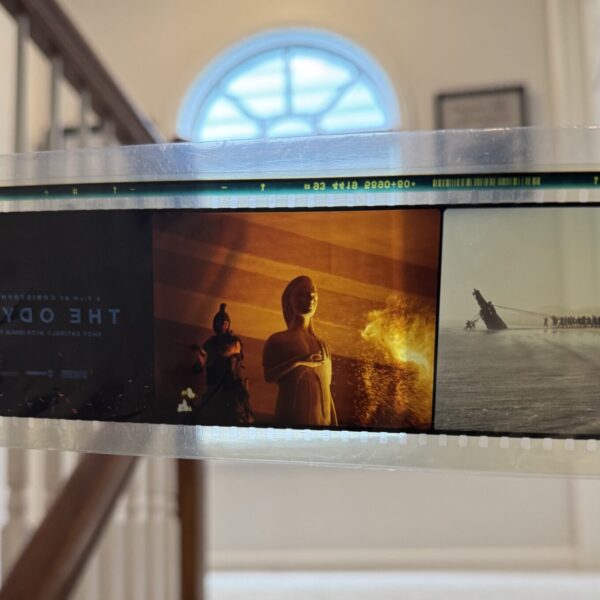
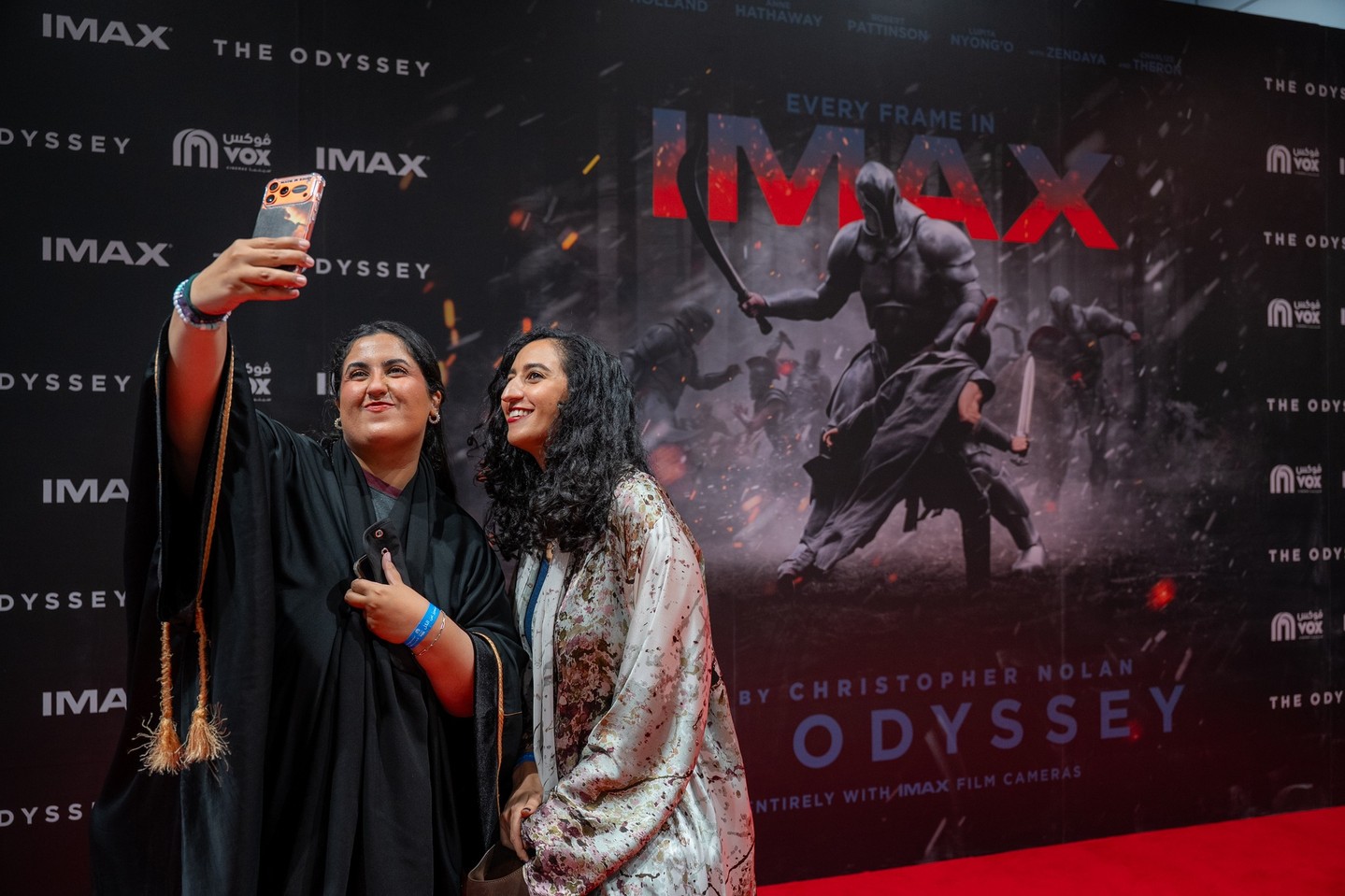

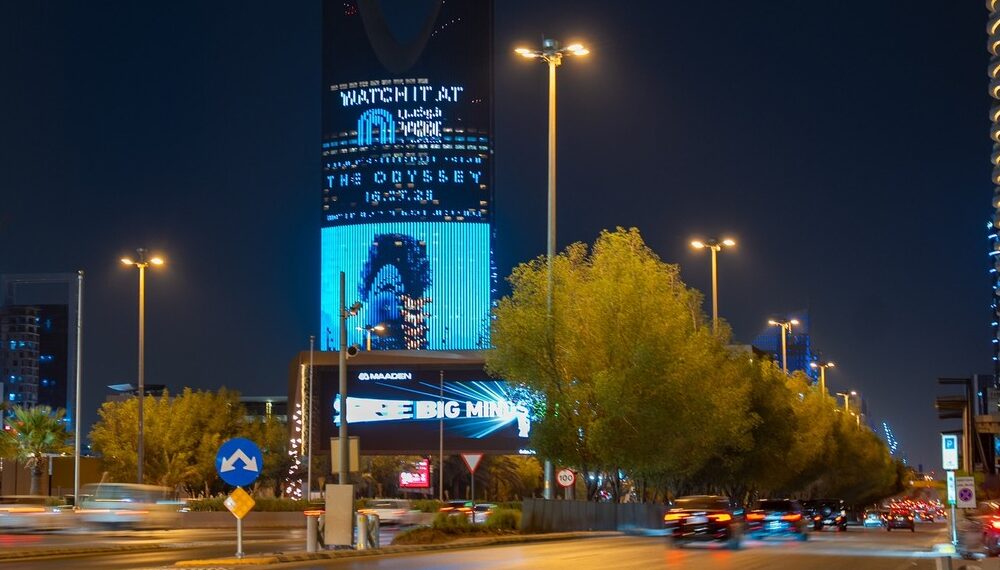
Eight years after Saudi Arabia officially reopened its movie theaters, the biggest cinematic event of the summer arrived from an unlikely source – a Greek poem composed almost 3,000 years ago. Christopher Nolan’s “The Odyssey” opened in Saudi cinemas July 16 and, by the end of its first 10 days, had sold 428,700 tickets, earning 26.1 million Saudi riyals, (roughly $7 million). In its first full week, it accounted for 54% of all Saudi box-office revenue. By July 27, Saudi Arabia was the 10th-largest national market in the world for the film and the largest in the Middle East. Worldwide, the film delivered the biggest opening of Nolan’s career and has since passed $1.1 billion, becoming his highest-grossing film ever and IMAX’s biggest release of all time.
The more revealing response, though, has taken place far beyond the ticket counter. A Saudi viewer’s illustrated guide to the epic’s names and terms, posted so friends could walk into screenings prepared to understand the film, spread widely on Saudi social media. Essays across Arab cultural media, from Al Majalla to Ultrasawt, asked why an ancient Greek epic had become important in 2026 and where the Arab narrative traditions stand today. Indeed, a 3,000-year-old poem that few Saudis had read before had become an essential part of contemporary public conversation.
Few people are better placed to interpret that conversation than Hatem Alzahrani. A poet, scholar, and cultural advisor from Saudi Arabia, trained at Yale and Georgetown, Hatem edited and introduced “The Mu‘allaqat for Millennials” – the 2020 bilingual edition of the 10 great pre-Islamic Arabic odes published by Aramco’s King Abdulaziz Center for World Culture (Ithra) with Qafilah Magazine. In 2023, he was one of 10 contemporary Saudi poets who composed poems emulating those odes for a national musical production.Today, alongside his academic and literary work, he advises Saudi and international cultural organizations. When I profiled him for AGSI in 2022, our conversation turned on the continuities linking past and present, East and West. Nolan’s film offered a chance to revisit those continuities through an unexpected lens.

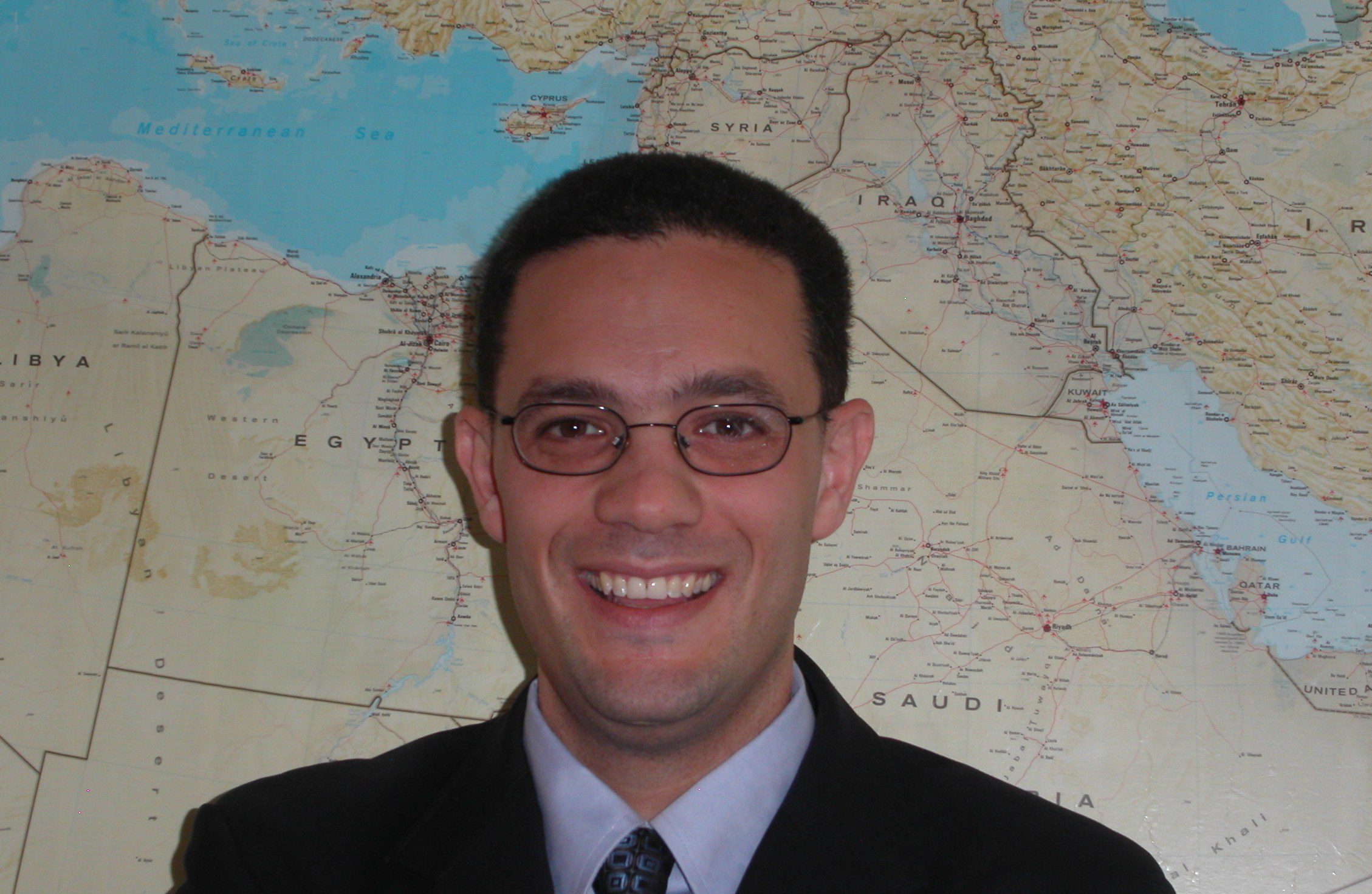
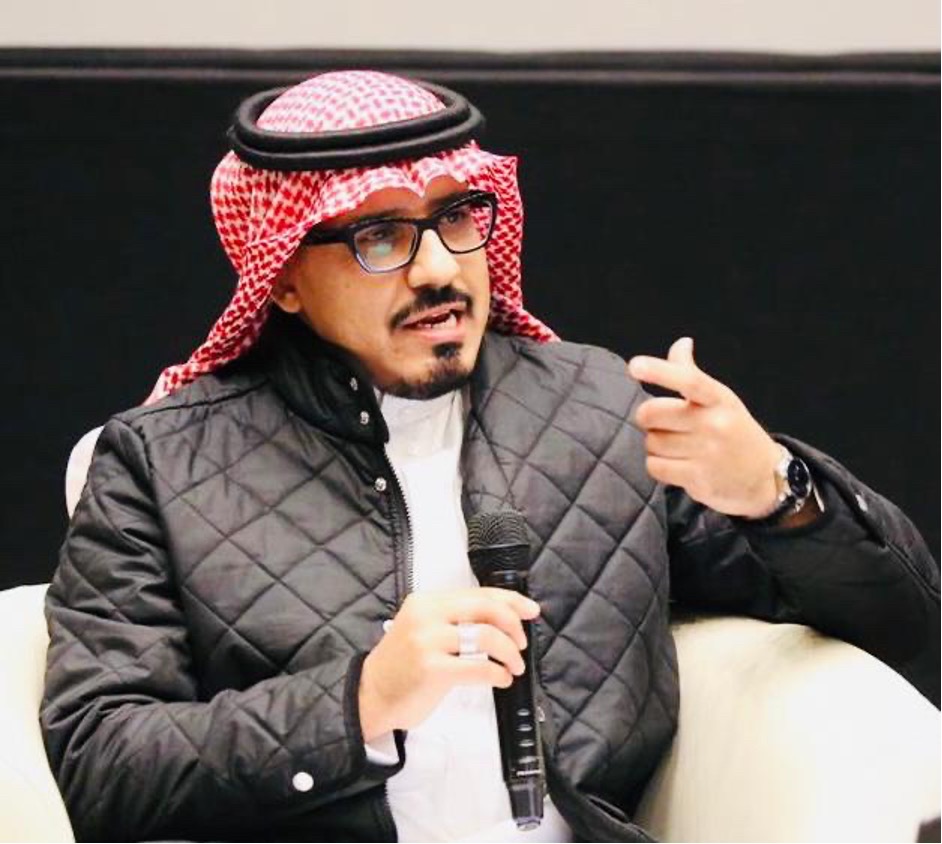
Hatem Alzahrani, left, in conversation with Sean Foley. (Courtsey of Sean Foley)
Movement One – The Saudi Response
Sean: Let’s begin with the scale of the response. How would you characterize the reception of “The Odyssey” in Saudi Arabia?
Hatem: Through three words: enthusiasm, curiosity, and argument.
The enthusiasm is the visible layer. The commercial success is striking, but what interests me more is the behavior around the film. People treated it as an occasion, so they prepared for it, debated the right format, and hunted for particular screens. The curiosity is the layer I find most touching. Viewers who knew Homer only in fragments went looking for the poem itself. That guide you mentioned is a perfect example: Someone watches the film then sits down to explain Poseidon, Telemachus, and the fall of Troy to strangers. Digital cultural platforms, such as Thmanyah, had prepared some of that ground, publishing on “The Iliad” and “The Odyssey” and their Arabic translations months before the release. And Saudi film platforms, such as Sollywood, had been tracking the film since its first trailer. So, when the film landed, it landed on prepared soil.
And then there is the argument, which for me is the deepest layer. People walked out of theaters praising and faulting Nolan’s choices, and one essay in the Saudi press suggested that Nolan had planted these quarrels in the work deliberately, calling them his “apples of discord.” At the same time the conversation kept drifting toward our own neglected epics and toward what fidelity in adaptation even means. I found that drift telling. You start by judging what Nolan did to Homer, and before long you are asking what we might do with our own great stories. That an audience in its first decade of reopened theaters is having this conversation at all says a great deal. Something larger than entertainment is happening here.
Sean: How did you watch the film?
Hatem: I watched it twice, and the two viewings were almost different activities. The first was pure wonder and awe. I went as a film lover to watch one of my favorite filmmakers, one of my favorite actors in Matt Damon, and a literary work I love meeting on screen. I also went to watch the room as much as the screen, to see where people leaned forward and what they whispered on the way out.
The second viewing was slower, because this time I brought the analytical lens with me. I was thinking about how a film translates one culture for another, what happens to an artwork as it migrates across forms, and what an event like this could mean for the future of Saudi film. So, you can say that the first viewing gave me the experience, and the second gave me this conversation.
Sean: How familiar were Saudi viewers with Homer before they entered the theater?
Hatem: Far less than audiences in places where Greek classics sit inside the school curriculum, and that is precisely what makes the reception interesting. Homer has never held a mass educational position in Saudi Arabia or the wider Gulf. Some people met him at university, others through Arabic translations, which have their own long and fascinating history, and many more through the side doors of popular culture, mythology books, video games, and earlier films. So, most viewers walked in with just fragments, a name here, an image there, an echo from somewhere.
The film became a gateway to the text, and for a cultural practitioner this matters enormously. We tend to assume people must know the canon before they can care about its contemporary adaptation, and the whole logic of heritage education is built on that sequence. “The Odyssey” suggests the movement can run the other way, with a powerful contemporary form sending people back to the poem, the translations, the old commentaries and arguments. That is exactly what interests me, and it is a movement Saudi institutions have been exploring for years.
Movement Two – Hollywood and the Saudi Audience
Sean: Why do you think a nearly three-hour adaptation of an ancient Greek poem connected so strongly with young Saudis?
Hatem: Saudis knew Hollywood long before their theaters reopened in 2018. The Film Commission’s history of cinema in the kingdom begins in 1937 with Khalil Al-Rawaf appearing opposite John Wayne in “I Cover the War!” and runs through decades of home viewing to the region’s largest theatrical market today. Theaters were new again in 2018, but Saudi film literacy was not.
But part of the answer is Nolan himself. His name, most of all after “Oppenheimer,” has become a promise of an event, and young Saudis answered that promise the way audiences did everywhere.
But Nolan alone cannot explain it, and this is where it gets more interesting, because the story itself remains remarkably legible. It follows a man who goes to war, spends years finding his way home, and is not the same man when he finally gets there. Its concerns are home and memory, loyalty and loss, pride and hospitality and fate, none of which requires any knowledge of ancient Greece and much of which sits at the very center of Arabic poetry and the stories our culture celebrates. That may be why the film’s story felt familiar even to viewers meeting it for the first time.
And there is a factor specific to Saudi Arabia, I think, and maybe the wider Gulf as well. We are living through a period of extraordinary cultural and social acceleration, and questions of continuity carry unusual force at moments like this, when a society is asking how to move forward while holding on to what it has inherited, what survives transformation, and what needs retelling. These are not abstract questions here but the daily work of a society redesigning its cultural life. An ancient poem that survived oral performance, manuscript culture, translation, and theater before becoming an IMAX film is itself a lesson in cultural continuity. I think some viewers sensed that, even without articulating it.
Sean: Nolan spent the summer talking about inherited forms, most substantively in a 17-minute Beijing interview with Zhongshu, a Chinese doctoral student of political philosophy, that drew over 20 million views. In that conversation, Nolan talked about creating inside storytelling traditions audiences already understand. Do Saudi audiences share that language?
Hatem: Very much so. Nolan defended narrative convention with a line I keep returning to, that being able to identify the mechanism does not invalidate the mechanism. Audiences carry a century of Hollywood expectations, and a filmmaker creates something new inside the forms they already know. Any poet understands this instinctively, and T. S. Eliot made it the center of his essay “Tradition and the Individual Talent.” The new work, Eliot argued, does not break from the tradition so much as enter it and rearrange it. So, originality is what happens inside a tradition. Our own qasida, the classical Arabic ode, is a long history of exactly that. Poets inherited its structure and its conventions and then bent them to their own ends, each generation reworking the form, testing its limits, and handing it on changed. Its vitality lived in what each new poet found to do with it.
The same is true of film, and Saudi audiences know its language well, because Hollywood had a Saudi audience for generations before the theaters reopened in 2018, as I have highlighted before. That is what makes the moment interesting. A shared grammar does not require a shared subject. Saudi filmmakers can work in the cinematic language their audiences already read fluently and tell stories that could only come from here, from Al-Ahsa or the Hijaz, from Najd or Asir, from our oral poetry and our family histories. The language is borrowed. What you say in it does not have to be.
Movement Three — Homer Meets the Arab Canon
Sean: You have said that you see the film as a poem. What makes it poetic to you, and where does that invite comparison with Arabic literary traditions?
Hatem: The film works through recurrence, memory, rhythm, image, and compression, and it shifts between the visible world and what its characters believe lies beyond it. Those are poetic operations. Here the sea carries meaning far beyond geography, and home behaves less like a destination than like memory under examination. There is also something profoundly right in the fact that “The Odyssey” began as oral performance. It was a poem sung to audiences, revised across generations of singers before anyone wrote it down. A film experienced collectively in a dark room, by people who prepared for it and argued about it afterward, is closer to that original condition than a paperback read silently alone.
As an Arab poet, the protagonist’s journey interests me most, because journey is foundational to classical Arabic poetry. The great classical qasida, the long polythematic ode that has organized Arabic poetry since before Islam, moves in three parts: It opens at the atlal, the traces of an abandoned encampment, where the poet stands over the ruins of a past love; it crosses dangerous country, the desert journey with its exhaustion, its animals, and its terrors; and it arrives at self-definition, boast, or praise. Departure, perilous crossing, arrival transformed. Any reader of Homer will recognize the deep structure, even though everything on the surface differs.
And the structures do differ, and I want to insist on that. Classical odes are lyric poems, compressed and nonnarrative, and “The Odyssey” is a narrative epic of thousands of lines. The richer comparison concerns what civilizations do with foundational poetry: why one ancient poem remains available for translation, argument, cinema, and new forms. What allows an old text to stay culturally alive?
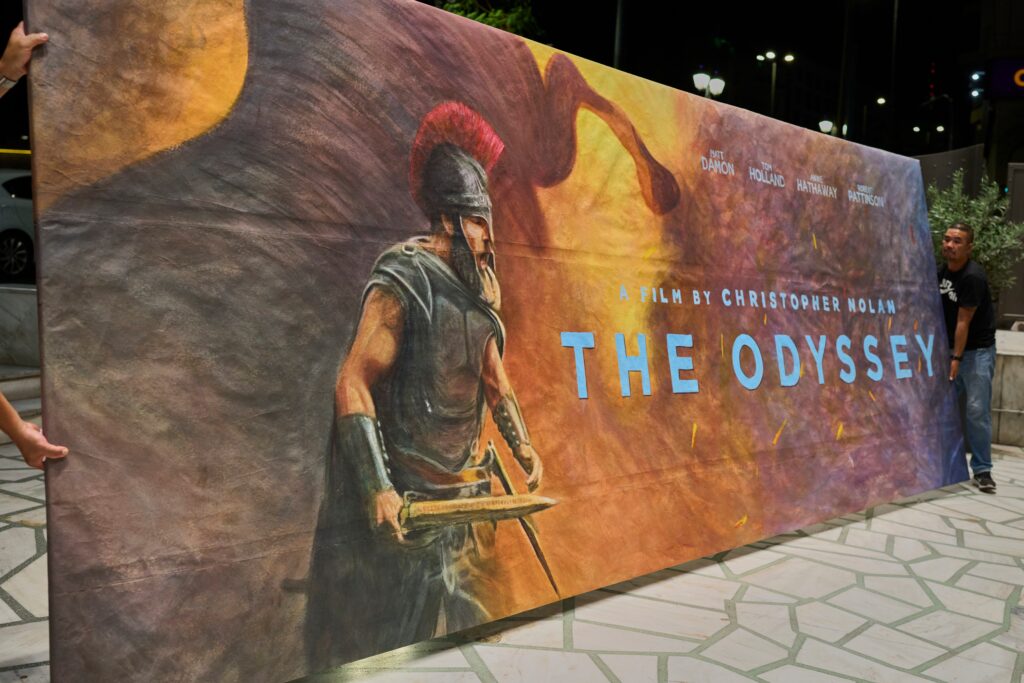
Workers install a billboard, painted by artist Virginia Axioti, for Christopher Nolan’s film “The Odyssey,” outside Athens’ Athinaion cinema, July 11. (AP Photo/Petros Giannakouris)
Sean: Audiences and critics debated the film everywhere it played. Emily Wilson, whose “Odyssey” translation Nolan drew on, gave it a scathing review in the London Review of Books, even as she admitted it was sending readers back to Homer. Among Arab readers and writers, the conversation ran a different way, toward Homer’s place beside the Arab literary tradition. So, where do you come down in that debate about Homer and the Arabic canon?
Hatem: That discussion interested me more than the familiar question of whether the film is faithful to Homer. The real question it raised was why the Greek epics traveled the world, while our own great narratives stayed home. I don’t think the answer is that Homer is simply greater. Canons do not survive on greatness. They survive because societies keep reading, teaching, translating, performing, and reinventing them, and Europe did exactly that with Greek antiquity for centuries, through schools, scholarship, opera, theater, and finally cinema. Homer became universal partly because institutions kept making him universal.
The history of Homer in Arabic makes the same point from the other side. The Arabs were once the great translators of the Greeks. In the early centuries of Islam they took Greek philosophy, medicine, and science into Arabic and passed that knowledge on to the world, but they mostly skipped the poetry. Homer had to wait. A full Arabic “Iliad” reached us only in the 20th century, and a complete verse “Odyssey” only this year. That was never a gap in curiosity or capacity. It was a gap in institutional attention, and institutional attention can change.
Sean: If Arab institutions gave their own classics the kind of sustained attention that kept Homer alive in the West, what text or texts would they use?
Hatem: We hold vast reserves of narrative. “Sirat Bani Hilal” is an oral epic still sung by poets today. “Sirat Antarah” is a saga of the pre-Islamic Black warrior-poet who fought his way from slavery to legend. And the lives of some classical Arabic poets are themselves legends. Imru’ al-Qays wrote the “Mu’allaqa,” or “Suspended Ode,” that many regard as the master poem of the whole Arabic tradition. He was a prince who lost his father, the king, to murder and spent his life on vengeance and wandering, dying, legend insists, of a poisoned robe from the Byzantine emperor whose help he had gone to seek. Shakespeare would have recognized this man. And then there is “One Thousand and One Nights,” known in the West as the “Arabian Nights.” So, the question was never whether we possess “our own ‘Odyssey.’” Of course we do. The harder one is whether we build the institutions to carry these stories across forms without embalming them.
Sean: How did “Arabian Nights” become the book the world knows?
Hatem: Through the strangest route imaginable, and it proves everything I have been saying about canons. For centuries our own literary establishment dismissed the “Arabian Nights” as popular entertainment, beneath the standards of proper literature, and it lived outside the canon. Then Antoine Galland translated it into French in the early 18th century, Europe fell in love, and his version spread into the major European languages, shaping European and world literature down to the modern novel. Gabriel García Márquez named it the first book that ever left a lasting mark on him. It became by far the most famous Arabic book in the world. Only after that global embrace did Arabic letters take it seriously, and it took Naguib Mahfouz, the only Arab to win the Nobel in literature, to write “Arabian Nights and Days” and bring the book home. So, a work we kept outside the canon became universal because other institutions gave it the attention ours withheld. There is no sharper lesson in how canons are made. And the story is still adding chapters. Just this month, MBC Group unveiled its new game studio with the debut title “1001 Threads of Mizan,” an Arabian fantasy adventure drawn from the world of the “Arabian Nights” and built for players everywhere. The book that reached the world through Paris three centuries ago is setting out again, this time from our own region, in the newest storytelling medium we have.
Sean: That new video game points to another key question linked to “The Odyssey” in the United States — not whether the classics get attention but who may reimagine them and how. The casting of Lupita Nyong’o as Helen of Troy drew months of hostile backlash before the film’s release, and after release critics, Emily Wilson foremost, argued over the film’s fidelity to the poem. How important have such casting and fidelity questions been in Saudi Arabia?
Hatem: They exist, but they did not organize the Saudi conversation, which ran toward the canon questions we have been discussing. The quarrel over the look of a mythological figure interested Saudi audiences least of all.
On casting itself, I approach adaptation with considerable freedom. A film is an interpretation, so fidelity cannot mean archaeological reconstruction, and even the category of a “Greek actor” dissolves when we are imagining a Bronze Age world separated by millennia from any modern nationality. Nyong’o herself answered simply that this is a mythological story, and she was exactly right. Helen is not a historical person with a passport. What matters is whether the adaptation builds a convincing world and whether its departures generate meaning.
And I think Wilson’s critique deserves to be taken more seriously than the casting noise, precisely because she accepts that major adaptations transform their sources. That is the serious conversation, a translator and a filmmaker arguing over what a retelling owes the original. I confess I enjoy the fact that millions of people are now arguing about a poem. A canon that produces disagreement is alive.
Sean: Nolan has said he “drilled down” on one Greek concept above all – “xenia,” the sacred law of hospitality between host and stranger, which his film calls “Zeus’s Law.” The film is concerned with hospitality, the gods, and the fragility of civilization. Which of these ideas translate particularly well into Arab culture?
Hatem: Hospitality translates immediately. You do not need to claim that Greek xenia and Arabian hospitality are identical to see a powerful analogy. In Arabian culture, karam, the ethic of open-handed generosity, carries comparable weight. The guest has a right to food, shelter, and protection, traditionally honored for three days before a host may even ask his name, and the host’s reputation is staked on how the guest leaves. And karam belongs to a larger code the pre-Islamic Arabs called muruwwa, the sum of the virtues that made a person complete, which prized courage in war and hospitality in peace. The Greeks made hospitality a law of Zeus; the Arabs made it the measure of honor itself.
As for the gods, a viewer from any tradition can enter the imaginative reality of the film without adopting its view of the world. We do this whenever we read literature, and it is one of literature’s oldest gifts. Strip away the mythology and the film is asking how much of a life is fate and how much is choice, and that is a question our own tradition has debated for centuries with the greatest seriousness.
Movement Four – Saudi Arabia Has Already Been Reactivating Its Classics
Sean: What are the “Mu’allaqat,” and what has been happening around them?
Hatem: The “Mu’allaqat,” or the “Suspended Odes,” are the 10 most celebrated poems of pre-Islamic Arabia. Legend has it they were once hung for display at the Kaaba in Mecca, hence the name, from the Arabic for “suspended,” and though scholars doubt the story, it stuck to the poems. They are the foundation of our poetic canon, and in recent years they have been moving through one form after another. In 2020, Ithra published “The Mu’allaqat for Millennials,” a bilingual edition I was fortunate to help lead, and the odes now appear in six languages. A year later, the Saudi pavilion at Expo 2020 Dubai screened five of the “Mu’allaqat” on its giant digital display, their verses translated into four languages for millions of visitors. In 2023, the Year of Arabic Poetry, 10 contemporary poets answered the 10 classical odes in a national musical; it was an honor to compose one of the poems based on the odes. And that December came “al-Mu’allaqa,” a televised poetry competition whose winning poems are displayed publicly in Riyadh, as legend says the ancient ones once were.
Sean: What does that experience with the “Mu‘allaqat” tell us about “The Odyssey”?
Hatem: That a canon stays alive when a cultural ecosystem allows it to migrate. In a few years the same ancient corpus has passed through a book, world-expo screen, musical, and television competition, and each medium discovered something different inside it. The “Mu’allaqat” are being continued in the present tense. And one text should be able to go further still, becoming a school program, film, game, public debate, because each form recruits a different audience, and each audience finds its own door into the text. That, for me, is cultural innovation in its deepest sense, and it is the truest way to understand what this film has done for Homer.
Movement Five – From Reception to Authorship
Sean: You advise cultural organizations in Saudi Arabia and beyond. When you watch a phenomenon like this, what do you see beyond the film itself?
Hatem: That work trains you to ask what made the phenomenon possible. Why did people show up in these numbers? Why did they pay a premium for particular formats and travel for particular screens? What institutions, schools, publishers, and translators kept a 3,000-year-old text available for Nolan to inherit? And what happened across publishing, education, and criticism after the film appeared?
Seen that way, the most consequential outcome of “The Odyssey” may lie outside the box office. One film set an entire value chain in motion. The poem is selling again, translations are being compared in public, classicists are arguing with filmmakers in the literary journals, young people are meeting Homer for the first time, and other cultures, ours among them, are looking again at their own epics. In creative-industry terms, that is the outcome every cultural strategist dreams of: a single work at the top, and value moving through publishing, education, tourism of the imagination, and public conversation beneath it.
Sean: On the Saudi side, the links of that chain are being forged quickly. By the Film Commission’s count, the kingdom now has 65 production companies and 17 studios with 37 sound stages, alongside the region’s largest theatrical market. Could this open the way for epic stories from the Arab tradition?
Hatem: This is where the institutional attention we spoke about earlier becomes practical. Source material is the easiest part. But a great old story does not automatically produce a great film. What carries a story to the screen is the ecosystem around adaptation. It means screenwriters who can move between literary and cinematic forms, directors with a strong visual language, scholars who can collaborate without turning a film into a lecture, designers and composers who can build a persuasive historical world, patient financing, and critics capable of taking the finished work seriously.
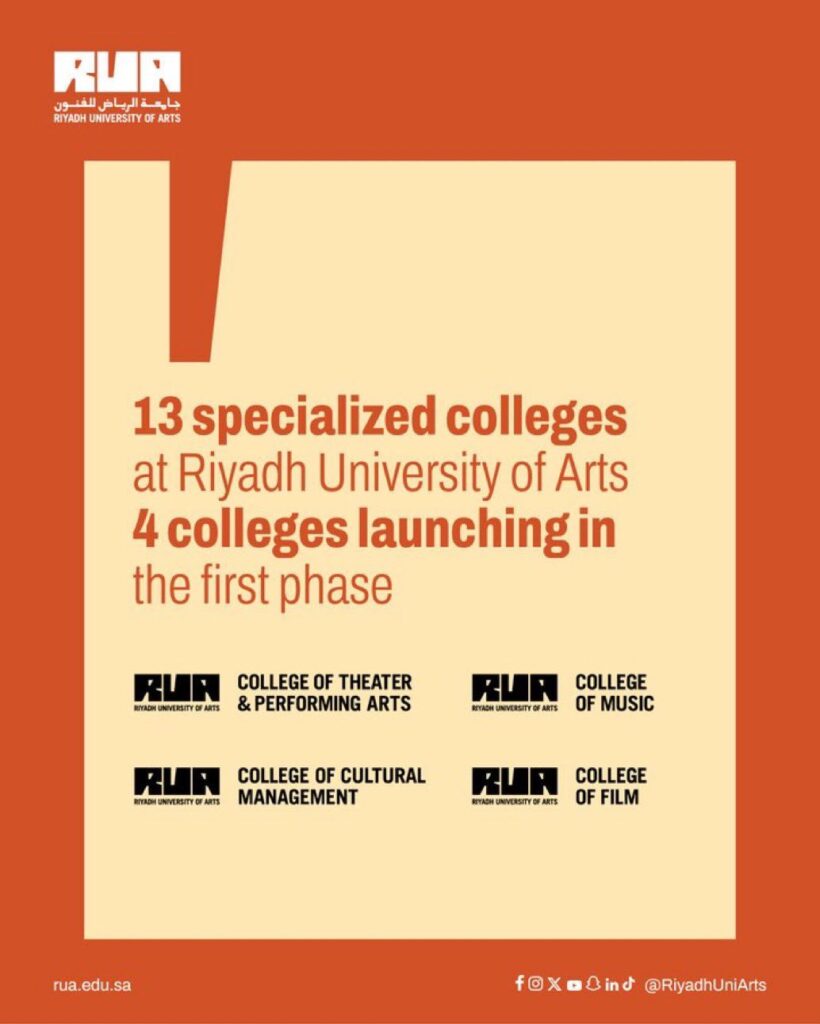
Much of that ecosystem is now being built, in the Gulf broadly and in Saudi Arabia foremost, with a speed that is easy to underestimate from outside. The clearest signal is Riyadh University of Arts, established by royal decree this year as the region’s first university devoted entirely to the arts, 13 colleges spanning the cultural sectors, designed with international academic partners and built on the idea that knowledge should flow directly into the creative industries. And what I would add to this buildout is the connective tissue: development labs that bring screenwriters together with poets, historians, folklorists, and game designers around the major Arabic narratives. Some projects would become films, and others series, games, animation, or forms we have not yet invented. Build the conditions in which these stories can migrate, and let each form find what it finds.
Sean: I have a final question. An American film set this whole conversation in motion in Saudi Arabia. What does that tell us about where cultural relations between Saudi Arabia and the United States, and the wider world, go from here?
Hatem: For decades the cultural traffic ran one way: American products finding Saudi audiences. What has changed is the scale of Saudi investment in its own cultural sector, which now creates genuine openings on the other side of the relationship: coproduction, film education, training partnerships, institutional collaboration. What might happen if the great narratives of Saudi Arabia’s own cultural tradition were given comparable creative ambition?
A global cinematic language does not require a globalized cultural vocabulary. Saudi and Gulf audiences already speak the first fluently. The cultural opportunity ahead lies in deciding what stories they want to tell through it and in the ecosystem now rising to tell them.
Sean Foley
Non-Resident Fellow, AGSI
Hatem Alzahrani
Contributor
