Why Moscow Won’t Side with Washington against Tehran
The administration of President Donald J. Trump has suggested that one of its foreign policy goals may be to attempt to persuade Russia to distance itself from Iran and even cooperate with the United States against Tehran. The benefits for Moscow seem clear to those in Washington who think the United States and Russia have...
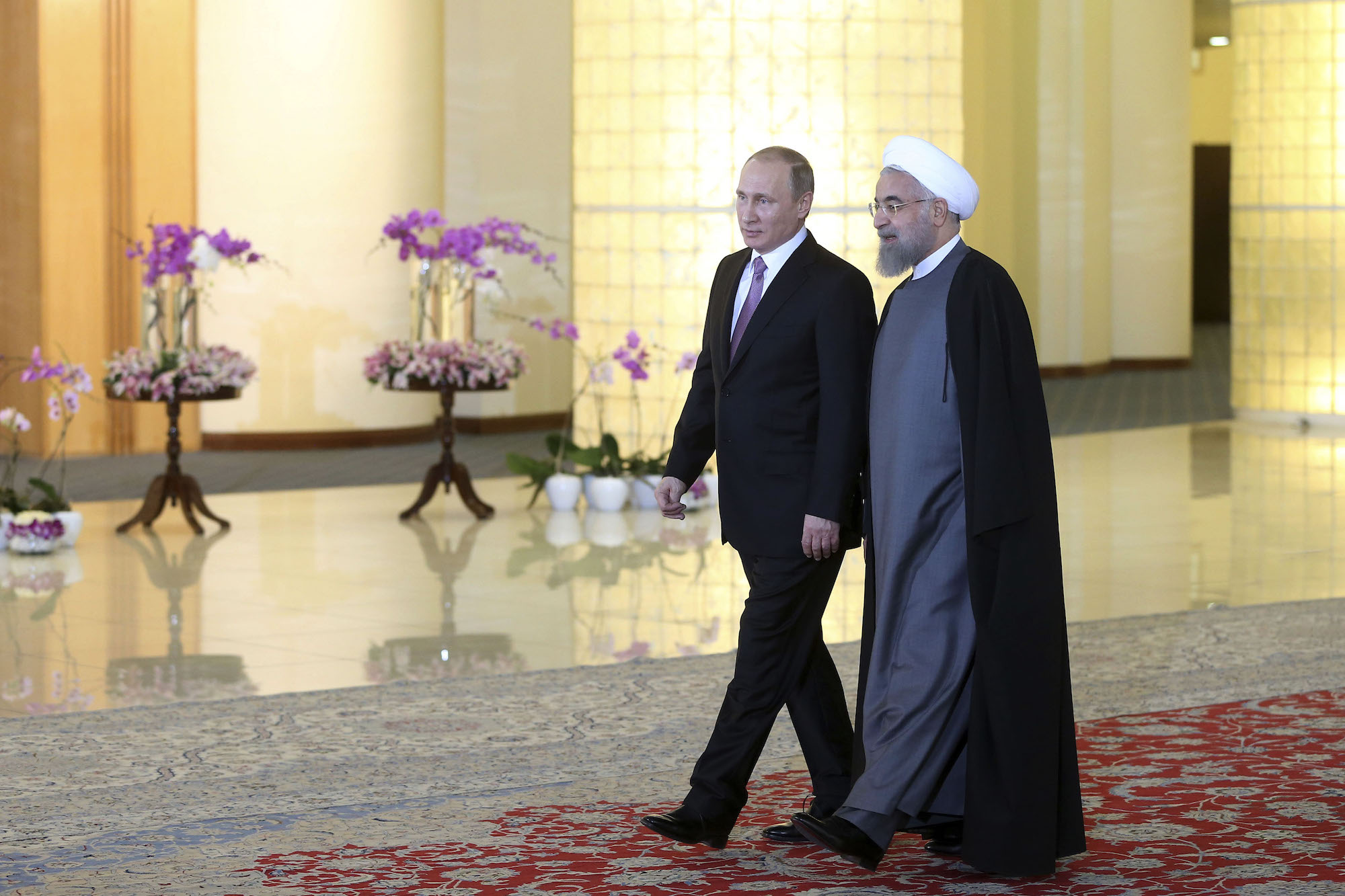
'Russian President Vladimir Putin, left, and Iranian President Hassan Rouhani meet prior to attending the Gas Exporting Countries Forum meeting in Tehran, Iran, Nov. 23, 2015. (AP Photo/Ebrahim Noroozi)'
The administration of President Donald J. Trump has suggested that one of its foreign policy goals may be to attempt to persuade Russia to distance itself from Iran and even cooperate with the United States against Tehran. The benefits for Moscow seem clear to those in Washington who think the United States and Russia have important common interests in the Middle East: Russia’s relations with the West and the Gulf Arabs would markedly improve, and, as the P5+1 nuclear deal demonstrates, the United States and Russia working together have greater prospects for ensuring that Iran does not break out of its commitment not to acquire nuclear weapons (which is just as much of a threat to Russia). Further, sidelining Tehran would enable Moscow and Washington to cooperate on resolving the conflict in Syria and pursue the mutual aim of eliminating the Islamic State in Iraq and the Levant and other extremist groups.
But, while this logic may appear compelling to its advocates in Washington, it is not likely to persuade Russian President Vladimir Putin, for whom it poses two problems: First, siding with Washington against Tehran involves serious risks for Moscow; second, Putin cannot be confident that the costs he incurs from a poorer Russian-Iranian relationship will be compensated by benefits from a potential improved Russian-U.S. relationship.
For Moscow to side with Washington against Tehran means that Russian-Iranian relations are bound to deteriorate, and Moscow has reasons to fear this. As many Russian observers have pointed out, the Kremlin has benefited significantly from the improvement in Moscow-Tehran ties that occurred at the end of the Cold War. Tehran worked with Moscow to resolve the 1992-97 Tajik Civil War on terms favorable to Tajikistan’s pro-Russian government. Moscow and Tehran both supported the Taliban’s adversaries that prevented the group from taking over Afghanistan before the U.S.-led intervention after 9/11. And most important, the Iranian government (unlike the governments of some Arab states) expressed support for Russian efforts to prevent secessionist efforts by Muslim rebels in Chechnya.
Maintaining good relations with Iran, then, has been seen as important for Moscow in maintaining its influence in Central Asia as well as control of the North Caucasus inside Russia. If Russian-Iranian ties deteriorate in response to Putin responding to Trump’s invitation to side with the United States against Iran, all this could be put at risk. A hostile Iran could do much to support anti-Russian forces in Afghanistan, Central Asia, and the Caucasus. Tehran may not be able to bring these groups to power, but it could greatly increase the costs Russia must pay to suppress them.
Perhaps the most contentious issue between Russia and Iran is the future of Syria, where, despite many tactical and short-term commonalities, the longer-term interests of the two partners appear to diverge. But even in this case, Moscow is in no position to break with Tehran, at least under current circumstances, and lacks any clear motivation to do so. The coordinated Russian-Iranian intervention in Syria that began in fall 2015 (supplementing an ongoing Iranian intervention with Hezbollah and Iraqi Shia militias that had been failing) was a dramatic military, diplomatic, and political success for both countries. Iran was able to secure its interests, and that of its paramount international asset, the Lebanese Shia Hezbollah militia, and forestall a potentially disastrous defeat through the downfall of the regime of Syrian President Bashar al-Assad. Russia was able to reassert its influence in the Middle East and claim to be a resurgent power on the international stage, not just along its borders or within the territory of the former Soviet Union.
However, their broader interests in Syria, while overlapping and complementary, are not, and never have been, identical. In addition to asserting a regional and global role, Russia is assuring access to its only major military bases outside of the territory of the former Soviet Union, in Tartus and Hmeimim. Russia also has major financial assets and investments in Syria, and a significant number of expatriates living in the country. The stakes for Iran are much more existential. Tehran regards its presence in Syria as essential to securing and maintaining its all-important “land bridge” to Hezbollah in Lebanon. It also regards the maintenance of a friendly, and in many ways subordinate, regime in Damascus as essential to the defense of the Shia-dominated (and Iran friendly) Iraqi government, which might be destabilized by a hostile Sunni regime in Syria. The Iranian right wing even raises fears that a hostile Sunni regime in Damascus could threaten Tehran’s hold over Iran’s predominantly Arab Khuzestan region. The emergence of an antagonistic, or even ambivalent, government in Damascus, then, would be an enormous setback to Iran and its entire regional project.
In the immediate term, Moscow and Tehran are both getting their way in Syria, though their interests might diverge. Any party seeking a stable end to the conflict in Syria will have to accept that the Assad regime, particularly without a change of leadership at the top, cannot preside over a sustainable new national order, however decentralized. Assad himself is simply too tainted with the brutality and bloodshed of the conflict to be seen by much of the population as minimally legitimate.
On this key point, Moscow and Tehran will not necessarily see eye to eye in the long run. For Russia, it is easy to imagine maintaining its interests in Syria following a regime change, as long as those interests are respected by all parties. However, neither Iran nor Hezbollah can secure their core interests in Syria beyond the present ruling elite, and probably not beyond Assad himself. There is simply no other plausible regime in Syria that would acquiesce to placing the basic interests of the state at the service of Iran and its Lebanese proxy group. Moreover, Russia could seek to parlay its influence in Syria; its ability to work with Turkey to forge a functional cease-fire, and possibly even a viable endgame in the country; and its vital cooperation in the battle against ISIL, for potential Western concessions regarding Crimea and parts of Ukraine.
However, none of these divisions has been exploited by the West, Turkey, or the Arab states in a manner that incentivizes Moscow to distance itself from Tehran. To the contrary, as things stand both Russia and Iran need each other to secure their fundamental interests in Syria. Russia has provided the air cover, intelligence, weapon systems, and key diplomatic and political support for the Iranian/Hezbollah project in Syria. Iran, Hezbollah, Iraqi Shia militias, and the Syrian forces under Iran and Hezbollah’s sway have provided the key ground troops that have driven rebel fighters out of Aleppo and many other areas of what both Moscow and Tehran regard as “necessary Syria” for their own purposes. Without Russian support, Iran and Hezbollah wouldn’t have been able to engineer the regime’s remarkable turnaround and inflict the strategic losses suffered by the Syrian rebels. But without Iranian-allied forces, Russia wouldn’t have been able to outflank the United States, Turkey, and the Gulf Arab countries in engineering the survival and limited victory of the regime.
Therefore, neither Moscow nor Tehran has any incentive to break their alliance on Syria. As things stand, they are both pleased, albeit for very different reasons, by the dramatic resuscitation of the Assad regime and the relative collapse of more moderate rebel groups in key strategic areas. And given that nothing has been done to exploit the ways in which they differ, Moscow has every reason to stick with the Iranians and their allies in a partnership that has produced strikingly effective mutual benefits.
Moreover, Iran and its allies on the ground in Syria have the ability to greatly complicate the Russian position in the country should Moscow attempt to undermine and thwart them, particularly in concert with other powers. Therefore, whatever Russia’s differences with Iran over the long-term future of Syria might be, for now the partnership between the two seems rock-solid, and highly unlikely to be threatened without major efforts to change Russia’s calculations and incentive structures. There is, moreover, scant basis for anticipating any such developments in the near future.
Besides, what would Putin gain from Trump in return for running the risks he would incur for distancing Russia from Iran? There was great hope in Russia when Trump was elected president that Washington would ease the sanctions regime on Russia as well as accommodate Russia on Crimea, Ukraine, and NATO (which candidate Trump had described as obsolete). So far, though, none of the benefits Moscow expected have materialized. Further, despite his positive statements about Russia, some of Trump’s top foreign policy, intelligence, and defense appointments have expressed a much more negative view toward the country. Finally, rising concerns about the Trump campaign’s ties to Russia have now made it very difficult for Trump to do much of anything favoring Russia. Indeed, Trump’s statements about increasing the U.S. nuclear arsenal after he became president may have led Putin to wonder whether Trump ever really intended to oversee an improvement in Russian-U.S. relations.
For Putin to side with Trump on Tehran, then, could risk serious costs for Moscow from Iranian retaliation while yielding few, if any, benefits from the United States in recompense. While the logic of why Russia should cooperate with the United States against Iran might seem persuasive in Washington, the logic of why Russia should not remains highly compelling in Moscow.
The views represented herein are the author's or speaker's own and do not necessarily reflect the views of AGSI, its staff, or its board of directors.
With Democrats taking both chambers of Congress in the midterms, the Gulf Arab states should watch the shifts in domestic U.S. politics and look to the 2028 presidential election.
While on a “working visit” to Moscow, Abu Dhabi Crown Prince Mohammed bin Zayed al-Nahyan met June 1 with Russian President Vladimir Putin, and the two leaders signed a Declaration of Strategic Partnership between Russia and the United Arab Emirates. Two weeks later, Saudi Crown Prince Mohammed bin Salman met with Putin in Moscow, where...
Shortly after the beginning of the Russian military intervention in Syria in September 2015, then-U.S. President Barack Obama predicted that Moscow would soon find itself in a quagmire there.
Russian President Vladimir Putin has recently been devoting considerable time and attention to diplomacy regarding the ongoing conflict in Syria. He not only met with Iranian President Hassan Rouhani and Turkish President Recep Tayyip Erdogan in Sochi on November 22 to discuss conflict resolution efforts, he also met with Syrian President Bashar al-Assad there just...
At the recent summit between Saudi Arabian King Salman bin Abdulaziz and Russian President Vladimir Putin in Moscow, the two leaders signed agreements that seem to herald a new era of Saudi-Russian cooperation. With Saudi Arabia previously standoffish toward Russia due to Moscow’s cooperation with Iran to prop up the regime of President Bashar al-Assad...
Policies that prevent Saudi Arabia from pursuing diplomatic normalization and are fueling alienation in large parts of the West seem to reflect a Jewish consensus in Israel.
President Trump has led the United States into an impossible dilemma in which resuming and intensifying the war presents one set of alarming consequences while ending it under current circumstances offers at least as many disasters for Washington.
The Trump administration has positioned the United States at a crossroads between a new regime of containment against Iran or a historic drawdown of U.S. influence in the Gulf and broader Middle East.
Riyadh and Abu Dhabi urged President Trump not to attack Iran, but now that the war is into its second month, leaving the current situation in place would be an unthinkable fiasco for them.