What Do the U.S. Midterm Results Mean for the Gulf States?
With Democrats taking both chambers of Congress in the midterms, the Gulf Arab states should watch the shifts in domestic U.S. politics and look to the 2028 presidential election.
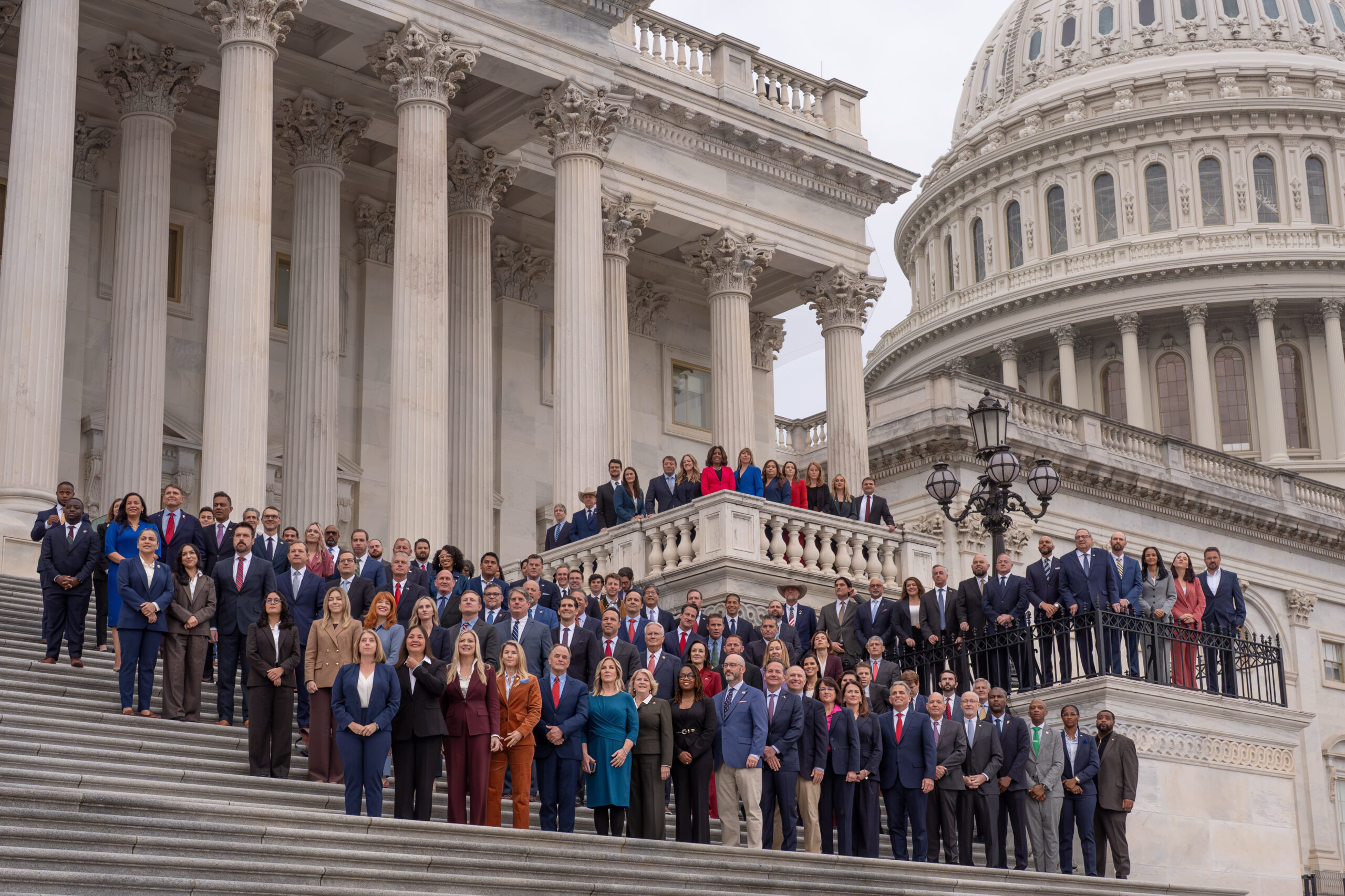
Newly elected members of the 120th Congress gather for a group photo on the steps of the House of Representatives at the Capitol in Washington, November 12. (AP Photo/J. Scott Applewhite)
Key Points
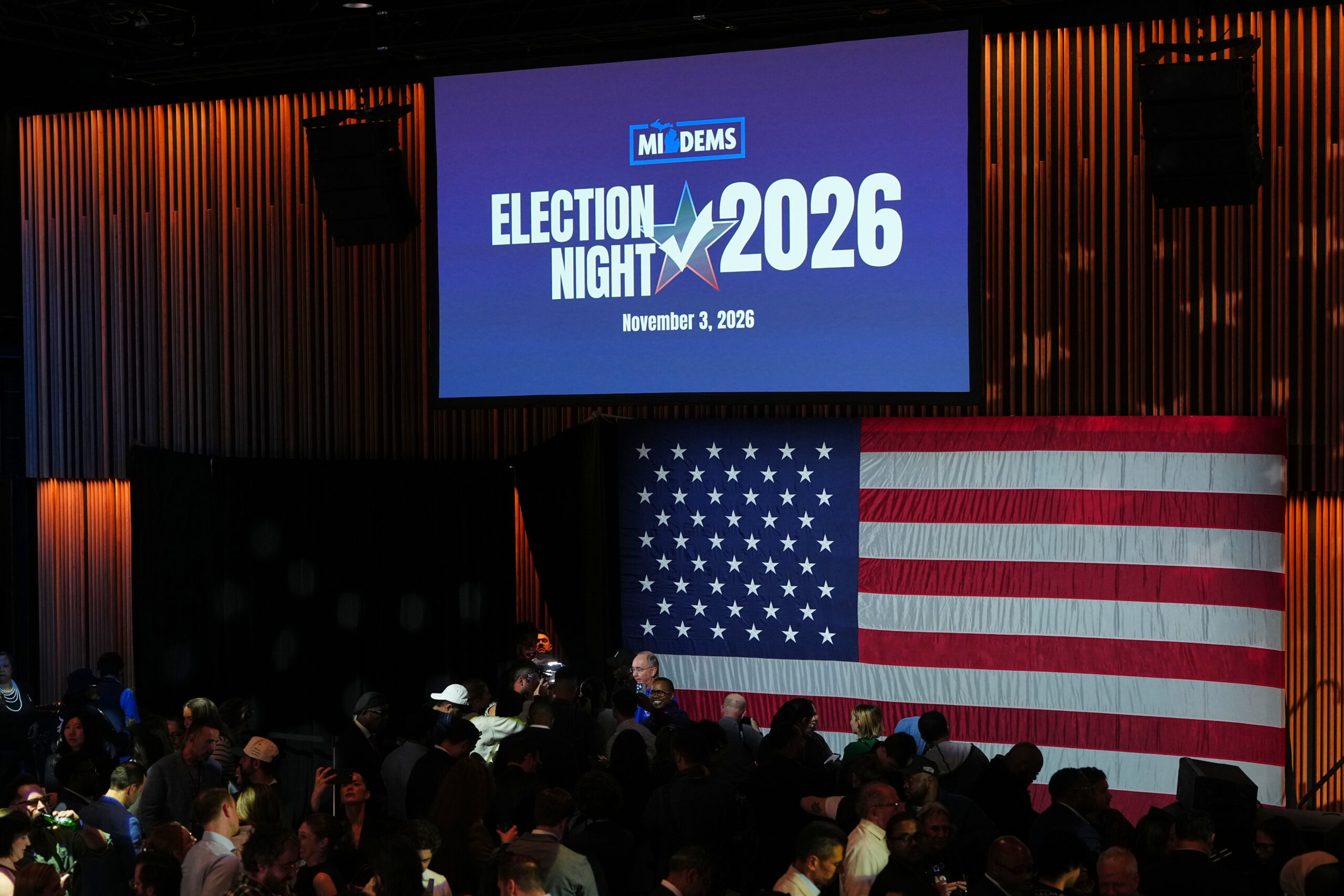
A resounding result. The Democrats took both chambers of Congress on November 3 with as many as 56 Senate seats and around 260 in the House of Representatives, the largest midterm margin since 1974. The new Congress is due to be seated on January 3, 2027.
The Iran war was key. Three-quarters of voters said the Iran war was a major factor in their vote and nearly two-thirds said starting the war was the wrong call. Senior Republicans, including Vice President JD Vance, have noted this.
Lower risk of escalation, no quick peace. President Donald J. Trump has an incentive to get a deal before January, before the new Congress can apply pressure with funding cuts and investigations. The price of Brent crude oil has fallen by around 20% since late October, but markets still see barely a 1 in 3 chance of traffic in the Strait of Hormuz normalizing by mid-2027.
AI cuts both ways. There will be increased scrutiny of chip exports to the Gulf, but the voter backlash against data centers in the United States could effectively halt up to one-third of planned capacity and in turn bolster the Gulf’s argument for being the place to locate compute.
Investigations are coming. Gulf dealings with the Trump family and envoys, in property, asset management, crypto, and gifts, will be examined. Blame is likely to fall mainly on the Trump circle, but there will be real reputational exposure.
Israel is losing support across both parties. Israel’s loss of support lowers the political premium for Arab states to normalize ties with Israel and moves U.S. public opinion closer to Saudi Arabia’s position on Palestinian statehood. AIPAC’s influence in Democratic primaries is waning.
A smaller U.S. military footprint is likely. The decision on whether to fund the repair of damaged U.S. bases in the Gulf will fall to the new Congress, even as some Gulf views of their value has changed. Arms sales to the Gulf will be subject to much more congressional scrutiny.
Financial conditions remain tight. The Gulf’s pegged currencies are importing the U.S. Federal Reserve’s monetary tightening, and high Treasury yields are also increasing the cost of long-term borrowing. U.S. fiscal policy is likely to be gridlocked until 2029, but a divided government may be favorable for U.S. equities in which Gulf funds are major investors.
A more diverse Congress. Abdul El-Sayed, who will be the first Muslim senator, has been celebrated in the Gulf and may help improve perceptions of the United States, but he and other progressives are also critical of Gulf human rights records.
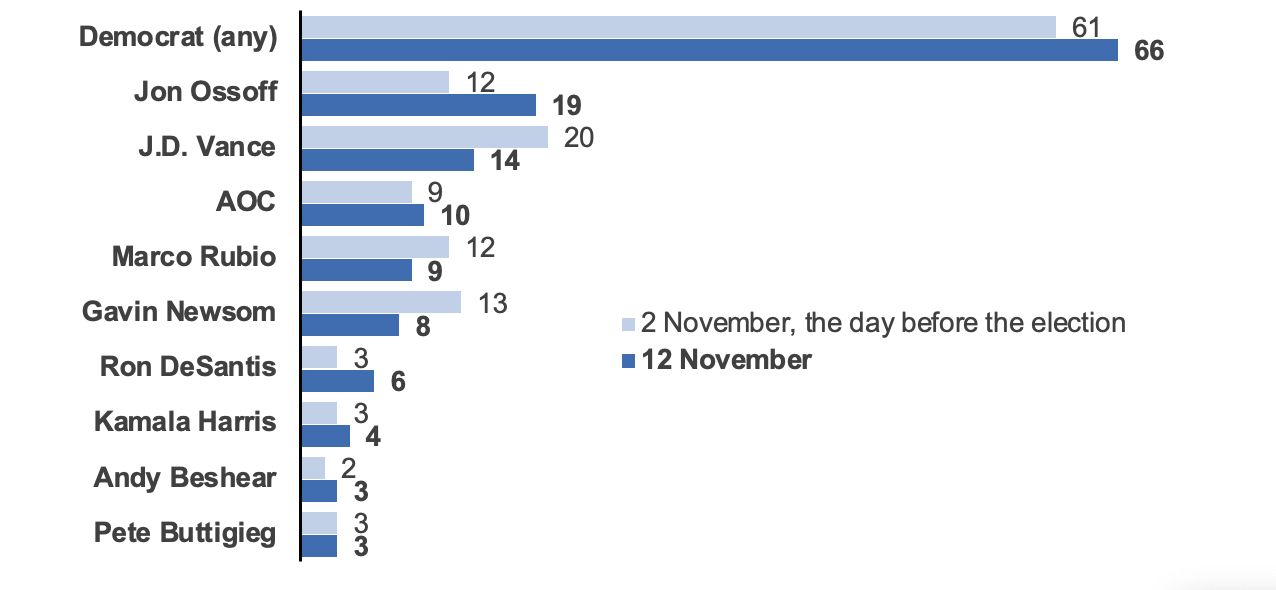
Prepare for 2029. The odds of Democrats winning the presidency have increased (66% on Kalshi, the U.S. prediction market exchange), with Senator Jon Ossoff of Georgia now the market favorite. Gulf states should broaden their engagement in Washington and ensure relationships are on an institutional footing ahead of the 2028 presidential election.
The Election Result
U.S. federal elections run on three overlapping cycles. All 435 members of the House of Representatives are elected every two years. Senators serve six-year terms, with roughly one-third of the 100 seats contested every two years (35 in 2026, including several special elections). The president serves for four years, so the elections that fall during a presidential term, the “midterms,” are usually viewed as a referendum on the incumbent. The president’s party has lost an average 26 House seats in midterms since World War II, although in more recent years gerrymandering of House districts has reduced the scale of these shifts.
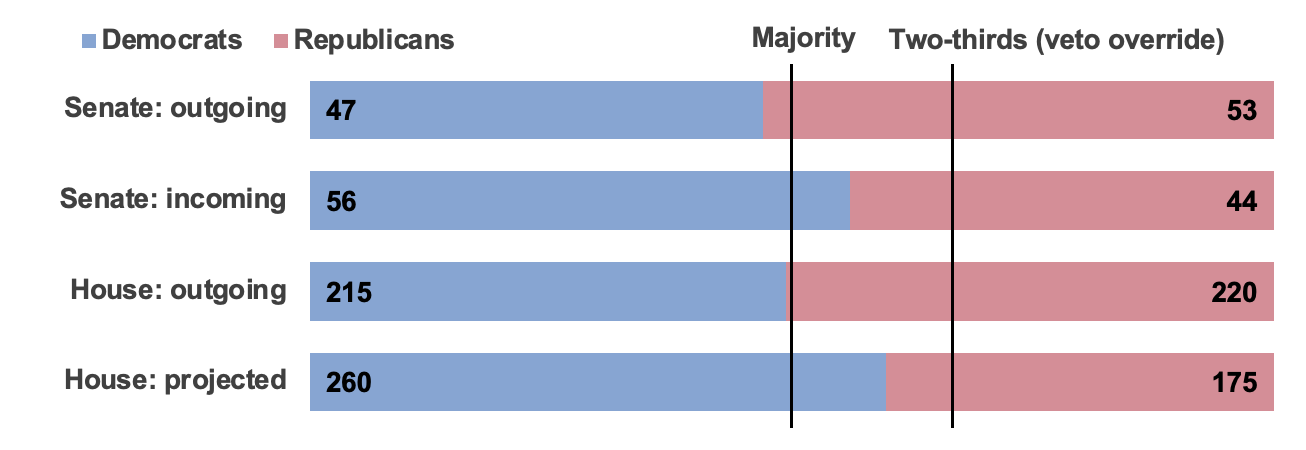
The November 3 vote went well beyond that norm. Republicans entered the elections with a 53-47 Senate majority and a narrow House majority (220 to 215 at the 2024 elections). Democrats won 56 Senate seats, flipping nine Republican-held seats in Maine, North Carolina, South Carolina, Ohio, Iowa, Kansas, Texas, Mississippi, and Alaska. In the House, they have won at least 257 seats and lead in three more races that are still counting votes, well above the 218 needed for a majority.
Democrats Win 56 Senate Seats and Are On Course for About 260 House Seats Share of seats by party, before the November 3 elections and if leads on November 18 hold
Source: Associated Press
In historical terms, this is one of the largest midterm swings of the modern era. A final tally of 56 Senate seats would be the largest majority for either party since the early years of President Barack Obama, and a House majority of about 260 would be the largest since the 1991-93 Congress. The House gain is the third largest of the past half century, behind the Republican waves of 2010 (63 seats) and 1994 (54) and ahead of the Democratic gains of 2018 (41). The Democratic lead in the national House vote, about 13 percentage points, is the widest in any midterm since the 1974 post-Watergate elections. Even so, Democrats will fall well short of the two-thirds majorities (290 in the House, 67 in the Senate) needed to override a presidential veto.
The swing was broad, both geographically and demographically. According to the ABC News Voter Poll, voters aged 18 to 29 moved 32 points toward Democrats relative to 2024, and a majority of young men, a group that had favored President Donald J. Trump, backed Democratic candidates. Independents broke heavily for Democrats, and around two-thirds of Hispanic voters in Texas, who had trended toward Republicans in recent elections, supported James Talarico, who won the Senate seat there by about 12 points, and enabled Democrats to hold on to congressional districts that were heavily gerrymandered in 2026. Kansas elected its first Democratic senator since 1932, Adam Hamilton, and Sherrod Brown won the Ohio special election for the seat that JD Vance vacated on becoming vice president. Scott Colom became the first African American senator for Mississippi since 1881. Democrats are also on course to hold up to 30 of the 50 state governorships, including Texas and Georgia. Moreover, according to Sabato’s Crystal Ball, Democrats won many down-ballot races, including flipping over 500 seats in state legislative chambers, securing “trifecta” control of state House, Senate, and governorships in Arizona, Wisconsin, Nevada, Pennsylvania, and Minnesota and winning control of one of the legislative chambers in several other states, including Texas, Georgia, and North Carolina.
The Role of the Iran War
Surveys have shown that the unpopularity of the war was one of the central factors contributing to the election result. In the NBC News exit poll, 74% of the voters surveyed said the war was a crucial or major factor in their congressional vote, and 64% said that military action against Iran had been the wrong decision.
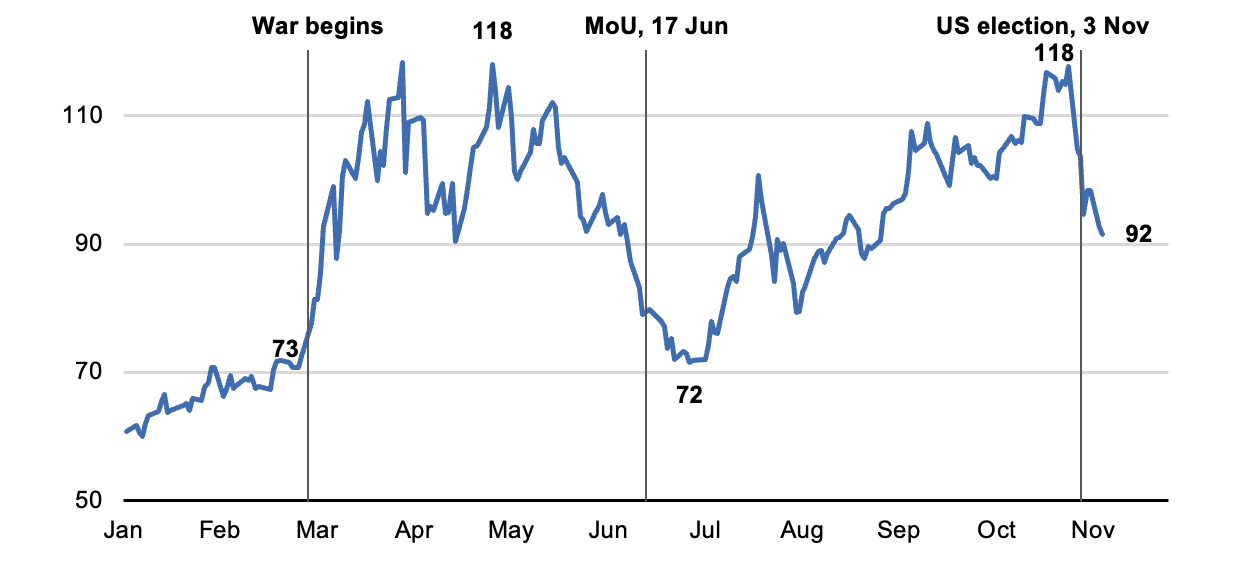
The main transmission channel was prices. Brent crude oil stood at $72 per barrel on the eve of the war in late February and was near the yearly high at $117/bbl on October 30, the Friday before the elections. U.S. gasoline prices have been above $4 per gallon since April. Higher fertilizer costs added to the pressure in farm states, such as Kansas, Iowa, and Mississippi, all of which elected Democratic senators. The direct fiscal cost has also mounted, raising broad complaints that funds that could be spent to support Americans are being wasted on a war of choice: The Pentagon’s inspector general put the cost of operations at $33.4 billion by the end of June, excluding repairs to damaged bases, and the Congressional Budget Office estimated $38 billion as of August 1.
There is a certain irony to the role that the Iran war played in this election cycle. Frustration with the involvement of the political establishment in both parties in the post-9/11 “forever wars” was one of the factors in Trump’s rise to power, helping him to win both the Republican primary election in 2016 and then the general election against Hillary Clinton. He repeatedly insisted during that campaign that he had opposed the invasion of Iraq, although there is little evidence to substantiate this claim, and pledged not to get involved in more “stupid wars” or nation building in the Middle East. The concept of “America First” was partly framed in contrast to these unpopular foreign policy entanglements. A University of Michigan study found a statistical relationship between the scale of battlefield casualties in Iraq and Afghanistan and votes in favor of Trump in the general election, which was sufficiently strong to explain the swing to Trump in the three states that won him the 2016 election (Pennsylvania, Michigan, and Wisconsin). Trump also repeatedly made pledges not to get involved in wars in his 2024 campaign, although the main driver for his victory then is widely agreed to have been the postcoronavirus cycle of inflation.
Senior Republicans have largely accepted that the war is to blame for their losses. In a widely discussed post on the day after the elections, Vice President JD Vance wrote that the reason for the defeat was obvious to almost everyone: the war. He listed four things that voters who switched sides wanted: an end to the war, a focus on the cost of living, an America First agenda, and a change in the relationship with Israel. Trump described the assessment as largely true, citing fuel prices, while standing by his decision to launch the war, which he continues to assert was necessary to prevent Iran from securing nuclear weapons.
The war was not the only cause. The AP Voter Poll, a survey of about 80,000 voters, found that around two-thirds of respondents believed Trump’s policies had made the economy worse, with respondents citing tariffs, the war, and unmet promises on prices, and about six in 10 were very concerned about grocery costs. Republican strategists quoted by CNN said the party’s problems went beyond the conflict, and the same survey shows concerns about corruption also weighing on the administration. The war likely turned what would probably have been an ordinary midterm loss into a rout, by keeping energy prices high through polling day and by alienating voters who had backed Trump in 2024 on a promise to avoid new wars.
Implications for the War
The new Congress will not be seated until January 3, 2027. Until then, the outgoing Congress continues in a “lame duck” session in which Republicans retain their majorities in both chambers. The delay is a historical quirk, a legacy of the practical constraints of travel across a large country. The most important date in the lame duck is December 11, when the current government funding package, including war funding, expires. Prediction markets put the odds of a shutdown at about 45% after the elections, up from about 30%.
An early test came on November 10, when the House voted 211 to 204 to refer to the Judiciary Committee a resolution by Republican Thomas Massie of Kentucky to impeach the defense secretary, Pete Hegseth, largely over the conduct of the war, including ignoring War Powers Resolutions from Congress. The referral shelves the resolution. Massie was the only Republican to vote with Democrats, and seven Republicans and 11 Democrats missed the vote. Some of the Democratic absences were attributed to traffic incidents and other mishaps, although commentators noted that several of those absent, such as outgoing Representative Haley Stevens, who lost the Michigan Senate primary to Abdul El-Sayed, have received funding from the pro-Israel lobby group AIPAC. The Democratic leader, Hakeem Jeffries, said the vote was only the beginning. A similar resolution would be likely to pass on party lines in the new House, possibly reviving articles proposed in April by Yassamin Ansari of Arizona, who is the daughter of Iranian immigrants. Conviction in the Senate requires 67 votes, however, so impeachment is better understood as a means of pressure and investigation than a realistic route to removal.
Democratic leaders have been explicit that they intend to use their majorities to end the war. The Senate Democratic leader, Chuck Schumer, said his party would do so through the power of the purse, and a House aide listed War Powers Resolutions, lawsuits, subpoena-backed investigations, and limits on arms sales among the tools under consideration. Each has limits. War Powers Resolutions have already passed, in the House by 220 to 204 in September and in the Senate in May and June, but they are subject to a veto that Democrats cannot override. Trump has said he will become “Mr. Veto.” Appropriations are the stronger lever, because spending bills cannot pass without Democratic votes after January, but using them risks repeated shutdown confrontations and would make it more difficult for Democrats to make progress on advancing domestic policies on which they were elected, although ending the war would be one of the fastest and most substantive ways to bring down costs. The realistic expectation is that Congress can make the administration’s Iran policy harder to pursue, but it cannot quickly force a change if Trump remains committed to the war.
The more immediate effect is on the president’s own incentives. Trump might seek a deal before the new Congress is seated so that he owns it, and the Democratic victory could strengthen those in the administration who favor a settlement. That said, there is only really time for an interim agreement this year, broadly revamping the June memorandum of understanding, not a full and final nuclear deal. Vance and Middle East envoy Steven Witkoff reportedly favor a deal, while Hegseth and Israel’s prime minister, Benjamin Netanyahu, favor renewed strikes. A third group, including Secretary of State Marco Rubio and Secretary of the Treasury Scott Bessent, prefers a continuation of the status-quo pressure tactics. Trump said after the elections that talks with Iran were under way, and Qatari mediators have shuttled between Doha and Tehran with a proposal under which the United States would lift its naval blockade of Iran and release some frozen funds while Iran readmits inspectors and reopens the Strait of Hormuz.
Escalation nonetheless remains possible. The United States struck an Iranian air-defense battery on Qeshm Island on the eve of the elections; a third aircraft carrier (the USS Theodore Roosevelt) arrived in the region; and Trump has said he may yet have to resume large-scale strikes. There has even been talk of a strike on Pickaxe Mountain, a site linked to the nuclear program that is probably impenetrable by conventional weapons so may require a tactical nuclear strike. Trump could choose to escalate in the hope of improving his bargaining position. The opposite risk is Iranian miscalculation. Officials in Tehran hailed the election result as a “political defeat” for Trump in Washington, and Rubio complained in September that Iran was holding out in the expectation of a Democratic win. Ali Vaez of the International Crisis Group warned that Tehran may mistake Trump’s political weakness for military weakness and overreach in its demands. Meanwhile, the Gulf continues to bear the costs: The United Kingdom’s maritime agency recorded 35 attacks on shipping in October, the highest monthly total of the war.
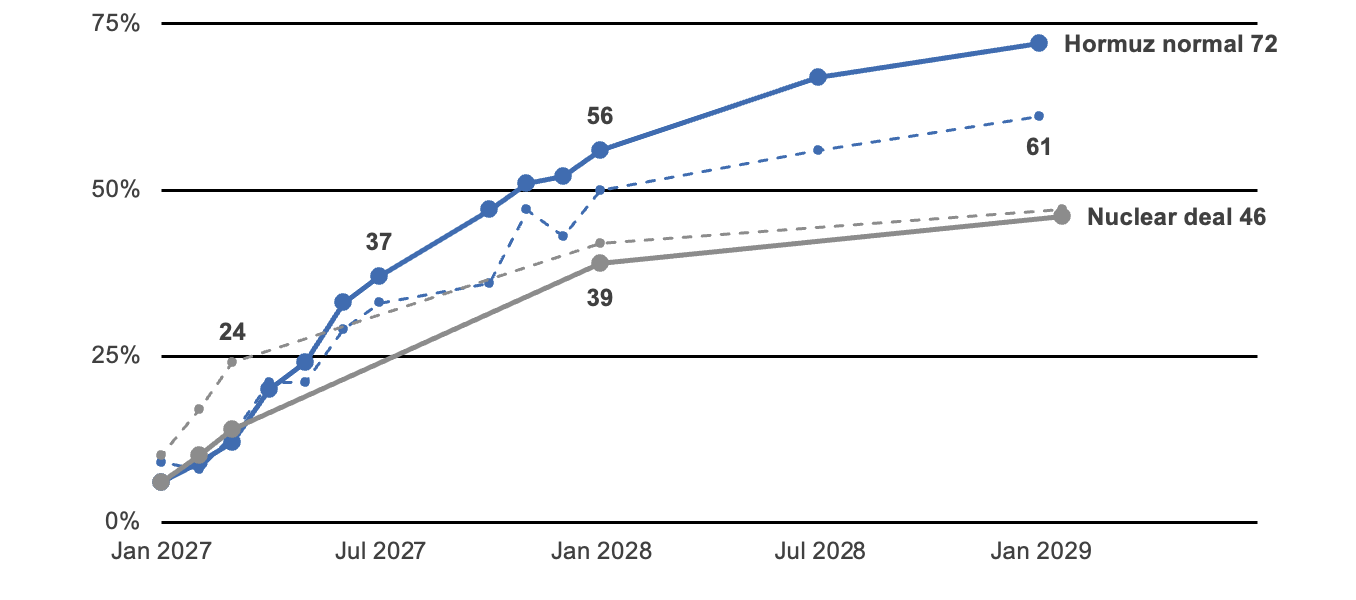
Markets have priced in a lower risk of escalation but not a quick peace. Brent fell from $117/bbl on October 30 to $94/bbl the day after the elections and closed near $92/bbl on November 10, still about one-quarter above its prewar level. On the U.S. prediction market Polymarket, the implied probability that the Israel-Iran cease-fire holds to the end of the year rose from 36% on November 2 to 70% on November 10, and the probability of a U.S. ground invasion fell from 18% to 6%. Yet the probability of a U.S.-Iran nuclear deal before March 2027 implied by Kalshi prices fell from 24% to 14%, while traders put the chance of Strait of Hormuz traffic returning to normal before July 2027 at 37% and 56% before 2028. The market-implied path is therefore neither renewed war nor rapid normalization following a peace deal but a prolonged period of disruption for the Strait of Hormuz, although with sufficient crude exports getting through to supply global demand.
Brent Has Fallen One-Fifth Since the End of October, but Remains One-Quarter Above Prewar Brent crude, front-month close, $ a barrel, 2026
Source: ICE Brent front-month daily close, January 2 to November 10, 2026
Markets Put the Chance of Normal Hormuz Traffic by Mid-2027 at 37% Implied probability before the date shown.
Solid lines: November 11, 2026. Dashed lines: November 2
Source: Kalshi
AI in the GCC
Artificial intelligence has become one of the main pillars of economic cooperation between the United States and Gulf Arab countries. The Gulf states’ abundant energy, capital, and capacity to build quickly, along with their close relationships with the United States, are among the advantages that leave the region well placed to become a major hub in a multipolar AI landscape despite the war. The relationship has continued to deepen. On July 10, the Commerce Department moved the United Arab Emirates into its most favored export category and authorized the UAE government and certain companies to receive advanced chips without a license. Deliveries have lagged the approvals, however, with reports in October that shipments of Nvidia’s most advanced chips to the UAE and Saudi Arabia remained well short of the 35,000 authorized a year earlier.
Commercial ties have continued to grow regardless. OpenAI signed four agreements in Abu Dhabi on November 2, during a visit by its CEO, Sam Altman, and Abu Dhabi’s MGX participated in an $11 billion bridge financing round at a $1.25 trillion valuation. In Saudi Arabia, Aramco has completed its $2.6 billion purchase of 49% of Humain, which has expanded its agreement with Nvidia.
Democrats have been more skeptical of the international diffusion of advanced computing than the Trump administration. The January 2025 diffusion rule of the administration of President Joseph R. Biden Jr. capped chip exports to the Gulf, among other countries. Democratic Senator Elizabeth Warren criticized the July upgrade to the UAE’s export status saying the chips could be diverted to China, and the senior Democrats on four House committees asked the Commerce Department’s inspector general to examine whether Trump family business interests influenced the UAE deal. These concerns are not new or purely partisan, with Republican China hawks raising similar objections. What Congress can do is limited, since export licensing is an executive function and legislation is subject to veto. The practical tools are hearings, subpoenas, conditions attached to the annual defense and appropriations bills, and public pressure on the companies involved. Analysts quoted by EnterpriseAM expect a substantive change of policy only under a Democratic president.
A major development since the elections, unrelated to the Gulf Arab states, may sharpen the scrutiny. Jensen Huang, the CEO of chipmaker Nvidia, resigned on November 12 following reports, citing U.S. intelligence assessments, that a woman he had an affair with, a former executive of Megaspeed, a Singapore-registered company that has bought billions of dollars of Nvidia-based equipment, is suspected of having worked for China’s security services and potentially diverting chips bought by Megaspeed to China. Both companies deny wrongdoing, Nvidia has commissioned an independent investigation, and Huang resigned on November 12. Whatever the facts prove to be, the episode is likely to revive bipartisan concerns about access to advanced computing through third countries, and the Gulf states’ efforts to mitigate those concerns may need to be redemonstrated.
A second election effect cuts the other way. Opposition to data centers, driven by electricity prices, water use, and wider unease about AI, was a notable feature of the campaign. Bloomberg Economics counted 46 local ballot measures that were approved or are on track to pass that will stall data center development, at least 17 of them outright bans. The governors-elect of Ohio, Georgia, Michigan, New Mexico, and Texas campaigned on pausing construction. Texas, which had become the center of the U.S. build-out, matters most: The incoming Democratic governor, Gina Hinojosa, who takes office on January 19, 2027, has pledged to block new approvals. UBS estimates that up to about 30% of the capacity additions planned for 2028 across the United States could be paused.
If constraints of this kind persist, they strengthen the case for building capacity in jurisdictions that offer power, land, and rapid permitting, which is the Gulf’s competitive advantage. Two caveats apply. First, the war has raised the cost and risk of building in the region: Abu Dhabi is reported to be redesigning its planned 5-gigawatt campus as hardened, distributed sites and insurers have cut the political-risk cover available. Second, a sell-off in AI-related equities following the elections also weighs on Gulf investors, who are heavily exposed to the sector. The net effect is therefore an opportunity for the Gulf as a location, combined with greater political risk around its access to chips and its financial exposure to U.S. AI companies.
Corruption Concerns and Gulf Dealings With the Trump Family
Concern about corruption and self-dealing in government, highlighted in tandem with the affordability crisis, was a significant factor in the vote. More than half of respondents to the AP Voter Poll said government corruption was crucial to their ballot decisions, and about seven in 10 said Congress was doing too little to check the presidency. Democratic candidates made the theme central to their campaigns, including several who flipped Republican seats. For example, Fred Wellman, who defeated long-serving Republican Ann Wagner 51% to 46% in Missouri’s second district, campaigned on ending “costs, corruption, and chaos” in Washington to benefit working Americans rather than those who, in his words, “get rich off” of running the county. Jeffries has promised an aggressive first 100 days focused on affordability and what he calls unprecedented corruption.
The scale of the Trump family’s business income while the president has been in office is the backdrop. Trump’s financial disclosure for 2025, published in June, shows income of about $2.2 billion, of which about $1.4 billion came from cryptocurrency ventures.
The Gulf states feature prominently in these business dealings, which generally fall into four categories. The first is property. Dar Global, the London-listed arm of Saudi developer Dar Al Arkan, is developing Trump-branded projects in Dubai, Jeddah, Riyadh, Qatar, and Oman. The partnership dates from 2022, before Trump’s return to office, but most of the projects have been announced during his current term. His disclosure shows $38 million in licensing fees from Gulf developers, including $21.9 million from Dar Al Arkan.
The second is asset management. Gulf sovereign wealth funds are the main investors in Affinity Partners, the firm founded by Trump’s son-in-law, Jared Kushner, which manages about $6.2 billion, almost all of it from foreign investors, including Saudi, Emirati, and Qatari funds. Liberty Strategic Capital, the fund of former Treasury Secretary Steven Mnuchin, also raised money from Saudi, Emirati, and Qatari state funds in 2021, including $1 billion from Saudi Arabia’s Public Investment Fund.
The third is cryptocurrency. The Wall Street Journal reported that a company backed by UAE National Security Advisor Tahnoun bin Zayed al-Nahyan, who is also the chairman of the AI group G42, agreed days before the January 2025 inauguration to buy 49% of World Liberty Financial, the Trump family’s crypto venture, for $500 million. According to the report, $187 million went to Trump entities and at least $31 million to entities linked to Witkoff’s family. Separately, in April 2025, the Abu Dhabi fund MGX (a joint venture between G42 and sovereign wealth fund Mubadala, focused largely on AI) used World Liberty’s stablecoin for a $2 billion investment in Binance, the world’s largest crypto exchange. Binance has since in effect made Abu Dhabi its base, and in October 2025, Trump pardoned Binance’s founder, Changpeng Zhao, who pleaded guilty in 2023 to charges of failing to maintain an effective anti-money-laundering program. Democrats strongly condemned the pardon.
The fourth is Qatar’s gift of a Boeing 747, for Air Force One, because of the yearslong delay in the manufacturing of replacements for the aging Air Force One fleet. Unusually, the plane is expected to pass to Trump’s presidential library foundation rather than remain in government service when he leaves office. The gilded jet has been a feature of stump speeches by Democrats since the gift was announced in 2025, with Senator Ed Markey referring to it as “Bribe Force One” and Ossoff insisting: “The President of the United States is not permitted to accept flying palaces from foreign princes.”
The motives of the Gulf funds, companies, and individuals involved may be purely commercial. World Liberty and the White House have both denied any connection between Tahnoun bin Zayed’s investment and policy decisions. There is nonetheless a widespread suspicion in Washington that deals with Trump companies and associates are partly intended to build relationships and influence U.S. policy. That Kushner and Witkoff, whose firms and families are among the beneficiaries, have been the administration’s principal negotiators on Middle Eastern issues, including the Iran war, has complicated the picture.
While in the minority, Democrats prepared the ground for extensive investigations in the new Congress. In Apri, Jamie Raskin, the senior Democrat on the House Judiciary Committee, opened an inquiry into Kushner’s Gulf funding. Gregory Meeks, in line to chair the Foreign Affairs Committee, has said he will examine Kushner’s and Witkoff’s overseas deals. And Robert Garcia, who is seeking the chair of the Oversight Committee, plans to pursue companies that have done business with the Trump family. As of January, these committees will have subpoena power. They will be able to compel documents and testimony from U.S. firms, banks, and individuals, although Gulf entities are less likely to cooperate and are largely beyond their reach.
The precedents suggest what such inquiries can and cannot achieve. House committees investigated Trump’s finances in 2019-20, and a 2024 report by Oversight Committee Democrats documented payments to his businesses by foreign governments, including Gulf states, during his first term. Those efforts produced disclosure and political damage rather than legal consequences, and the Supreme Court’s 2020 ruling in Trump v. Mazars set limits on congressional subpoenas for a president’s records. The likely outputs this time are hearings, published reports, referrals, and possibly a basis for articles of impeachment.
For the Gulf states, the bulk of the blame is likely to fall on the Trump family and the officials involved. There are seemingly no recent statements by Democratic officials criticizing Gulf governments themselves over these deals. The exposure is nonetheless real. Analysts at the Arab Center in Washington expect inquiries into Emirati crypto links and Gulf money in Kushner’s fund, and Al-Monitor wrote that the Gulf’s investment pledges to the United States now carry greater political risk. The perception that there could have been influence on certain policy decisions related to the Gulf Arab states could result in those being reconsidered or delayed by Congress, or it could at least take less favorable positions when future agreements with Gulf states come up. This includes AI chip exports, the agreement to sell advanced F-35 jets to Saudi Arabia, and the U.S.-Saudi civil nuclear agreement. Named Gulf institutions and officials may feature in hearings, and a future Democratic administration is likely to be less receptive to a relationship built on personal and commercial ties to one family.
Israel and Palestine
Israel featured in the elections to an unusual degree and in the campaigns of both parties. Vance’s postelection statement listed a change in the relationship with Israel as one of the four things that voters who abandoned the Republicans wanted. Trump said in a “60 Minutes” interview that “great dislike” of Israel contributed to the losses. On Election Day itself, in an announcement possibly intended to win votes, he said that by the end of the year, the United States would stop paying military aid to Israel, about $3.8 billion per year, under a memorandum that runs to 2028, while continuing to sell Israel weapons. It is unclear that he has the authority to do so, since Congress appropriates the funds.
On the Democratic side, the role of AIPAC became a major issue in the primaries. According to The Intercept, AIPAC gave $53 million directly to candidates in this cycle, and its super PAC spent an additional $67 million. It also routed $13 million into Democratic primaries through other committees, including newly created groups with unrelated names, a tactic that critics attribute to the declining appeal of its endorsement. A growing number of Democratic candidates publicly refused its support, including high-profile figures, such as Talarico, who said in an interview: “I’ve never taken money from AIPAC … Seeing what’s happening in Gaza makes me sick to my stomach as a teacher, as a Christian, as a human being.” AIPAC-backed candidates still won more often than they lost, but there were prominent defeats, above all in Michigan, where its super PAC spent more than $30 million opposing El-Sayed or supporting his primary opponent, and El-Sayed won both the nomination and the seat.
These events reflect a long-term shift in U.S. public opinion that predates the Iran war. Gallup’s annual survey in February found, for the first time, that more Americans sympathized with Palestinians (41%) than with Israelis (36%). Among Democrats, the split was 65% to 17%, respectively. Republicans remained strongly sympathetic to Israel, at 70%, but that figure had fallen 10 points in two years to its lowest since 2004. A Pew Research Center survey in late March, after the war began, found that 60% of Americans held an unfavorable view of Israel, up from 42% in 2022, including 80% of Democrats and 57% of Republicans under the age of 50. The generational divide on the right is as significant as the partisan one.
The shift extends to American Jews, who remain attached to Israel but are increasingly critical of its government. A postelection survey commissioned by J Street found that 72% of Jewish voters backed Democrats, 72% held an unfavorable view of Netanyahu, and 80% believed Israel’s actions in Gaza and the West Bank were increasing antisemitism in the United States. Nearly half of younger Jewish voters said they sympathized more with the Palestinians. A September poll for the Jewish Electorate Institute found that 86% described themselves as pro-Israel but that 60% wanted Netanyahu replaced, and a narrow majority supported reducing or ending U.S. military aid.
Israeli politics is part of the explanation. The rightward shift of Israeli governments, the presence of far-right parties in the outgoing coalition, and the conduct of the wars in Gaza, Lebanon, Syria, and Iran have eroded support among Democrats, younger Republicans, and many American Jews. Israel’s own elections on October 27 were inconclusive. Netanyahu’s bloc won 53 of the 120 seats, the opposition bloc won 48, and Arab-led parties won a record 19. On November 8, Israeli President Isaac Herzog gave the opposition leader Gadi Eisenkot, a former military chief, the mandate to form a government. However, it is far from clear if he can achieve this given opposition within his bloc to alliances with either ultra-Orthodox or Arab parties, whose support he would need even to form a minority government. If neither he nor Netanyahu can form a government, there will be fresh elections in 2027. A change of government in Israel might slow the erosion of U.S. support, but it is unlikely to reverse a trend that is now generational.
In the new Congress, Democrats are reported to be preparing legislation to restrict military aid and arms sales to Israel and to sanction settlement activity and settler violence. In April, most Senate Democrats voted for resolutions to block arms sales, which failed but had more than double the support of resolutions two years earlier. Senator Chris Van Hollen, a potential Senate majority leader (as an alternative to Schumer, who has been a lifelong ally of Israel), argues that there should be no “Israel exception” in the application of U.S. law. Of course, Trump could veto any legislation.
For the Gulf states, the implications are mixed but on balance favorable. Normalization of ties with Israel has been the main currency that Washington has sought from Saudi Arabia, and in July Trump made a civil nuclear agreement with Saudi Arabia conditional on it. As U.S. support for Israel becomes more contested, the political premium attached to normalization in Washington declines, and Saudi Arabia’s insistence on a credible path to a Palestinian state sits closer to the center of U.S. opinion, with about six in 10 Americans favoring Palestinian statehood. The Kalshi market on Saudi Arabia joining the Abraham Accords during Trump’s term fell from 33% on the eve of the elections to 20% on November 11. The countries that have already normalized relations, the UAE and Bahrain, may find that the relationship earns them less credit with the new Democratic Congress than it did with either the Biden or Trump administrations.
Energy, Trade, and Other Congressional Levers
Beyond the war itself, several congressional powers bear directly on the Gulf. Most are blunt, because legislation can be vetoed, but the committee chairs that Democrats will hold beginning in January give them real influence over timing and conditions.
On energy, the perennial risk is the NOPEC bill, which would expose OPEC members to U.S. antitrust law. It has been introduced repeatedly and cleared the Senate Judiciary Committee in 2022 without being enacted. There do not appear to be any current moves to revive it, and doing so would be open to criticism given the damage caused to Gulf producers by the war. However, the risk might arise in the future if prices remained high after the Strait of Hormuz reopens and if OPEC+ was seen to be managing the recovery of supply to keep prices high. In the meantime, the war is deepening energy ties in the other direction, with QatarEnergy contracting to buy U.S. liquefied natural gas from Cheniere and Woodside as a hedge against further disruption.
On arms sales, Congress can block a sale by joint resolution, which requires a two-thirds majority to survive a veto. The more practical lever is the informal hold that the chairs and ranking members of the foreign affairs committees can place on a sale before it is formally notified. Democrats will now hold those chairs. In September, the State Department approved a proposed sale of F-35 aircraft to Saudi Arabia, which Senate Democrats had questioned when it was first mooted, and there are also pending resolutions on the UAE and Sudan. A U.S.-Saudi civil nuclear agreement would also come before Congress for review. Meeks and three colleagues introduced a resolution of disapproval in September, objecting to provisions on uranium enrichment.
Any nuclear agreement with Iran would be subject to the Iran Nuclear Agreement Review Act of 2015, which requires it to be submitted to Congress for a 30-day review during which statutory sanctions cannot be eased, and permanent removal of statutory sanctions requires legislation. Here the change of control probably helps a settlement. The strongest congressional critics of the summer’s draft memorandum with Iran were Republican hawks, and a Democratic majority that wants the war ended is less likely to obstruct a deal.
On trade, Gulf exports to the United States currently face a 12.5% tariff under Section 301, the third regime to apply since the Supreme Court annulled the emergency tariffs in February, with energy and fertilizers exempt. Steel and aluminum, including Gulf aluminum exports, face a separate 50% tariff under Section 232, which was tightened in April and was unaffected by the court ruling. Voters cited tariffs among their grievances, and Democrats are likely to try to reassert congressional authority over them, but a veto again limits what can be done before 2029. The larger question concerns the roughly $3 trillion in pledges made by Gulf states to the United States during Trump’s visits to the region in 2025. Only a small part of these headline figures related to investment pledges, with other elements reflecting long-term planned purchases in aerospace, defense, AI, and other sectors. With the president weakened, and the Gulf states strained financially by the war, there will be less political return on delivering on the headline pledges and more scrutiny of the transactions behind them, although it is unlikely they will be formally revoked, and Gulf states will continue investing in the United States opportunistically.
Finally, the Senate’s power to confirm presidential appointments is the one lever that a veto cannot touch, and in January it passes to Democrats. Three areas matter to the Gulf. The first is diplomatic representation. The United States currently has no Senate-confirmed ambassador in Saudi Arabia, the UAE, Qatar, or Kuwait; only Bahrain and Oman have one. The administration has relied instead on envoys, such as Witkoff and Kushner. Democrats have criticized the gaps repeatedly. Senator Jeanne Shaheen, the senior Democrat on the Foreign Relations Committee (whose surname comes from her Lebanese American husband), complained in March that the administration had not made it a priority to put experienced ambassadors in place in the Middle East, and Democratic Senator Tim Kaine said in August that their absence had made U.S. diplomacy much harder during the war. A Democratic Senate is therefore likely to welcome qualified nominees, but it will use confirmation hearings to press them on the war, arms sales, and the Trump family’s business ties and could reject candidates it considers unsuitable. Partly for this reason, the administration has finally made nominations for Saudi Arabia, Kuwait, and the UAE, in a push to get them confirmed before the Senate changes hands. The second area is military posture: Senior Pentagon officials and the generals who command U.S. forces in the region, including the head of U.S. Central Command, which covers the Middle East region, require Senate confirmation as would a successor to Hegseth if he were to leave. The third area is monetary policy, since nominees to the Federal Reserve’s Board of Governors need Senate approval, which limits Trump’s ability to appoint officials inclined to cut interest rates faster than the Fed otherwise would.
U.S.-Gulf Defense Cooperation, Human Rights, and Regional Conflicts
Democrats in Congress have historically been more willing than Republicans to press Gulf governments on human rights and on their roles in regional conflicts, although often backtracking as they are reminded of the strategic and economic importance of the region. Biden campaigned in 2019 on making Saudi Arabia “the pariah that they are” over the killing of journalist Jamal Khashoggi. As president he released the U.S. intelligence assessment that Saudi Crown Prince Mohammed bin Salman had approved the operation and imposed sanctions and visa bans on others involved, although not on the crown prince himself. Biden soon revised his stance and visited Saudi Arabia in July 2022. He said that he sought to reorient rather than rupture relations with a strategic partner of 80 years. A relevant precedent for how the new Congress might behave is during Trump’s first term, when Democrats won control of the House in the 2018 midterms and went on to pass a War Powers Resolution to end U.S. support for the Saudi-led coalition in Yemen and also resolutions disapproving emergency arms sales to Saudi Arabia and the UAE, which Trump vetoed. The incoming majority contains more members than previous Congresses for whom these issues are a priority, including the progressive wing to which several of the new senators and representatives belong.
Sudan is the most active file. A group of senators wrote to Rubio in August urging a halt to arms sales to the UAE over its alleged support for the Rapid Support Forces, which the UAE denies. Van Hollen and colleagues filed resolutions of disapproval on $1.6 billion in arms sales to the UAE in 2025 along with a bill to pause sales until the administration certifies that Emirati support for the Sudanese paramilitary group has ended. Those efforts failed in the Republican Senate. In a Democratic one they could pass, although they would still face a veto.
Yemen presents a different picture from 2019. Saudi Arabia is now on the defensive, with Houthi forces reported to have advanced to within 50 miles of Aden, and the crown prince is reported to have asked Trump for U.S. strikes on the Houthis, which he declined. A Democratic Congress is unlikely to support deeper U.S. military involvement there, and U.S. operations in Yemen were among the grounds cited in the Hegseth impeachment resolution. But Congress may not be as critical of Saudi operations following the recent devastating Houthi attacks on Riyadh’s King Khalid International Airport and other strikes on the kingdom.
Criticism does not preclude engagement. Senator Chris Murphy, one of the most persistent critics of arms sales to the Gulf, toured the region in October and met with the Saudi crown prince. While the war continues, human rights are unlikely to dominate the congressional agenda on the Gulf. They are more likely to resurface as conditions attached to arms sales and as a theme of a future Democratic administration.
The larger long-term question is the future of U.S. bases in the region. The war has done severe damage to the U.S. military footprint in the Gulf. A Washington Post analysis of satellite imagery in May identified at least 228 damaged structures at U.S. bases, and the Pentagon’s inspector general reported in September that hundreds of buildings had been hit at bases in eight countries. The American Enterprise Institute estimates repairs will cost about $5 billion. Many facilities are now only lightly occupied, and in October the United States ordered nonemergency staff and families out of its embassy in Riyadh due to the Houthi threat and drew down personnel elsewhere in the region.
No decision has been made on rebuilding, and there are no official estimates for repair costs, because the Pentagon has not decided its future posture or how costs would be shared with host countries. Officials told appropriators in May that they had no good estimate on the cost of operations, and no supplemental funding request has been submitted. The choice will therefore fall to the new Congress. Even before the elections, there was a debate over whether rebuilding was sensible. The Wall Street Journal reported in June that the Pentagon was weighing a revamp of its naval base in Bahrain, a reduced presence in Kuwait and Saudi Arabia, and the relocation of some functions farther west. Analysts at the Stimson Center have argued against rebuilding at all. Advocates of a smaller footprint are found in both parties, among America First Republicans and progressive Democrats alike, on the argument that the bases proved a strategic liability rather than an asset.
Gulf views of the bases have changed as well. The U.S. presence expanded substantially after Iraq’s invasion of Kuwait in 1990, and the 1991 liberation and was seen as a guarantee against a repeat. It has at times proved its value to the hosts: The base at Al Udeid was arguably a restraining factor during the 2017 rift within the Gulf Cooperation Council. In the current war, the bases have attracted Iranian attacks and extended well beyond them, as documented in a Reuters special report. There is no clean counterfactual, because all six states host U.S. forces, to varying extents. Oman has a smaller U.S. presence, greater geographical separation, and a different relationship with Tehran, but it has still been attacked to some extent. The suspicion remains that Iranian attacks on other countries would have been more limited without the presence of the bases.
No Gulf government has said publicly that it wants U.S. forces to leave, which would be politically difficult while the war continues. The idea is nonetheless being aired. The influential Emirati political scientist Abdulkhaleq Abdulla wrote in April that it was time to rethink U.S. bases in the UAE, describing them as a burden, although he later said any change should be gradual and agreed upon. Others caution that there is no substitute. Kristian Alexander of the Rabdan Security and Defence Institute in the UAE said that there is currently “no credible alternative” to replace the United States at scale.
Gulf states are hedging in the meantime. Saudi Arabia concluded the Mecca Joint Defense Agreement with Turkey and Pakistan in August, and the members of the Mecca pact have engaged Tehran directly. Iran’s foreign minister said in early November that Iran has no hostility toward the GCC states. The U.S. commitments that do exist rest on weak foundations: The security guarantee to Qatar made after the 2025 Israeli strike on a Hamas villa in Doha, for instance, takes the form of an executive order that binds neither Congress nor a future president. The most likely outcome is a smaller, hardened, and less visible U.S. presence, with greater demands on hosts to share costs. The election reinforces that direction, since the incoming majority is skeptical of open-ended military commitments in the region, and it strengthens the case for Gulf states to diversify their security relationships. The Gulf’s most urgent need is a resupply of air-defense interceptors, something for which they hope there would be bipartisan support, although production is limited, and there is competition from other allies and the U.S. military itself.
Economic and Financial Channels
The U.S. economic outlook matters to the Gulf through four channels: short-term interest rates, long-term borrowing costs, the strength of the dollar, and the value of Gulf assets held in the United States.
The first channel runs through the Federal Reserve. Because Gulf currencies are pegged to the dollar (or, in Kuwait’s case, to a basket dominated by it), Gulf central banks generally have to follow the Fed’s direction on interest rates. This year, that has meant tightening. The Fed raised its policy rate by 25 basis points in September, to 3.75% to 4.00%, in response to the inflationary effect of the war, and all the Gulf central banks except Kuwait followed. Futures markets put the probability of another rise on December 9 at around 80%, and most Gulf central banks would mirror this. The U.S. posture on rates often differs from the optimal posture for Gulf economies, including now, when tighter monetary policy has the tendency to dampen economic activity, at a time when the war is already weighing on their non-oil activity.
The question for the next two years is whether the new political configuration in Washington helps to bring U.S. inflation and rates down. The largest factor is outside Congress’s direct control: An end to the war and the reopening of the Strait of Hormuz would lower energy prices and make cuts possible. Rolling back tariffs could be disinflationary, supporting an environment for lower rates, and divided government makes new (and inflationary) fiscal stimulus unlikely. On the other side, if growth stays strong and unemployment low, the Fed will have little reason to ease, and a rollback of tariffs, which would reduce prices, is unlikely to survive a veto.
The second channel is long-term rates. The United States has a structural budget deficit of 6% to 7% of gross domestic product, debt over $40 trillion, and annual interest costs above $1 trillion. The national debt has expanded sharply, and the 10-year Treasury yield rose above 5% over the summer. It fell toward 4.9% after the elections, as investors concluded that gridlock would prevent additional borrowing. This matters to the Gulf in two ways. It affects the value of Gulf holdings of Treasuries, which Saudi Arabia and the UAE reduced by nearly $17 billion in March. It also sets the cost of borrowing for Gulf governments, banks, and companies, which issue at a spread over Treasuries whether they borrow in dollars or in pegged local currencies. That cost is material: According to Fitch Ratings, the GCC debt market exceeds $1.2 trillion, with $240 billion issued in the first nine months of the year. The reduction in oil revenue for most countries as a result of the war has resulted in higher borrowing requirements for most countries and wider credit spreads.
The third channel is the dollar itself. Because of the pegs, Gulf currencies move with it against the euro, yen, and other currencies in which much of the region’s imports are priced. The dollar has been firm for most of this year, supported by rising U.S. interest rates and safe-haven demand during the war. And the dollar index against a basket of major currencies has risen by about 5% year to date to its highest level since early 2025. That has partly cushioned the Gulf from the war’s inflationary effects by lowering the local currency cost of imports from Europe and Asia, although it also makes the region more expensive for tourists and buyers of its non-oil exports, albeit the disruption resulting from the war is far more significant a drag than the currency. The dollar slipped a little immediately after the elections, but by November 11 was up by about 1%, largely due to growing expectations of a December rate hike. Currency strategists polled before the vote already expected the dollar to weaken over the coming year, with the euro forecast to rise from about $1.12 to $1.16, although they have underestimated its strength for most of 2026. If they are right this time, Gulf import costs would rise at the margin, adding modestly to inflation.
The fourth channel is asset valuations. Gulf sovereign wealth funds, central banks, and private investors hold very large positions in U.S. equities, bonds, and property, sometimes over half their total assets. Therefore, trends in the U.S. markets have significant implications for Gulf wealth. Markets fluctuated sharply in the week after the elections, which suggests that investors are struggling to weigh the consequences, particularly on AI-related stocks. Divided government is often regarded as benign for equities because it limits policy change, although the evidence is mixed. Conversely, it also makes a long-term compromise on issues driving the deficit harder to achieve.
U.S. economic policy is therefore likely to be in a holding pattern until 2029. If Democrats then control the presidency and both chambers, they are likely to attempt major reforms, particularly of healthcare and taxation. As the shape of those plans becomes clearer over the coming years, it will affect the relative valuation of U.S. assets, to the benefit of some sectors and the cost of others. Gulf investors have time to adjust but should start to monitor the direction of travel.
Gulf Perceptions of the United States
The election results may also, to some extent, change how the United States is seen in the region. The most visible symbol is Abdul El-Sayed, a 42-year-old doctor of Egyptian descent who defeated the Republican Mike Rogers in Michigan to become the first Muslim elected to the Senate. A clip from his victory speech, in which he used several Arabic phrases, including jokingly addressing the vice president as “JD, habibi,” noting that Vance will be constitutionally obliged to swear him in, has circulated widely in the Arab world. The Associated Press reported celebration across the region, and Khaleej Times interviewed his in-laws who live in Dubai. Kuwaiti political scientist Abdullah Alshayji provided an extensive summary of the regional response during a November 10 Arab Gulf States Institute webinar.
In the House, Keith Ellison of Minnesota became the first Muslim member in 2006, followed by André Carson of Indiana in 2008; both are African American converts. Two Muslim women were then elected as representatives in the 2018 midterms, Rashida Tlaib of Michigan of Palestinian heritage and Ilhan Omar of Minnesota of Somali heritage. California added its first Muslim representatives in the current Congress, Lateefah Simon, who is African American, and Aisha Wahab, who is the daughter of Afghan refugees. Newcomers in this year’s midterms were Adam Hamawy of New Jersey, who was born in Egypt and notably volunteered as a doctor in Gaza in 2024, and Darializa Chevalier, a convert who is a close ally of New York Mayor Zohran Mamdani, arguably the most prominent Muslim in U.S. politics. Overall, this means that the incoming Congress will include a record eight Muslims (plus two others from Muslim families who do not personally express a religious identity). There have also been dozens of non-Muslim Arab members of Congress, mainly of Lebanese Christian origin, such as former Senator George Mitchell, and several in the incoming Congress.
Many of the Muslims elected to Congress in recent years sit on the progressive wing of the Democratic Party. Tlaib is a member of the Democratic Socialists of America, and El-Sayed, although not a member, has had its support and ran on a platform centered on universal healthcare. This partly reflects an alignment between progressives and many American Muslims on the Middle East, above all on Palestine. It also brings positions that differ from majority opinion in the more conservative Gulf societies, for example on LGBT rights, on which El-Sayed is described by advocates as an ally. The same politicians are also among the firmest critics of Arab governments on human rights. El-Sayed has sought to balance his criticism of U.S. military aid for Israel by also opposing its support provided to Egypt. In addition, he has questioned military support for Saudi Arabia and criticized the UAE’s alleged role in Sudan, telling ABC News in October, “I would like us to figure out how to stop making deals with countries like Saudi Arabia or the UAE.” Greater Muslim representation in Washington will not automatically mean a more sympathetic hearing for Gulf states.
More broadly, a more prominent role for Muslims in U.S. politics, and a possible shift in the tone of the immigration debate, may make the United States feel more welcoming to visitors from the Gulf. Much of the anti-immigration sentiment of the Trump years has had an Islamophobic component, beginning with the 2017 travel ban on several Muslim-majority countries. Few Gulf citizens emigrate to the United States, but many study there, and the numbers have fallen steeply. Saudi enrollment dropped from 44,432 in 2017-18 to 12,702 in 2024-25. The causes are debated. Cuts to Gulf government scholarship programs account for much of the decline, and The National suggested in a 2025 article that it was not necessarily linked to U.S. policy. More recent evidence points to a policy effect: Kuwaiti student visas fell 10% year on year in August 2025 after a pause in visa processing, visa revocations, and new social-media vetting. A similar dip and recovery followed the September 11, 2001 attacks. Congress has little direct control over visa policy, so any change before 2029 is likely to be one of atmosphere rather than rules.
The Outlook for 2028
The election results have made it considerably more likely that Democrats will win the presidency in 2028, with their odds on Kalshi rising to 66%, and moreover take office in January 2029 with control of both legislative chambers. The Senate arithmetic is the firmest part of that judgment. Apart from Brown, whose Ohio seat comes up again in 2028, the Democrats elected this year will not face voters until 2032. Of the 34 seats contested in 2028, Republicans hold 19, including vulnerable seats in Wisconsin, North Carolina, and Iowa, while Democrats must defend five in states that Trump won in 2024. Governor Ron DeSantis of Florida has said that Republicans may not have a realistic chance of regaining the Senate until 2032, and some Democrats are speculating about reaching 60 seats, the threshold to overcome a filibuster, which no party has held since 2010. The whole House is elected every two years, so it could in principle change hands in 2028, but the size of this year’s majority and the expected boost from a Democratic presidential candidate at the top of the ticket make that unlikely.
The elections have also reshaped the Democratic presidential field. Ossoff has become the favorite in prediction markets both for the nomination and the presidency. He was reelected to the Senate in Georgia by an impressive 18-point margin, in a race that was initially viewed as a top target for Republicans. His position was strengthened by the election of a Democrat, Keisha Lance Bottoms, as governor of Georgia, since she would appoint his replacement if he vacates the seat. That consideration is not trivial: Democrats won a Senate seat in Ohio this year because Vance had vacated it. Ossoff is young, handsome, and widely agreed to be an impressive orator. Also, he is highly regarded by many African Americans, in part because he was mentored since his teens by civil rights icon Congressman John Lewis, which would be supportive in the primaries.
Ossoff Has Overtaken Vance as the 2028 Favorite Betting implied probability of winning the 2028 presidential election, %
Source: Kalshi
The victory of progressives in some purple seats, including El-Sayed in Michigan, which has been a key swing state in recent elections, is seen as providing a boost to the viability of Alexandria Ocasio-Cortez. However, it is not yet clear if she will run for the presidency and may alternatively seek to contest Schumer’s New York Senate seat, which is also up for election in 2028. One candidate who will almost certainly run is Pete Buttigieg, the former transportation secretary who rose to prominence in the 2020 primaries. He was the most active Democratic surrogate in competitive districts, campaigning with close to half of the candidates who flipped Republican House seats as well as with winning Senate and gubernatorial candidates. His market odds remain relatively low, but his standing among party insiders and pundits has grown, with journalist Chris Cillizza listing him third in his latest top 10 ranking of likely Democratic nominees, after Ossoff and Ocasio-Cortez. Some of the newly elected senators, including Talarico, El-Sayed, and Hamilton, are also being discussed as possible candidates, although there is no modern precedent for winning the presidency so soon after entering the Senate. Barack Obama, the usual comparison, had served two years when he declared his candidacy.
On the Republican side, Vance remains the clear leader, but his implied chance of winning has fallen since the midterms. He has notably tried to distance himself from the war, although this will be difficult to achieve. Rubio ranks second among Republicans but has also slipped a little since the elections. Conversely, DeSantis’ chances have improved, as talk grows of what a post-Trump Republican Party might look like.
Of course, a lot can change in two years, and an end to the war, a reduction in prices, and a strong economy could revive the prospects of Republicans. Early favorites for both parties should be treated with caution. In several recent cycles, the perceived front runner two years out did not win the nomination: Hillary Clinton and Rudy Giuliani after the 2006 midterms, Jeb Bush after 2014, and DeSantis, briefly the market favorite after 2022. There is the possibility of wildcard candidates, perhaps focused on newly important issues such as AI, reminiscent of Andrew Yang’s unexpectedly strong showing in the 2020 Democratic primaries.
What would a Democratic presidency mean for the Gulf? The individuals matter. Ossoff would be the first Jewish president and one who has been willing to criticize Israeli policy and voted in 2025 to block some arms sales to Israel. Depending on the state of Israeli politics in 2029, he might be unusually well placed to broker progress on the Israeli-Palestinian conflict, an outcome the Gulf states would welcome, although it is far from assured. Ocasio-Cortez, meanwhile, is the firmest critic of Israel among the prospective candidates, including calling the Gaza war genocidal and supporting an end to all military aid. She has also been critical of several human rights and foreign policy issuesrelated to the Gulf, although other progressives, such as Bernie Sanders and Ilhan Omar, have been more outspoken on these issues. Buttigieg has personal experience of the wider region, having studied Arabic in Tunisia (and is fluent in Arabic-inflected Maltese, from where his name derives), and served as a naval intelligence officer in Afghanistan, where he learned some Dari. Such regional experience and linguistic skills would be unique in an U.S. president.
Irrespective of the specific president, a Democratic administration would include a less personalized and more institutional relationship than has been the case under Trump, closer attention to human rights and export controls on advanced technology, a more critical approach to Israel, and less appetite for military commitments. The precedent of the Biden administration, which began by promising to treat Saudi Arabia as a pariah and ended by courting it, suggests that shared interests in energy, investment, and regional stability reassert themselves. A cooler but stable relationship is a reasonable central expectation.
How the Gulf is Responding, and What to Watch
Official Gulf reaction has been muted, as is customary for another country’s domestic elections. The tone of commentary has been pragmatic. A National editorial argued that the midterms matter for the region but that Gulf states are betting that strategic interests endure across administrations. Khalid Al-Jaber, the executive director of the Middle East Council on Global Affairs in Doha, argued that “The future of Gulf security cannot be held hostage to domestic U.S. political dynamics … This does not diminish the importance of the strategic partnership with the U.S., but it does highlight the limitations of relying on it exclusively.” Abdulaziz Hamad Al-Aweisheg, the GCC’s assistant secretary-general for political affairs and negotiations, writing in Asharq Al-Awsat, asked if Trump, faced with barriers from Democrats for his domestic priorities, might focus even more on foreign policy in pursuit of legacy achievements. Meanwhile, efforts are already underway to expand engagement with Democrats, including the UAE’s Embassy contracting Jennifer Poersch, a lobbyist whose husband manages the Democrats’ Senate Majority PAC, which spent $317 million supporting candidates this cycle.
With the shifts stemming from the midterm elections, Gulf policymakers should consider six priorities:
Broaden engagement in Washington beyond the White House to the incoming committee chairs and the progressive wing, which now has considerably more clout.
Put commercial relationships on an institutional footing and expect transactions involving the president’s family and envoys to be examined in public.
Use the weeks before January 3, when Trump has the strongest incentive to settle the war with Iran, to support the Qatari-led mediation.
Be ready to demonstrate compliance on advanced chips, as scrutiny of diversion risk intensifies in both parties.
Plan for a smaller U.S. military footprint and continue to diversify security partnerships.
Base funding plans on U.S. interest rates staying higher for longer, with borrowing costs tied to Treasury yields and a dollar that may weaken and raise import costs.
The views represented herein are the author's or speaker's own and do not necessarily reflect the views of AGSI, its staff, or its board of directors.
The Iran war has changed the basing question. Washington will have to determine how much infrastructure it can sustain, which missions deserve priority, and how much responsibility regional partners can realistically assume.
The outbreak of the Iran war has halted the deepening of the economic relationship between the United States and the Gulf countries. While likely temporary, it could take some time before the upward trajectory is restored.
Payments by Aramco are still the key driver of government revenue in Saudi Arabia despite the notable increase in non-oil revenue, particularly from the value-added tax, in recent years.
Recent aviation agreements between the United States and the United Arab Emirates and Qatar have ended a bitter dispute over alleged anti-competitive practices. In the aftermath of the agreements, Delta announced plans to relaunch its nonstop route to India, three years after it cancelled the flights, blaming competition from Gulf airlines. However, the agreements are...
In response to fiscal pressures and concerns about the efficiency of project and service implementation, Gulf Arab states are increasingly looking to the private sector to finance and manage infrastructure projects.
On April 14, AGSI hosted a discussion on how the Gulf Arab states can transition from crisis management to position themselves for sustainable postconflict growth.