Israeli Politics Can’t Address International, Especially Saudi, Concerns
Policies that prevent Saudi Arabia from pursuing diplomatic normalization and are fueling alienation in large parts of the West seem to reflect a Jewish consensus in Israel.
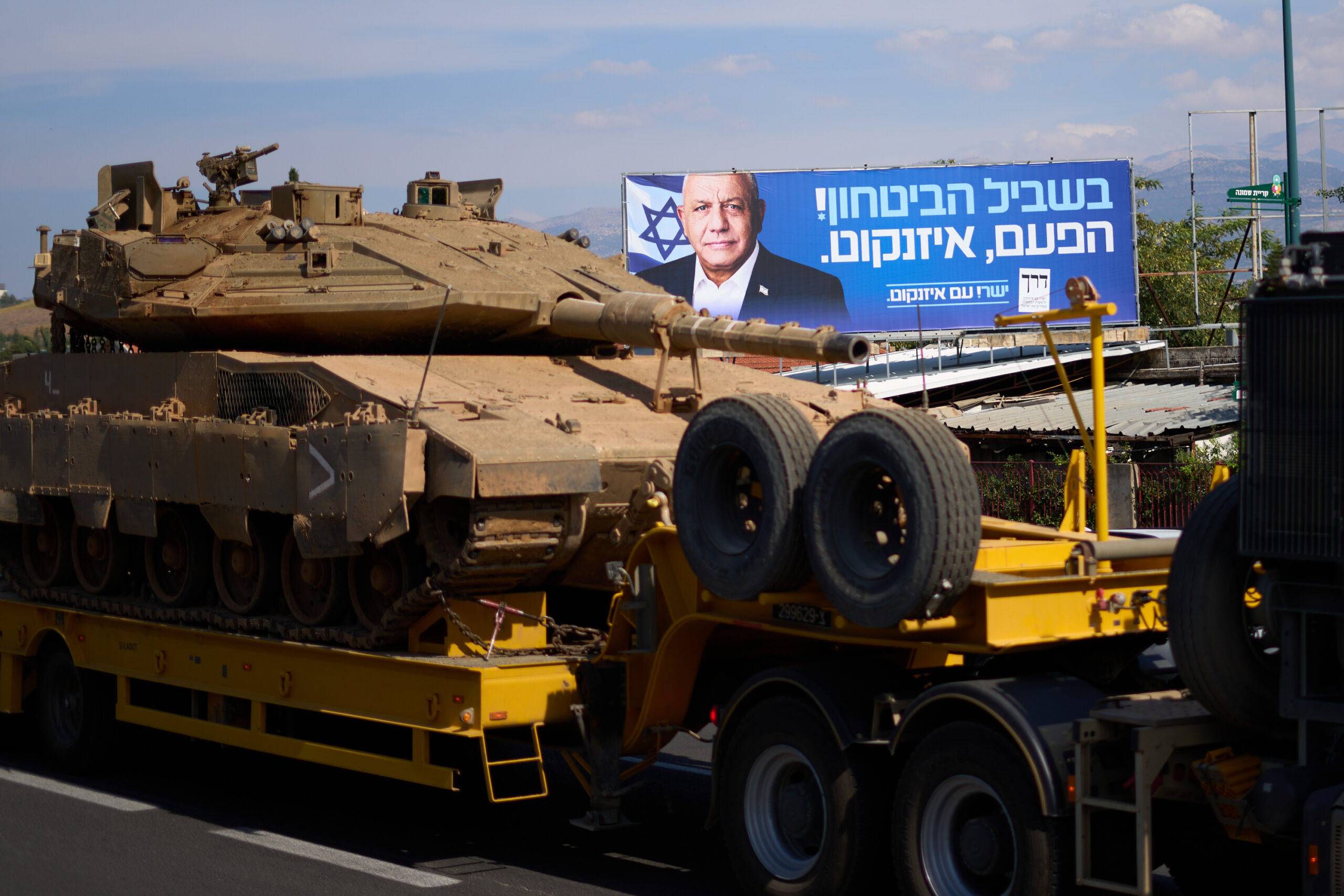
A tank mounted on a military truck passes an election campaign poster featuring Gadi Eisenkot, leader of the centrist Yashar party, in Kiryat Shmona, near the border with Lebanon in northern Israel, October 20. (AP Photo/Ariel Schalit)
On October 27, Israelis delivered yet another inconclusive national elections, again leaving power balanced between the center and right. But perhaps even more precarious is Israel’s quest for greater regional acceptance in the Middle East and efforts to avoid creeping international isolation with parts of the formerly supportive West over repressive occupation politics, especially in the West Bank. Indeed, many Jewish Israelis may not appreciate the extent to which their bitter internal divisions do not address regional and international concerns about Israeli conduct and policies or that they are being perceived as developing a strong consensus. They seem united in rejecting almost anything that could win them greater acceptance and increased partnerships, including with key Arab and Muslim majority countries, notably Saudi Arabia.
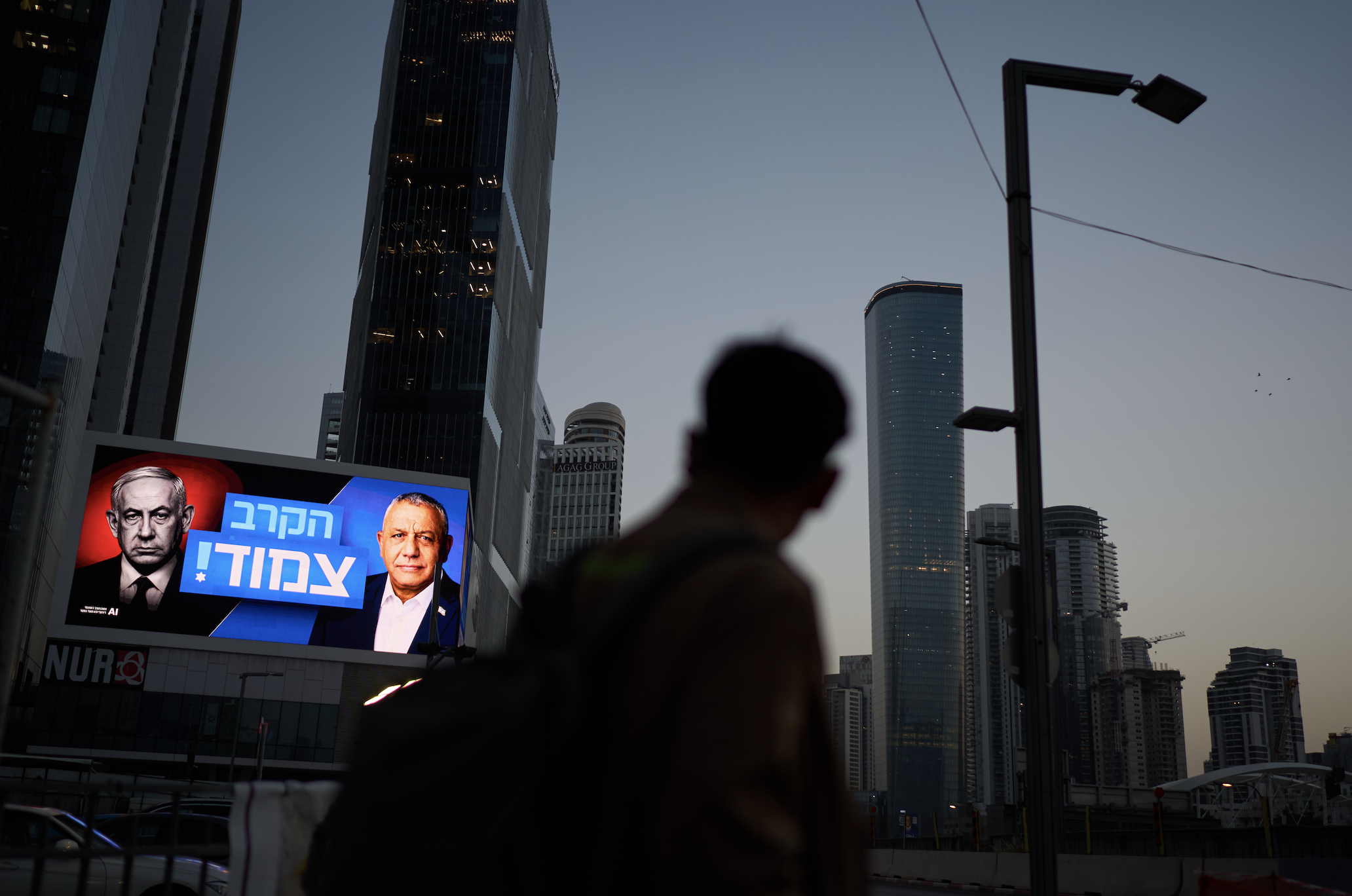
As things stand, neither Israeli Prime Minister Benjamin Netanyahu nor his primary opponent, Gadi Eisenkot, former chief of staff of the Israel Defense Forces, appeared to be well positioned to form a stable new cabinet that can survive no-confidence votes in the Knesset with at least 61 votes. It’s not even clear which of the two President Isaac Herzog will formally invite first to try to assemble a government. The political division among Jewish Israelis is familiar and deep, arising from fundamental disputes about rule of law with an independent judiciary, whether ultra-Orthodox men can continue to avoid military service, and even the nature of Israel’s “Jewish character.”
Much of the Israeli center and left has effectively cooperated with Israel’s brutal war in Gaza. There has been little opposition to Netanyahu’s open instigation of the war against Iran (primarily being conducted by the United States) that has destabilized much of the Middle East and shaken the globally economy. With the exception of a dispute over the upsurge of settler violence terrorizing Palestinians, this was yet another Israeli election that effectively left unchallenged the country’s policies in the occupied West Bank, including increasingly aggressive preparations for future large-scale annexation. These are the concerns that are severely damaging Israel’s standing and reputation, particularly in the West and the Arab world. After the “Abraham Accords” diplomatic normalization began with the United Arab Emirates and Bahrain, and then extended to Morocco and Sudan, there were hopes of securing greater regional acceptance for Israel after a long history of ostracization by the Arab and Muslim-majority world. Such dreams are threatened to be dashed by these entrenched policies.
Therefore, Israelis and their allies who are hoping that the potential removal of Netanyahu can begin a rapid repair of their country’s reputation, particularly with an eye to restoring prospects for the normalization of ties with Saudi Arabia, may be bitterly disappointed, even if Eisenkot is able to form a viable government. Just a few years ago, the administration of former President Joseph R. Biden Jr. seemed to be on the brink of a breakthrough normalization with Riyadh that could have been the key to ending the refusal of most Arab and Muslim-majority states to recognize Israel and deal openly with it.
For decades, the expectation has been that once Saudi Arabia, currently the unchallenged diplomatic leader of the Arab states and one of the most influential of the Muslim-majority countries given its status as the birthplace of Islam and guardian of the key holy cities of Mecca and Medina, opened diplomatically to Israel, most other Arab League and Organization of Islamic Cooperation states would eventually follow suit. The assumption is that such a diplomatic breakthrough with the Arab and Islamic worlds would finally free Israel of the painful isolation from key parts of the international community, particularly in the Middle East, since its founding in 1948 and the displacement of most Palestinians from the territory that became Israel after the 1949 armistice. That would be, as Biden might have said, “a big deal.”
Seeking to build upon the 2020 breakthrough for Israel with the UAE and Bahrain during President Donald J. Trump’s first term, the Biden administration crafted an ambitious and cunning effort to link Saudi bilateral goals with Washington to convincing Riyadh to also sign onto the Abraham Accords. In just a few months over the spring and summer of 2023, the Biden administration and the Saudi government agreed on almost all key questions, and even the precise language of some detailed draft agreements, on a new mutual defense treaty, a strategic alignment agreement, and a formula for U.S. technological transfer and oversight in developing a Saudi civilian nuclear energy program.
The UAE and Bahrain entered into the agreements to normalize relations with Israel for reasons of their own that are not paralleled by other states, and even Sudan and Morocco secured specific goals from Washington for entering the process. The UAE secured an informal five-year commitment from Israel not to annex more territory in the occupied West Bank. It managed to extend that five-year period into the second Trump term by quietly encouraging the Trump administration to view the commitment in terms of five “Trump years.” Yet few Palestinians and their supporters view that agreement as particularly useful or a significant contribution toward their eventual independence, even if it keeps the possibility of a two-state solution more viable.
Because of its regional Arab and global Islamic leadership roles (as well as a far larger and more complex domestic political equation), Saudi Arabia felt the need to secure more readily identifiable and measurable gains for Palestinians as part of its own potential diplomatic opening to Israel. Most of the significant diplomatic efforts during the spring and summer of 2023 focused on the bilateral U.S.-Saudi track. What, exactly, the Saudis were asking of Israel on the Palestinian question wasn’t nearly as well developed, although it involved considerable aid and investment from Riyadh in the West Bank and material support for the Palestinian Authority facilitated by Israel. In addition, Saudi Arabia sought to secure some meaningful diplomatic gains for Palestinians, probably involving adjustments of “Areas A, B, and C,” that delineate the zones of limited Palestinian self-rule under Israeli occupation. This could have involved some expansion of the Palestinian Authority’s territorial authority.
Whatever Riyadh and Washington had in mind as benefits for Palestinians for most of 2023 appeared relatively modest but not insignificant. Crucially, however, there was no real indication then or now that Israel under Netanyahu and his right-wing coalition might be willing to accept anything along these lines – even to secure a triangular agreement delivering normalization with Saudi Arabia and a presumed pathway to most of the rest of the traditionally closed global bloc. As the United States and Saudi Arabia were wrapping up their own bilateral track in a two-pronged process that would have necessitated that Washington begin to concentrate on what it could deliver from Israel for the Palestinians on behalf of Riyadh, on October 7, 2023, Hamas and others ferociously struck southern Israel from Gaza, killing or abducting more than 1,000 Israelis.
As Israel pursued Netanyahu’s promised “mighty vengeance” in Gaza, Saudi Arabia made it clear that negotiations toward normalization were suspended as Riyadh assessed a radically altered cost-benefit equation arising from Israel’s brutal response. By early 2024, though, Saudi officials indicated that although the pathway to normalization remained open, demands on behalf of the Palestinians had greatly increased. They spoke more bluntly about the need for a Palestinian state and concrete and irrevocable steps toward its creation. At times, it sounded as if Saudi Arabia had returned to its earlier posture, arising out of the Arab Peace Initiative that Riyadh had championed since 2002, casting diplomatic normalization with Israel as the end result of, and ultimate inducement for, the establishment of a Palestinian state alongside Israel.
Yet Saudi Arabia still hoped to secure the coveted agreements with Washington such normalization might secure, at least under Biden. So, the real Saudi bottom line was decidedly more realistic. Once again, the exact parameters Riyadh would ask of Israel on behalf of the Palestinians were not clear, but over time it became obvious that Israel would have to at least recognize the Palestinian right to an eventual state in the occupied territories. The territorial and administrative details would presumably be largely decided in future negotiations between Israel and the Palestine Liberation Organization, but some concrete steps toward the establishment of a Palestinian state were nonetheless required to secure Saudi Arabia’s diplomatic recognition, including the reopening of a diplomatic and political dialogue between Israel and the PLO.
However, just as October 7 and its aftermath significantly intensified Riyadh’s requirements for the Palestinians on normalization, Israel’s own attitudes hardened. Before the October 7 attacks, there was no evident Israeli willingness to agree to the relatively modest Saudi demands on behalf of Palestinian statehood and efforts to shore up the Palestinian Authority and prospects for eventual diplomacy between Israel and the PLO. If the Biden administration had any practical strategy to convince Netanyahu and his colleagues to agree to enough of that limited framework to secure a triangular arrangement yielding Saudi recognition of Israel before October 7, it never hinted at what it might involve. And while the October 7 attacks had virtually eliminated any political space in Israel sympathetic to even the most limited iteration of Palestinian statehood, the Gaza war had simultaneously forced Saudi Arabia to significantly increase the Palestinian component of any framework for diplomatic recognition of Israel, particularly with reference to eventual Palestinian statehood. The two parties were already very far apart, particularly given the apparent determination on the part of the Israeli government long before the October 7 attacks to move toward eventual annexation of much or all of the West Bank and, above all, to never countenance the creation of a Palestinian state.
Netanyahu and his Cabinet members represent the factions most implacably determined to annex much or all of the West Bank, and possibly Gaza, and to seek to answer the October 7 attacks by surrounding Israel with uninhabited, and possibly uninhabitable, border regions violently freed of Arab populations. Yet, in truth, politically viable enthusiasm in Israel for a two-state solution that could allow for peaceful coexistence with Palestinians never survived the shock of the second intifada. Among Palestinians, the bloody conflict from 2000-04 laid the groundwork for Hamas to finally pose a viable challenge to Fatah for national leadership by championing armed struggle over diplomacy. And among Israelis, the “peace camp” that was open to eventual Palestinian statehood alongside Israel effectively shriveled.
Therefore, the Israeli elections took place less in a post-October 7 environment than a post-second intifada one. The last meaningful negotiations between Israel and the PLO date back to the 1990s, and Netanyahu has for many years boasted that he played a central role in killing prospects for a two-state agreement. It’s no secret in Israel that he was instrumental in using Israeli power to keep Hamas in power in Gaza to divide Palestinians between Islamists there and the Fatah nationalists running the self-ruled enclaves in the West Bank. This effectively crippled the Palestinian movement and any chance Palestinians could establish a small, unarmed state alongside Israel, as Fatah and the PLO have sought since the early 1990s.
That those policies of divide and rule might have played a direct role in creating conditions for the October 7 attacks have not crippled Netanyahu’s continued political viability. Instead, they appear to have been forgotten or simply too painful to ever consciously assimilate. The Israeli center and left were hoping that the voting public would hold Netanyahu responsible for the intelligence and military failures evident in the October 7 attacks. However, he and his supporters created a potent counternarrative blaming the military and security services.
Unfortunately, it is not the outcome of the recent Israeli elections but the outline of the competing political campaigns that demonstrate how far Israel is from addressing the concerns of Saudi Arabia and many Western countries. Eisenkot does not support a two-state solution and has not explained what he wants Israel to do about the millions of Palestinians in the occupied territories of East Jerusalem, the West Bank, and Gaza. A centrist government in Israel, if it does emerge, will, therefore, almost certainly not be willing to consider, let alone lay the diplomatic or practical foundations for, the eventual creation of a Palestinian state. The grim truth is that the occupation deepened, and settlements expanded, at least as much under center-left Israeli governments since 1967 as it has under the right and far-right.
Eisenkot might produce a change in tone and even some important changes to policies in Gaza and elsewhere. But as far as Palestinian statehood goes, neither a coalition led by him nor any other government the current polity in Israel would conceivably yield is likely to deviate in any substantial way from the current trajectory of de facto annexation on the ground. The consensus in Israel and its administrative systems and structures in the occupied West Bank are structured around eventual annexation. It has become the prime objective of the Israeli state, in much, if not at all, of the occupied West Bank.
Yet the Saudis and other Gulf Arab leaders that are not already committed to bilateral normalization with Israel will most certainly regard Israel’s policies in Gaza, the West Bank, East Jerusalem, and even Lebanon and Syria as antithetical to their strong interest in a stable and secure region that will allow them to focus on the economic transformation on which most of them are focused. The Saudi commitment to Palestinian statehood was never based on sentiment but rather the realistic and accurate understanding that as long as the Palestinian issue remains unresolved, it will qualify as one of the most dangerous and destabilizing variables in the Middle East. Indeed, the October 7 attacks and their aftermath stand as irrefutable confirmation that this issue simply will not go away, and no matter how pacified and passé it appears, the Palestinian issue, until it is resolved by mutual consent, will keep erupting like recurring regional tremors.
For that reason, the Saudi commitment to Palestinian statehood is firmly restored as central to strategic thinking in Riyadh. The successful negotiations with the Biden administration were focused on bilateral deliverables. But it is exceedingly difficult to imagine a scenario that would renew Saudi enthusiasm for such a triangular agreement on similar terms now. The Trump administration does not seem to be interested in the kind of new major security commitment to which the Biden administration was apparently open. Not only has the U.S.-Israeli war with Iran that began in February reinforced the sense that Israel is a purveyor of insecurity and instability in the Middle East, it has also severely undermined enthusiasm throughout the Gulf region for U.S. security guarantees.
A defeat for Netanyahu will not undo any of that, particularly not in short order. The aftermath of these or any similar Israeli elections is unlikely to convince anyone in the Gulf that has not already decided to normalize relations with Israel that this would be a wise or advantageous decision. Only a radical reevaluation among Israelis and the revival of real interest in coexistence with Palestinians is likely to prompt a parallel resurrection of interest in diplomacy with Israel among Saudis and many others.
The views represented herein are the author's or speaker's own and do not necessarily reflect the views of AGSI, its staff, or its board of directors.
The Houthis appear to be following a North Korean playbook, using recurring cycles of provocation to extract concessions, forcing Saudi Arabia to carefully calculate its security ties.
President Trump has led the United States into an impossible dilemma in which resuming and intensifying the war presents one set of alarming consequences while ending it under current circumstances offers at least as many disasters for Washington.
The Trump administration has positioned the United States at a crossroads between a new regime of containment against Iran or a historic drawdown of U.S. influence in the Gulf and broader Middle East.
Riyadh and Abu Dhabi urged President Trump not to attack Iran, but now that the war is into its second month, leaving the current situation in place would be an unthinkable fiasco for them.
Though they were unsuccessful in preventing the current conflict, and, as expected, have been dragged into the U.S.-Israeli confrontation with Iran, Gulf Arab countries remain crucial to hopes for limiting the war and bringing it to a quick resolution.