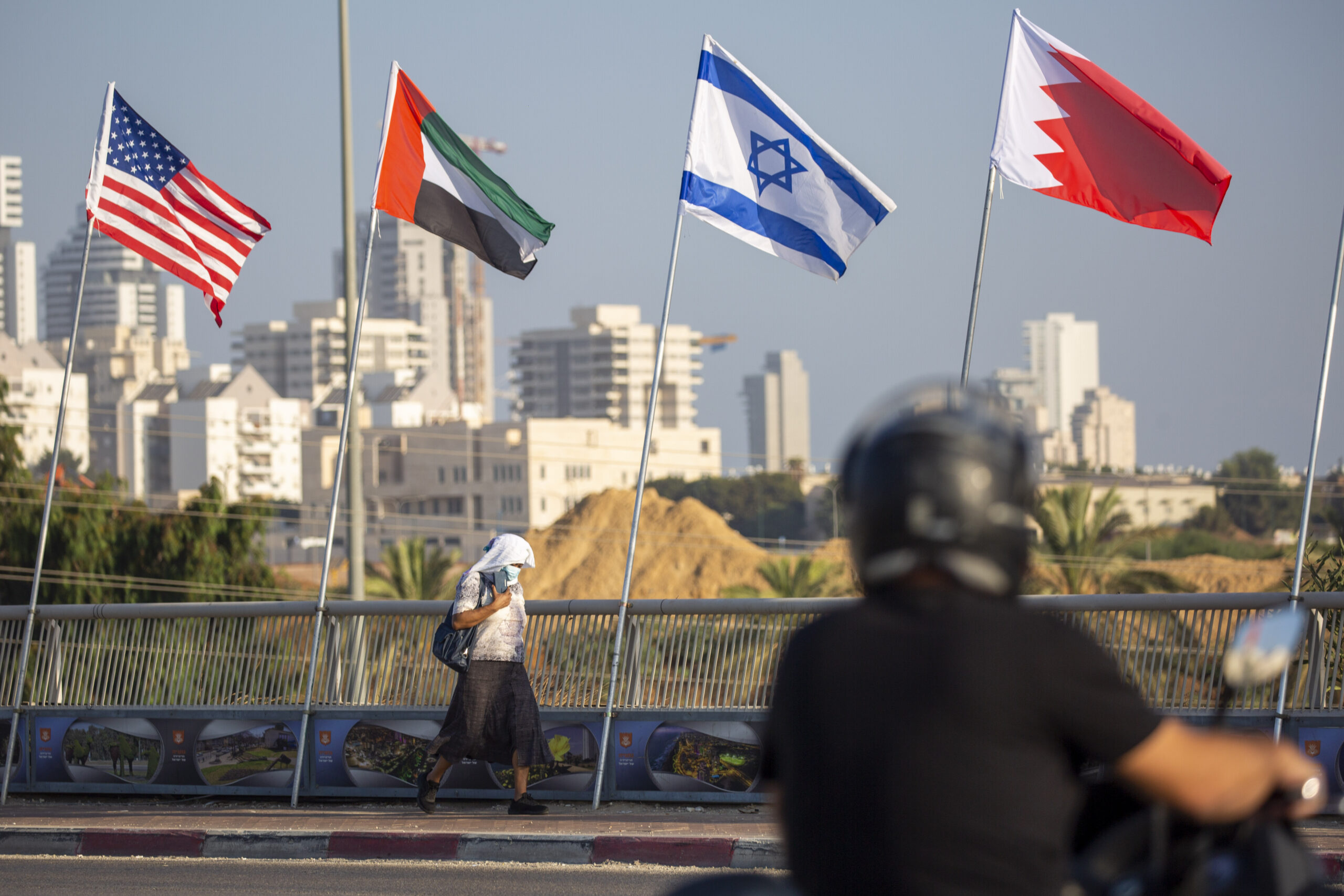
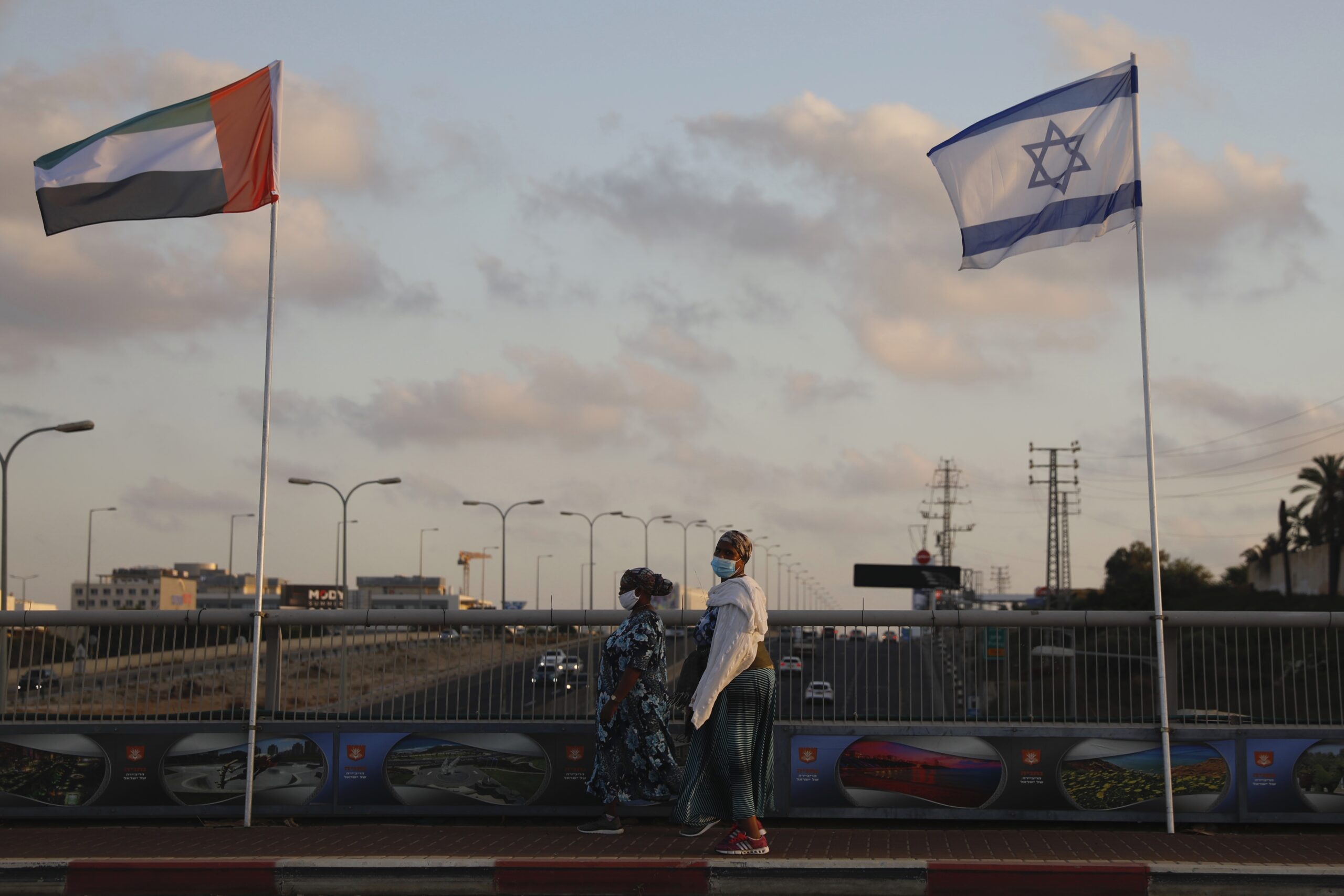
A woman wearing a face mask walks past flags for the United States, the United Arab Emirates, Israel, and Bahrain in Netanya, Israel, Sept. 14. (AP Photo/Ariel Schalit)
A White House Declaration of Peace signing ceremony on September 15 will not only include the official proclamation of a normalization process between Israel and the United Arab Emirates, but now Bahrain has announced that it, too, will make such a commitment at the event. This is another significant win for the administration of President Donald J. Trump and adds substantially to the diplomatic breakthrough Israel is achieving with Gulf Arab countries.
The Bahraini decision to follow the UAE’s lead is another blow to the Palestinians’ hopes of using Arab recognition of Israel as leverage in their efforts to end the occupation that began in 1967. And it’s yet another indication that the Arab Peace Initiative – initiated by Saudi Arabia in 2002 and unanimously endorsed by the Arab League and Organization of Islamic Cooperation – is effectively defunct.
The Arab Peace Initiative was intended to initiate a process that would end the Israeli occupation, with normalization following the conclusion of that process. In recent years, many Gulf Arab countries reconceptualized that timeline, opening the door for mutually reciprocal steps in both directions, positing that if Israel took measures to ease or pull back from the occupation that could be met by Arab diplomatic overtures short of full recognition. Though the UAE and Bahrain insist they continue to support the Arab Peace Initiative, by committing to normalize relations with Israel they are effectively finalizing the reversal of the initiative’s trajectory: Normalization will come first, eventually followed by steps to end the occupation. That is, at least, how they explain their position, emphasizing that they have preserved the viability of a two-state outcome, and therefore also the Arab Peace Initiative, by getting the United States to commit to not backing any new Israeli annexations through at least 2024.
But why did Bahrain take this step so quickly on the heels of the UAE? There are several other Arab countries that are open to normalization with Israel, including Oman, Sudan, Morocco, and Qatar, if Doha’s boycott-induced dependence on Turkey and Iran were to ease. In going first, the UAE took the really bold step, leaping effectively into the unknown. However, the days following the UAE’s announcement demonstrated that the diplomatic and political price for smaller Gulf Arab states in taking this step would be limited.
Almost no Arab countries have strongly denounced the UAE’s move. Even Palestinian President Mahmoud Abbas ordered his officials to stop criticizing the UAE after many of them got it off their chests and since these condemnations have not been echoed by other Arab leaders. There has also been no measurable political blowback for the UAE. The Emiratis demonstrated that the costs, in the immediate term at least, for committing to an opening with Israel are minor.
In addition, Saudi Arabia almost certainly did not raise strong objections to such a move, given the degree to which Manama tends to defer to Riyadh on matters of defense and foreign policy. That could indicate a degree of openness for Saudi Arabia to take such steps in the future if conditions are right, although Riyadh’s calculations will be much more complex than those of its smaller neighbors. It also reflects a growing closeness between Bahrain and the UAE and the push by both to diversify their strategic options in the context of deepening doubts about U.S. commitment and reliability as a guarantor of national security and regional stability.
As for motivations for normalizing relations with Israel, the UAE is the proverbial fox, with many agenda items, while Bahrain is the hedgehog, focusing primarily on one thing. The UAE is interested in: countering Iran and Turkey, outreach to the United States (including the Trump administration and mainstream Democrats), accessing advanced U.S. weapon systems, forging a partnership with Israel on high tech and cybertechnology and commerce, and a number of other factors. However, Bahrain is almost entirely driven by the threat posed by Iran, which has multiple times insisted that Bahrain is part of its sovereign territory.
In addition, while Bahrain has a Sunni ruling family and political elite, it also has a restive and politically marginalized Shia majority. Extreme elements within the Bahraini Shia population have proved more receptive to Iranian overtures than Shia communities in Kuwait or Saudi Arabia, and there is considerable evidence that Iran has been attempting to exacerbate unrest in the country and encourage anti-government violence and even terrorism.
So, while all Gulf Arab countries, to varying degrees, regard Iran as a threat, for Bahrain the existential anxiety posed by Tehran is uniquely acute. Israel is Iran’s most potent regional adversary and is responsible for most of the low intensity countermeasures against pro-Iranian militia groups in the form of repeated airstrikes in Syria and, increasingly, Iraq. Bahrain sees itself as Iran’s most vulnerable target and Israel as Tehran’s most significant foe. Therefore, while the UAE seeks a range of specific benefits, such as the ability to purchase U.S. F-35 fighter jets, for Bahrain the prospect of closer relations to Israel is more straightforward. The other major benefit is simply strengthening ties to Washington, but these are already very strong as Bahrain hosts the U.S. 5th Fleet, which is largely dedicated to Gulf security, and has the valuable distinction of having been formally identified as a major non-NATO ally. While Bahrain may hope for more sophisticated weapons from Washington, and new commercial or tourism opportunities from Israel, these are secondary considerations. For Bahrain, closer ties to Israel are almost an end in themselves given Manama’s laser-like focus on the threat from Iran.
Yet Bahrain may, in some ways, be taking more risks than the UAE. While the UAE demonstrated that regional blowback to an opening with Israel is extremely limited, Bahrain may encounter some negative domestic political reactions. Although Bahrainis have, for years, seen their government increasingly interact with Israeli officials, there is always a risk that formal recognition could be the impetus for unrest in some Shia communities. Insofar as Iran views this as an anti-Iranian entente, and is able to convince its supporters in Bahrain of that, it could become a key grievance driving another round of anti-government protests. As Arab Gulf States Institute in Washington Senior Resident Scholar Kristin Smith Diwan explains, “Opposition to normalization appears to be widespread across Bahraini society and was expressed in a statement signed by 17 political and civil society groups representing both Sunni and Shia Islamists, leftists and nationalists, and professional and labor organizations.”
If Bahrain can contain such potentially destabilizing domestic political consequences, as well as the regional diplomatic consequences, its moves to normalize relations with Israel could encourage others, especially Oman and Sudan, to follow suit. Israel and the United States have a powerful incentive to make this process go well for both Gulf Arab countries. The other Arab candidates for potential diplomatic overtures to Israel will be closely watching the process and its consequences.
The views represented herein are the author's or speaker's own and do not necessarily reflect the views of AGSI, its staff, or its board of directors.
Palestinians are fuming, but the United States, the United Arab Emirates, and Israel all see clear benefits in the normalization of relations between a key Arab state and Israel.
President Trump has led the United States into an impossible dilemma in which resuming and intensifying the war presents one set of alarming consequences while ending it under current circumstances offers at least as many disasters for Washington.
The Trump administration has positioned the United States at a crossroads between a new regime of containment against Iran or a historic drawdown of U.S. influence in the Gulf and broader Middle East.
Riyadh and Abu Dhabi urged President Trump not to attack Iran, but now that the war is into its second month, leaving the current situation in place would be an unthinkable fiasco for them.
Though they were unsuccessful in preventing the current conflict, and, as expected, have been dragged into the U.S.-Israeli confrontation with Iran, Gulf Arab countries remain crucial to hopes for limiting the war and bringing it to a quick resolution.