Jul 31, 2026
Data Confirms a Large Economic Contraction in Saudi Arabia in the Second Quarter
The Saudi economy contracted sharply in the second quarter of 2026. Any recovery will be slowed by the recent renewal of hostilities in the region.

The General Authority for Statistics has published the “flash” (or preliminary) estimates for economic growth in Saudi Arabia in the second quarter of 2026. Real gross domestic product contracted by 4.9% relative to the first quarter of the year. This was largely due to the oil sector, with real oil GDP falling by 21.5% as oil production was severely affected by the closure of the Strait of Hormuz. Real non-oil GDP also contracted, declining by 0.4% relative to the first quarter. This decline had been foreshadowed by the weakening of business confidence in the Riyadh Bank purchasing managers’ index since February. In terms of year-over-year growth, real GDP contracted by 4.8% in the second quarter of 2026 relative to the second quarter of 2025, real oil GDP contracted by 24.7%, and real non-oil GDP grew by 1.7%.
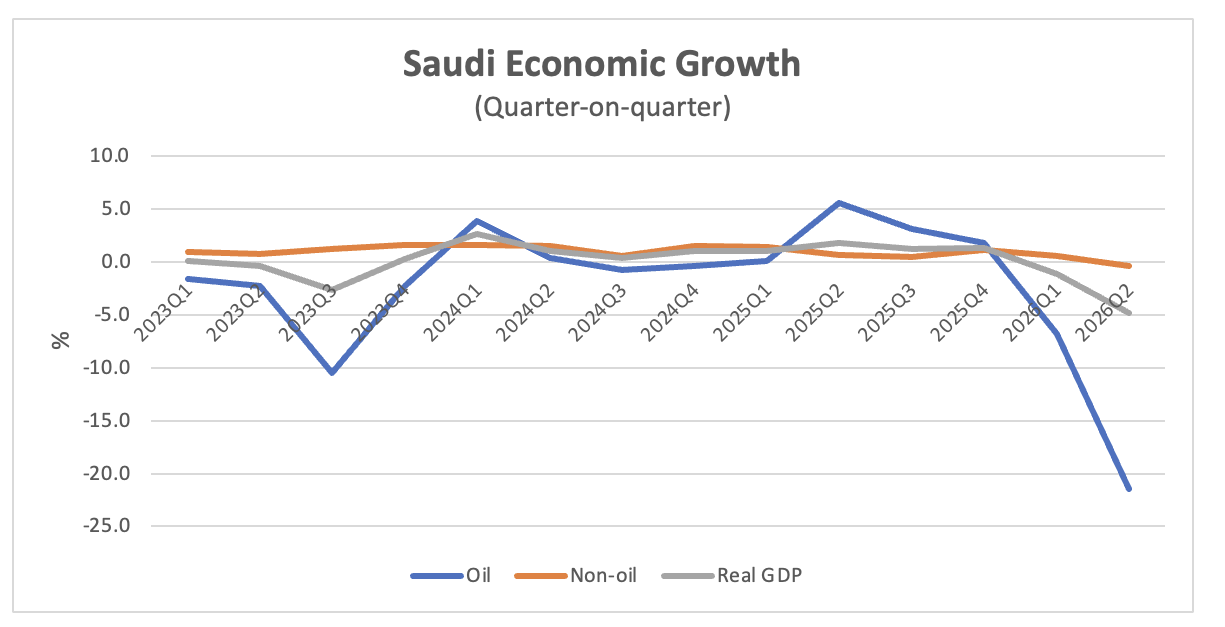
Sources: General Authority for Statistics; author calculations
Economic Rebound Delayed?
The second quarter data was not a surprise given the decline in oil production and the negative impact of the regional conflict on business confidence. A strong third quarter rebound, however, had seemed in the cards until recently. Now that hostilities have restarted, this is unlikely. The sharp contraction of the second quarter will not be repeated, but the third quarter may only see tepid growth at best. The threat to shipping is now not just in the Strait of Hormuz but also in the Red Sea with the Houthis threatening attacks on Saudi vessels. While risks to shipping remain elevated, oil exports and production will be constrained. On the non-oil side, business confidence is likely to have risen in July (the survey concluded before the resumption of hostilities) but could fall again from August, particularly if attacks on the kingdom by the Houthis and other armed groups increase.
The second quarter data and the weaker outlook for the third quarter mean that the Saudi economy is heading for a sizeable contraction in 2026. The eventual outcome will depend on the length and breadth of regional hostilities and the amount of money the government is prepared to spend to support the economy. A contraction in real GDP of 1% seems a reasonable forecast at this stage.
The views represented herein are the author's or speaker's own and do not necessarily reflect the views of AGSI, its staff, or its board of directors.
Related
Saudi Economic Spotlight
May 6, 2026
Spending Surge Puts Saudi Budget in Large First Quarter Deficit
The Saudi budget recorded a large deficit in the first quarter of 2026 as spending surged, but higher oil revenue during the rest of the year should limit the size of the annual fiscal deficit.
Saudi Economic Spotlight
May 5, 2026
Gulf PMIs Raise Specter of Stagflation
Business conditions in the Gulf generally improved in April, but they remained weaker than before the Iran war. There are signs that price pressures are increasing as the conflict impedes trade.
The Iran War and the Saudi Economy
Data shows that the Saudi economy is being negatively affected by the U.S.-Israeli war on Iran, and the impact will likely continue for the next few months at least.
May 6, 2026
Spending Surge Puts Saudi Budget in Large First Quarter Deficit
The Saudi budget recorded a large deficit in the first quarter of 2026 as spending surged, but higher oil revenue during the rest of the year should limit the size of the annual fiscal deficit.
May 5, 2026
Gulf PMIs Raise Specter of Stagflation
Business conditions in the Gulf generally improved in April, but they remained weaker than before the Iran war. There are signs that price pressures are increasing as the conflict impedes trade.
The Iran War and the Saudi Economy
Data shows that the Saudi economy is being negatively affected by the U.S.-Israeli war on Iran, and the impact will likely continue for the next few months at least.
Analysis
The Trump Presidency, Iran War, and U.S.-Gulf Economic Relationship
The outbreak of the Iran war has halted the deepening of the economic relationship between the United States and the Gulf countries. While likely temporary, it could take some time before the upward trajectory is restored.
Have Saudi Labor Market Reforms Run Their Course?
Recent data suggests that the positive impact of a decade of reforms to improve Saudi labor market outcomes may now be waning.

Saudi Arabia Weathers the Iran War Thanks to Investments in “Economic Resiliency”
The impact of the Iran war on the Saudi economy has been mitigated by investments in “economic resiliency,” including the East-West oil pipeline, relatively prudent fiscal policy, and the accumulation of a large stock of foreign financial assets.
Saudi Economic Outlook Positive If U.S.-Iran Deal Holds
If the memorandum of understanding between the United States and Iran holds, the Saudi economy will grow strongly in the second half of 2026 and into 2027.
Events
Mar 11, 2026
Shockwaves From Iran: Implications for Energy Markets and the Global Economy
On March 11, AGSI hosted a discussion on global energy and economic market volatility.

Speakers




Jan 8, 2026
Outlook 2026: Prospects and Priorities for U.S.-Gulf Relations in the Year Ahead
On January 8, AGSI hosted a virtual roundtable with its leadership and scholars as they look ahead and assess trends likely to shape the Gulf region and U.S. foreign policy during the coming year.
Speakers





Dec 15, 2025
Looking to 2026: Economic Prospects and Policy Challenges in the GCC
On December 15, AGSI hosted a discussion on the future of Gulf economies.

Speakers


Sep 4, 2025
Saudi Arabia: Sustaining Strong Growth Amid Global Economic Uncertainty
On September 4, AGSI hosted a discussion on the International Monetary Fund’s 2025 Article IV report on Saudi Arabia.
Speakers