Saudi Economic Outlook Positive If U.S.-Iran Deal Holds
If the memorandum of understanding between the United States and Iran holds, the Saudi economy will grow strongly in the second half of 2026 and into 2027.
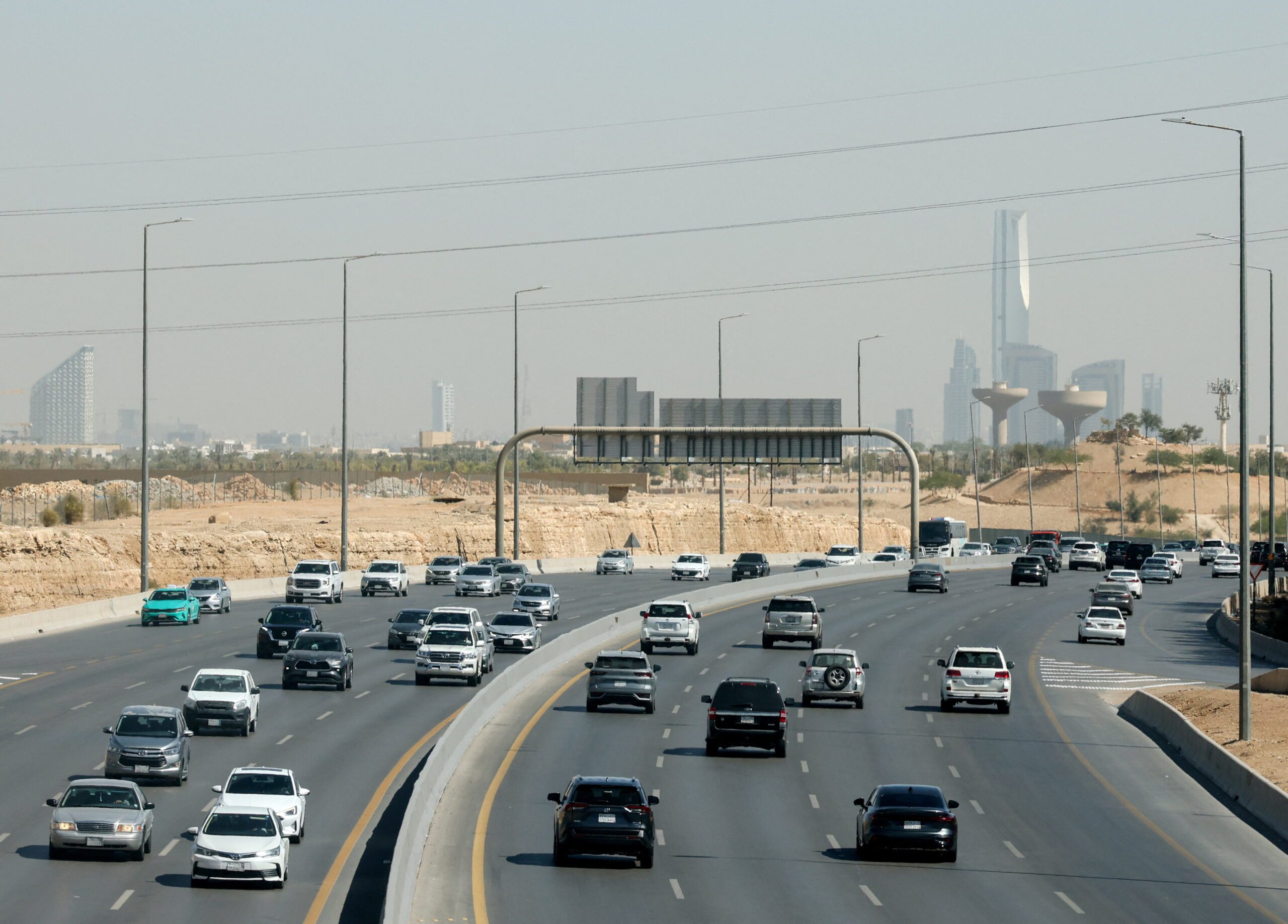
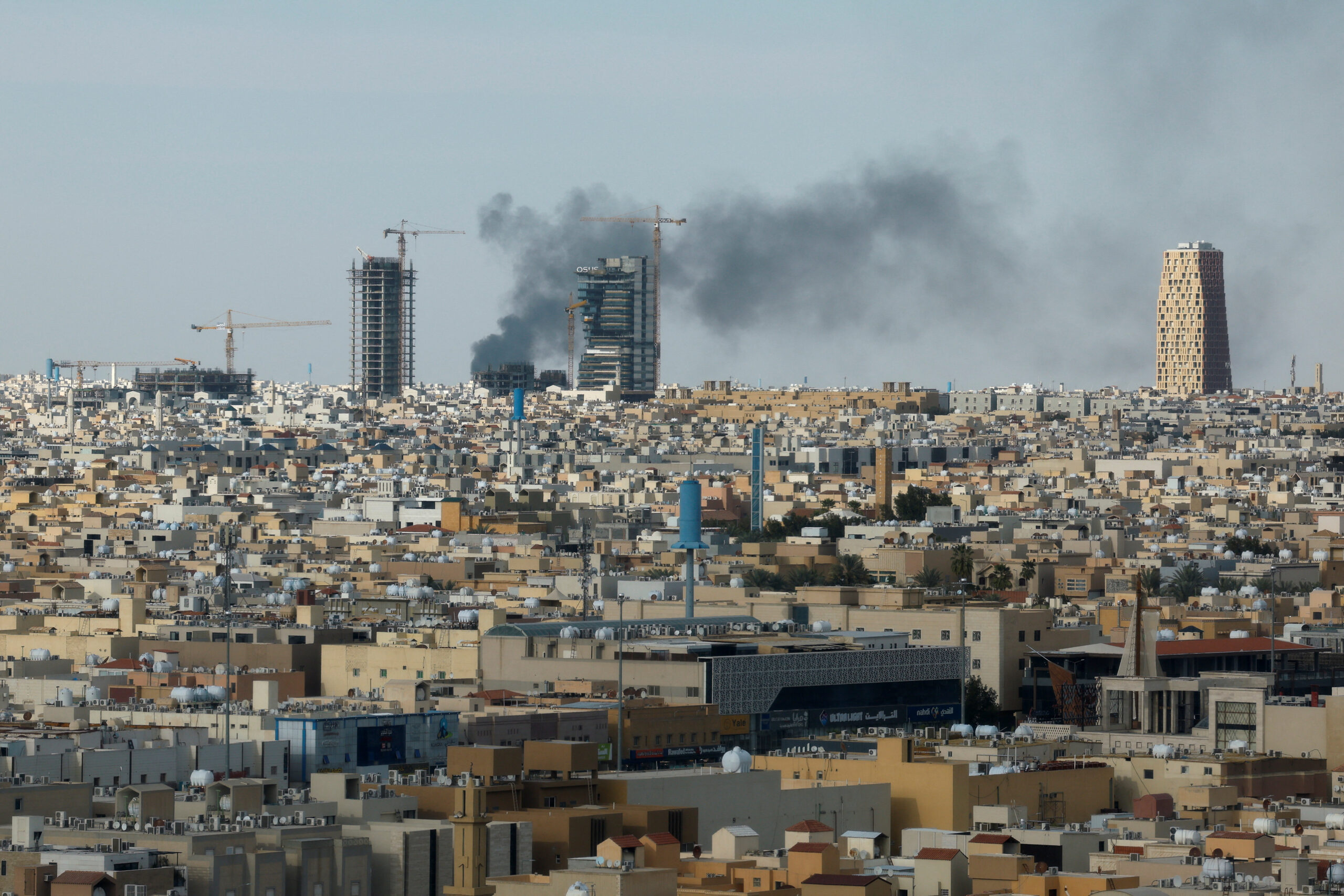
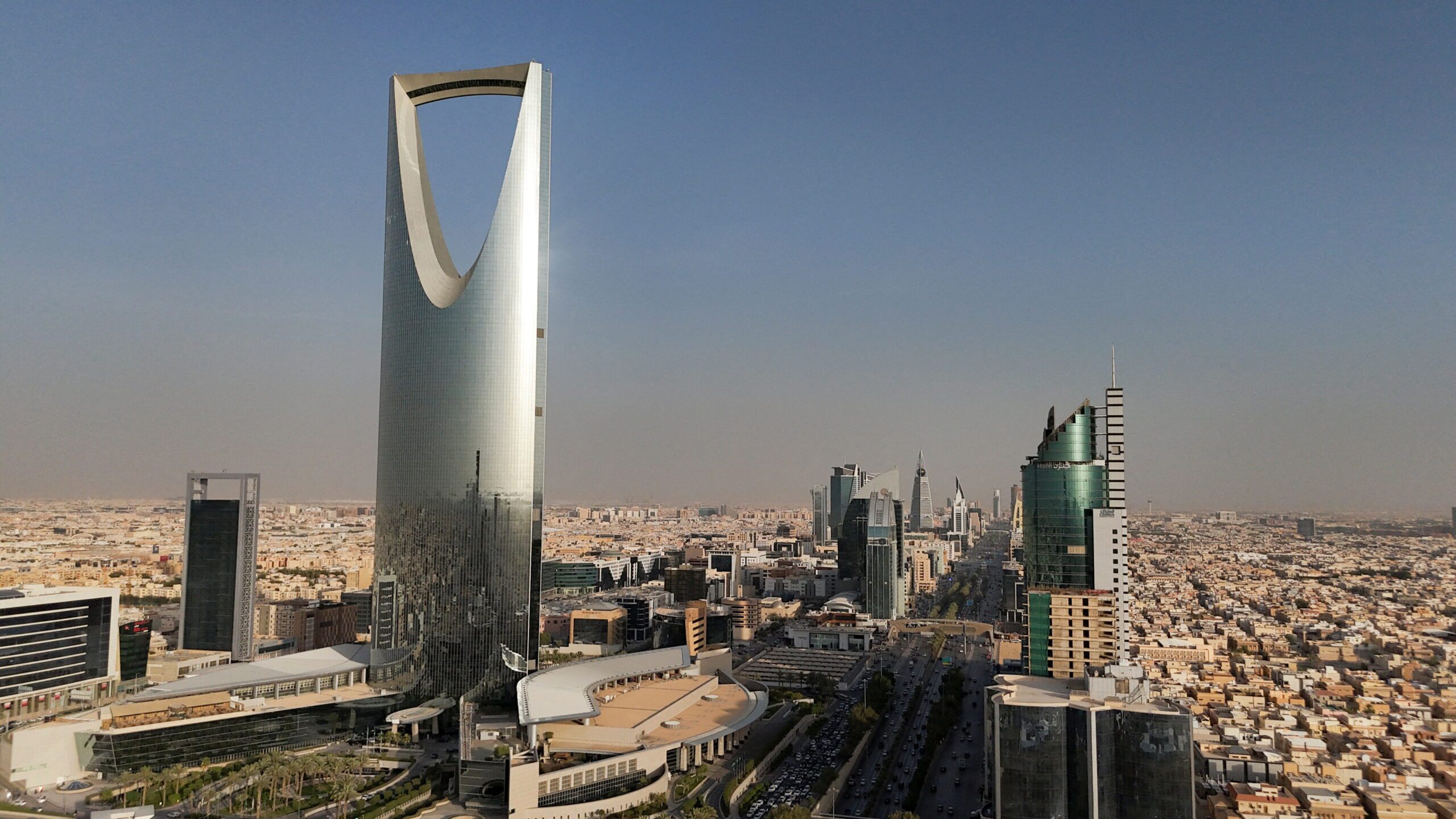
Traffic moves on a road in Riyadh, Saudi Arabia, February 9. (REUTERS/Isabel Infantes)
The Saudi economy has been negatively affected by the U.S. and Israeli conflict with Iran, although to a lesser degree than some of its neighbors. The negative growth impact has mainly come through the loss of oil exports through the Strait of Hormuz, which have only partially been offset by increased flows through Saudi Arabia’s East-West pipeline. A drop in business confidence has also curtailed private sector investment. If the recently agreed memorandum of understanding between the United States and Iran holds, this will be good news for the Saudi growth outlook.
Hit by War
The Saudi statistical authority has recently published revised and more detailed economic growth data for the first quarter of 2026 building on the previously published “flash” estimate. The new data has more information on the sector and expenditure components of gross domestic product than the “flash” estimates and therefore provides a fuller analysis of how the Saudi economy has been affected by the U.S.-Israeli war with Iran.
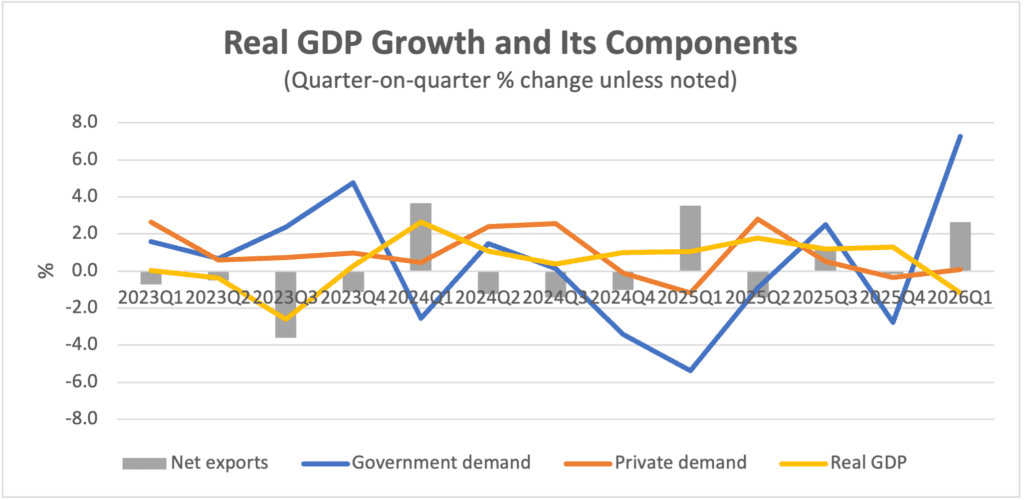
The Saudi economy contracted in the first quarter of 2026 relative to the fourth quarter of 2025. The decline in real (i.e., after accounting for inflation) GDP, however, was slightly smaller than estimated in the “flash” data (-1.2% compared to -1.5% previously).
Sources: General Authority for Statistics; author calculations Note: Net exports shown as the contribution to growth
Government spending and changing patterns of trade worked to support the economy in the first quarter of 2026 and help offset weakness in private sector demand.
Government demand (comprising both spending on consumption and investment) grew by 7% (quarter on quarter), the strongest growth since the second quarter of 2022. This is consistent with the first quarter budget data published by the Ministry of Finance that showed a large increase in government spending on goods and services and capital projects.
External demand (what the economy receives from the rest of the world for its exports of goods and services minus what it pays for its imports of goods and services) contributed positively to growth. This may sound counterintuitive given the decline in oil exports following the closure of the Strait of Hormuz but reflects the fact that imports actually contracted by more than exports (12.2% compared to 2.1%) leading to a positive contribution to real GDP growth from net trade.
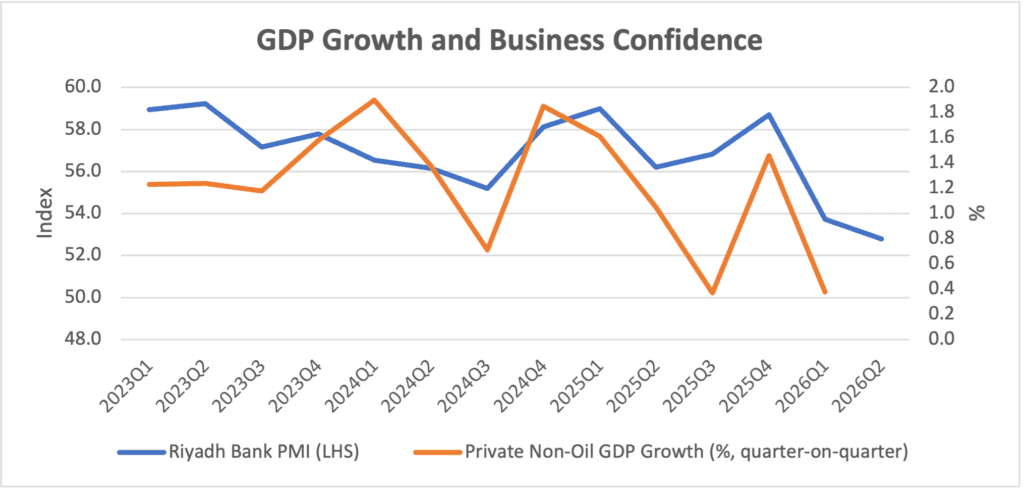
Private demand was broadly flat in the first quarter, as a small decline in investment spending (consistent with the decline in business confidence in the Riyadh Bank purchasing managers’ index) was offset by a modest increase in consumption spending.
Inventories made a significant negative contribution to growth in the first quarter. Unfortunately, detailed data is not available to understand if this was due to a drawdown of oil inventories or the drawdown of non-oil inventories to compensate for the decline in imports.
The construction, real estate, and retail and wholesale trade sectors all contracted in the first quarter.
Second Half Rebound
The Saudi economy will contract sharply in the second quarter of 2026, largely because of a 25% to 30% decline in oil output relative to the first quarter. Non-oil GDP may also contract modestly given the drop in business confidence, although this will depend on whether government spending has remained at an elevated level in recent months. The bottom line is that the Saudi economy will have contracted in the first half of 2026 due to the fallout from the war.
Sources: Riyadh Bank, General Authority for Statistics; author calculations
A strong rebound, however, can be expected in the second half of the year as long as the memorandum of understanding between the United States and Iran holds. Oil production should start normalizing as the Strait of Hormuz reopens. Saudi Aramco says that it can ramp up production in a matter of days, so the main constraint will be how long it takes shipping to normalize. Assuming a gradual return to output of 10 million barrels per day in the fourth quarter of the year, oil production in the second half of 2026 would be about 20% higher than in the first half. The extended cease-fire will also support a continued recovery in business confidence, investment, and employment leading to stronger growth in the non-oil economy in the second half of the year even if government spending slows.
For 2026 as a whole, the Saudi economy is likely to contract by 0.5% to 1%. This is based on a projected decline in real oil GDP of between 7.5% and 8% and growth in real non-oil GDP of between 2.5% and 3%. The second half rebound will position the economy for a strong 2027. It is not unreasonable to expect growth in the 7% to 8% range next year if oil production is fully restored. Of course, this positive outlook assumes that there is no renewal of U.S. and Israeli hostilities with Iran, that shipping through the Strait of Hormuz returns to prewar levels, and that the agreement ensures the future security of Saudi Arabia. If these conditions are not met, the outlook will not be as rosy.
The views represented herein are the author's or speaker's own and do not necessarily reflect the views of AGSI, its staff, or its board of directors.
The outbreak of the Iran war has halted the deepening of the economic relationship between the United States and the Gulf countries. While likely temporary, it could take some time before the upward trajectory is restored.
The impact of the Iran war on the Saudi economy has been mitigated by investments in “economic resiliency,” including the East-West oil pipeline, relatively prudent fiscal policy, and the accumulation of a large stock of foreign financial assets.
On January 8, AGSI hosted a virtual roundtable with its leadership and scholars as they look ahead and assess trends likely to shape the Gulf region and U.S. foreign policy during the coming year.