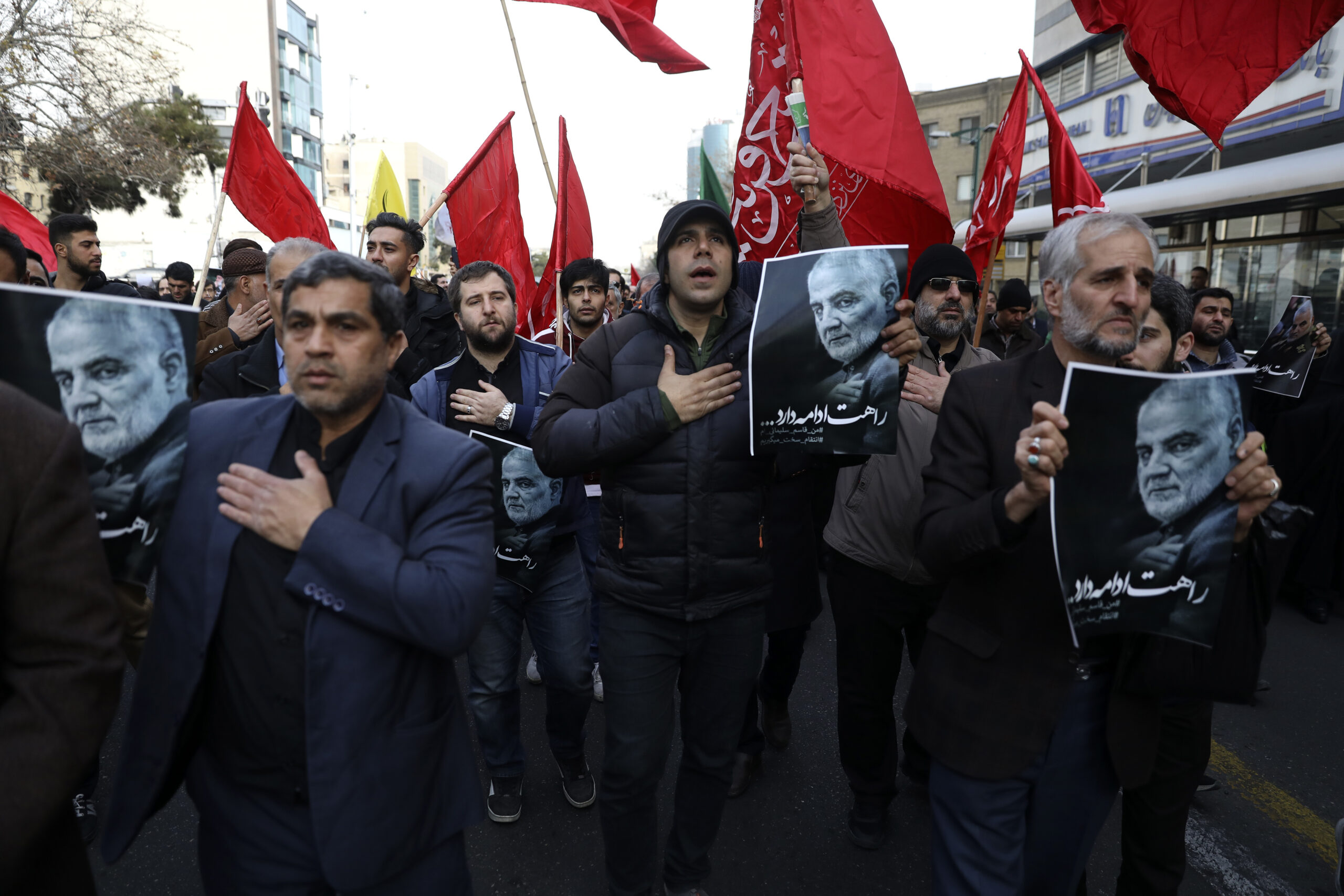
In Tehran, Iran on Jan. 3, protesters mourn during a demonstration over the U.S. airstrike in Iraq that killed the Islamic Revolutionary Guard Corps Quds Force commander, Major General Qassim Suleimani, shown in the posters. (AP Photo/Vahid Salemi)
Gulf Arab countries face an extraordinary and unexpected set of challenges and, potentially, opportunities in the wake of the January 3 U.S. drone strike that killed Iran’s key regional military commander and one of its most important Iraqi allies. As is usually the case with major regional developments, opinion is divided among the Gulf Arab states. But they are bracing for the next moves by the United States and, especially, Iran. Tehran’s regional adversaries, Saudi Arabia and the United Arab Emirates, will be torn between the potential opportunities created by the demise of a long-standing and successful opponent on the one hand and the prospect of Iranian retaliation directed against them on the other. Other Gulf countries, particularly Oman but also Kuwait and Qatar, will see even more danger in a potential regional conflagration, but also could find a diplomatic opportunity to play a mediating or message-transmitting role if the parties wisely choose the path of de-escalation.
What happens next is by no means certain. Iranian leaders have vowed revenge and a decisive response to the loss of Major General Qassim Suleimani, the head of the Islamic Revolutionary Guard Corps’ Quds Force, the expeditionary wing of Iran’s armed forces and its ideological vanguard in the region. He was, arguably, the most experienced, effective, and significant military figure in the history of the Islamic Republic and the key architect of Iran’s post-2003 hegemonic expansion into Iraq and Syria. In addition, the Iranian regime lost Abu Mahdi al-Muhandis, a major and long-standing Iraqi sectarian Shia ally, head of the Kataib Hezbollah militia that has been in a deadly confrontation with Americans in Iraq. So, the pressure on the regime to take revenge will be strong.
Iran will also feel pressed to try to restore the deterrence that has heretofore mitigated the U.S. response to its increasingly intensified provocations during the past year. After a devastating and humiliating loss of this kind, the imperative to demonstrate power and initiative is inevitably compelling. However, Iran has every reason to pause to carefully consider its response, and might even explore the potential for de-escalation, especially if Washington seriously pursues that path.
After initially seeking to wait out the “maximum pressure” sanctions campaign the administration of President Donald J. Trump launched following Washington’s withdrawal from the Joint Comprehensive Plan of Action nuclear agreement, by May 2019 Tehran decided to pursue a strategy of strategic recklessness. The “maximum resistance” campaign – which included attacks on international shipping, the downing of a U.S. military drone, and a stunning attack on Saudi Aramco oil installations – was plainly designed to create an atmosphere of crisis that would compel the international community to intervene diplomatically to ease such attacks and the sanctions strangling the Iranian economy. By carefully intensifying these highly calibrated, and often deniable, attacks, Iran apparently sought to provoke the United States into a disproportionate response that would prompt international diplomatic intervention.
That did not happen. Trump even called off retaliatory strikes after the drone was shot down and instead called for negotiations with Iran. But Trump and his senior officials repeatedly articulated a “red line” that would ensure a U.S. military response: any American casualties at Iran’s hands.
When the attack on the Saudi oil facilities failed to produce the crisis Tehran has been seeking, Iran’s proxy militias in Iraq, especially Kataib Hezbollah, began a series of rocket attacks at the rate of almost once a week beginning on October 28, 2019. The red line was finally crossed on December 27, with the killing of a U.S. contractor and the wounding of several U.S. military personnel, although Kataib Hezbollah is believed responsible rather than Iran itself. The Trump administration responded militarily, but in effect maintained the fiction that Kataib Hezbollah would have acted independently from Iran by attacking the group’s headquarters in the Iraqi city of Qaim and other targets on December 29, killing at least 24 militia members. The U.S. Embassy compound and the Green Zone in Baghdad were then violently besieged and badly damaged by Kataib Hezbollah members on December 31. The incident finally ended, apparently without loss of life. But the attack on the embassy and, the U.S. government claims, plans by Kataib Hezbollah and other Suleimani-directed groups to further attack U.S. targets in Iraq appear to have directly prompted the January 3 drone strike.
In short, what since May 2019 has been a basically one-sided campaign of largely low-intensity and indirect provocations suddenly and dramatically became mutual when Suleimani’s Kataib Hezbollah operatives crossed Trump’s red line on American casualties. The logic of low intensity war and tit-for-tat provocations would dictate a significant Iranian retaliation next, whether directly or by proxy, against U.S. or U.S.-related interests. However, for the first time since May, by attacking Kataib Hezbollah and killing Suleimani and Muhandis, Washington has significantly altered the calculus for Iran by substantially retaliating and, therefore, reintroducing meaningful deterrence. Secretary of State Mike Pompeo has gone out of his way to call for de-escalation, as has most of the international community. The rational Iranian evaluation of the situation should lead the regime to seriously consider this option, despite anger and the desire to re-establish its own deterrent to U.S. attacks.
Even if Tehran has already decided to retaliate, how, where, and when it does so will help to determine the U.S. response and therefore the impact of Iran’s next move. Tehran has many options and many surrogates around the region and the world. But it is now on notice that responses can and may well be harsh. Therefore, the Iranian regime must also carefully consider the possibility that additional escalation could lead Tehran into a devastating conflict with a far more powerful enemy. Washington, too, has nothing to gain from further escalation or additional confrontations. Neither do the Gulf Arab countries, which face the prospect of being caught in the crossfire, as Saudi Arabia has already discovered.
Therefore, the potential exists for subtle de-escalation, even if underneath a veneer of angry rhetoric, threats, and even symbolic, but practically minor, retaliatory acts. Iran’s logic in seeking to create and exploit a crisis through gradually intensifying provocations has been evident since May. But since Washington has now called Tehran’s bluff and seriously raised the prospect of an eventual conflict if mutual provocations persist and, especially, intensify, Iran will have to reconsider its strategic choices very carefully.
Close U.S. allies in the confrontation with Iran such as Saudi Arabia and the UAE can help by encouraging Washington to make it clear to Tehran that the offer of de-escalation is serious and meaningful. Gulf countries such as Oman and Kuwait are potentially well positioned to pass messages between Washington and Tehran and even, potentially, serve as mediators. Despite angry rhetoric and heated passions, quiet de-escalation based on a mutual understanding that intensification of the confrontation is in nobody’s interest should be not only desirable but achievable.
The views represented herein are the author's or speaker's own and do not necessarily reflect the views of AGSI, its staff, or its board of directors.
Iran's supreme leader demanded the establishment of a "war room" to safeguard the regime against economic pressure from the United States. This left politicians and bureaucracies engaged in a blame game as the Islamic Republic faced mass protest.
Policies that prevent Saudi Arabia from pursuing diplomatic normalization and are fueling alienation in large parts of the West seem to reflect a Jewish consensus in Israel.
President Trump has led the United States into an impossible dilemma in which resuming and intensifying the war presents one set of alarming consequences while ending it under current circumstances offers at least as many disasters for Washington.
The Trump administration has positioned the United States at a crossroads between a new regime of containment against Iran or a historic drawdown of U.S. influence in the Gulf and broader Middle East.
Riyadh and Abu Dhabi urged President Trump not to attack Iran, but now that the war is into its second month, leaving the current situation in place would be an unthinkable fiasco for them.