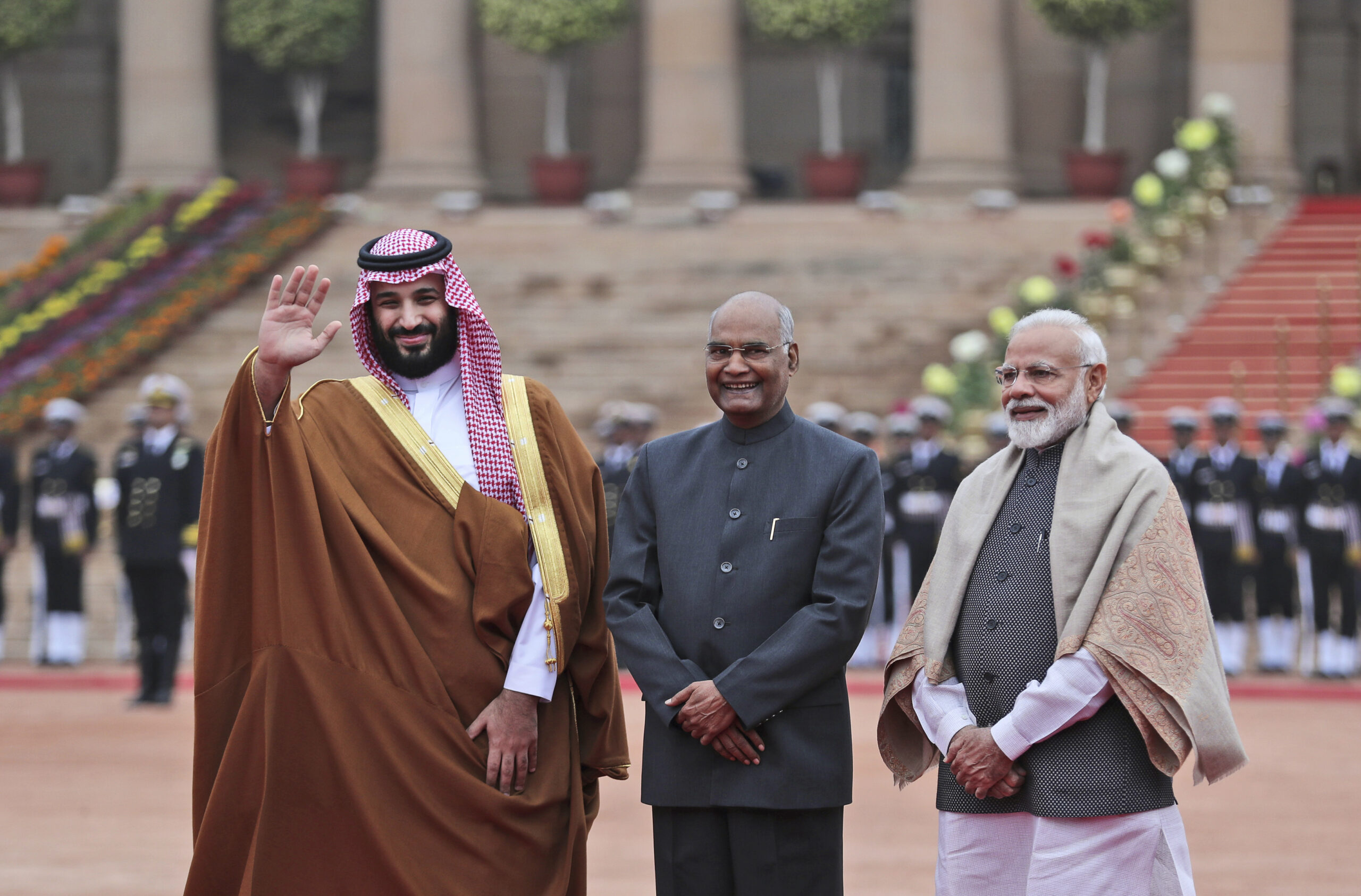
Saudi Arabia's Crown Prince Mohammed bin Salman, waves to the media, with Indian Prime Minister Narendra Modi, right, and Indian President Ram Nath Kovind standing beside him during a ceremonial welcome in New Delhi, India, Feb. 20. (AP Photo/Manish Swarup)
Executive Summary
The ties between the Gulf Arab countries and South Asia reflect evolving, dynamic relationships building on deep historical roots. Although the foundations of long-established interregional engagement remain intact, the economic, political, and security-related connections are undergoing a transformation in nature and depth. Examining the direction and rate of this change is key to understanding Gulf Arab states’ foreign policy choices relating to South Asia and the approaches of South Asian powers to the Gulf.
The most visible aspects of this transformation involve the economic parameters of interregional engagement. South Asians have long played an integral role in Gulf Arab labor markets, but strict workforce nationalization policies in Gulf countries are squeezing expatriate labor markets, thereby threatening remittance flows to South Asia. Gulf officials and businesspeople also view South Asia as offering opportunities to deepen energy cooperation beyond the exportation of crude oil to the region and into newer downstream capabilities.
Beyond the energy sector, India’s National Infrastructure Investment Fund and the China-Pakistan Economic Corridor have attracted significant attention from Gulf investors. In terms of trade, the United Arab Emirates and Saudi Arabia account for around 75 percent of the $103 billion in total trade volume between Gulf Arab countries and India, and these figures are expected to grow in the coming years. Fiscal support packages and other forms of economic aid from Gulf states will further interconnect the regions’ economies.
The strategic implications of interregional engagement between the Gulf and South Asia are becoming clearer and more pronounced. Gulf Arab states are taking note of India’s rise as an important global actor and its position as a key regional and naval power in the Indian Ocean area. Closer political and security engagement between the Gulf states and India, however, requires balancing relations with Pakistan. Gulf Arab states also recognize that both India and Pakistan maintain close relations with Iran, and Pakistani and Indian engagement with Gulf countries and Iran is not mutually exclusive.
Closer economic and strategic ties will involve growing pains. The fate of South Asian workers in the Gulf depends largely on the trajectory of labor market interventions, while economic actors involved in trade and investment between the regions must navigate emerging commercial regulations, red tape, and other challenging aspects of the business environment. At the same time, the strengthening of Gulf-India relations risks antagonizing Pakistan, and the operating space for smaller Gulf Arab and South Asian states may be overshadowed by the dominant interactions among Saudi Arabia, the UAE, India, and Pakistan.
The AGSIW Gulf Rising Series
This paper was developed as part of AGSIW’s Gulf Rising series analyzing the energized role of the Gulf Arab states in the international system. The series looks beyond Gulf Arab relations with the United States to examine ties with other key countries and regions. Additionally, it investigates motivations behind Gulf Arab states’ foreign policy choices and evaluates the implications for U.S. foreign policy toward the Gulf Arab states and the region.
AGSIW’s Gulf Rising series analyzes the energized role of the Gulf Arab states in the international system. The series looks beyond Gulf Arab relations with the United States to examine ties with other key countries and regions. Additionally, it investigates motivations behind Gulf Arab states’ foreign policy choices and evaluates the implications for U.S. foreign policy toward...
Three processes of interregional engagement – labor dynamics, energy cooperation, and strategic investments – are crucial for understanding how Gulf Arab states will exercise economic power in South Asia over the coming years.
Beijing keeps treading carefully around conflict in the Middle East while seeking opportunities to deepen ties with key country partners through a longer-term regional engagement strategy.
The UAE’s decision to halt trade and commercial ties with Iran reflects an exercise in applying carefully calibrated geoeconomic pressure amid an uncertain and evolving geopolitical context.