Unfulfilled 2014 Riyadh Agreement Defines Current GCC Rift
The past week has witnessed an unprecedented escalation of tensions among the Gulf Cooperation Council states, culminating with Saudi Arabia, the United Arab Emirates, and Bahrain severing ties with Qatar. AGSIW offers insights into the ongoing tensions and identifies the implications for Qatar and its GCC neighbors. Historical context is essential to understanding the escalating...
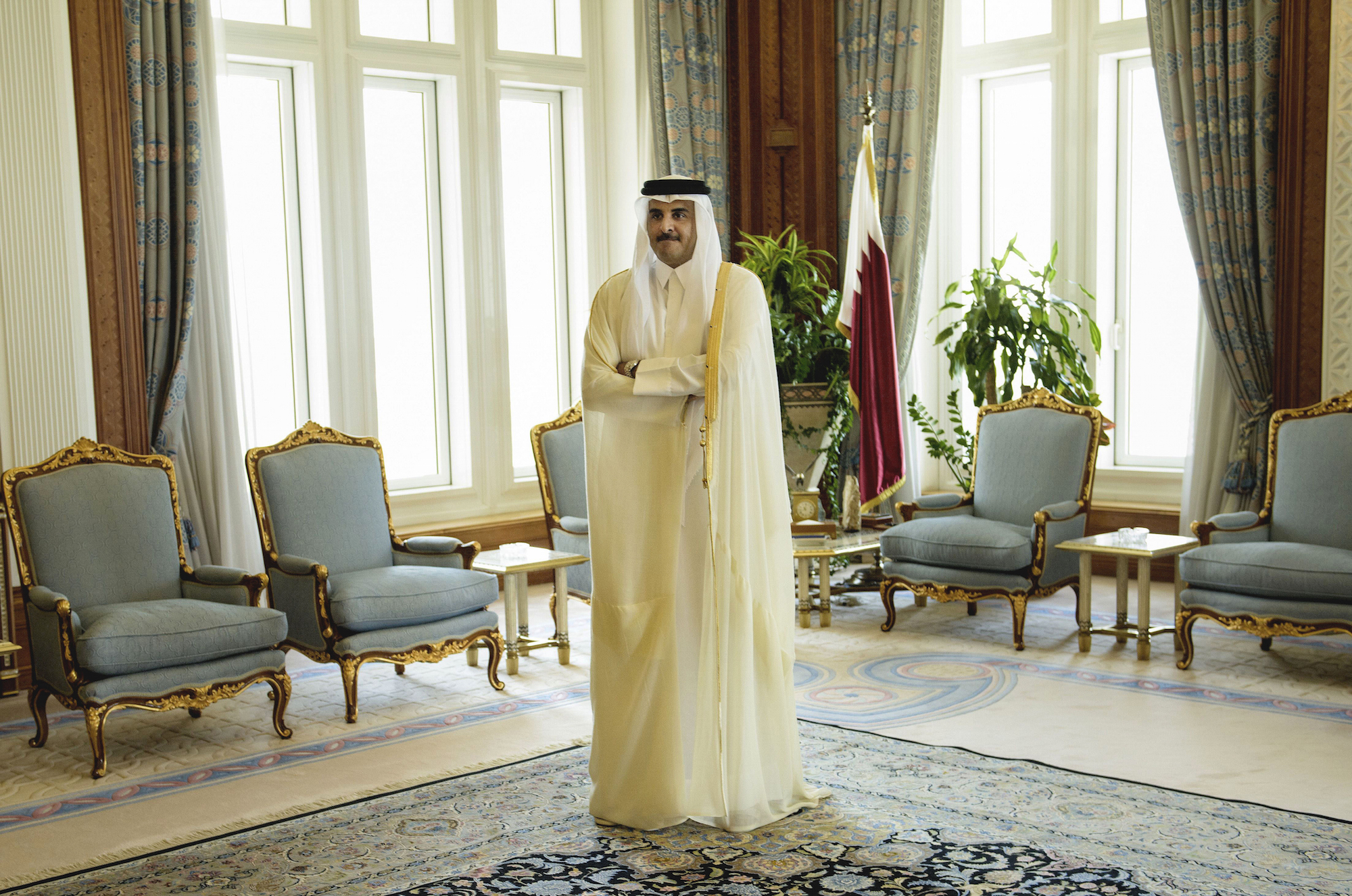
'Qatari Emir Tamim bin Hamad al-Thani waits for the arrival of then-U.S. Secretary of State John Kerry ahead of their meeting at Diwan Palace in Doha, Qatar, Aug. 3, 2015. (Brendan Smialowski via AP)'
The past week has witnessed an unprecedented escalation of tensions among the Gulf Cooperation Council states, culminating with Saudi Arabia, the United Arab Emirates, and Bahrain severing ties with Qatar. AGSIW offers insights into the ongoing tensions and identifies the implications for Qatar and its GCC neighbors.
Historical context is essential to understanding the escalating rift among the Gulf Cooperation Council states. Saudi Arabia, the United Arab Emirates, and Bahrain broke diplomatic relations with Qatar in 2014. Back then the dispute was resolved within weeks. This time, these three countries, now backed by Egypt, Yemen, and others, have not only broken relations with Doha, they have cut all trade and travel ties, instructed their citizens to return home, and ordered Qatari diplomats to leave within 48 hours and private citizens within 14 days, among other extraordinary gestures. The crisis this time is much deeper, in that it involves broader sanctions, and far wider, in that it draws in more countries. The dispute now rests on what Saudi Arabia and the UAE say are unfulfilled promises from 2014, and additional demands regarding Iran.
In March 2014, the three countries broke diplomatic relations with Qatar, accusing Doha of interfering with their internal affairs, promoting extremism through Al Jazeera and other Qatari media networks, and supporting the Muslim Brotherhood throughout the region. If the three GCC powers were outraged then, they are infuriated this time, in part because they believe that Qatar has not fulfilled the terms of the bargain by which they returned their ambassadors to Doha, and in part because they believe that the Qataris are flouting the principle of Gulf unity toward Iran at a time of growing danger.
In January 2014, the other Gulf Arab states tried to induce Qatar to sign a broad agreement about noninterference in each other’s affairs, cooperation on regional issues, and declining to support extremist groups. This was the proximate cause for the dramatic rift, though, as now, the underlying tensions had been brewing for years. In April, at a meeting in Saudi Arabia, the Qataris signed the Riyadh Agreement, a document that has never been made public. It is, apparently, similar or virtually the same as the document they had refused to sign a few months before.
There are conflicting accounts of what, precisely, is in the document. However, it is clear that Saudi Arabia, the UAE, and Bahrain took away a very different view of what Qatar had agreed to than the Qataris did. These countries expected Doha to curtail its support for Islamists, particularly Muslim Brotherhood figures, around the region. They believe that Qatar had agreed to muzzle, or greatly attenuate, support for Islamists on Al Jazeera and other Qatari media outlets, and particularly attenuate Muslim Brotherhood-oriented and other harsh criticism of Egypt’s government and President Abdel Fatah al-Sisi. They also expected Qatar to expel, or at least silence, a range of provocative Islamist and Arab nationalist voices that dominate its extensive and popular media platforms, including Muslim Brotherhood preacher Yusuf al-Qaradawi and the Palestinian Arab nationalist firebrand Azmi Bishara.
None of that happened. If anything, Bishara and his left-wing nationalistic agenda have received greater funding and attention in the interim, and Qaradawi and other prominent Islamists remain mainstays of Al Jazeera and other Qatari-backed media. Some Hamas members were encouraged to leave Doha recently, but the organization presented its “new charter” at a lavish ceremony in the Qatari capital, which still serves as a de facto headquarters for Hamas outside of Gaza. Whatever their GCC partners believe Doha had agreed to, the Qataris either came away with a completely different impression of the meaning and implications of the 2014 agreement, or they had no intention of fulfilling them to the satisfaction of their allies.
In addition to this ongoing ideological dispute is a highly bitter accusation that Qatar is sabotaging Gulf Arab efforts to contain, confront, and roll back Iran. Qatar has a strong incentive to maintain decent working relations with Iran. Its economy depends on the natural gas North Field site, which it shares with Iran. So it’s not hard to understand why Doha would want to avoid unnecessarily antagonizing Tehran.
Uncomfortable as this may sometimes be, the GCC is used to its diverse members maintaining individual and distinct policy orientations toward Iran. Even the UAE is not as categorical toward Iran as Bahrain and Saudi Arabia. Kuwait, and even more, Oman, maintain much closer relations to Tehran. Yet neither Kuwait nor Oman, as they strive to avoid becoming excessively entangled in disputes between Iran and some of their GCC allies, are not perceived as undermining their partners’ key national security concerns. For various reasons, including the pro-Islamist ideological orientation of its substantial media arsenal, Qatar is regarded as not simply maintaining is own policies but as disrupting the national security agendas of its allies. If the dispute continues to deteriorate, Kuwait and Oman may, eventually, be asked to choose sides. But for now, they are remaining distant from the controversy and continuing their own distinct policies toward Tehran.
It’s no coincidence that this effort to once again try to get Qatar to change its objectionable behavior comes in the context of the recent Riyadh summit with U.S. President Donald J. Trump. Trump emphasized unity in order to combat terrorism and extremism and confront Iranian regional hegemony. The Gulf countries that have broken relations with it are accusing Qatar precisely of promoting extremism, coddling terrorism, cozying up to Iran, and undermining unity on these issues. The rift between them is an escalation of disunity. But, from the point of view of Saudi Arabia and the UAE, what they are demanding of Doha amounts to an attempt to create real unity, or at least noninterference in these campaigns.
That there was already an effort in Washington to pressure Doha to amend its policies undoubtedly encouraged Saudi Arabia, the UAE, Bahrain, and the other countries. Adding to their mounting outrage was the payment, reported by the Financial Times, of up to $1 billion in ransom for 26 Qatari royal family members kidnapped in Iraq and 50 rebels captured in Syria. Reports suggest that $700 million of the funds went to Iran or pro-Iranian militias in Iraq, and the rest to Islamist groups in Syria, including an al-Qaeda affiliate. Reports of these payments could well have served as a last straw for Saudi Arabia, the UAE, and others. Sensing both an urgent need, and an opportunity, to try again, these countries began to demand last week that Doha fulfill its 2014 commitments – as they understood them – with regard to extremists and Iran.
Yet the risks of the campaign are potentially daunting, which is a measure of the seriousness and determination of these countries to shift Qatar’s conduct. There will be a significant economic price for all sides. Qatar’s mighty media and soft power empire may shape the perceptions of many Arabs and others around the world in its favor. Iran and its proxies may find openings in the discord to exploit. The long-term viability of the GCC is being called into question. Moreover, the situation could significantly deteriorate. If Doha does not concede, or even raises the stakes further, would Qatar’s neighbors and putative allies be compelled to consider trying to effectuate a regime change? Could Qatar face a prolonged period of isolation? Doha will almost certainly eventually have to give way, though the path to doing so is not yet clear and might prove costlier than any party has yet to realize.
This time around, repairing the rift will not be as easy as signing an unpublicized declaration was in 2014. The Trump visit to Riyadh, the successful summit meeting, and Trump’s strong support for Saudi Arabia and the UAE – particularly the administration’s priorities of combatting terrorism and confronting Iran, the two top complaints against Qatar – all played a significant role in prompting the effort to resume pressuring Doha to alter its behavior. Trump stressed unity in Riyadh and this rift will probably disturb Washington even as it indicated it shares some of the concerns about Qatar’s conduct.
Trump’s June 6 tweets on the topic seemed to slam the final door shut on any hopes Doha may have had that Washington would seek to mediate the dispute in a manner that would allow Qatar to avoid making major concessions. Trump seemed to take personal credit for the campaign to pressure Qatar; he wrote that it indicted his trip was “paying off,” accused Qatar of terrorism financing, and even speculated that “Perhaps this will be the beginning of the end to the horror of terrorism.”
Under the circumstances, and facing this united front, it seems inevitable that Doha will have to take some serious measures to alter its soft power projection, ideological interventions, and media profile, as well as expelling, or at least muzzling, some notorious provocateurs and members of radical organizations. Qatar cannot sustain this level of isolation and has few options beyond the GCC states and Washington for support, and Iran’s offer of emergency food shipments did not help Doha counter the accusations or contain the crisis. Doha will now have to shift under the pressure. The only real questions are how far, for how long, and at what cost.
The views represented herein are the author's or speaker's own and do not necessarily reflect the views of AGSI, its staff, or its board of directors.
With Democrats taking both chambers of Congress in the midterms, the Gulf Arab states should watch the shifts in domestic U.S. politics and look to the 2028 presidential election.
Policies that prevent Saudi Arabia from pursuing diplomatic normalization and are fueling alienation in large parts of the West seem to reflect a Jewish consensus in Israel.
President Trump has led the United States into an impossible dilemma in which resuming and intensifying the war presents one set of alarming consequences while ending it under current circumstances offers at least as many disasters for Washington.
The Trump administration has positioned the United States at a crossroads between a new regime of containment against Iran or a historic drawdown of U.S. influence in the Gulf and broader Middle East.
Riyadh and Abu Dhabi urged President Trump not to attack Iran, but now that the war is into its second month, leaving the current situation in place would be an unthinkable fiasco for them.