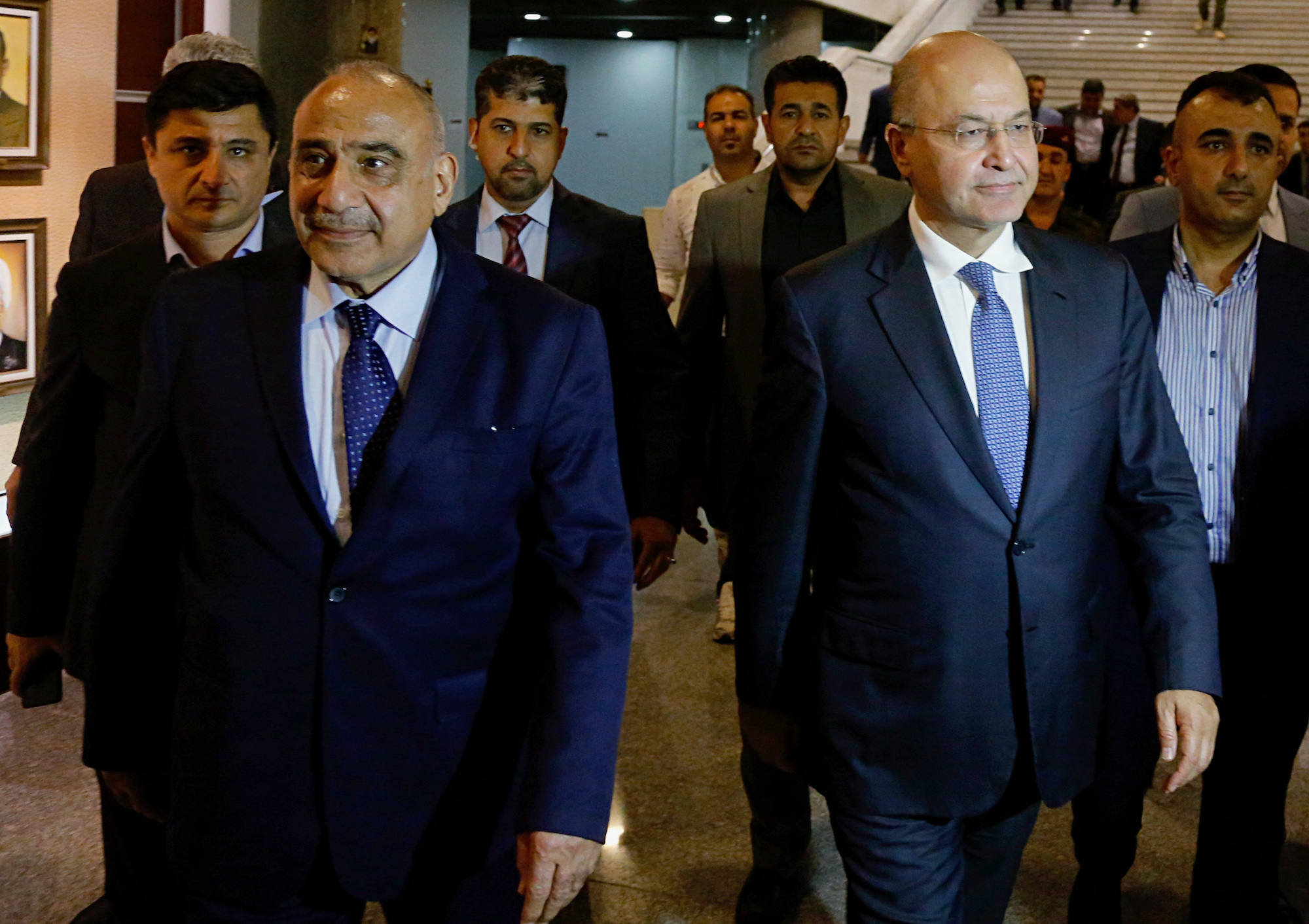
Newly elected Iraq President Barham Salih, center right, walks with newly Iraq prime minister Adel Abdul-Mahdi, center left, in the parliament building in Baghdad, Iraq, Tuesday, Oct. 2, 2018. Iraq’s new president has tasked veteran Shiite politician Adel Abdul-Mahdi with forming a new government nearly five months after national elections were held, state TV reported late Tuesday. (AP Photo/Karim Kadim)
The formation of Iraq’s new government under the prime minister-designate, Adel Abdul Mahdi, could represent another small step forward in the incremental process, being led by Saudi Arabia and Kuwait, of counterbalancing Iran’s hegemonic influence in Iraq and reintegrating that country into its broader Arab milieu. Much depends on the nature of the government Abdul Mahdi will assemble in the coming weeks, and how the division of power plays out as various Iraqi leaders orient themselves in the postelection environment.
Abdul Mahdi is a consensus choice that points to continuity rather than reform and avoids consolidating or institutionalizing the rise in power of the Popular Mobilization Forces pro-Iranian sectarian militia groups that, along with their allies, represent Tehran’s strongest assets in Iraq. As The Washington Post reported, “A pro-Iran bloc of lawmakers, led by [PMF] militia commander Hadi al-Amiri and former prime minister Nouri al-Maliki, tried to block Abdul Mahdi’s nomination but eventually dropped their opposition once they realized they did not have enough seats for a parliamentary majority.” Eventually Amiri joined Muqtada al-Sadr, head of the largest bloc in Parliament, in backing Abdul Mahdi, presumably in exchange for key posts in the forthcoming Cabinet.
Abdul Mahdi’s elevation, therefore, is a compromise everyone can live with, including the United States, Saudi Arabia, Sadr, Kurdish parties, and even Iran. Indeed, he is a formerly sectarian Shia politician who once had deep ties to Tehran, but has since become much more of a nationalist nonsectarian figure. He therefore represents many of the same tendencies as Sadr – Iraqi nationalism and outreach to Kurds and Sunni Arabs but from an unmistakably Shia communal basis. The days in which the United States and Iran could essentially cooperate in Iraq, for example to maintain the status quo and stability or, especially, to defeat the Islamic State in Iraq and the Levant, are long gone. However, the appointment of Abdul Mahdi as prime minister, with Sadr lurking closely behind him in a position of authoritative kingmaker power doesn’t particularly favor either Washington or Tehran, the two outside powers that have dominated Iraqi politics since the ouster of Saddam Hussein’s regime in 2003.
However, it could represent a significant step forward for the newest external players in the Iraqi political scene, the Gulf Arab countries – particularly Saudi Arabia and Kuwait. Saudi Arabia, of course, has a long history with Iraq, but essentially walked away from efforts to seriously engage with Iraqi domestic politics during the premiership of Nuri al-Maliki, who pursued an increasingly sectarian and pro-Iranian policy. In the past few years, however, Riyadh has made a major effort to re-engage with Iraq largely through incentives and positive diplomacy, seeking to foster Iraqi policies that are more balanced between Arab and Iranian influences and interests. For instance, Sadr and Saudi Arabia publicly built strong channels of communication in the run-up to the Iraqi election, as the Shia cleric was representing himself as a nationalist alternative to unwaveringly pro-Iranian policies by the PMF groups or Maliki.
Therefore, that Tehran, Amiri, and Maliki all have found it advantageous to help Abdul Mahdi secure his position, after initially trying and failing to block him, opens even further precisely the space within Iraqi politics in which Saudi Arabia operates: promoting Iraqi nationalism and reintegration in the Arab world as opposed to the country operating as a colony or satellite of Iran. Saudi Arabia’s room to maneuver in Iraq seems to be growing, especially as the election results and Sadr’s successful campaign suggested that many Iraqis are looking for alternatives to Iranian or U.S. hegemony. This is underscored by offers from Iraq to mediate between Washington and Tehran as tensions rise in the wake of the U.S. withdrawal from the nuclear agreement and the administration’s campaign of “maximum pressure” against Iran.
Major political unrest and mounting U.S.-Iranian tensions in strategically and politically crucial parts of Iraq in recent weeks have also created new opportunities for Gulf Arab engagement. In early September, mobs of angry protesters in Basra, chanting “Iran out, Iran out,” torched the Iranian Consulate in the heavily Shia and traditionally pro-Iranian city. At least 15 people died in the unrest, which went on for many days and appeared targeted at both Iran and the local government. Grievances included lack of clean water, an electricity crisis exacerbated (if not created) by Iran, and abuses by pro-Iranian militia groups. As tensions rose, the United States was forced to close its consulate in Basra due to threats from Iranian-backed extremists. The outpouring of popular anger against Iran and its local Iraqi clients in the heartland of Shia Iraq was the most dramatic of many indications in recent years that Iran has overplayed its hand in Iraq and that, even among Iraqi Shias, the constituency for greater distance from Iran is powerful and growing.
Iran helped provoke this crisis through a clumsy and heavy-handed tactic: cutting off electricity supplies to the Basra area in the midst of Iraq’s sweltering summer heat. Iran provides an estimated third of all electricity supplies to Basra, and the resulting crisis focused much attention on Iran’s accumulation of power and economic, political, and military stranglehold on much of Iraqi life. It seems clear that the move, ostensibly based on nonpayment of bills, was actually designed to send a message to Iraqis, and especially the outgoing government of Prime Minister Haider al-Abadi, as well as all those involved in the formation of the new government, that Iran has tremendous power in Iraq and is willing to use it to make a point, even in Basra and at the expense of the Iraqi public. None of these messages went down particularly well. The term “political blackmail” was leveled by more than one official, and that seemed to represent much of public opinion.
Into the breach immediately stepped Gulf Arab countries, especially Saudi Arabia and Kuwait. Saudi Arabia agreed to sell electricity, as well as a large solar power plant, to Iraq for heavily discounted prices, and Kuwait, which has long been involved in investments and other major projects in southern Iraq, also moved to help replace Iran’s corner on this market. As Evan Langenhahn has argued, Saudi Arabia and Kuwait “together have the resources to provide Iraq with the electricity it requires, diminishing Iranian control over Iraq’s economy, depriving Iran of hard currency, and bolstering political stability through economic development.” Saudi Arabia’s position in Iraq is also strengthened by the selection of Kurdish leader Barham Salih as Iraq’s new president. Salih has few ties and no history of cooperation with Tehran and favors a strong Kurdistan Regional Government within Iraq but is not a major proponent of Kurdish secession, which dovetails well with Gulf Arab interests. Saudi Arabia is also increasingly looking to the KRG as a vital entry point to the broader Iraqi economy and increased investments in the country.
In order to offset or balance Iran’s influence in Iraq, however, the Gulf Arab countries don’t only need each other. They will also rely on a partnership with Washington, which still has a considerable economic, military, and political presence in Iraq, to complete the assemblage. Tehran has a unique degree of leverage and influence in Iraq, unmatched by any other outside power. But if Saudi Arabia, Kuwait, and the United States coordinate their efforts to undermine Iran’s hegemonic influence, and promote a more independent Iraqi nationalism and Iraq’s reintegration in the Arab world, Tehran would be facing a combined effort that could well match its prowess. The elevation of Abdul Mahdi hardly guarantees this will happen or would succeed. But, along with the Basra unrest and many other recent indicators, it does suggest that the conditions for such an initiative are ripe as ever, and that Iraq can, and should be, a major arena for those seeking to roll back the disproportionate influence Tehran has accumulated in the Arab world over the past 15 years.
The views represented herein are the author's or speaker's own and do not necessarily reflect the views of AGSI, its staff, or its board of directors.
Policies that prevent Saudi Arabia from pursuing diplomatic normalization and are fueling alienation in large parts of the West seem to reflect a Jewish consensus in Israel.
Policies that prevent Saudi Arabia from pursuing diplomatic normalization and are fueling alienation in large parts of the West seem to reflect a Jewish consensus in Israel.
President Trump has led the United States into an impossible dilemma in which resuming and intensifying the war presents one set of alarming consequences while ending it under current circumstances offers at least as many disasters for Washington.
The Trump administration has positioned the United States at a crossroads between a new regime of containment against Iran or a historic drawdown of U.S. influence in the Gulf and broader Middle East.
Riyadh and Abu Dhabi urged President Trump not to attack Iran, but now that the war is into its second month, leaving the current situation in place would be an unthinkable fiasco for them.