Trump’s Pick of Hawkish Bolton Raises Old Ghosts of 2003 Iraq Invasion
And then there was one “grown-up” left in the Trump White House. National security advisor HR McMaster was living on borrowed time for months. He never clicked with Donald Trump and openly disagreed with the sudden opening to North Korea and ongoing appeasement of Russia. Now he’s gone, to be replaced at the National Security...
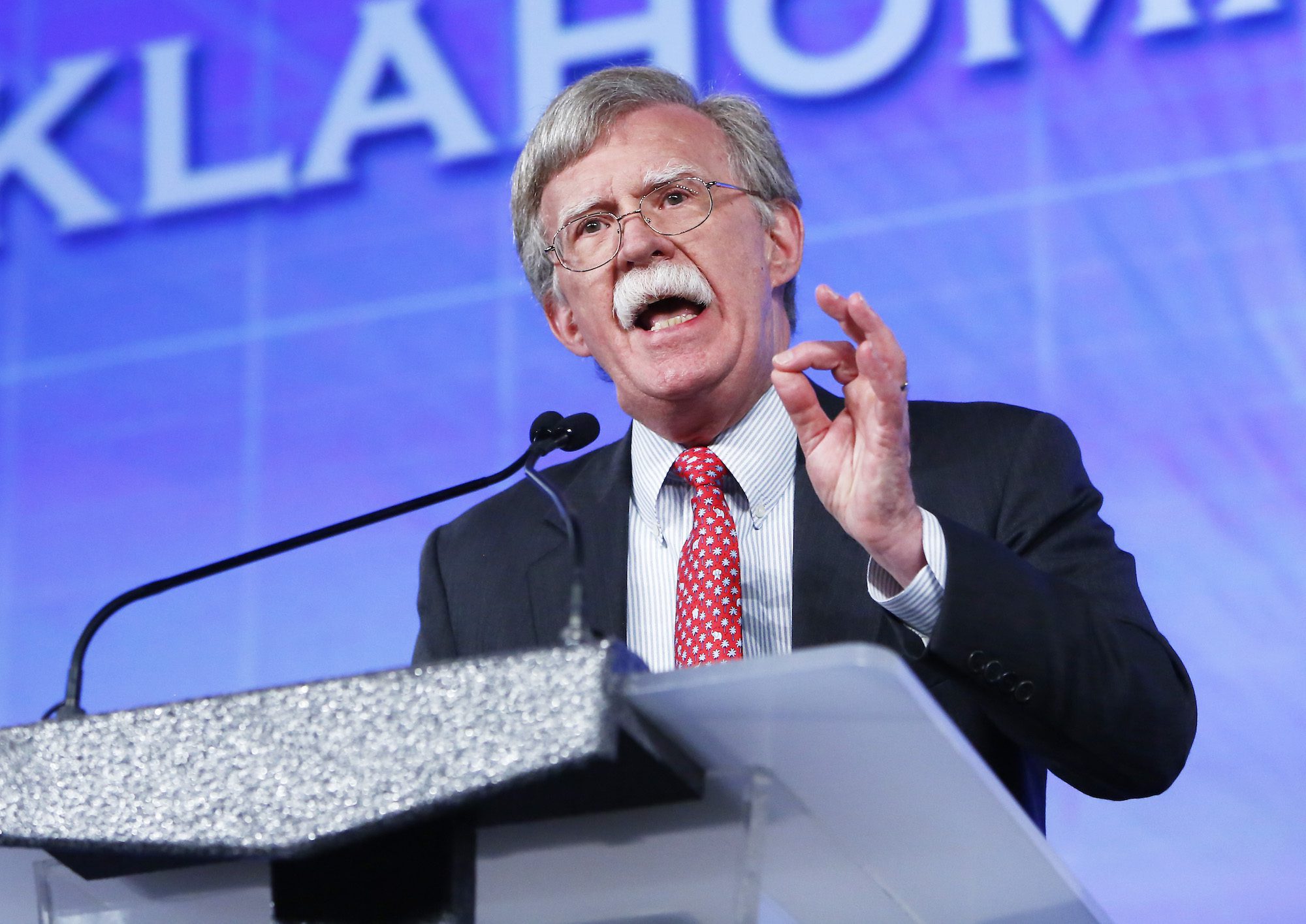
Former U.S. ambassador to the United Nations John Bolton speaks at the Southern Republican Leadership Conference in Oklahoma City, May 22, 2015. (AP Photo/Alonzo Adams)
And then there was one “grown-up” left in the Trump White House.
National security advisor HR McMaster was living on borrowed time for months. He never clicked with Donald Trump and openly disagreed with the sudden opening to North Korea and ongoing appeasement of Russia. Now he’s gone, to be replaced at the National Security Council by the ultimate Washington hardliner, John Bolton.
From the outset of the Trump administration hopes were pinned on a group of experienced and sensible professionals, usually nicknamed “the grown-ups,” to restrain Mr Trump’s most reckless and disruptive impulses and impose some order and continuity, especially on foreign policy. The group was generally held to include Gen McMaster, outgoing Secretary of State Rex Tillerson, and former economic advisor Gary Cohn, all recently removed in what looks like a purge of level-headed and independent-minded officials.
Some originally included John Kelly, now Mr Trump’s Chief of Staff, in the group, but everyone paying attention to how he led the Department of Homeland Security crossed him off the list in short order. Indeed, he increasingly looks like Mr Trump’s South Boston alter ego. Sad.
All this means we can no longer speak of “grown-ups,” but only “the grown-up,” singular.
Defence secretary Jim Mattis was always the most important and impressive of them, and if he’s the next to go, profound anxiety would be warranted. For now, he seems secure, in large measure because he has defended his strong grip on the Department of Defence by avoiding any public disagreements with the president, keeping a very low public profile, and interpreting his authority exceptionally narrowly while defending it extremely tenaciously. His tenure has been an object lesson in how to be a successful and dignified senior official under Mr Trump.
This purge is accompanied by the rise of ideologues who are much more hawkish and politically aligned with, and personally beholden to, Mr Trump. It does seem to signal that the president is growing more comfortable in his first political position, dispensing with people he didn’t like, agree with or trust much but were appointed to communicate something or reassure some constituency.
The myth of the “grown-ups” was, in fact, deliberately authored by Mr Trump himself through these appointments. And now he seems to feel no further need of it.
The replacement of Mr Tillerson with former CIA chief Mike Pompeo will be applauded in much of the Gulf, which felt he was unduly sympathetic to Qatar and insufficiently tough on Iran. The same logic might even welcome having Mr Bolton, rather than Gen McMaster, at NSC.
And, perhaps, these appointments are designed to make the administration look “tough” as a negotiating tactic and intimidate North Korea and China, or Iran and the European signatories to the nuclear agreement, in pursuit of the “art of the deal”. But it looks increasingly likely that, in a few weeks, Mr Trump will simply withdraw from the Iran nuclear agreement.
If there is a realistic plan for what comes after that, it’s been concealed with an effectiveness rarely seen in Washington in general, and this administration in particular.
On Thursday, Saudi Foreign Minister Adel Al Jubeir at the Brookings Institution encouraged Washington and the three European signatories to find a way to keep the agreement alive while dealing with Iran’s continued misbehaviour. His implicit point is that simply walking away from the deal would play directly into the hands of Iranian hardliners.
But Mr Trump has given no indication he understands that, and neither have Mr Pompeo or Mr Bolton, the latter of which recently made the legal as well as practical case for an attack on North Korea.
Toughness is a virtue. Recklessness is dangerous. Wars are best avoided. Hard-nosed negotiating and even psychological warfare can work, but, as recent American history has shown, bellicosity and impulsiveness can lead to miscalculations and colossal blunders.
If there is a serious plan for dealing with Iran in the aftermath of a deconstructed nuclear agreement, there’s been no hint of it. And, as the 2003 invasion of Iraq demonstrates, even when there is a clear plan, it’s not always a good one.
In a way, it’s useful that Mr Trump increasingly has the team he wants and is comfortable with. Hopefully, if nothing else, it will yield more policy clarity and predictability. And if belligerent rhetoric and bellicose advisers are all part of complex posturing by Mr Trump in preparation for getting “better deals” with Pyongyang and Tehran, that would be welcome. But the world and the region can’t afford another fiasco like the Iraq invasion.
The danger is that with Mr Trump growing in confidence and purging most of the somewhat independent and sober-minded “grown-ups” from his team he will be empowered to follow his instincts in situations where careful strategy and rational calculations based on fully-understood complex realities are indispensable. These instincts led many of his companies into bankruptcy.
Even those applauding now may one day miss the grown-ups more than they would imagine.
This article was originally published by The National.
The views represented herein are the author's or speaker's own and do not necessarily reflect the views of AGSI, its staff, or its board of directors.
As the September deadline for the U.S. troop drawdown approaches, Iraq’s period of comfortable neutrality is ending, but the country’s policymakers should not rush into unsustainable alignments.
President Trump has led the United States into an impossible dilemma in which resuming and intensifying the war presents one set of alarming consequences while ending it under current circumstances offers at least as many disasters for Washington.
The Trump administration has positioned the United States at a crossroads between a new regime of containment against Iran or a historic drawdown of U.S. influence in the Gulf and broader Middle East.
Riyadh and Abu Dhabi urged President Trump not to attack Iran, but now that the war is into its second month, leaving the current situation in place would be an unthinkable fiasco for them.
Though they were unsuccessful in preventing the current conflict, and, as expected, have been dragged into the U.S.-Israeli confrontation with Iran, Gulf Arab countries remain crucial to hopes for limiting the war and bringing it to a quick resolution.