As the September deadline for the U.S. troop drawdown approaches, Iraq’s period of comfortable neutrality is ending, but the country’s policymakers should not rush into unsustainable alignments.
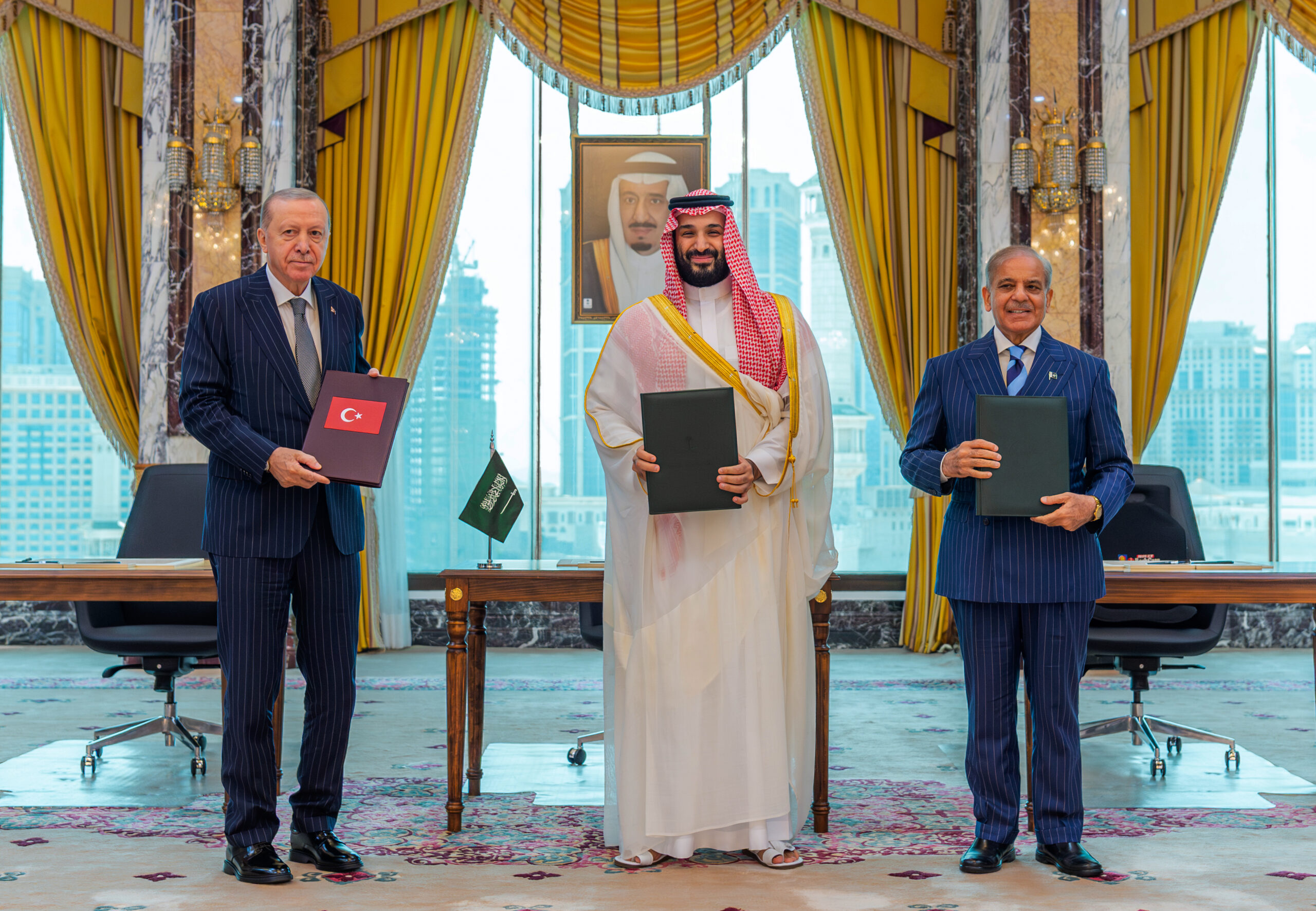
Turkish President Recep Tayyip Erdogan, Saudi Crown Prince Mohammed bin Salman, and Pakistani Prime Minister Shehbaz Sharif pose after signing a trilateral defense agreement in Mecca, Saudi Arabia, August 7. (Saudi Press Agency via AP)
The emerging defense agreement among Turkey, Pakistan, and Saudi Arabia marks a significant recalibration of the Middle Eastern security architecture. Spurred by escalating regional tensions and the protracted confrontation between the United States and Iran, Saudi Arabia has sought to diversify its strategic dependencies beyond its traditional Western umbrella. However, while Saudi Arabia’s drivers are primarily defensive – impelled by immediate vulnerabilities across its maritime and territorial perimeter – the motivations of Turkey and Pakistan are fundamentally opportunistic.
For Turkey and Pakistan, this trilateral alignment offers a high-value vector to project influence into the Gulf. Ankara views the partnership through the lens of economic expansion, defense-industrial export growth, and strategic hedging against Israel’s expanding regional footprint. For Islamabad, deeper military and security integration with the Gulf reinforces domestic legitimacy, secures much-needed capital, and counters India’s growing diplomatic and commercial overtures toward Gulf Cooperation Council states. Far from a mere transactional arrangement, the emerging axis reflects a calculated effort by non-Gulf regional powers to embed themselves in the heart of Middle Eastern security.
At the center of this shifting geopolitical matrix sits an increasingly vulnerable Iraq. Baghdad is at a perilous crossroad, facing domestic political complexities compounded by acute external pressures. The structural baseline of Iraq’s vulnerability remains its relative military weakness compared to its neighbors – a deficit that is set to sharpen dramatically as the withdrawal of U.S. forces from Iraq, currently underway, nears its scheduled completion in September.
For the past several years, Iraq’s diplomatic doctrine has relied on a policy of strategic neutrality and balanced regional engagement. This approach succeeded in elevating Baghdad’s international standing, transforming the country from a regional battleground into a convener of regional dialogue. Yet, as the broader Middle East fractures into competing, hard-security blocs, maintaining this delicate equilibrium is becoming structurally untenable, sparking intense debate over three primary strategic trajectories.
Integration Into the Turkey-Pakistan-Saudi Arabia Axis
On paper, joining this emerging trilateral bloc appears compelling. It offers a combination of Saudi Arabia’s economic capital, Turkey’s NATO-standard defense-industrial capabilities and elevated international standing, and Pakistan’s status as a nuclear-armed power with a formidable military posture. Proponents argue this provides Iraq with a robust, Sunni-inclusive umbrella that balances Iranian overreach without requiring formal dependence on Western-led frameworks.
However, there are profound strategic flaws in the rationale for Iraqi inclusion:
Asymmetric Influence: Iraq lacks the institutional, military, and economic leverage to shape decision making within the alliance. In practice, Baghdad would be relegated to a peripheral member, with slim prospects of benefiting equally from the group’s strategic dividends.
Legitimizing Turkish Encroachment: A major strategic blunder of joining this axis would be the inadvertent creation of a backdoor opportunity to legitimize the presence of Turkish military forces in northern Iraq, which Baghdad has officially deemed illegal. This bilateral stalemate remains unresolved, as Ankara routinely refuses to negotiate the issue, while successive Iraqi governments have inexplicably refrained from leveraging international legal mechanisms to enforce sovereign integrity. Joining an alliance with Turkey risks codifying this status quo.
Inherent Structural Fragility: The long-term viability of the Turkey-Pakistan-Saudi Arabia bloc remains questionable, as historically trilateral and bilateral initiatives among these states have struggled under the weight of divergent long-term agendas. While bound by immediate tactical interests and shared threat perceptions, Turkey and Saudi Arabia remain geopolitical rivals whose regional ambitions directly overlap and collide. Suspicion regarding one another’s ultimate motives could easily derail the partnership before it yields meaningful results.
A Hard Alignment With the United States
Advocates for a renewed, binding strategic partnership with Washington contend that, despite the ongoing drawdown of conventional forces, the United States remains the only global power capable of guaranteeing Iraqi sovereignty, providing advanced defense capabilities, and deterring external encroachment. Yet, this option faces fierce resistance from nationalist and resistance-aligned factions inside the Council of Representatives, who view any formal defense treaty with Washington as a violation of national sovereignty and a betrayal of the legislative mandate driving the U.S. troop withdrawal.
More critically, this path assumes a willingness on Washington’s part that simply may not exist. It remains fundamentally unclear whether the United States retains any appetite to elevate Iraq to the status of a major strategic ally or a primary non-NATO partner. Decades of transactional engagement have left deep structural divergences between Washington and Baghdad on core regional issues, ranging from the influence of nonstate armed actors to Iraq’s economic and energy ties with neighboring states.
Underpinning this reluctance is a profound deficit of trust within the U.S. policy establishment regarding the Iraqi political class. U.S. decision makers increasingly view Baghdad’s leadership as either unwilling or structurally unable to insulate state institutions from factional interests, enforce the rule of law, or deliver on long-term commitments required for a durable strategic partnership. From Washington’s perspective, investing high-level political capital or committing major security guarantees carries an unacceptably high risk of compromise, as internal political shifts in Baghdad could easily undermine shared strategic objectives or see U.S. defense technology diverted to adverse regional actors. Consequently, Washington’s prevailing preference appears focused on managing a downgraded, functional relationship rather than underwriting a comprehensive strategic alliance.
Deepening the Partnership With Iran
Sectors of the political class advocate for formalizing Iraq’s defensive posture to align with Tehran, arguing that geography, shared security threats, and deep economic interdependencies leave Baghdad with no viable alternative. Proponents assert that a weakened Iran requires greater solidarity to prevent regional destabilization from spilling into Iraq. Conversely, critics argue that doubling down on an increasingly isolated and militarily strained Iran would permanently alienate Iraq from its Arab neighbors, invite international sanctions, and subordinate Iraqi national interests to Tehran’s regional agenda.
Beyond the severe diplomatic and economic fallout, a formal security alignment with Tehran at this critical juncture rests on a fundamental strategic illusion: the expectation that Iran could act as a reliable security guarantor for Iraq against external threats.
Iran is in no position – militarily, technologically, or economically – to project a credible defensive umbrella over Iraqi airspace or territory. Strained by years of systemic sanctions, internal domestic pressures, and intense external military degradation, Tehran’s own conventional military architecture remains largely defensive and retaliatory rather than protective. It lacks the advanced integrated air defense, air superiority, and logistical bandwidth necessary to shield Iraq from regional superpowers or sophisticated external aggression.
Moreover, relying on Tehran for protection misreads Iran’s fundamental modus operandi. Under its core strategic doctrine of “forward defense,” Tehran does not hold the security interests of its regional partners on equal footing with its own national survival. Historically, Iran’s network of regional partners has served as an operational buffer – designed to absorb kinetic shocks and project influence outside Iran’s borders to keep conflict away from Iranian soil.
This creates a dangerous strategic asymmetry for Baghdad:
One-Way Expectations: Tehran routinely expects its partners to mobilize, absorb retaliatory strikes, and weaponize domestic political leverage to defend Iranian strategic interests or relieve pressure on the regime.
Calculated Retraction: When those same partners face direct, existential threats or severe military escalation, Iran often calibrates its response around strategic self-preservation, preferring rhetoric and proxy maneuvering over direct military intervention that could endanger the Iranian state.
For Iraqi decision makers, binding Baghdad’s defense posture to Tehran during a period of acute regional instability offers no real protection against external aggression. Instead, it risks reducing Iraq to a sacrificial shield – forcing Baghdad to shoulder the immense costs of Iran’s regional confrontations without receiving a tangible or reliable security guarantee in return.
Policy Recommendations for Iraqi Decision Makers
To avoid becoming collateral damage in the reordering of the Gulf security architecture, Baghdad should reject reactionary realignments and adopt a disciplined, sovereignty-first posture. Iraqi policymakers should pursue the following strategic imperatives:
Maintain Strategic Nonalignment Without Isolation: Baghdad should resist pressure to join the Turkey-Pakistan-Saudi Arbia axis or commit to rigid bilateral defense pacts. Instead, Iraq should double down on its role as a neutral, regional mediator and economic transit hub (e.g., leveraging the Development Road initiative), utilizing functional bilateral cooperation rather than formal military alliances.
Decouple Northern Sovereignty Disputes From Regional Alliances: The Iraqi government should immediately address the presence of foreign military forces in northern Iraq through dedicated bilateral channels and international legal mechanisms, such as the United Nations Security Council. Under no circumstances should Baghdad engage in multilateral defense frameworks that Ankara could exploit to validate its unauthorized military footprint in Iraqi territory.
Institutionalize Defense Self-Reliance Ahead of September: With the U.S. troop withdrawal deadline approaching, Iraq should prioritize the consolidation and modernization of its national armed forces under a unified command structure. Rather than seeking an external “security umbrella,” Baghdad should allocate state resources toward air defense capabilities, border security infrastructure, and intelligence modernization through diversified defense procurement.
Pivot From Hard Security Alliances to Economic Interdependence: Iraq should engage Saudi Arabia, Turkey, and other regional neighbors through joint economic ventures, energy grid interconnections, and water management agreements. Grounding relations in mutual economic benefit creates leverage that hard military alliances cannot provide while reducing the risk of entrapment in broader regional conflicts.
Establish a Bipartisan National Security Council: To insulate foreign policy from domestic political factionalism and politicization for its own sake, Iraq should establish an empowered, professionalized National Security Council. This body would be tasked with evaluating long-term strategic decisions against objective national interest criteria rather than sectarian or ideological affiliations.
The Imperative of Sovereignty
As the September deadline for the U.S. troop drawdown approaches, Iraq’s period of comfortable neutrality is ending. Yet, rushing into unsustainable alignments – particularly an asymmetric, structurally fragile trilateral bloc that risks compromising Iraqi sovereignty in the north – offers a false sense of security. Navigating this era of strategic chaos requires Iraqi leadership to resist factional politicking, avoid the temptation of illusory security umbrellas, and focus on building internal military capacity while preserving a sovereign, independent foreign policy.
The views represented herein are the author's or speaker's own and do not necessarily reflect the views of AGSI, its staff, or its board of directors.
A strong relationship with the GCC acts as a stabilizing force for an inherently fragile Iraqi state. But to maintain this, Iraq needs to pair sophisticated regional diplomacy with assertive control over the nonstate actors operating within its borders.
With the Strait of Hormuz closed and alternative export routes infeasible in the short term, a comprehensive agreement with Erbil can help Baghdad address its critical lack of oil export capability.
A strong relationship with the GCC acts as a stabilizing force for an inherently fragile Iraqi state. But to maintain this, Iraq needs to pair sophisticated regional diplomacy with assertive control over the nonstate actors operating within its borders.
The U.S.-Israeli attack on Iran has exposed Iraq’s structural fragilities: territorial permeability, economic monoculture, energy dependence, and politically mediated sovereignty.
The government-formation crisis is a test of whether Iraq can assert genuine sovereignty in a system still shaped by foreign influence, factional vetoes, and constitutional loopholes.
On January 8, AGSI hosted a virtual roundtable with its leadership and scholars as they look ahead and assess trends likely to shape the Gulf region and U.S. foreign policy during the coming year.