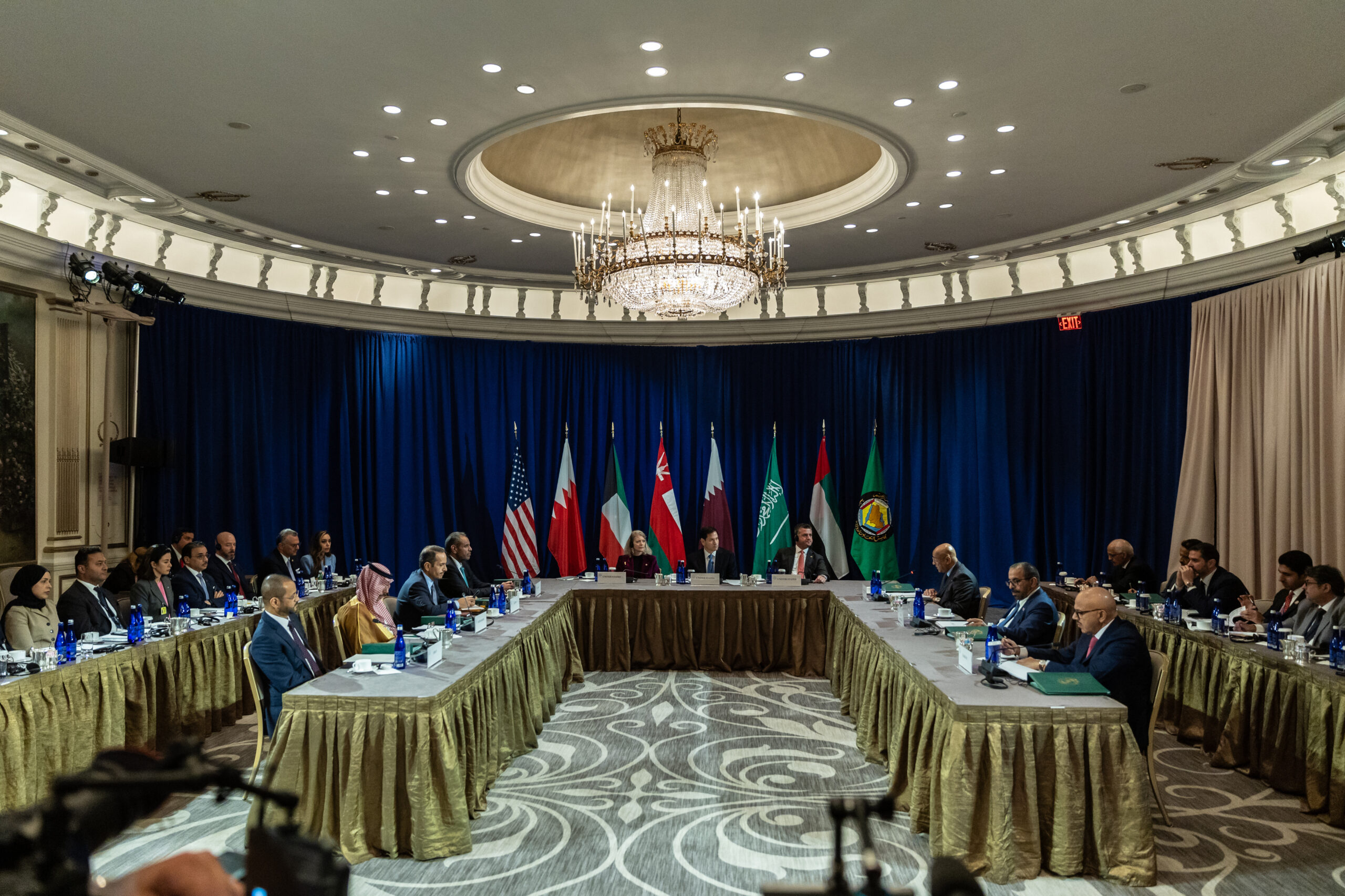
A strong relationship with the GCC acts as a stabilizing force for an inherently fragile Iraqi state. But to maintain this, Iraq needs to pair sophisticated regional diplomacy with assertive control over the nonstate actors operating within its borders.
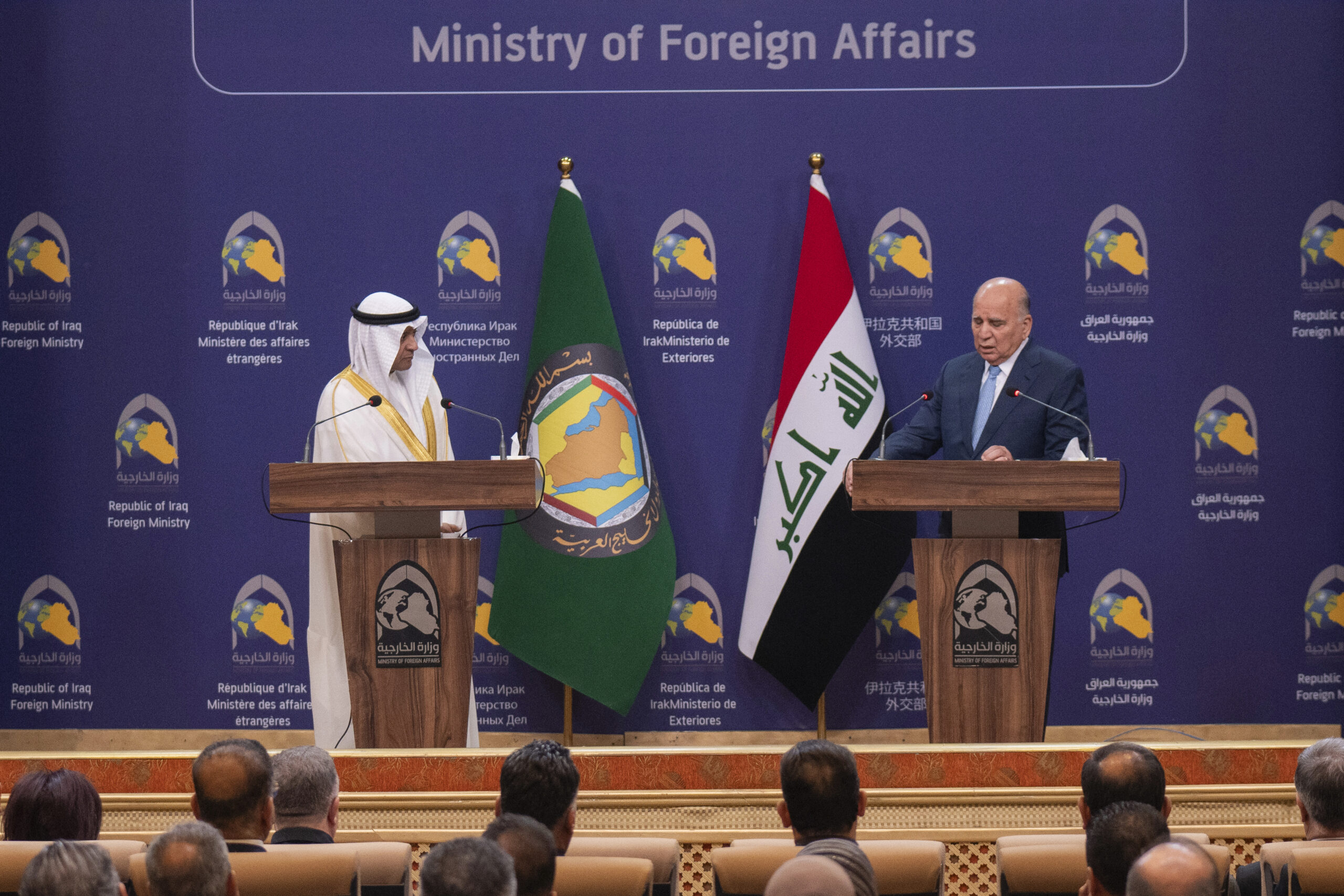
Iraqi Foreign Minister Fuad Hussein and Gulf Cooperation Council Secretary-General Jasem Mohamed AlBudaiwi attend a press conference in Baghdad, Iraq, July 31, 2023. (AP Photo/Hadi Mizban)
The geopolitical equilibrium of the Middle East has long depended on Iraq’s positioning between Iran and the Gulf Arab countries. Amid the devastating military confrontation between the United States (partnered with Israel) and Iran, this equilibrium has been severely fractured. While Baghdad has consistently articulated a doctrine of strict strategic neutrality, the operational reality on the ground tells a more volatile story.
Recent militant actions apparently executed by Iranian-aligned armed groups operating within Iraqi territory have triggered a sharp downturn in Iraq’s relations with the Gulf Cooperation Council states. This diplomatic friction exposes a persistent structural paradox: Despite the Iraqi state’s official disapproval of cross-border aggression, regional capitals, hewing to standard notions of sovereignty in which governments maintain a monopoly on the use of force, continue to hold Baghdad accountable for its domestic security deficit.
For Iraq, rebuilding and sustaining robust ties with its Gulf Arab neighbors is a vital national security interest. In an era dominated by a transactional and highly punitive U.S. foreign policy under President Donald J. Trump, Baghdad’s relationship with the GCC states has become the primary barometer for its standing with Washington. Navigating this axis of vulnerability requires Iraq to pair sophisticated regional diplomacy with assertive, uncompromised control over the nonstate actors operating within its borders, a balance it has struggled to maintain during the Gulf conflict.
If the current diplomatic downturn is not addressed properly, it can undo the substantial progress achieved over the preceding two decades. The post-2003 era was initially defined by deep mutual suspicion. The GCC states viewed the newly established political order in Baghdad with profound apprehension, interpreting the rise of Shia-led governments as an organic extension of Iranian regional influence. This estrangement, exacerbated by the Gulf Arab states’ fears that Iran was the favored beneficiary of these Shia-led governments, frequently manifested in negative meddling, where regional rivalries played out across Iraq’s fragile sociopolitical landscape, further destabilizing the state.
However, there has been a significant pivot over the last decade, driven largely by a fundamental reevaluation of Saudi Arabia’s regional strategy under King Salman bin Abdulaziz. Recognizing that isolating Iraq only accelerated its integration into Iran’s security architecture, Riyadh initiated a policy of proactive reengagement.
This diplomatic progress rapidly consolidated relations with Iraq across the GCC states. High-level state visits, the reopening of crucial border crossings, such as Arar, and joint coordination councils transformed Iraq’s status from an excluded neighbor into a critical partner. This rapprochement demonstrated the utility of a stable, Arab-aligned Iraq for the collective equilibrium of the Middle East.
From a multilateral perspective, the benefits of a robust relationship between Iraq and the GCC states span across economic, security, and diplomatic dimensions. Iraq requires immense capital injection and infrastructural modernization to sustain its projected gross domestic product growth and diversify away from absolute oil dependency. The GCC states possess the sovereign wealth and corporate capacity to serve as prime engines for – and important beneficiaries of – this transformation. Initiatives to link Iraq’s electricity grid with the Gulf network symbolize a broader effort to tether Iraq’s economic future to dynamic Gulf Arab markets, with the goal of reducing Iraq’s reliance on Iranian energy imports, a key marker for broader Iraqi integration with the Gulf Arab states.
The proliferation of transnational threats – ranging from the resurgence of extremist insurgencies to maritime insecurity – demands highly coordinated intelligence sharing and border management. A cooperative relationship allows Iraq and the GCC to build a defensive buffer against destabilizing asymmetric threats.
When aligned, Iraq and its Gulf Arab neighbors can wield considerable diplomatic leverage on the international stage. The GCC can champion Iraq’s interests in global financial institutions and Western capitals, while Baghdad can position itself as a diplomatic and geostrategic bridge between the Levant and the Gulf, a connector the GCC sorely missed during the decades when Iran dominated Syria.
While both sides acknowledge the strategic value of this alignment, their underlying motivations stem from fundamentally different geopolitical calculations. From the perspective of the Gulf Arab states, the calculation veers toward zero-sum assessments regarding Iranian influence but with some nuance. The closer Baghdad is drawn into the GCC economic and political orbit, the less threatening the inevitable cooperation between Iraq and Iran becomes. Riyadh, Abu Dhabi, and Kuwait do not realistically expect Iraq to completely sever its deep historical, religious, and economic ties with Tehran. Instead, they seek to offer a compelling Arab alternative that dilutes Iranian advantage, ensuring that Baghdad’s relationship with Iran does not morph into an exclusive structural subordination.
From the Iraqi perspective, maintaining strong relations with the GCC serves as a vital shield against external destabilization. When relations soured in the past, some Gulf Arab states reportedly utilized various levers of influence that exacerbated Iraq’s internal fractures. Cultivating deep, institutionalized partnerships with the GCC states minimizes the incentive for these wealthy neighboring states to intervene unhelpfully in Iraqi domestic politics. In essence, a strong relationship with the GCC acts as a stabilizing force for an inherently fragile Iraqi state, safeguarding its sovereignty from being torn apart by competing regional actors.
The strategic value of the Iraq-GCC relationship is further amplified by its direct impact on U.S.-Iraqi relations. Historically, Washington’s view of Baghdad has moved in tandem with Iraq’s standing in the U.S.-allied Arab states, particularly in the Gulf. Under the current Trump administration, this dynamic has crystallized into an explicit foreign policy framework. Trump has consistently maintained a transactional approach to the Middle East, pressuring Iraq and its Arab neighbors to permanently move past their historical grievances and establish a self-sustaining regional security order. For the Iraqi government, maintaining highly visible, positive relations with the GCC states has in the past represented crucial low-hanging fruit. It was a clear, quantifiable metric that demonstrated to the White House that Baghdad was actively working to align itself with primary U.S. allies in the region.
Conversely, unnecessarily strained relations with the GCC states bring immediate and severe consequences for Iraq. Because Baghdad maintains a highly complex and deeply entrenched relationship with Iran, any escalation by Iraqi-based armed groups, particularly when viewed from the hyperpolarized lens of the current conflict, instantly draws U.S. wrath. In the current policy climate in Washington, an inability to protect Gulf interests from Iraqi soil may be interpreted not as a lack of state capacity but as a deliberate alignment with Tehran. This perception can expose Iraq to targeted economic sanctions, diplomatic isolation, and potential military actions that could derail its fragile economic recovery.
Iraq stands at a historical crossroads where it has much to gain from an expertly orchestrated relationship with the Gulf Arab states and much to lose from letting it deteriorate. The current downturn, while dangerous, is not irreversible. But salvaging this relationship cannot be achieved through rhetoric alone. The GCC states, burned by repeated drone and missile provocations from Iraqi territory, are no longer placated by Baghdad’s formal proclamations of neutrality.
To secure its strategic future, the Iraqi government must implement a dual-track strategy:
Dynamic Regional Diplomacy: Baghdad must employ sophisticated, high-level diplomacy to convince its Gulf partners of its genuine commitment to regional stability, leveraging shared economic interests to keep communication channels open.
Assertive Domestic Sovereignty: Iraq must demonstrate absolute command over its domestic geography. This requires the state to transition from passive disapproval to assertive containment of both state and nonstate actors operating within its borders.
Only by establishing a monopoly on the legitimate use of force within its own territory can Iraq assure its neighbors that its soil will not be used as a launchpad for proxy warfare. Ultimately, a stable, sovereign, and GCC-aligned Iraq is an indispensable anchor for a peaceful Middle East. Achieving this is the paramount challenge – and the ultimate necessity – for modern Iraqi statecraft.
The Gulf Arab states stand at a critical strategic juncture as well. They too have much to gain from a structurally secure, independent Iraq and much to lose by allowing it to be weakened or fall completely outside their security orbit. The current diplomatic friction, while significant, should not be met with premature disengagement. The GCC states, rightfully concerned by regional asymmetric threats, must understand that a policy of pure containment or diplomatic isolation will not fix Baghdad’s security deficits – it will only deepen them.
To secure a balanced and peaceful regional future, the GCC states must match Iraq’s domestic efforts by implementing their own dual-track strategy:
Proactive Strategic Integration: Rather than treating economic partnerships as a reward for future good behavior, the Gulf states must aggressively accelerate joint infrastructure, energy, and sovereign wealth investments inside Iraq. By binding Iraq’s economic survival directly to the Arab world, the GCC provides the Iraqi state with the tangible leverage and alternative revenue streams it desperately needs to balance its structural interregional dependency.
Adaptive Security Partnership: The GCC must shift from a posture of collective blame to one of defense cooperation. This requires providing targeted intelligence sharing, border-security coordination, and diplomatic support that helps empower the formal, sovereign institutions of the Iraqi state. Expecting Baghdad to instantly suppress deeply entrenched nonstate actors without a strong, institutionalized regional security network is a recipe for state collapse.
Only by establishing a genuine, reciprocal framework of mutual economic interest and institutional defense support can the Gulf Arab states expect Iraq to successfully assert its sovereign neutrality. Ultimately, a stable Middle East cannot be built by demanding that Iraq act as an isolated buffer; it requires the GCC to act as a resilient anchor that redoubles efforts to pull Iraq firmly back into the Arab fold. Fulfilling this partner-state obligation is the paramount challenge – and the ultimate strategic necessity – for modern Gulf diplomacy.
The views represented herein are the author's or speaker's own and do not necessarily reflect the views of AGSI, its staff, or its board of directors.
The U.S.-Israeli attack on Iran has exposed Iraq’s structural fragilities: territorial permeability, economic monoculture, energy dependence, and politically mediated sovereignty.
With the Strait of Hormuz closed and alternative export routes infeasible in the short term, a comprehensive agreement with Erbil can help Baghdad address its critical lack of oil export capability.
As the September deadline for the U.S. troop drawdown approaches, Iraq’s period of comfortable neutrality is ending, but the country’s policymakers should not rush into unsustainable alignments.
The U.S.-Israeli attack on Iran has exposed Iraq’s structural fragilities: territorial permeability, economic monoculture, energy dependence, and politically mediated sovereignty.
The government-formation crisis is a test of whether Iraq can assert genuine sovereignty in a system still shaped by foreign influence, factional vetoes, and constitutional loopholes.
On January 8, AGSI hosted a virtual roundtable with its leadership and scholars as they look ahead and assess trends likely to shape the Gulf region and U.S. foreign policy during the coming year.