China’s ties with Yemen’s Houthis could bolster Beijing’s regional ambitions, but they also risk drawing it into conflicts that complicate its broader strategic goals.
A man walks past mock drones put on display in Tharir Square in Sanaa, Yemen, September 15. (REUTERS/Adel Al Khader)
The escalation of hostilities between Saudi Arabia and Yemen’s Houthi rebels in recent weeks is significantly impacting Gulf security. China, as a major stakeholder in the outcome of the current crisis between Saudi Arabia and the Houthis, has stuck publicly to its established diplomatic strategy – condemning all attacks on civilian and critical infrastructure, expressing concern about casualties, and calling for dialogue among the various actors. Beijing has also reportedly sought to leverage its ties with Iran to rein in Houthi actions to prevent further expansion of the conflict. Nonetheless, Beijing is reportedly providing support to the Houthis, which complicates China’s overall foreign policy vis-à-vis the crisis in Yemen and the Red Sea.
Iran’s support for Yemen’s Houthis is widely understood as the main factor that drove the rebel movement’s ascendancy as a powerful military force. Yet now there is increasing attention paid to the role of Chinese companies as a key source of the Houthis’ dual-use technology, drone components, communications equipment, and other materials underpinning their robust capabilities.
Although Beijing has not replaced Tehran as the Houthis’ key sponsor and likely won’t, China cautiously engages in a policy of strategic ambiguity toward the Houthis that serves Beijing’s commercial and geopolitical interests. However, as Houthi-Saudi hostilities escalate, China may need to reassess its cost-benefit analysis regarding its support for the Houthis to maintain its balanced foreign policy toward the Gulf.
An October 2025 United Nations panel report found that the majority of drone components seized from shipments bound for the Houthis were from China. Yet, beyond these individual components themselves, what matters most is that these Chinese companies are enabling the Houthis to better access international commercial markets and obtain technological inputs that make it possible for the group to operate, modify, and manufacture weapons systems that become increasing sophisticated.
Essentially, Iran has supplied the Houthis with finished weapons and training, while these Chinese firms have provided the Houthis with commercial and dual-use inputs, which have contributed to their ability to expand production. As Washington and other Western capitals have imposed increasingly tight control of technologies that can reach Tehran and Sanaa, Chinese commercial networks have made it possible for the Houthis to secure access to these dual-use components. Consequently, the Houthis have been able to diversify their sources of military technology, helping them to reduce their dependence on Iran.
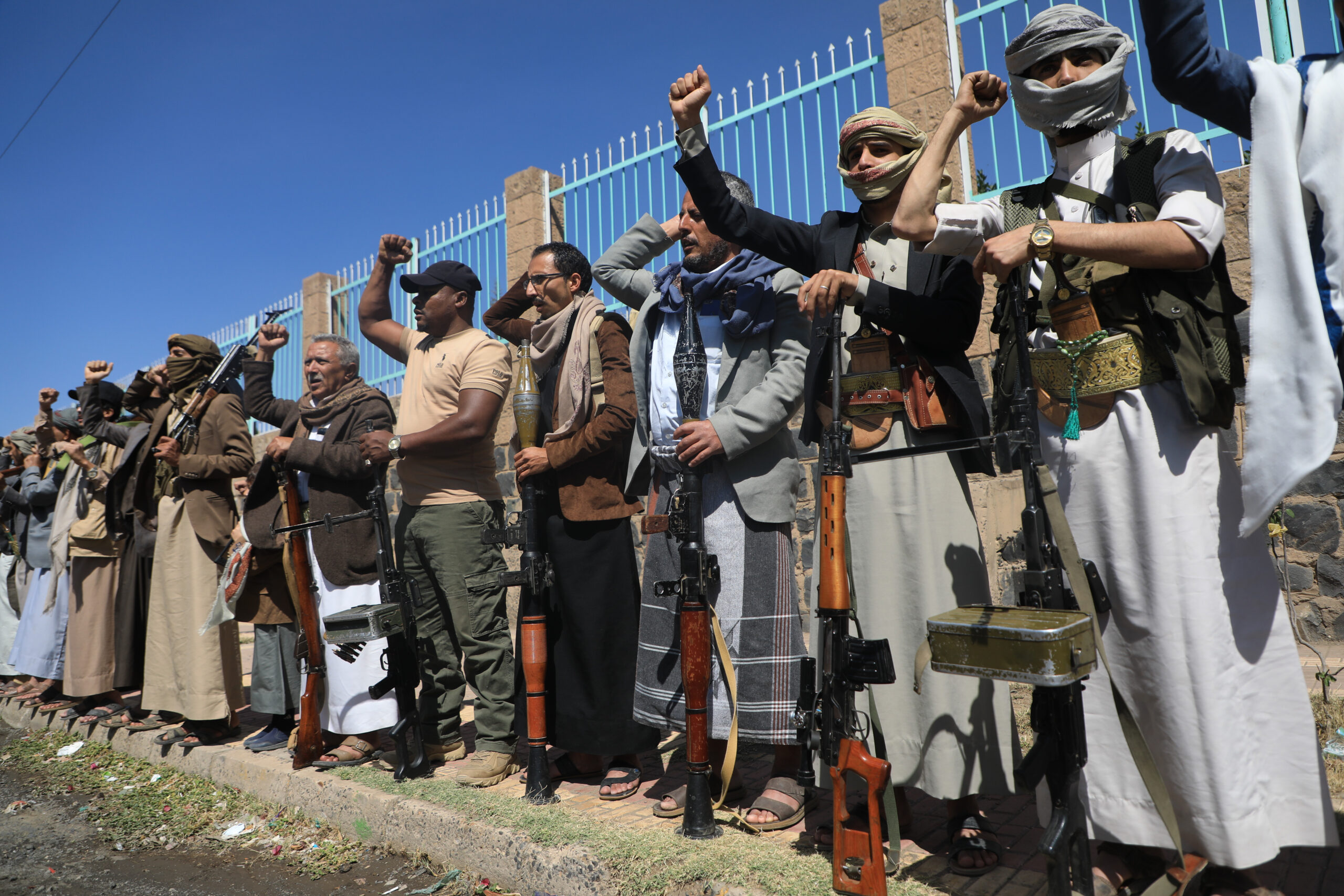
The Houthis have actively pursued deeper relations with Beijing. Traders linked to the group have cultivated long-standing ties with Chinese companies. And the Houthis have personnel who speak Mandarin and have gained deep understandings of China’s commercial landscape. Statements from Houthi officials depict China as an important power in the world that counterbalances the West and as a major source of investment in Yemen’s economy and Houthi-held territory.
China can offer the Houthis much that a heavily sanctioned Iran cannot. However, while strong ties with the Houthis provide China with opportunities to grow its influence in the region and undermine U.S. foreign policy interests, support for the Houthis may backfire against China.
Engagement Without Alignment
In 2025, China depended on Saudi Arabia for 14% of its oil imports, and Beijing wants the kingdom to be a stable oil supplier. Yet, disruptions to maritime trade and attacks on Saudi Arabia amid this ongoing regional crisis have imposed costs on China. As a result of the Strait of Hormuz’s effective closure, China’s crude oil imports decreased by approximately one-third in the second quarter of 2026 – down from 12 million barrels per day prior to the war’s eruption on February 28 to 8.1 mb/d. In June, they dropped to 7.12 mb/d – a 41% decline compared to before the war and the lowest level in nearly a decade.
The recent Houthi attacks on Saudi energy infrastructure and strikes on Saudi ships transiting the Red Sea and Gulf of Aden exacerbate this threat to China’s energy security. This is forcing Beijing to face the dilemma of how to leverage its relationship with the Houthis to serve its national interests without having to suffer from the fallout from the group’s actions both within and beyond Yemen’s borders.
To reconcile these competing interests, China has embraced a policy of strategic ambiguity and quiet diplomacy toward the Houthis to avoid being perceived as a formal ally of the group. Chinese officials frequently emphasize the importance of resolving the conflict in Yemen through dialogue and diplomacy, while avoiding direct condemnation of the Houthis. Furthermore, Beijing is keen to constantly maintain contact with the Houthis as a means of obtaining assurances from the group that Houthi maritime operations do not target Chinese vessels near Yemen. Nonetheless, Beijing’s disingenuous strategy toward the Houthis carries risks, especially as the ambiguity underpinning it has unraveled amid the group’s escalating offensive in Yemen and brazen attacks on high-value Saudi targets, intensifying scrutiny of who is helping the Houthis.
The Limits of China’s Houthi Strategy
The future of China’s relationship with the Houthis will have limits. Given the extent to which Beijing’s partnerships with Saudi Arabia and other Gulf Cooperation Council states are extremely important to China’s national interests, Beijing will be careful about how much it allows its ties with the Houthis to grow. Moreover, with a foreign policy doctrine in the Middle East that rests on maintaining balanced ties with Saudi Arabia and Iran, Beijing seeks to manage adversarial relationships in the region rather than choosing sides. By this point, the role of Chinese-sourced parts in the Houthis’ advancing military capabilities has become a “displeasure” for Saudi Arabia. However, the issue has not prompted Riyadh to be confrontational toward Beijing, which is understandable given China’s economic importance to the kingdom. In the near term, Saudi Arabia will likely seek to pressure China on this front without risking serious problems in its relationship with Beijing. While Chinese officials have signaled their willingness to cooperate with Riyadh and the U.N.-recognized Yemeni government and firmly maintain that Beijing complies with all U.N. Security Council resolutions pertaining to regulations of such exports, it remains to be seen if the issue will become a greater source of friction between Saudi Arabia and China.
A longer-term consequence of the U.S.-Israeli war on Iran and its spillover effects, including the resumption of Houthi-Saudi hostilities, may be a more influential China and a Middle East that is more Beijing oriented. With Gulf Arab states increasingly questioning the utility of U.S. security guarantees, China can gain geopolitically even if it has no interest in replacing the United States as a security provider in the Gulf. Through a foreign policy strategy that cultivates China’s ties to both GCC states and Iran, while keeping channels open to the Houthis, Beijing is positioned to engage actors in manners that are difficult for Washington. If played right, Houthi threats to Saudi Arabia can advance broader Chinese interests, even if such actions by the Houthis occasionally make Chinese officials uncomfortable, because these hostilities serve to highlight real limitations of U.S. capabilities in the region.
In an era of growing disorder in the Middle East and fragmentation of states such as Yemen, China is positioned to secure greater leverage in the balance of power. For Beijing, a test will be to use that leverage and its ability to selectively engage actors such as the Houthis to advance Chinese interests. A key challenge for Beijing will be to use its influence in Yemen to benefit from channels of communication with the de facto regime in Sanaa while also preventing the Houthis from becoming an uncontrollable and increasingly destabilizing force whose actions harm Beijing’s commercial, diplomatic, and geopolitical interests. While that balance has seemed relatively easy to strike in the past, the current threat the Houthis pose to Saudi strategic interests and security is making it an increasingly hazardous undertaking for the Chinese to manage.
The views represented herein are the author's or speaker's own and do not necessarily reflect the views of AGSI, its staff, or its board of directors.
The significance of Kuwait’s defense pact with Pakistan lies less in any immediate military transformation than in what it reveals about the evolving security landscape of the Gulf.
The revived Hejaz Railway could become one of the region’s most significant transportation and integration projects as a land route connecting Europe to the Gulf.
Iranian attacks on Omani ports and oil tankers are straining Oman’s long-standing “friend to all” regional foreign policy, but Muscat still has a part to play in achieving peace.
Through its increasing ties with Serbia, the UAE has secured a lasting strategic foothold in the Western Balkans, and Serbia has gained an influential Arab partner that is likely to remain central to Belgrade’s multipolar foreign policy calculus.