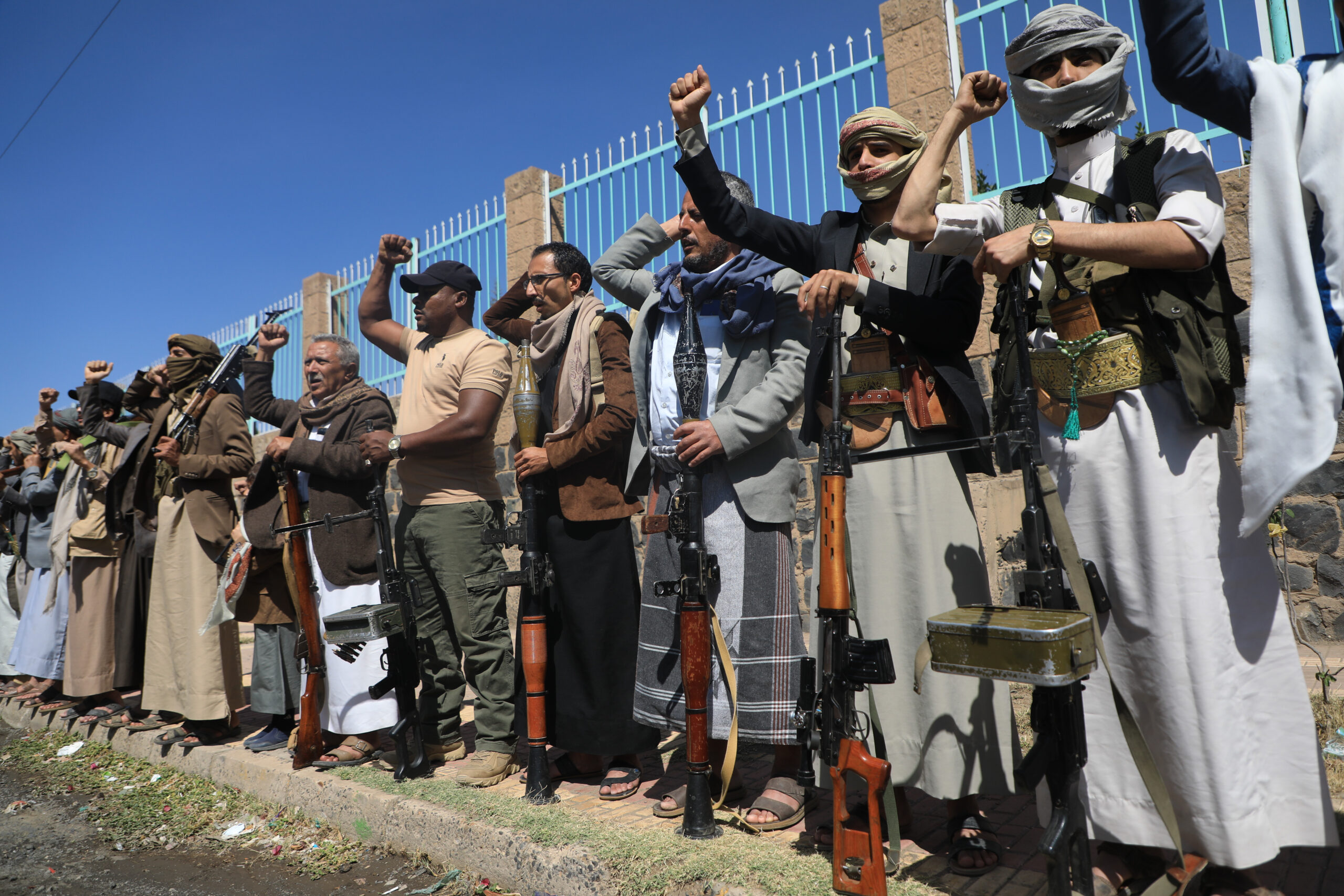
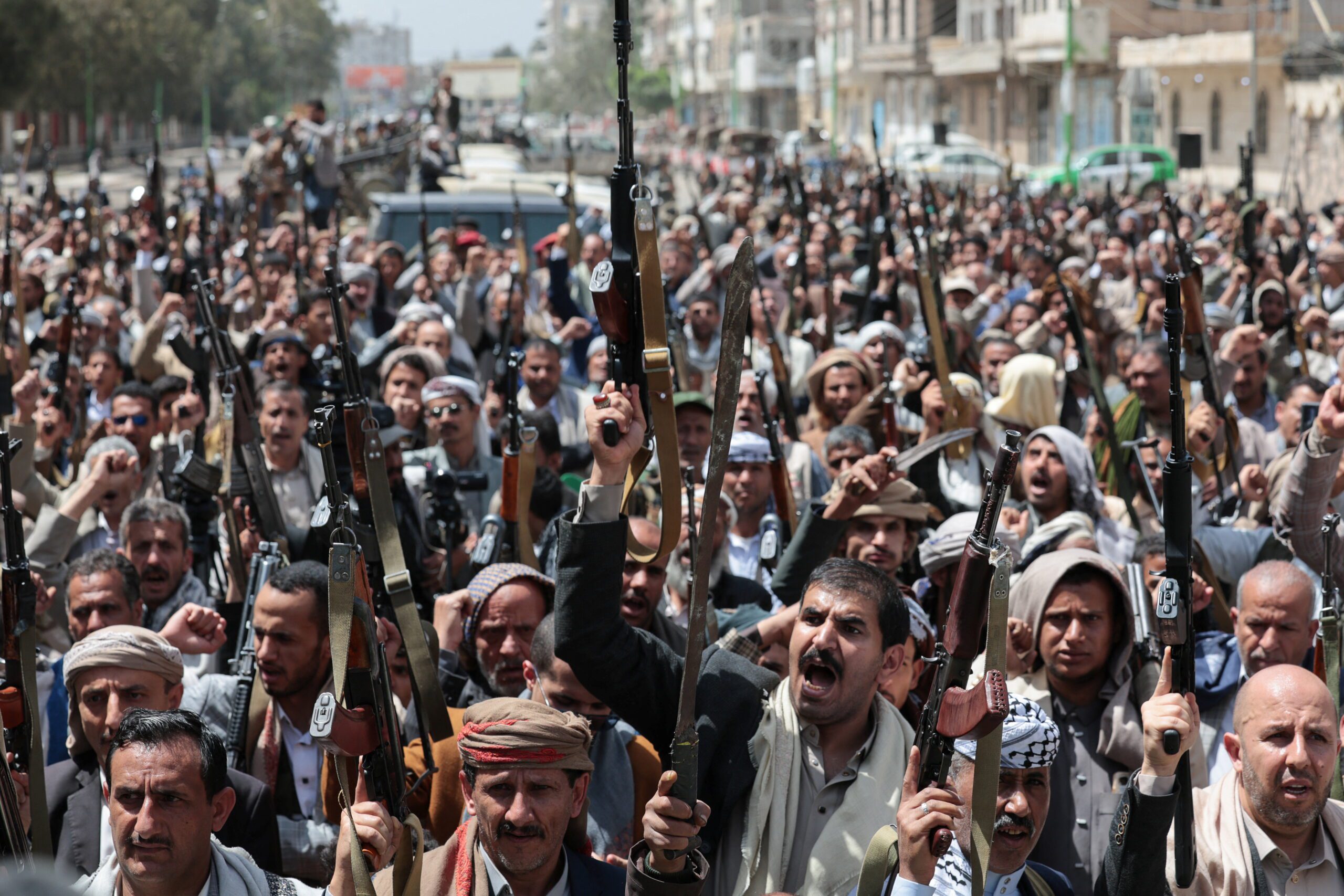
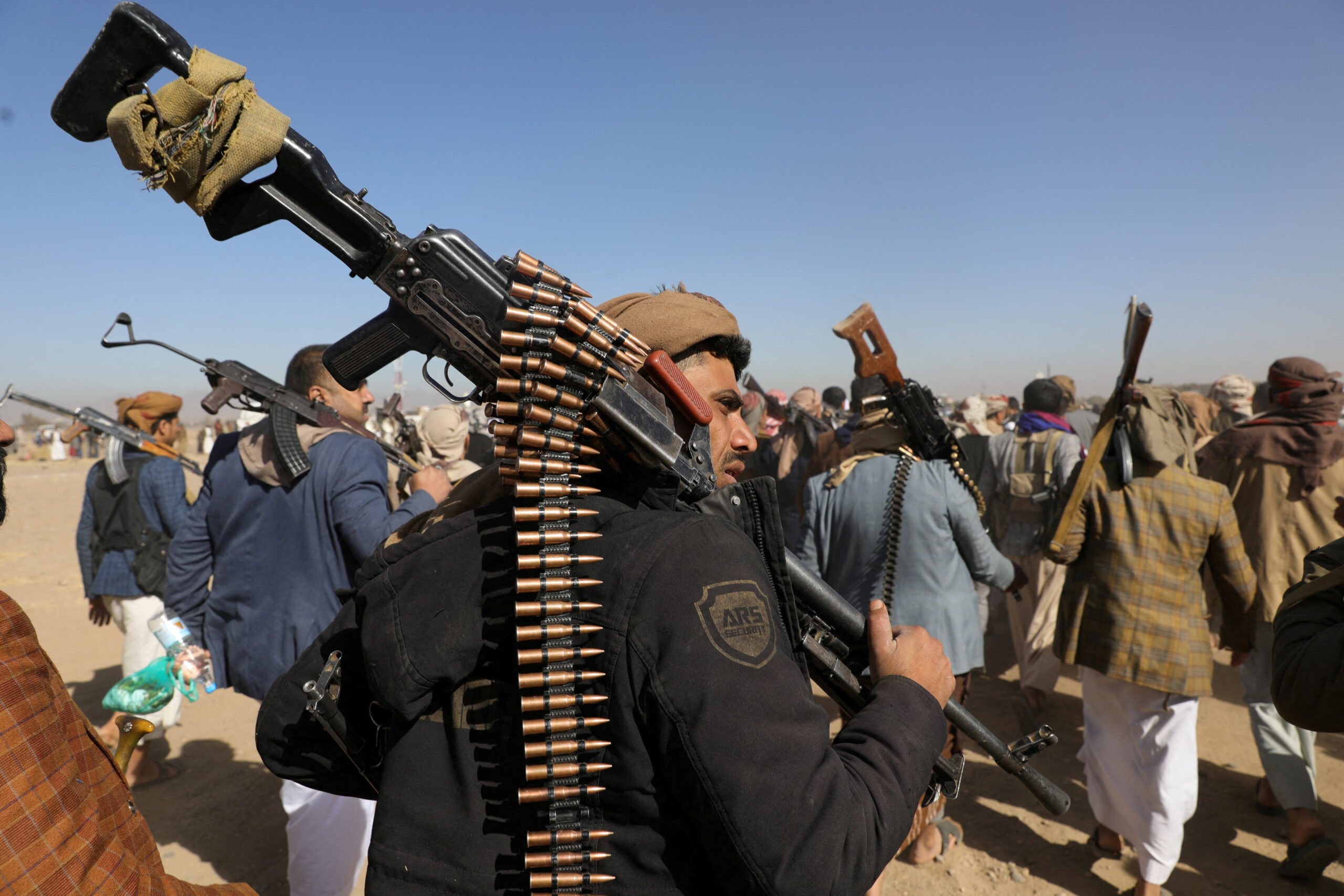
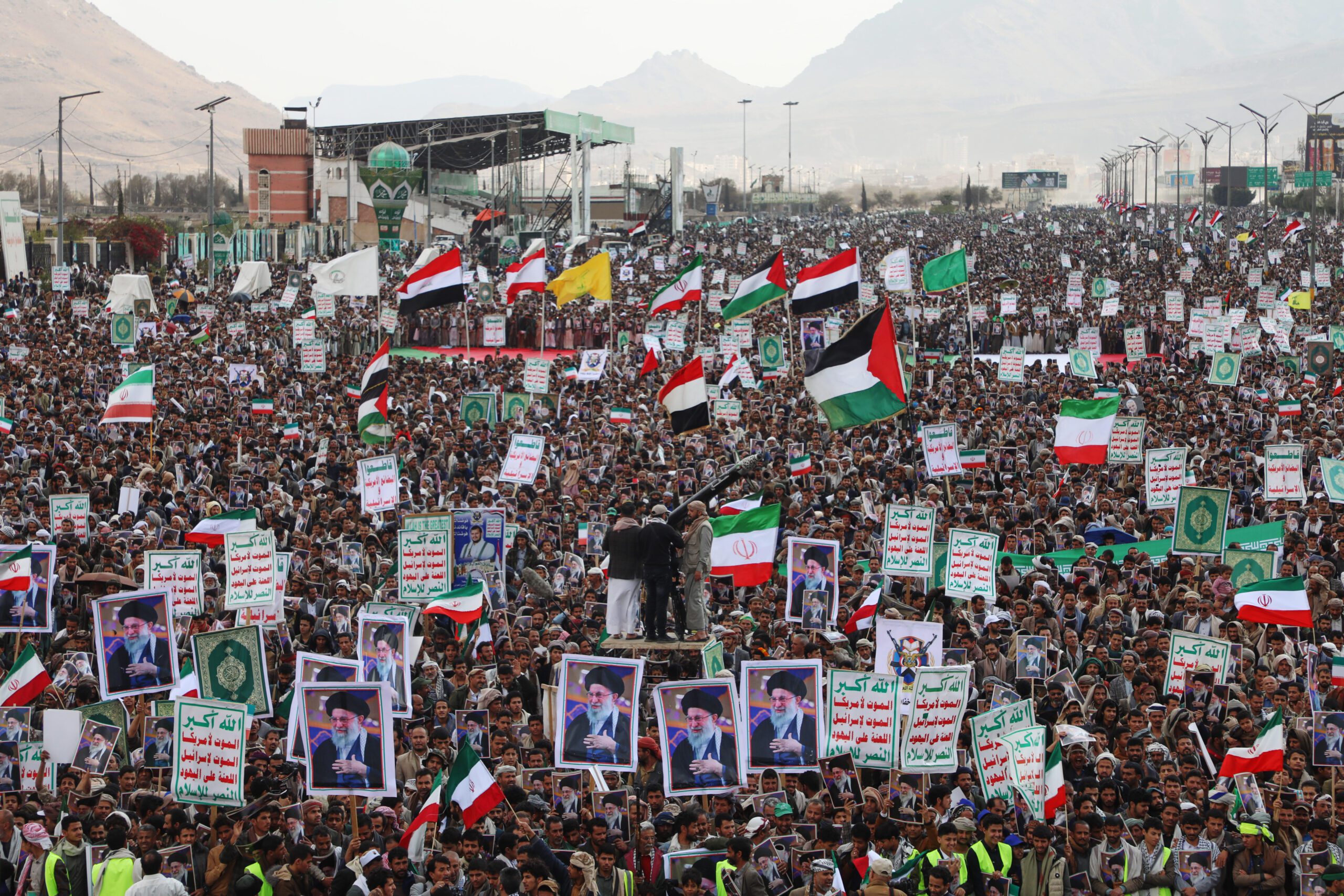
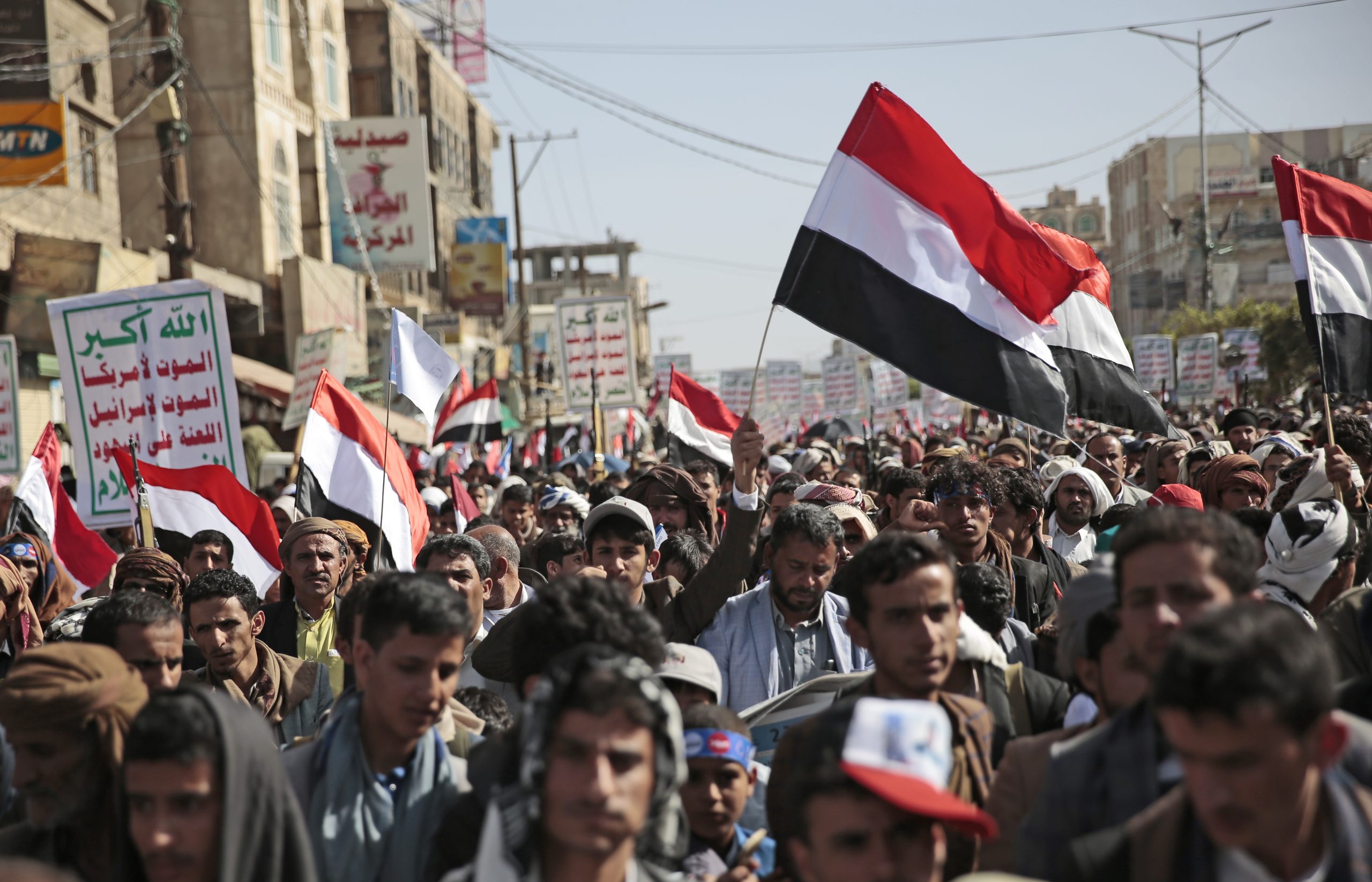
Houthi supporters chant slogans during an armed tribal rally in Sanaa, Yemen, October 7. (AP Photo/Osamah Abdulrahman)
It might be tempting to see recent Houthi attacks on Saudi Arabia as just another round of escalation, but Saudi Arabia had made a conscious choice to de-escalate with the Houthis by normalizing relations with Iran in the 2023 Beijing agreement. Tehran may have pushed to restrain the Houthis, and their attacks on the kingdom had paused until recently. So why have the Houthis chosen to escalate now, and what do they hope to accomplish by bringing the confrontation directly to Saudi soil?
Tehran benefits from the Houthis’ disruption of the Bab el-Mandeb, but the broader strategy is becoming clearer. Both Tehran and the Houthis, part of the “axis of resistance,” now talk about it openly in their media, and the restraint that the Beijing agreement once imposed on Houthi attacks against Saudi Arabia is gone. Through the Houthis, the axis could create a new balance of power on the Arabian Peninsula that the region is not prepared for. Getting there takes time, and patience is something the Houthis have plenty of. They are working on two clocks. In the short term, they seek to escalate to get a deal on their terms, after acquiring wins and additional positions in Yemen. But any deal would simply be a steppingstone to a bigger objective that Riyadh might not be taking seriously, because the real prize is Saudi Arabia itself. The Houthi worldview treats the Saudi state as an illegitimate custodian of Islam’s holy sites, and it sees Saudi territory as something to be contested, sooner or later. Houthi leader Abdul Malik al-Houthi has accused the “Saudi regime” of turning the “pilgrimage into a nightmare of obstacles” and of failing to respect “the sanctity of the Islamic nation.” When the Houthis warned airlines to avoid Saudi airspace, they exempted the skies over Mecca and Medina.
The Houthis are openly expressing support for any revolutionary action against Saudi Crown Prince Mohammed bin Salman inside Saudi Arabia, an unusual thing to state so publicly. Houthi official Mohammed al-Bukhaiti told Iran’s Mehr News the Houthis would back a popular revolt, the Sahwa opposition, or even Saudi royals willing to replace the crown prince. The Houthis are likely making a parity play, backing Saudi Arabia’s opposition so that Riyadh drops its support for the Yemeni government as it did in 2022.
Expanding Battlefronts to Paralyze Strategic Focus
For the Houthis, whose entire threat projection is asymmetric, the line between military offense and defense is blurry. The Houthis tend to broaden the scope of a conflict so their opponents cannot concentrate on a single line of engagement. When the Giants Brigades pushed them out of Shabwa in January 2022, for example, the Houthis struck Abu Dhabi. Every new front the Houthis open forces their opponent to defend one more place. In March 2022, the Houthis hit an Aramco facility in Jeddah, and a few weeks later Saudi Arabia agreed to a United Nations-brokered truce. The Houthis want territory, but they also want to be the ones deciding where and how the next battle gets fought.
The Houthis attack Saudi Arabia to create pressure. While Saudi-backed Yemeni forces operate along the western coast, the Houthis can threaten Saudi commercial aviation inside the kingdom, which changes Riyadh’s calculations entirely. The Saudi leadership now has to weigh frontline coordination inside Yemen alongside the security of its capital and the confidence of international airlines.
Taiz and the western coast are a good example of the Houthi strategy of opening several fronts at once. Despite Taiz sitting high in the mountains and the coast being flat, the two are tied together strategically. The mountains of western Taiz overlook the coastal plain, and the roads down to Mokha and the Bab el-Mandeb, so whoever holds the high ground can protect or threaten the coast. Saudi backed-Yemeni government forces are pushing along the coast to roll back the Houthi offensive and take pressure off Taiz, where the Houthis have cut off the main road to Aden at al-Safiya and taken al-Turbah, which connects the city’s supply lines to Aden. More than half a million people live in Taiz, and the Houthis have surrounded the city and choked it off, including from humanitarian aid. That’s why the Houthis are targeting Saudi infrastructure and stretching the kingdom’s defenses – they want Saudi Arabia defending its own airports instead of backing the government’s push to break the siege of Taiz.
StressTesting and Deterring External Security Guarantees
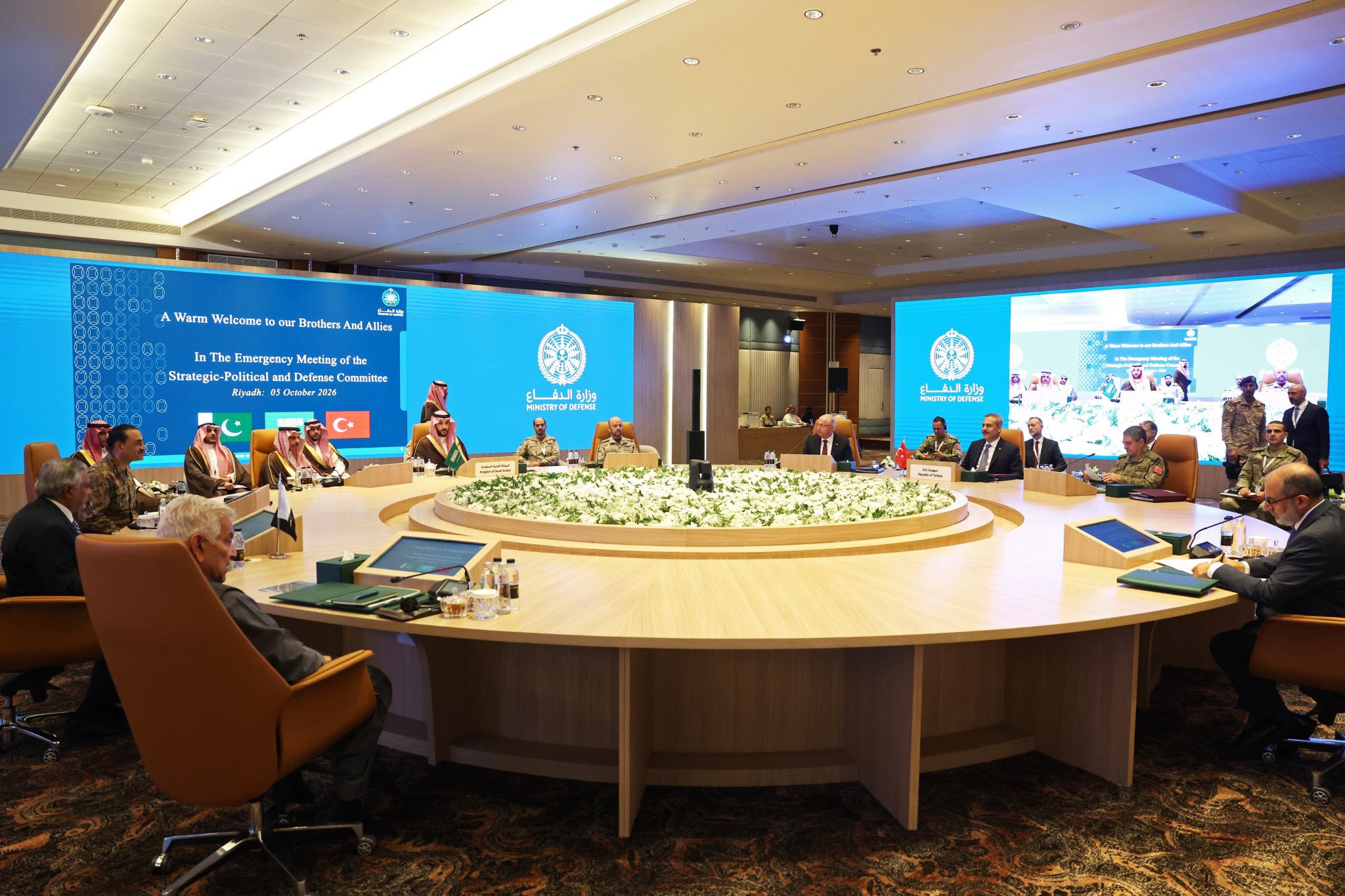
The Houthis are continuing to test Riyadh’s redlines, and although this is not new, this time they are testing them within the parameters of the Mecca Joint Defense Agreement among Saudi Arabia, Pakistan, and Turkey. The three countries activated the pact on October 5 to implement their collective defense commitments and agreed to deploy forces inside Saudi Arabia. However, the pact failed as a deterrent – five days later the Houthis hit Riyadh’s airport. The Houthis are attempting to show that their reach can inflict real damage as a way to deter Saudi Arabia’s partners. Pakistan and Turkey care about their relationship with the kingdom, economically as well as politically, but they may not see the Houthis as their problem, and neither one wants to get dragged into fighting in Yemen. So far, their forces inside Saudi Arabia are playing a supporting role, while Yemeni forces, represented by the Southern Giants Brigades and National Shield Forces, are doing the actual fighting.
Exploiting Civilian Infrastructure Against Vision 2030
Meanwhile, Mohammed bin Salman has stayed committed to Saudi Vision 2030, and the Houthis know exactly where the kingdom is vulnerable. The crown prince was positioning Saudi Arabia as an epicenter for investment and tourism and tying the country’s future to Vision 2030, which the Houthis recognize requires stability and investor confidence. King Khalid International Airport is right at the heart of that. That’s why the Houthis struck the airport and forced its closure. By weaponizing casualties and the threat to Muslim pilgrims on their way to Mecca, they directly multiplied their ability to stifle confidence in the kingdom.
At its core, this is an ideological clash. Saudi Arabia is promoting a future of modernity and globalization, while the Houthis are dedicated to what could be described as Vision 1979, that of Grand Ayatollah Ruhollah Khomeini, in which ideological differences translate into permanent revolution. The Houthis have made sectarian grievance and Yemen’s cultural isolation the organizing principles of their movement. As a totalitarian militia that thrives by indoctrinating children and militarizing society, the Houthis have no other currency but conflict.
Iran is working to wage this clash against Saudi Arabia through the Houthis while maintaining tissue-thin but arguable deniability. So, while Iran is staying out of the clash politically and pretending to stay out of it militarily, Saudi Arabia still feels the pressure. Given the current battlefield dynamics, the Houthis have almost nothing to lose, and they get headlines and a chance to look almost as powerful and dangerous as Iran.
Tehran also answers pressure in kind. When Washington launched Operation Economic Outcast on August 24 to cut Iran off from the global economy, Major General Mohsen Rezaei, secretary of Iran’s Supreme National Security Council, warned that “If the economic war continues, not a single drop of oil will be exported.” The Houthis began their offensive on Yemen’s western coast 10 days later and soon took the Bab el-Mandeb – so that with the Strait of Hormuz already squeezed, a second chokepoint was in the axis of resistance’s hands.
Aviation followed the same pattern. Washington gave airlines until September 23 to stop servicing Mahan Air and Iran Air, and Turkey, Oman, and the United Arab Emirates stopped flights from Iranian airlines. Advisor to the supreme leader Mohammad Mokhber responded that “Either flights are free for everyone in the region, or for no one.” Two weeks later, the Houthis were hitting Saudi airports and warning international airlines to stay out of Saudi airspace. The Houthis call it an airport-for-airport equation, and Tehran calls it flights for everyone or no one. Either way, if Iran’s planes can’t fly, the Houthis are making sure Saudi Arabia’s can’t either.
The Limits of a Deal
The Houthi attacks on Riyadh’s airport should not come as a surprise, because the Houthis have been targeting Saudi airports for years, and Tehran has been hitting Gulf infrastructure since February 28. When the United States and Israel launched their air campaign on Iran, Tehran responded by attacking its Gulf neighbors with missiles and drones, killing 18 people in the first week, 10 of them civilians. In early March, Iran hit fuel tanks at Kuwait’s international airport, damaged a desalination plant in Bahrain, and struck the UAE port of Fujairah. When President Donald J. Trump threatened Iran’s power plants later that month, Parliamentary Speaker Mohammad-Bagher Qalibaf threatened to “irreversibly destroy” infrastructure across the region. In July, Iran struck Kuwait’s power and desalination plants on two consecutive days, knocking some of them offline.
It is understandable that policymakers call for de-escalation, but this fundamentally misunderstands the drivers behind the current escalation and the end goals dictating it: an Iranian-backed Houthi territorial conquest in which escalation is used to force negotiations, rearm, and regroup. This dynamic of escalating with territorial conquest to compel the other side to call for de-escalation pairs nicely with the Houthis’ tactics for rearming and recruiting. They thrive on building internal alliances, providing security and benefits to their loyalists, and weakening their opposition. The six Saada wars from 2004-10 taught them that, as long as they remain uncompromising, their less authoritarian, more bureaucratically minded adversaries will eventually back off.
Meanwhile, Iranian Foreign Minister Abbas Araghchi already called his counterpart in Riyadh, Faisal bin Farhan, after the King Khalid airport was attacked, having sought to broker a deal, likely one that reopens Sanaa’s airport. If Saudi Arabia gives in now and accepts a deal with the Houthis arranged by Tehran that reopens Sanaa’s airport on Houthi terms, it would hand Iran a direct air link to the Houthis, the very thing Riyadh struck the runway in July to prevent, and reward a movement that wants to destroy Vision 2030 with its own vision of 1979. Saudi Arabia will be left with an expansionist Iranian arm permanently on its doorstep – one that eyes the two holy mosques alongside what it claims as Yemeni lands in Jizan and Najran. As dangerous for Saudi Arabia in some ways, a concession after strikes of this magnitude would tell the region that extortion works. It would leave Yemenis stuck under a clerical police state that judges its own success by how much chaos it can send across its borders.
The international community fatally underestimated the Houthis’ reach, objectives, and intentions in 2018 by allowing them to cement their hold on Hodeidah, and today’s threats in the Red Sea are rooted in the 2018 U.N.-brokered Stockholm Agreement that eventually emerged from that miscalculation. That deal stopped Saudi Arabia, the UAE, and the Yemeni government at the edges of Hodeidah port, from which the Houthis now project their power. The 2022 truce then gave them time to rebuild, and they used it to hit the government’s oil terminals.
Riyadh faces real pressure from its military strategy, but it seems to also recognize that peace with the Houthis has never bought anything. On October 13, the coalition struck Houthi positions in Sanaa, and the question now is whether Riyadh is willing to push further while the Houthis punish it for supporting the Yemeni government in its recent counteroffensive. If Riyadh steps back now, Yemenis will be the first to pay for it.
Yemenis also know what happens to anyone who makes a pact with the Houthis. The Houthis’ alliance with former President Ali Abdullah Saleh, whose forces had killed the founder of their movement in 2004, offers the clearest lesson. The moment Saleh announced in December 2017 that he was ready to turn a new page with Saudi Arabia, the Houthis killed him within days. Houthi deals only last as long as the Houthis need them, and once they feel there is nothing left to extract, they turn on whoever made the deal with them.
The views represented herein are the author's or speaker's own and do not necessarily reflect the views of AGSI, its staff, or its board of directors.
In tandem with President Trump’s refusal to offer help with the Houthis, the Saudis are facing grim options to reverse Houthi military successes and a chokehold over their oil exports.
The Houthi escalation against the port city of Mokha is rooted in intra-Yemeni power balances but, at the same time, it has broader implications for Saudi and regional security, testing new defensive coalitions and alliances.
While not without risks, Trump’s redesignation of the Houthis as a foreign terrorist organization is a powerful diplomatic tool for Yemen’s government.