Of Course the UAE Is Not Preparing To Take Over Gaza
When quickly debunked rumors in the Israeli media that the UAE was seeking to manage postconflict Gaza were widely welcomed in Israel, it demonstrated both the trust the UAE has built among Israelis but also their lack of understanding of Emirati policies and interests.
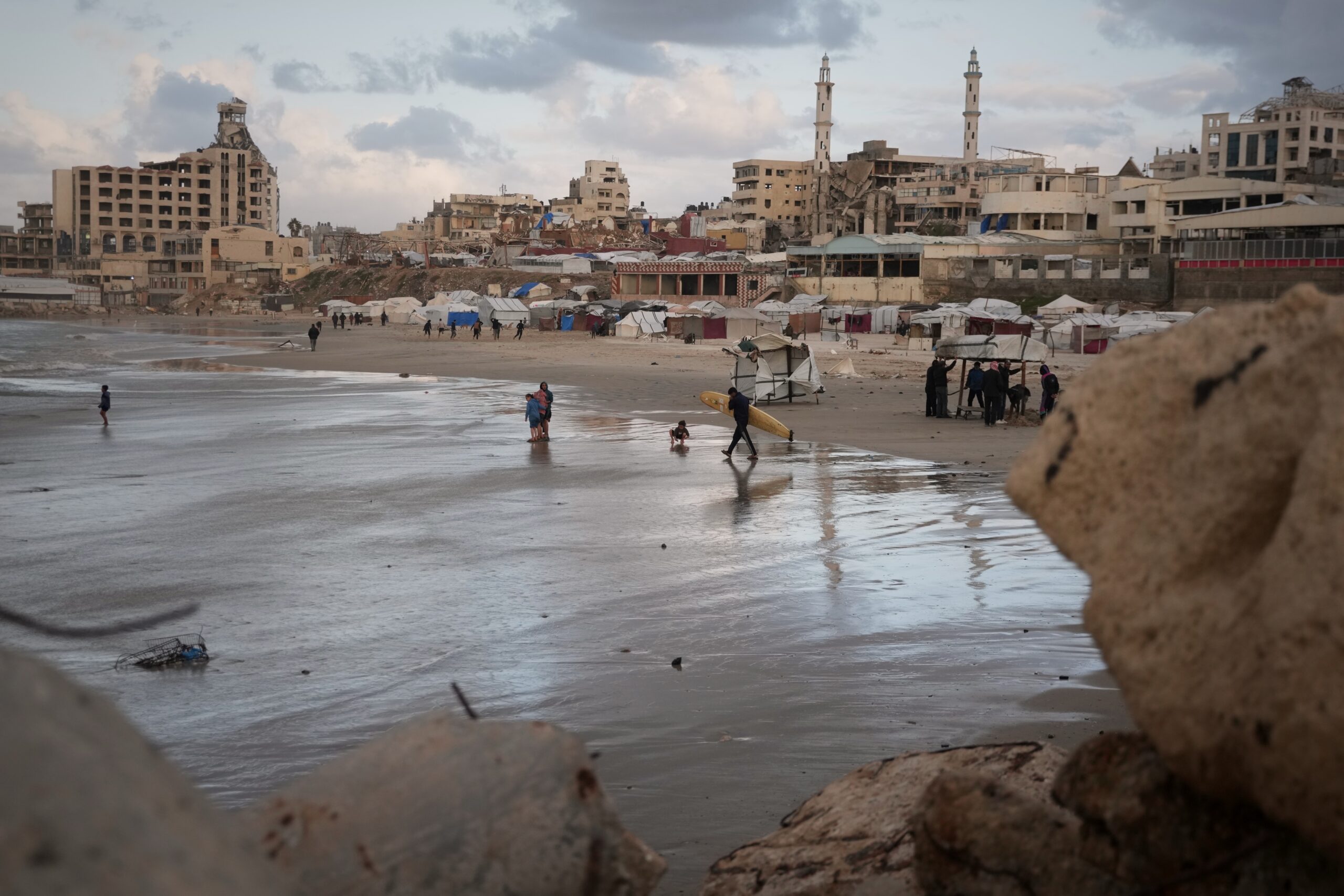
People on the beach near Gaza City, Dec. 28, 2025. (AP Photo/Jehad Alshrafi)
On February 1, a report from Israel’s Channel 12 TV station alleged that the United Arab Emirates was in advanced negotiations with the United States to entirely take over the management of postconflict Gaza, including governance, security, and enforcement, and control over trade, including all imports and exports. This “news” was greeted with considerable enthusiasm in many Israeli quarters, which clearly reflects the significant trust the Emiratis have developed with Israel. The UAE was quick to issue a statement reiterating that governance in Gaza must be a Palestinian affair – implying that any central governance structure will have to be linked to the Palestinian Authority and the Palestine Liberation Organization, which has been the policy of the UAE since the beginning of the Gaza war.
Given the current tensions between the UAE and Saudi Arabia, which have included accusations from some prominent Saudis that the UAE has become too close to Israel, some speculated that the report originated from elements in the Arab world, possibly in Qatar or even Riyadh itself. However, several well-informed Israeli sources have confirmed to this author that the story came entirely from within Israel itself.
But why would anybody make up such a fantastical story? Who would believe that the UAE would want to take over the governance and management of Gaza, violently confront Hamas and possibly Israel too, and oversee an unmanageable, vast reconstruction campaign under such onerous circumstances? What would be in it for the Emiratis?
Why anyone in Israel would concoct such a false story is not entirely clear. Possibly it was an extreme misinterpretation of communications with the UAE, which indeed does want to be involved with reconstruction and postconflict stabilization in Gaza and has joined President Donald J. Trump’s “Board of Peace.” It could have been wildly overreading Abu Dhabi’s ambitions to get involved in Palestinian affairs and directly on the ground in Gaza. If it wasn’t wishful thinking, perhaps it was calculated misdirection on the part of an Israeli government that isn’t interested in implementing Trump’s “Phase 2” of the ongoing cease-fire, such as it is. By suggesting that the UAE might serve as a deus ex machina to save Israel from the catastrophe it has created in Gaza, officials might be sending the message to other Israelis that the situation is not hopeless and, as Trump might have put it, “help is on the way.” However, there is no deus ex machina or third party coming to resolve the conflict in Gaza – the only plausible alternative being the Palestinian Authority.
There are only two poles in Palestinian politics: the Islamists of Hamas and the secular nationalists of Fatah. Israel’s refusal to allow, especially in practice, anything that smacks of a stronger Fatah presence in Gaza is completely understandable given that the prime directive guiding the current Israeli Cabinet is the eventual annexation of the West Bank.
Prime Minister Benjamin Netanyahu and his, in many cases more extreme, Cabinet colleagues, essentially regard all Palestinians as adversaries. They do not see much of a distinction between Fatah and Hamas as different variants of the Palestinian obstacle to the creation of a greater Israel in the entirety of British mandatory Palestine, all of which they now control. But if one must choose between adversaries, it is obviously preferable to be dealing with one that has very little support regionally and globally and is pursuing a fundamentally irrational and unattainable aim: the creation of a kind of Muslim Brotherhood-inflected theocratic state in exactly the same area between the Mediterranean Sea and Jordan River.
The secular nationalist troika of Fatah and the Palestinian Authority on the ground, along with the PLO and its formidable international diplomatic presence (including nonmember observer state status at the United Nations General Assembly and membership in important multinational organizations) poses by far the greatest threat to ambitions for the creation of a permanent and recognized greater Israel in all of mandatory Palestine. In sharp contrast to Hamas, with its unachievable stated goal, and largely unpopular reactionary social policies, the Fatah-controlled secular nationalist forces still constitute the only serious obstacle to Israeli territorial ambitions. In 1993, the PLO recognized Israel, and, despite Israel never recognizing the Palestinian right to a state, the PLO has consistently maintained this asymmetrical diplomatic recognition. Israel’s response to the PLO recognizing Israel was to recognize the PLO as the legitimate representative of the Palestinian people and undertake to enter negotiations that produced the Oslo agreements, which have not made any progress since the mid-1990s.
Yet the Fatah/Palestinian Authority/PLO project of establishing a small, nonmilitarized Palestinian state based in the West Bank alongside Israel as a conflict- and claims-ending agreement remains a mortal threat to Netanyahu and his Cabinet’s annexationist aspirations. The PLO project is rational, is now supported by almost all governments in the world, was endorsed by the U.N. Security Council (including the United States under President George W. Bush in 2002), and offers the only plausible formula to end the endemic and deepening violence between the Jewish Israeli and Palestinian peoples. Even some advocates of a single state have recognized that it will probably have to pass through the phase of the creation of a Palestinian state alongside Israel before various forms of federation, confederation, or other mechanisms of greater integration might become viable. But under the circumstances, especially since October 7, 2023, sudden reconciliation and unification is simply inconceivable given the current extreme levels of mutual mistrust, and even hate.
Netanyahu’s long-standing policy of maintaining Hamas in power in Gaza, albeit contained and subject to repeated and literal cutting down to size, while keeping Fatah in power in the small self-ruled areas of the West Bank, evidently continues to inform his approach to blocking any prospect of Palestinian statehood. Since the Gaza war began, Netanyahu has steadfastly refused to allow any Fatah-based presence in the territory, preferring to allow Hamas to reassert power in the areas disengaged from by the Israeli military by blocking any possible alternative. The Israelis clearly need the Palestinian Authority to provide security in the small self-ruled areas of the West Bank, so there is some degree of Israeli cooperation with Fatah in that regard.
But in many other ways the Israeli right, including Netanyahu, has been in effect a more reliable partner with Hamas in continuing the conflict between Israelis and Palestinians and blocking any diplomatic progress or prospects for the small and nonmilitarized Palestinian state that Fatah seeks to establish alongside Israel. Both ardently oppose that project, and both are committed to continuing to fight each other, so there is a de facto partnership – at least in the form of an overlay of transitional long-term objectives – between the Israeli ultra-right and the Hamas Islamist extremists that runs far deeper than the more superficial cooperation between the Israeli government and Palestinian Authority.
And that’s exactly why the UAE continues to demand a significant role for the Palestinian Authority in postconflict Gaza and has been clear that it will only operate in any capacity in that territory at the explicit invitation of the Palestinian Authority. The notion that the UAE would decide to partner with Israel and impose an external, albeit Arab, rule in Gaza absent a clear partnership with the Palestinian Authority and PLO runs counter to every stated UAE policy and the UAE’s national interests and security strategy.
It remains unclear who in Israel cooked this rumor up and exactly why. However, that it was greeted with so much credulous enthusiasm demonstrates that the UAE has built a level of trust among Israelis that surpasses anything any other Arab country has achieved. This is, of course, an ambition that may be unique to the UAE, but the Emiratis have succeeded in forging a remarkable sense of trust with Israelis in a fairly short time, which was a strategic policy goal of the UAE’s normalization of relations with Israel. However, that anyone seriously imagined that the UAE would wish to effectively govern Gaza is a telling indication of how misunderstood the policies of the UAE, especially toward Israel and the Palestinians, have become.
The views represented herein are the author's or speaker's own and do not necessarily reflect the views of AGSI, its staff, or its board of directors.
The GCC +2 meeting, followed by the Arab League, has to take Trump's dangerously implausible ideas about Gaza seriously, but Israel won't countenance the Arab states’ alternative.
The disconnect on Syria is so profound it risks rupturing the assessment of shared interests that underlies the Abraham Accords and the tentative efforts by others in the Gulf to find the right circumstances and timing to sign on to that project.
Palestinians are fuming, but the United States, the United Arab Emirates, and Israel all see clear benefits in the normalization of relations between a key Arab state and Israel.
Though they were unsuccessful in preventing the current conflict, and, as expected, have been dragged into the U.S.-Israeli confrontation with Iran, Gulf Arab countries remain crucial to hopes for limiting the war and bringing it to a quick resolution.
After decades of tolerating Hezbollah’s warmaking independence, the current crisis has compelled Lebanese leaders to ban its military activities; this project will do much to determine the reach Iran can maintain in the Arab world.
Gulf Arab countries urged the United States not to strike Iran, but now that is happening, they are in danger of being sucked into a conflict they cannot control but that will likely reshape their present and future realities.
When the Saudi crown prince meets President Trump in Washington, the main topics of discussion are likely to be commercial deals, a defense pact, a Saudi civilian nuclear program, and normalization with Israel.
On January 8, AGSI hosted a virtual roundtable with its leadership and scholars as they look ahead and assess trends likely to shape the Gulf region and U.S. foreign policy during the coming year.