Following Saudi Arabia’s early exit from the World Cup, the kingdom’s soccer authorities may enter a period of introspection considering challenges that have cast a shadow over the post-2023 landscape of Saudi soccer.
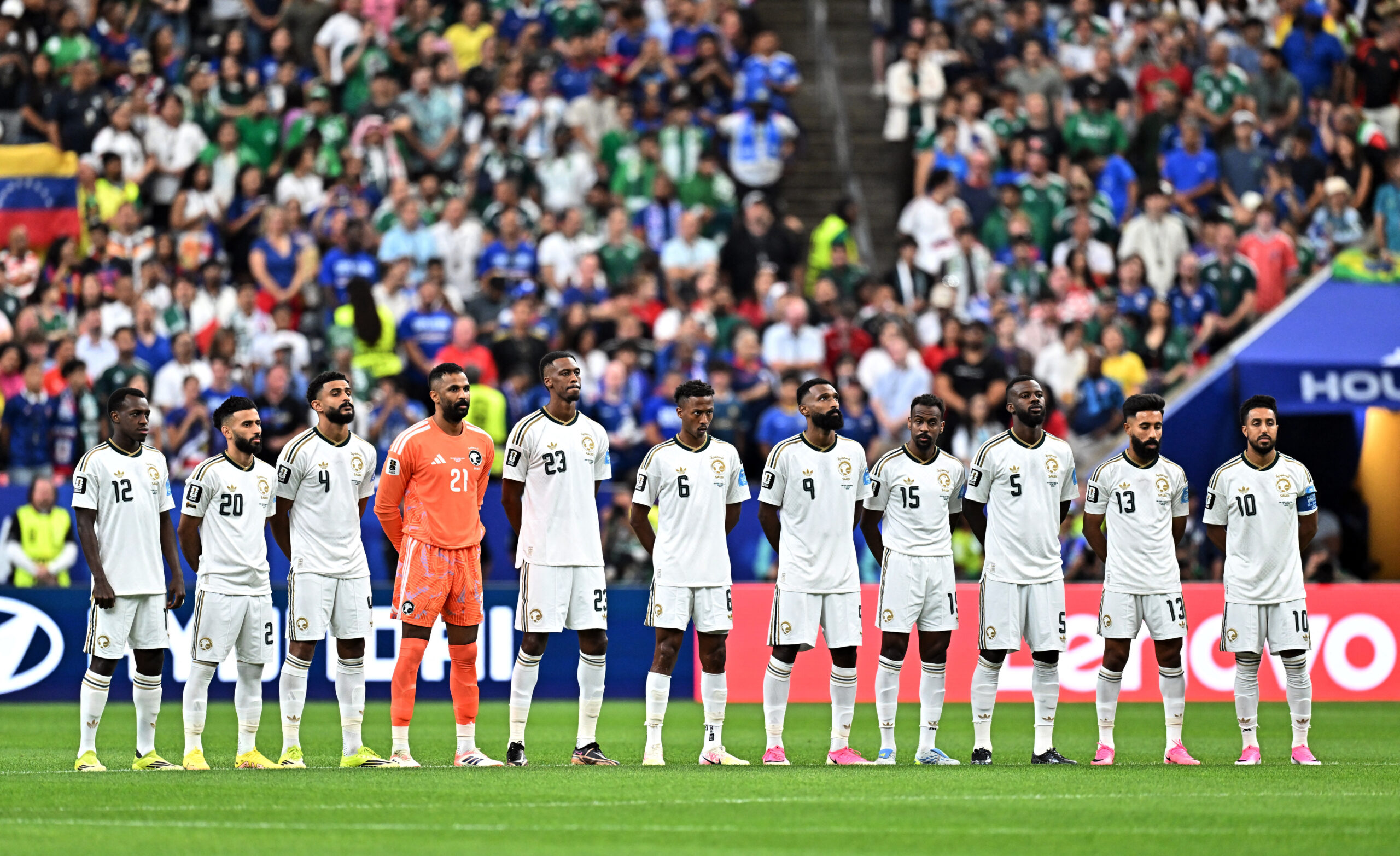
Players from the Saudi national team ahead of the match against Cape Verde at Houston Stadium, Houston, Texas, June 26. (IMAGN IMAGES via Reuters/Maria Lysaker)
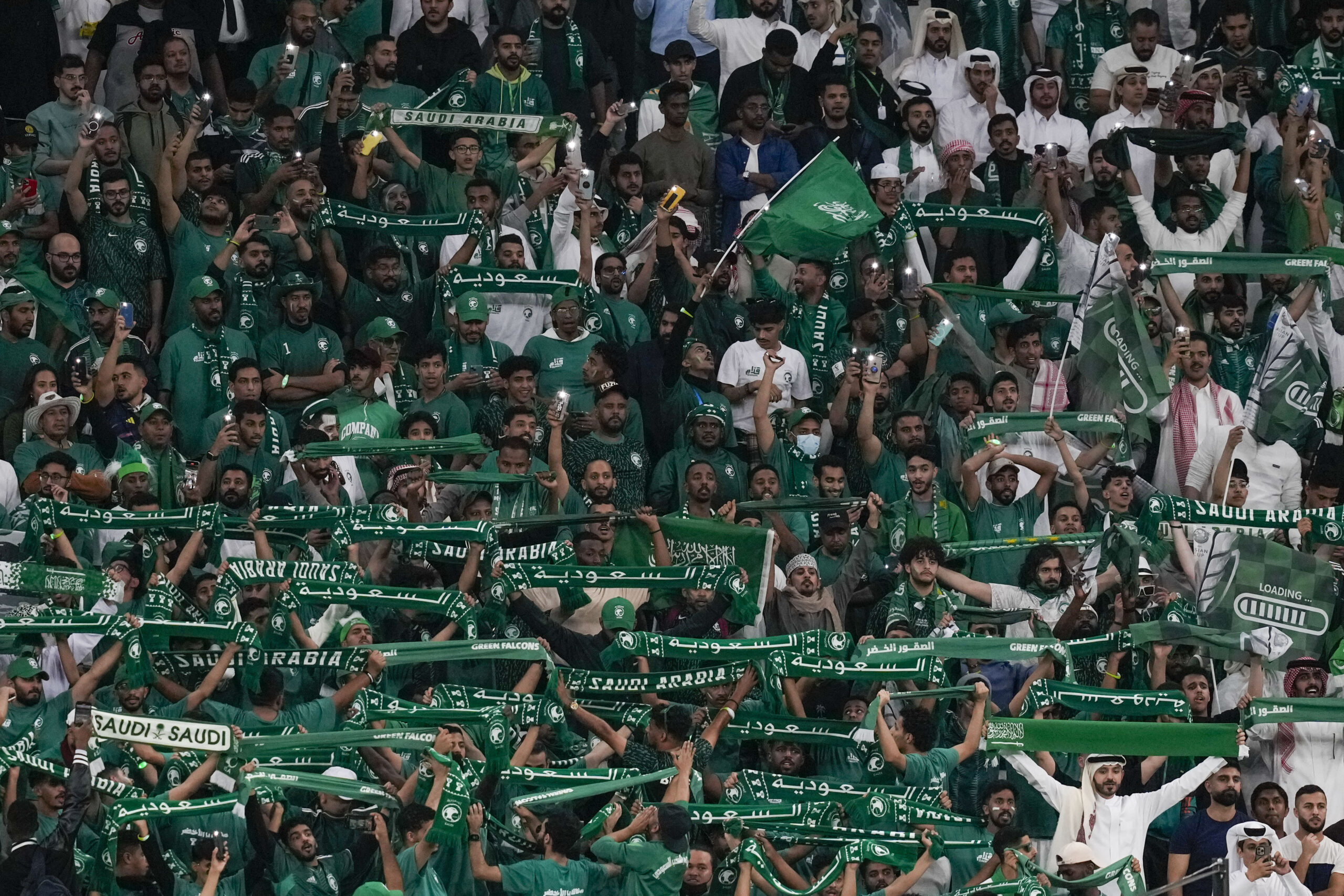
For the second time in a row, Saudi Arabia finished at the bottom of its group and made an early exit from the FIFA World Cup. This time around, there was none of the heroics of the victory over eventual champion Argentina in 2022, as the Green Falcons – a nickname for the Saudi national team – drew with Uruguay and Cape Verde either side of a heavy defeat against Spain. Scrutiny of the national team’s failure to make an impression in the United States will be magnified, as it comes after three years of heavy investment into the football, or soccer, ecosystem in Saudi Arabia, which is also now the host of the 2034 World Cup. A period of introspection may follow that assesses how and where best to allocate resources as attention turns to hosting and being competitive at the 2027 AFC Asian Championships as a staging-post to 2034.
To be sure, the recent Saudi performance was not wholly negative, as the team came within 10 minutes of defeating two-time champion Uruguay, while Cape Verde was the surprise package of the tournament and captured hearts worldwide as it took Argentina to extra time in the Round of 32. However, the 4-0 defeat to Spain reawakened memories of heavy defeats in past World Cups, such as the 8-0 to Germany in 2002, 4-0 to Ukraine in 2006, and 5-0 to Russia in 2018, which Saudi officials doubtless hoped were firmly a thing of the past. Moreover, the results added to a sense of unease expressed at various points since 2023 that investment into domestic clubs in Saudi Arabia was paradoxically undermining the prospects for the national team by restricting opportunities – and game time – for Saudi players back at home.
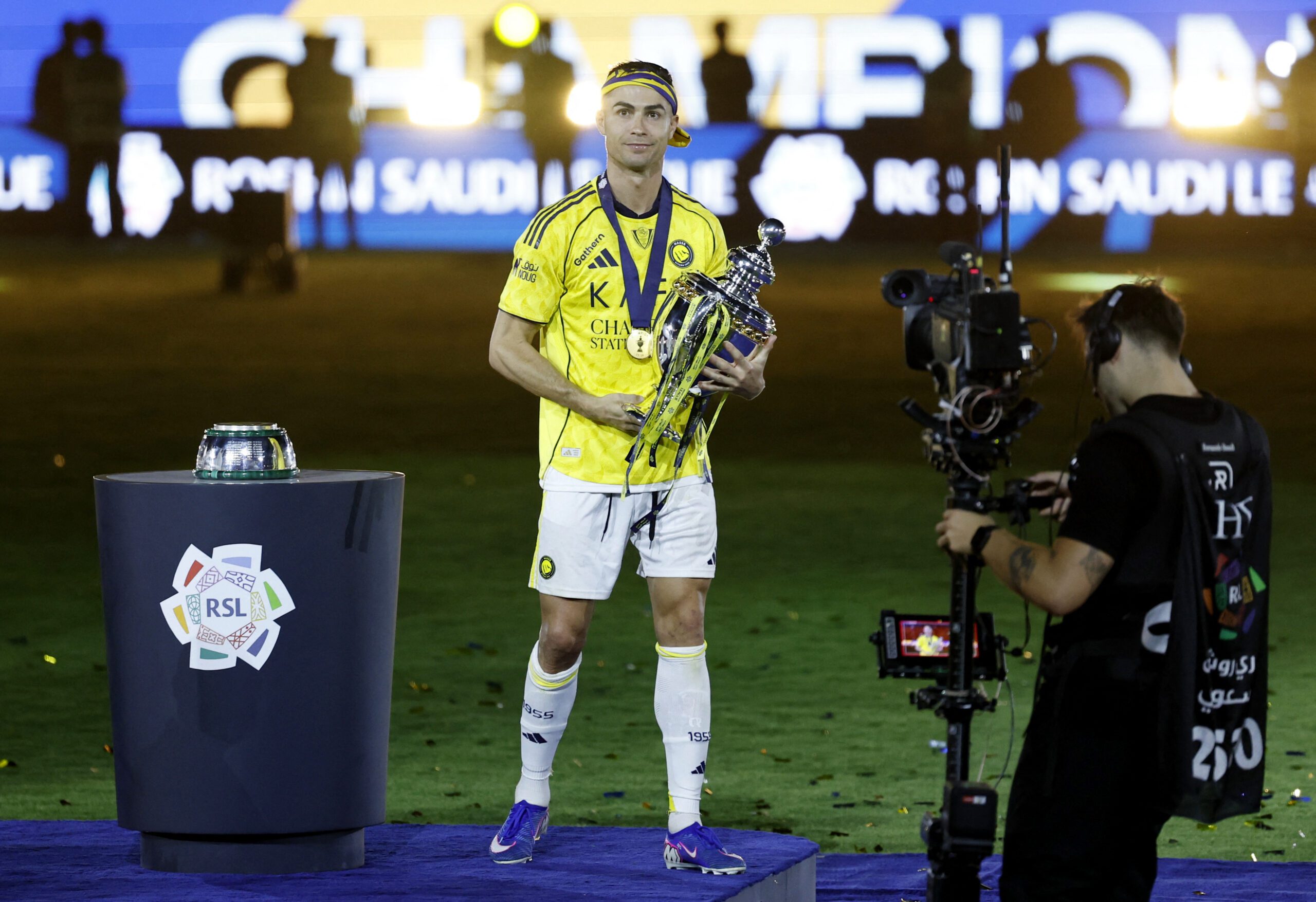
Flush from the glow of the win over Argentina in 2022, Saudi Arabia made global headlines the following month when Al-Nassr signed Cristiano Ronaldo, the Portuguese captain and, along with Lionel Messi of Argentina, one of the two defining superstars of his era. Allaying concerns that Ronaldo’s arrival might be a one-off, as had happened in 1978 when Brazil’s captain Roberto Rivelino signed for Al-Hilal, a host of international stars moved to Saudi clubs in the summer of 2023, including Neymar, the Brazilian superstar who had been the most expensive player in the world when he left Barcelona for Paris Saint-Germain in 2017.
Their arrival transformed the Saudi Pro League into one of the most talked about in the world, as the subsequent 2023-24 season began in a blaze of global publicity and media interest. Many of the foreign stars arrived on three-year contracts that took them through to 2026. All eyes are now on whether Egyptian superstar Mohamed Salah continues his career in Saudi Arabia or whether he chooses the United States instead, as Messi did when he joined Inter Miami rather than Al-Hilal in 2023. Should Salah move to Saudi Arabia, he would become the “face” of the Saudi Pro League, as it moves closer toward a post-Ronaldo era, considering the Portuguese forward is 41 and approaching the inevitable end of his playing career.
While the scale of investment in the domestic game has been impressive, facilitated by the Public Investment Fund’s acquisition in 2023 of 75% stakes in four of the biggest Saudi clubs (Al-Hilal and Al-Nassr in Riyadh, Al-Ittihad and Al Ahly in Jeddah), several areas of concern have cast a shadow over the post-2023 landscape of Saudi soccer. One has been the struggle to generate large attendances for games not involving the big clubs, as crowds have lagged behind those in comparative leagues, such as Major League Soccer in the United States. A reason occasionally given for the low figures has been that stadiums are being refurbished ahead of the Asian Cup, which Saudi Arabia will host in January 2027, so it will be instructive to see if the completion of improved facilities leads to a sustained rise in attendance figures.
Another issue that has periodically been raised by coaches of the national team since 2023 has been that the high number of foreign players allowed on each team has narrowed the chances for Saudi talent to break through. Since 2024, each team in the Saudi Pro League has been allowed a quota of 10 foreign players, of whom eight can be registered for a match. Then-national team Coach Roberto Mancini stated in October 2024 that “Three years ago all the Saudi players played every game,” but he continued that “today, 50, 60 percent don’t play in the game.” While Mancini may have been excusing an underwhelming start to World Cup qualification, which cost him his job a week later, his observation carried merit, as the team made heavy weather of qualifying, only winning four of 12 games in the final two rounds and benefiting from the expansion of the tournament to 48 countries, which opened up more spots.
The Saudi soccer authorities thus find themselves at a crossroads. 2026 completes the first World Cup cycle of large-scale investment, which began with Ronaldo’s arrival 10 days after the ending of the 2022 tournament in Qatar, and the results have been underwhelming. Questions may now be asked about whether resources should be focused on developing Saudi players at every level of the age pyramid and facilitating their pathway to regular game time at their clubs. There is still time to invest in a youthful cohort of players who could become stars in 2034, just as Qatar did with the team that won the AFC Under-19 championship in 2014 and went on to win back-to-back Asian Cups in 2019 and 2024. In the Qatari case, no fewer than eight of the 22 players who became Under-19 Asian champions in 2014 were in the squad that triumphed in the senior tournament in the United Arab Emirates five years later.
Between 1984 and 2000, Saudi Arabia reached five consecutive Asian Cup finals, a record unmatched by any other country, and the 2027 tournament offers a chance for the national team to look forward and begin the long preparation for the 2034 World Cup. At club level, Saudi teams remain competitive, and Al Ahly has won the last two AFC Champions League, albeit in a controversial new format that sees the quarter-finals, semifinals, and final all take place in the kingdom under a five-year agreement that began in 2024. The challenge will be how to balance the continental success of Saudi clubs, stocked with foreign players, with the need to nurture the next generation of Saudi players. Investment in the ecosystem of training facilities and the wider sporting infrastructure may improve the chances available to Saudis, although progress may only become apparent over many years. The recent success of the English national team offers hope in this regard after officials faced similar challenges in the early years of the Premier League in the 1990s and 2000s over the foreign-to-local ratio.
Should the Saudi authorities divert resources away from big-name foreign stars toward local talent in the next phase of their soccer strategy, they would replicate some of the shifts seen in the broader economy in recent months, as gigaprojects have been downsized or suspended. Simultaneously, major initiatives have been retooled to place greater emphasis on the domestic economy, as evidenced in the unveiling in April of the new five-year strategy for the Public Investment Fund up to 2030. The launch of projects such as The Line and the planned Trojena winter resort reflected an era of near-limitless ambition among the Saudi leadership, as did the “big bang” transformation of the Saudi Pro League in 2023 and the securing in 2023-24 of the hosting rights to the FIFA World Cup. As initial ambitions are pared back, it is likely that the 2034 tournament will be the most tangible outcome of the early-2020s era of grandiosity and big-picture planning in Saudi Arabia.
The views represented herein are the author's or speaker's own and do not necessarily reflect the views of AGSI, its staff, or its board of directors.
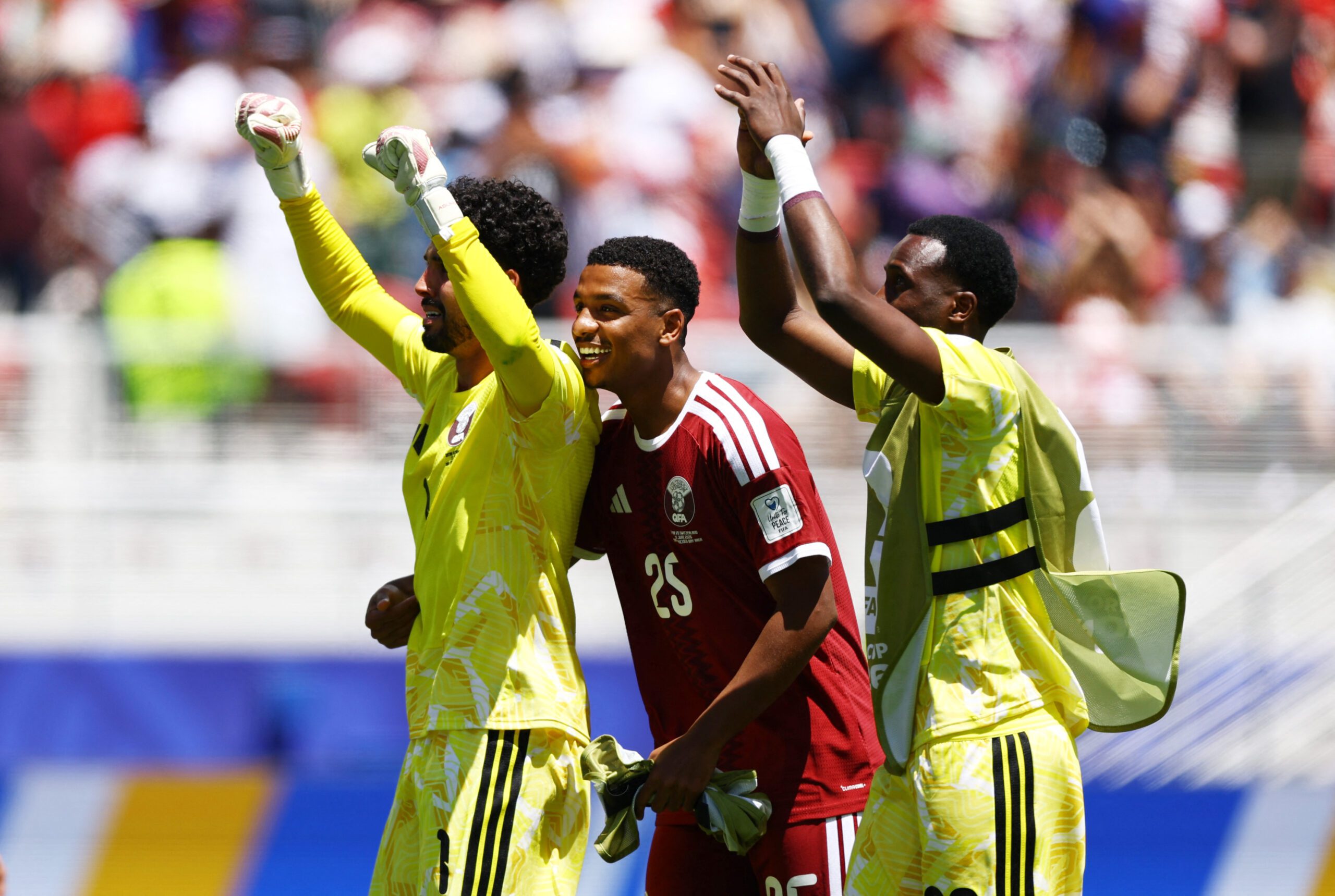
Qatar's first World Cup point, earned through a goalkeeper of Palestinian descent, reveals how the emirate has turned a tiny citizenry, migration, and naturalization into an instrument of statecraft and where that instrument meets its limits.
Hosting the World Cup will be a huge opportunity for Saudi Arabia, supporting Vision 2030 reforms. While preparations for the tournament will be costly, they will boost economic growth and could spur further social change.
Saudi-Emirati public reconciliation, a result of hard-earned lessons about the difficulty of going it alone, bodes well for a region at war and under attack, but there are still issues left to resolve.
Gulf capitals are facing immediate policy choices around how to restore order in a regional setting that is greatly changed – for the worse – as a result of the Iran war.