Qatar's first World Cup point, earned through a goalkeeper of Palestinian descent, reveals how the emirate has turned a tiny citizenry, migration, and naturalization into an instrument of statecraft and where that instrument meets its limits.
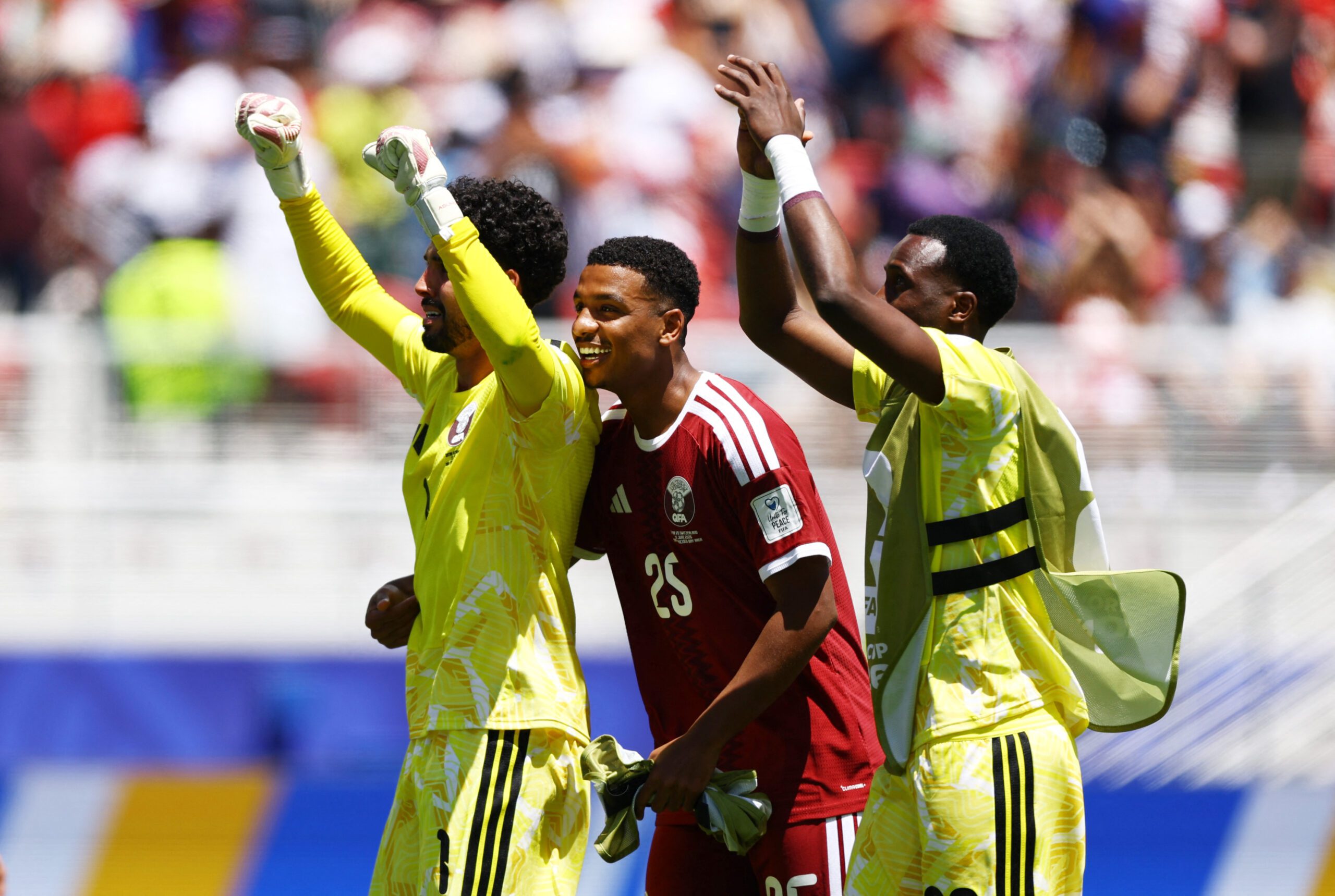
Qatar's Mahmoud Abunada and Al-Hashmi Al-Hussain celebrate after the match against Switzerland at San Francisco Bay Area Stadium in Santa Clara, California, June 13. (REUTERS/Luisa Gonzalez)
When Qatar’s Mahmoud Abunada was named man of the match in Santa Clara, the award went to a goalkeeper who had conceded a first-half penalty before keeping his side alive with a string of saves. The performance June 13 secured Qatar a 1-1 draw with Switzerland and its first point in FIFA World Cup history, erasing the memory of 2022, when Qatar became the first host country eliminated without a single point. Born in Doha to a family from Gaza, Abunada is a more faithful portrait of contemporary Qatar than the stadiums and broadcasters that form its sporting storefront. Far from those emblems, the national team is one of the state’s quieter mechanisms, and he is the part that, having faltered early, kept the apparatus standing. The squad that crossed the Atlantic to play in a 48-team tournament shared among the United States, Canada, and Mexico closely resembles Qatar itself. Twice the reigning Asian champion, it follows the geopolitics of the state that built it.
A Point Shaped by Football’s Hierarchy
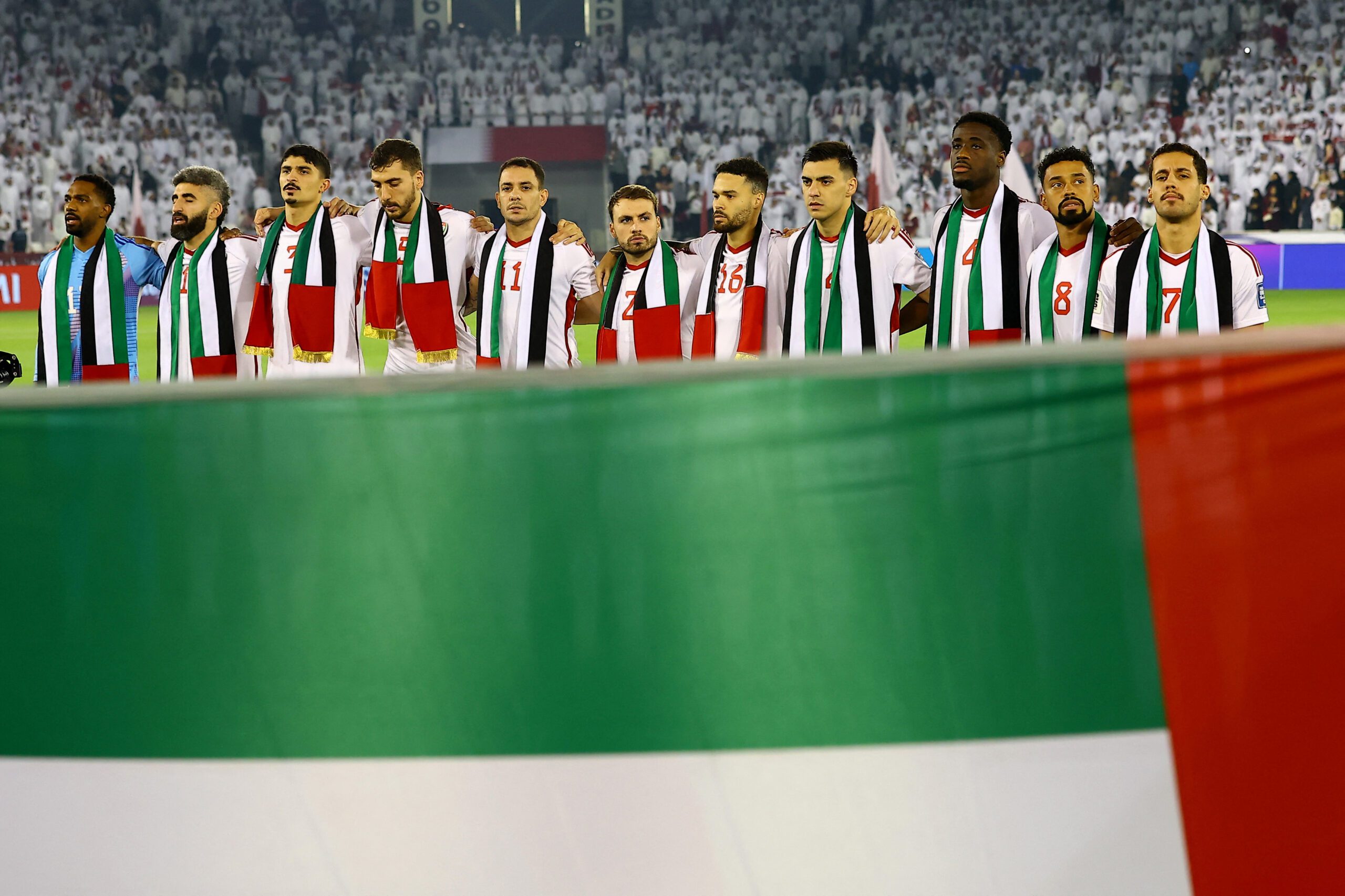
Qatar’s first point is also an artifact of how access to the global game is apportioned. Expanding the finals to 48 teams widened a door long narrow for the Asian, African, and Oceanian confederations. Yet, if the opening genuinely raises the level of teams kept at the margins, it stems first from FIFA’s underlying desire to enlarge its profits – more teams means more revenue, expanding FIFA’s balance sheet as much as the game. The allocation still encodes a durable hierarchy. Europe, with 55 members, is awarded 16 places; the South American confederation, with 10 members, receives six direct berths; the Asian confederation, with more than 40 members, gets eight places; and Oceania is guaranteed a single place. Qatar reached North America only through an Asian playoff, past the United Arab Emirates and Oman, a measure of how steep the climb remains for countries outside the historic core.
A History Obscured
To audiences who follow neither Asian nor Arab football, Qatar can seem a country without a footballing past, its prominence bought rather than built. The archive says otherwise. At the 1981 World Youth Championship in Australia, a barely known Qatari team reached the final, eliminating Brazil 3-2 and England 2-1 before losing to West Germany. That generation was celebrated in the song “Hayu Fariqi” (Let’s Go, My Team!) by Ali Abdel Sattar, which remains popular today, a marker of a first golden age. Qatar also reached the summer Olympics in Los Angeles in 1984 and Barcelona in 1992, advancing to the quarterfinals in Barcelona. The run followed the building of a sporting system in the 1970s, driven by the influential first minister of education, Jassim bin Hamad bin Abdullah al-Thani, who was appointed in 1958 and held the post until his death in 1976. The impression of a country without history is also a residue of the information contest among Qatar, Saudi Arabia, the UAE, and Israel that emerged in the early 2010s, in the wake of Qatar’s award of the 2022 World Cup, in which rival campaigns found it convenient to cast Qatar as a parvenu with money but no sporting substance.
The Decline of the Founding Families
From that promise, Qatari football slid into a long decline bound up with rising wealth. The game was then rooted in Doha’s neighborhoods and clubs and sustained by established local families – the face of a state independent only since 1971. Gas wealth then reshaped the demographic structure. Of some 3 million residents today, nationals form a narrow minority amid expatriates drawn from South Asia, the Arab world, and Africa to run the economy. As society grew rich, the citizen families who had carried the team withdrew toward the stands, boardroom, and majlis. Affluence hollowed out the very base from which the 1981 generation had sprung.
The Champion Factory
The instrument of recovery was the Aspire Academy, launched in 2005 to rebuild the sporting system and lend athletic substance to Doha’s broader international strategy. Its mission has been to detect, train, and shape – identifying talent in Qatar’s schools, among nationals and long-settled expatriates alike, and molding it to European standards under coaches drawn from Spain, Germany, France, South America, and North Africa. Almost the entire Qatari squad that won the 2019 and 2023 AFC Asian Cups emerged from the Aspire Academy’s ranks. Without the Aspire Academy, there would have been no continental title and no sporting legitimacy to accompany Doha’s projection of influence.
A Mosaic of Migration
In the 2026 squad, the children of Qatari families can be counted on one hand, beginning with veterans, including Hassan Al-Haydos, the last thread to the founding lineages. Beyond them the team reads as a mosaic of the migrations that supply the Qatari economy with labor. Its leading figures embody the shift – Akram Afif, of Somali Tanzanian Yemeni descent and named Asia’s best player, and Almoez Ali, born in Khartoum to a Sudanese family, alongside the goalkeeper Abunada of a Gazan family and players of Iraqi, Egyptian, Moroccan, Somali, and Senegalese descent. To these the squad adds naturalized players from the domestic league, among them Boualem Khoukhi, the Algerian defender who scored the equalizer against Switzerland, and more recently two Brazilians. The 2022 team was meant to embody an “Arab World Cup”; by 2026, on North American soil, symbolism could recede behind efficiency. When the domestic market does not suffice, Qatar imports the competence it needs, on the pitch as elsewhere.
Sports as an Insurance Policy
This sporting logic mirrors security strategy. Wedged between far larger Saudi and Iranian neighbors, and only recently out of the 2017-21 boycott by Saudi Arabia, the UAE, Bahrain, and Egypt, Qatar has used sports to project beyond its size. The purchase of Paris Saint-Germain, the launch of beIN Sports, and the hosting of the 2006 and upcoming 2030 Asian Games, world championships in handball and athletics, 2022 World Cup, and upcoming 2027 Basketball World Cup are investments in this high-visibility sector of globalization. The architecture holds only if maintained; to stay dynamic Qatar must keep capturing new audiences by folding new sports into its events portfolio. The aim is less prestige than the interdependencies and reputational stakes that work as a security guarantee for a state that cannot rely on demographic or military weight.
The Trauma of 2022 and the Test of Geography
The limits are equally clear. Losing every match in 2022, to Senegal, Ecuador, and the Netherlands, the host and reigning Asian champion became a counterargument to those who challenged Qatar’s legitimacy as a stage for major international events, first and foremost the World Cup. The internal humiliation, and the quiet purge of players that followed, showed how sensitive the file is for the state. Won at home months later, the 2023 Asian title healed part of the wound left by the 2022 humiliation, but it also underlined the project’s central ambiguity: Qatar is dominant within Asia yet exposed the moment it faces the wider world.
That fragility is a matter of geography more than talent. These players are formed for Asia, not the world. Almost all play in the Qatari league, competing at most in the Asian Champions League, and few have established themselves in the European competitions where the standard is forged. The result is not a deficit of quality but a level that, collectively, plateaus for want of sustained exposure to top intensity. Aspire’s own staff concede as much internally. The talent is there, they say, but it quickly shows its limits as adversity rises, the obstacle less technical than mental, the team unsettled too easily.
Yet the same World Cup run furnished a blunter measure of where the team truly stands. The lone point earned against Switzerland was followed by a 6-0 defeat to Canada, the kind of result in which the gap in intensity stops being an internal assessment and becomes a public fact. Once the tempo rose beyond anything the domestic calendar had ever demanded, Qatar was overrun, the ceiling its own coaches describe laid bare in a single afternoon.
Abunada complicates that verdict. The very mental fragility his coaches describe found, in him, one of its exceptions. Abunada was formed entirely within the domestic game, where the level of competition rarely rises above the Asian stage. In Santa Clara, he nonetheless met the physical and mental demands of a World Cup. His composure under a Swiss siege was that of a goalkeeper measuring up to a stage his weekly football almost never offers, proof that the ceiling, though real, is not a wall. Yet a goalkeeper cannot, on his own, close the gap that separates his side from the world’s best. Against the limits of his own team – and, more broadly, of the very system that allowed him to emerge – Abunada could not reproduce the feat, and Bosnia and Herzegovina will be a fresh test of whether he can once again rescue his teammates. There lies the paradox the draw leaves intact, a team engineered for Asia yet capable, for 90 minutes, of answering the world. And perhaps, like their forebears of 1981, these players will outwit geography and force a feat of their own.
The views represented herein are the author's or speaker's own and do not necessarily reflect the views of AGSI, its staff, or its board of directors.
Hosting the World Cup will be a huge opportunity for Saudi Arabia, supporting Vision 2030 reforms. While preparations for the tournament will be costly, they will boost economic growth and could spur further social change.
Cricket has become a key part of the United Arab Emirates’ multipolar approach to sports investment, where franchise ownership, player markets, and transnational capital converge to support economic diversification and power projection.
As Saudi Arabia seeks to reposition itself as a leading regional and global actor, its embrace of camel diplomacy reflects a sophisticated recalibration of tradition for modern ends.