Saudi State and Society React to JASTA Saudi Arabia and its fellow Gulf states were quick to react to the passage of the Justice Against Sponsors of Terrorism Act (JASTA) by the U.S. Congress and, in an equally overwhelming vote, its override of the presidential veto of the bill. Still the negative, yet cautious, tone...
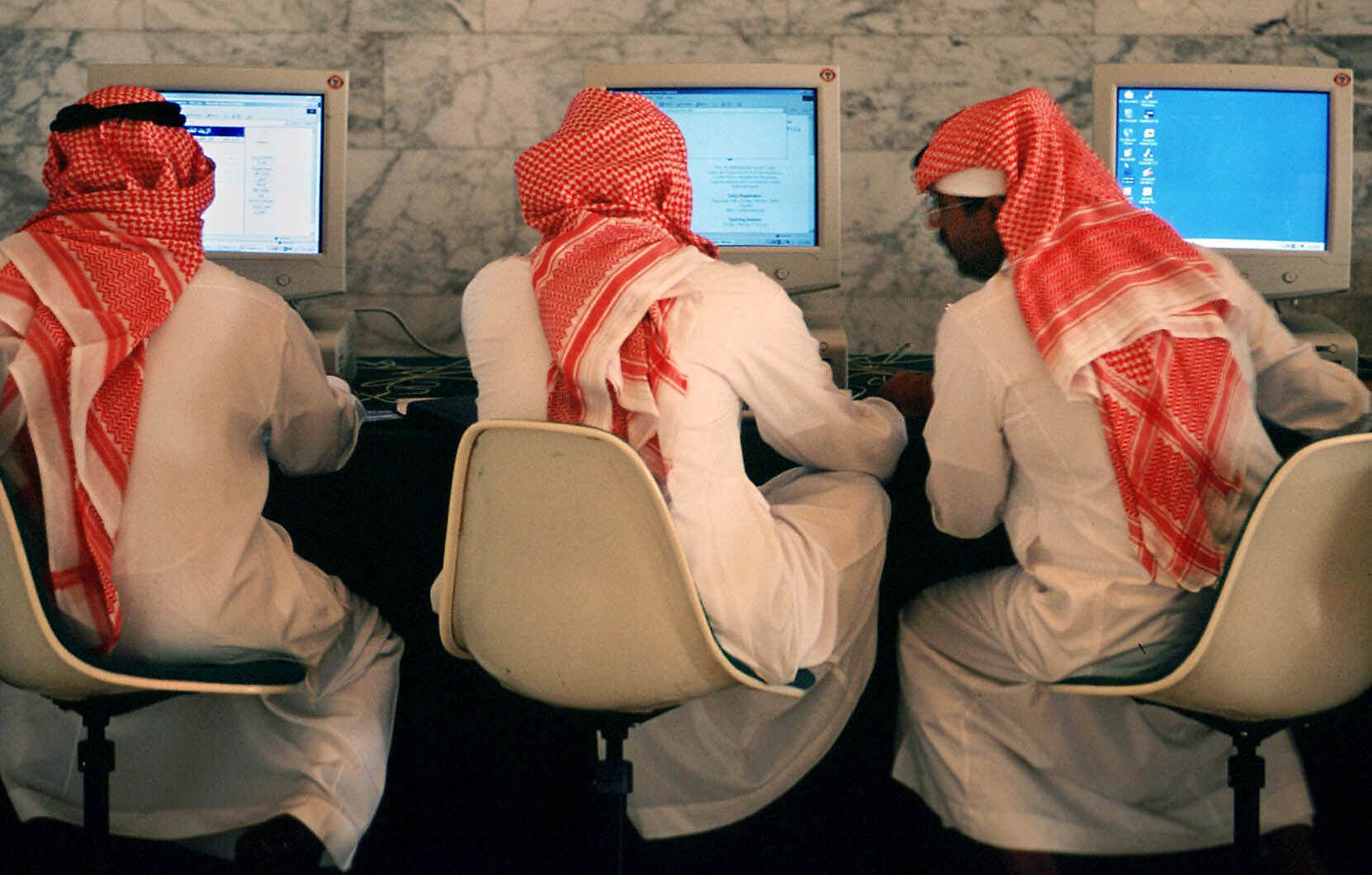
FILE- In this November 17, 2000 file photo, Saudi men talk and browse the internet at a hotel in Riyadh, the capital of Saudi Arabia. When a teenager in Saudi Arabia began chatting up an American woman online, he first found fame and then notoriety before he was arrested over concern his clumsy cyber flirtation violated the kingdom’s conservative norms. (AP Photo/Kamran Jebreili, File)
Saudi State and Society React to JASTA
Saudi Arabia and its fellow Gulf states were quick to react to the passage of the Justice Against Sponsors of Terrorism Act (JASTA) by the U.S. Congress and, in an equally overwhelming vote, its override of the presidential veto of the bill. Still the negative, yet cautious, tone of the official response does not fully capture the nature of the discussion among Saudi opinion makers and the public to this latest challenge to U.S.-Saudi relations. While some op-ed writers praised the measured response of the government, counseling patience and forethought in crafting a reaction, others urged their government to rethink the strategic relationship with the United States. Meanwhile, the more freewheeling commentators on social media mocked the hypocrisy of the United States, while weighing the potential impact of the law on Saudi Arabia’s future, and their own.
A Measured Official Statement
The Gulf state most directly affected by the act, Saudi Arabia, issued a very brief condemnation. A statement by the Ministry of Foreign Affairs highlighted the potential impact of JASTA on international law, stressing the erosion of the principle of sovereign immunity, and noting the shared opposition to the act by U.S. national security experts and other U.S. allies. The official statement and statements by Saudi scholars have expressed the hope that the act may be amended or repealed, especially as new members join Congress after the November elections. Other Gulf countries added their own displeasure at the passage of JASTA, showing their support by expressing common concerns with Saudi Arabia.
Saudi opinion makers echoed the concerns of their government. Considering the major and multifaceted consequences of JASTA, most editorials and op-eds advised the Saudi government to avoid overreacting, which seems to be the official stand anyway. Jamal Khashoggi, editor-in-chief of Al Arab News Channel, further provided recommendations to strategically deal with the situation, such as suggesting that the government conduct an internal assessment and policy analysis into the reasons and circumstances behind the strong support for JASTA in the U.S. Congress. Majed Garoub, a Saudi lawyer, advised the Ministry of Foreign Affairs to form legal and media committees dedicated to dealing with JASTA’s enforcement and any ensuing ramifications.
Scholars and journalists, on the other hand, emphasized the impact of JASTA on the broader Saudi-U.S. relationship, some going so far as to encourage the government to review the alliance. Others targeted the area of greatest importance to the United States: counterterrorism and intelligence collaboration. Salman Alansari, president of the Saudi American Public Relation Affairs Committee, warned that this would be disrupted; others urged it to be so.
Meanwhile, Saudi analysts delved into the reasons behind the passage of JASTA. Most found a way to insert Saudi Arabia’s arch foe, Iran, into the analysis. Abdulrahman al-Rashed, former general manager of Al Arabiya News Channel, highlighted the shift in American thinking after a 40-year-old partnership, with the current U.S. administration and lawmakers looking for ways to punish Saudi Arabia and praise Iran. The editor of the online journal Al-Akhbar summed up JASTA as an attempt to freeze Saudi money to stymie its geopolitical role in Yemen and Syria, while “releasing Iranian money to tip the balance.”
Outrage and Worry on Twitter
Public reactions on social media were far less constrained and, par for Twitter, contained plenty of outrage and cynicism. Many took the tack of highlighting the hypocrisy of the congressional move, urging JASTA-like retaliation for U.S.-initiated wars and violence around the world. Justice was demanded for the victims of U.S. wars and attacks in Vietnam, Iraq, Afghanistan, and Japan. Others were quick to establish a U.S. connection to or even sponsorship of terrorist groups and activities around the world.
Some citizens in Saudi Arabia and across the Gulf were hungry for retaliation. There were public calls on Twitter for a collective Gulf boycott of U.S. products in response to the passing of JASTA, a campaign supported by the editor-in-chief of the Qatari newspaper Al Sharq, Jaber Al-Harmi. A Saudi lawyer, Khalid Alnowaiser, encouraged the Saudi Shura Council to promptly initiate a Saudi JASTA, which would permit any Saudi citizen to file a lawsuit against any government that supports terrorism against Saudi Arabia, such as Iran and Lebanon. He further encouraged all of the Gulf governments to enact similar legislation.
Another theme on social media emphasized the profit motive. Saudis examined the business interests behind the legislation, including the fees U.S. law firms would be getting from litigating cases under JASTA. Others took the opposite tack, arguing that the United States would suffer financial losses upon the implementation of JASTA. They drew upon the analysis of Fawaz Gerges, a professor at the London School of Economics, who noted that Saudi assets in the United States are estimated to be $700 billion to $1 trillion dollars. Some commentators speculated that these assets may be sold by Saudi Arabia in anticipation of assets being frozen if JASTA come into force: something Saudi Foreign Minister Adel al-Jubeir alluded to in March.
Closer to home, some Saudi citizens expressed their concerns about the impact of JASTA on their personal lives. The financial implications of the legislation for the kingdom were widely discussed, with many Saudis fearing the economic impact on a country already subject to new austerity measures. Others fretted about the impact on Saudi Arabia’s already tarnished reputation, protesting that the United States has not found Saudi involvement in any terrorist attacks, despite numerous congressional inquiries. It seems unlikely that the Saudi government will take for granted any positive outcome in the courts based on investigations thus far: Saudi Arabia has accelerated the hiring of international lobbying firms in preparation to deal with JASTA lawsuits.
The views represented herein are the author's or speaker's own and do not necessarily reflect the views of AGSI, its staff, or its board of directors.
Gulf national oil companies are looking to increase stockpiles in Asia to meet customer needs, address their energy security concerns, and enable a nimbler response to unexpected market disruptions.
Gulf states are combining military modernization, diplomacy, diversified external partnerships, and domestic resilience into a new framework for regional security.
Dissatisfied with existing political dynamics, a group of young activists established a think tank as a new approach to effectively contribute to Kuwaiti politics. The Rai Institute for Strategic Studies and Research is the first private think tank in Kuwait. It aims to provide fact-based research and analysis to better inform the issues influencing, and...
Motivated to discover their own potential and voice, independent of the prevailing social and political norms, Gulf youth have been establishing reading clubs at a rapid pace. On their face, these initiatives might look like typical intellectual activities. However, considering the Gulf social context, the particular goals and activities on which these initiatives focus, and...
Tam is a public interest initiative registered in Saudi Arabia as a limited liability company. Its activities focus on transforming social problems and challenges in the Arab world into competitive opportunities, encouraging local talents to engage in the discovery of solutions. Tam’s team is committed to making a social impact, while maintaining a high standard...
Syria hopes to use the Iran war to deepen its connection to its Gulf Arab partners. Can it compete for inclusion within the regional security order and emerging trade corridors?
The imperative for Gulf states to unify their position has grown since the onset of Iranian attacks on their countries. Yet under conditions of uncertainty about the U.S. position and the war's outcome, Gulf states are demonstrating differing regional alignments and preferences for managing the crisis.
Caught between Iranian strikes and U.S.-Israeli pressure to join the fight, Gulf Arab states strive to maintain their autonomy over decision making, playing defense and preserving the space to maneuver when the war ends.