Mattis’ Resignation is Bad News for Gulf Arab Countries
Dealing with an unpredictable, exceptionally political, and nonstrategic administration in Washington poses serious problems for all U.S. allies, including those in the Gulf.
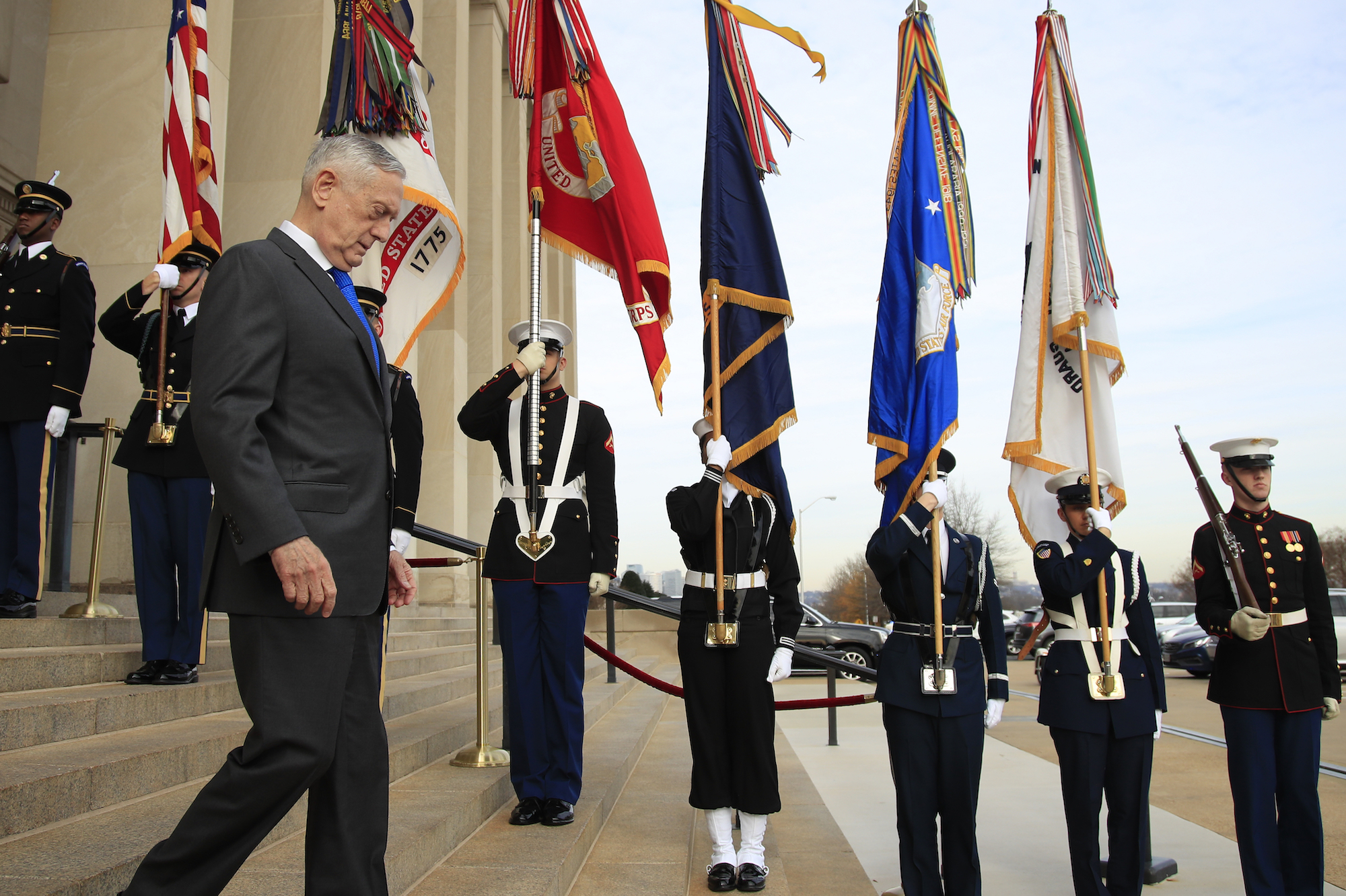
U.S. Defense Secretary Jim Mattis walks down the steps of the Pentagon, Dec. 19. (AP Photo/Manuel Balce Ceneta)
On December 20, U.S. Secretary of Defense Jim Mattis announced he would be stepping down, after he reportedly failed to dissuade President Donald J. Trump from announcing the rapid withdrawal of all U.S. troops from Syria. Mattis’ resignation has significant, and almost entirely negative, implications for the Gulf Arab countries and their relations with the United States.
Most obviously, with the departure of Mattis, the Gulf countries lose a familiar and much-appreciated U.S. interlocutor who they have known and worked with for many years. From 2010-13, Mattis served as the head of U.S. Central Command from which he ran major portions of the conflict in Iraq. In that role, he came to perceive regional dynamics from a similar perspective to many Gulf Arab states, developing a negative view of the role of Iran. As Trump’s defense secretary, Mattis was a key figure in developing a more robust policy of confronting Iran and restoring U.S. focus on two issues central to Gulf Arab concerns: Iran’s missile development program and its destabilizing regional policies, particularly support for nonstate armed groups such as sectarian militias.
So, Mattis’ departure means the loss of a key interlocutor at the Department of Defense, the Cabinet-level agency with which the Gulf countries deal most. It also means losing a senior figure who views Middle Eastern strategic realities in terms very similar to their own. The fact that Mattis resigned over policy disagreements with the president does not bode well for future trends in Washington from a Gulf Arab perspective. It’s unlikely that Mattis’ replacement will understand, and indeed share, as much of the Gulf Arab regional strategic evaluation. So, his resignation will undoubtedly be a blow to their interests and could complicate their relations with Washington, and particularly the Pentagon.
This is also suggested by the proximate cause of Mattis’ resignation: Trump’s sudden decision to withdraw all U.S. forces from Syria as soon as possible. This decision, which Mattis reportedly attempted to reverse in a meeting with Trump, is extremely troubling for Gulf Arab interests. Among the biggest winners from it will be Iran, which now has a chance to consolidate a decisive position in the emerging postwar Syria. Tehran may even be able to finally construct its long-coveted “land bridge” to the Mediterranean, a secure military corridor running through Iraq and Syria down into Lebanon, especially since the biggest obstacle to this has been U.S. and U.S.-backed forces in key areas of eastern Syria such as Al Bukamal and Al-Tanf, where the United States has a military base. With these forces removed, there may be little stopping Iran and its proxies from creating such a strategic asset.
For Gulf countries, which have a large stake in Syria but few resources on the ground, it will mean rapidly shifting their approach. Like many others, including the Kurdish and Arab groups that have been allied with the United States in the fight against the Islamic State in Iraq and the Levant, they will have little choice but to try to ally with Turkey and Russia, and possibly even the regime of President Bashar al-Assad itself, to try to block Iran and Hezbollah from emerging as the primary winners from the Syrian conflict and avoiding Tehran becoming a fully realized regional superpower. Gulf countries have been preparing for this contingency, but had hoped to continue to rely on Washington, a long-standing and well-established ally, rather than Ankara and Moscow, with which they are still struggling to build closer ties, and which may not share many of their most important goals.
The Syria decision in particular, and Trump’s lack of regard for long-standing alliances cited in Mattis’ resignation letter in general, have troubling implications for Gulf-U.S. relations. They suggest that U.S. foreign policy in the Trump era is guided by very narrowly drawn self-interest. Trump’s “America first” policy is looking increasingly like a mercantilist agenda with a large amount of neo-isolationism informing it. Trump’s policies and speeches, and key documents such as the National Security Strategy issued in December 2017, have articulated an incongruous mixture of traditional Republican internationalism inherited from the Cold War era, a mercantilist emphasis on boosting exports reminiscent of 17th and 18th century thinking, and an isolationist streak that seems to harken back to the period between World War I and World War II.
Moreover, Mattis was the last remaining Cabinet secretary among the “grown-ups” in the Trump administration who were seen, both domestically and internationally, as adding vital experience, knowledge, gravitas, and broader perspective to an administration that lacks these qualities at the top. Other such figures, including HR McMaster, Rex Tillerson, Gary Cohn, and even John Kelly, have, one by one, either left or been forced out of the administration. Trump is increasingly unbound by powerful, independent advisors who are willing to say “no” to, or challenge, the president. Indeed, with Kelly and Mattis leaving, it’s hard to identify anyone in the Trump administration who could play such a role.
That leaves the president in complete control of his foreign policy agenda and capable of making radical decisions, such as the sudden and complete withdrawal of U.S. forces from Syria, and the 50 percent reduction in U.S. forces in Afghanistan, over the objections of virtually everyone else, including almost all of his own experts, and Republican allies in Congress. This raises a final concern from a Gulf Arab perspective, which many other U.S. allies will share: the total primacy of politics over both policy and strategy. It is virtually impossible to explain or justify the Syria withdrawal in terms of coherent policy or rational strategy. Indeed, it flies directly in the face of Trump’s own stated priorities of defeating terrorism and confronting Iran, since ISIL and Tehran will be among the largest and most immediate beneficiaries of the withdrawal.
But clearly the president believes that removing U.S. troops from Syria will be extremely popular with his base in the right wing of the Republican Party. That such a momentous decision seems to have been taken for entirely domestic political reasons without any regard for policy implications or strategic consequences puts U.S. allies, including Gulf Arab countries, in an extremely difficult position. They must be concerned that not only will their interests not be taken into consideration, but traditional understandings of the U.S. national interest won’t be either.
To try to predict Trump’s next move will essentially mean trying to understand what he thinks will play well with his domestic constituency, a process complicated by the degree of disregard, or even hostility, to the outside world, including long-standing allies, that is one of the characteristics of this presidency. Given the mercantilist aspect of the agenda, financial inducements may be the only reliable guide left, but that’s not much for U.S. allies to work with in the bigger picture. Gulf Arab countries thus approach 2019 dealing with a new, Trumpian Washington that is far more unpredictable, harder to read, and apparently more unreliable, than they had heretofore imagined.
The views represented herein are the author's or speaker's own and do not necessarily reflect the views of AGSI, its staff, or its board of directors.
A coordinated strategy with allies, alongside sustained military and economic pressure, can help the United States end the conflict with Iran in a way that stabilizes the region, restores freedom of navigation, and prevents Tehran from becoming a nuclear power.
As hostile actors recognize the vulnerability of critical water infrastructure, recognizing water as a national security priority is the first step toward resilience.
President Trump has led the United States into an impossible dilemma in which resuming and intensifying the war presents one set of alarming consequences while ending it under current circumstances offers at least as many disasters for Washington.
The Trump administration has positioned the United States at a crossroads between a new regime of containment against Iran or a historic drawdown of U.S. influence in the Gulf and broader Middle East.
Riyadh and Abu Dhabi urged President Trump not to attack Iran, but now that the war is into its second month, leaving the current situation in place would be an unthinkable fiasco for them.
Though they were unsuccessful in preventing the current conflict, and, as expected, have been dragged into the U.S.-Israeli confrontation with Iran, Gulf Arab countries remain crucial to hopes for limiting the war and bringing it to a quick resolution.