A showdown on Capitol Hill over what is potentially one of the most far-reaching and consequential pieces of foreign policy legislation in many years was set up on Friday, September 23, when U.S. President Barack Obama vetoed the Justice Against Sponsors of Terrorism Act (JASTA). The act, which would allow U.S. citizens to sue foreign...
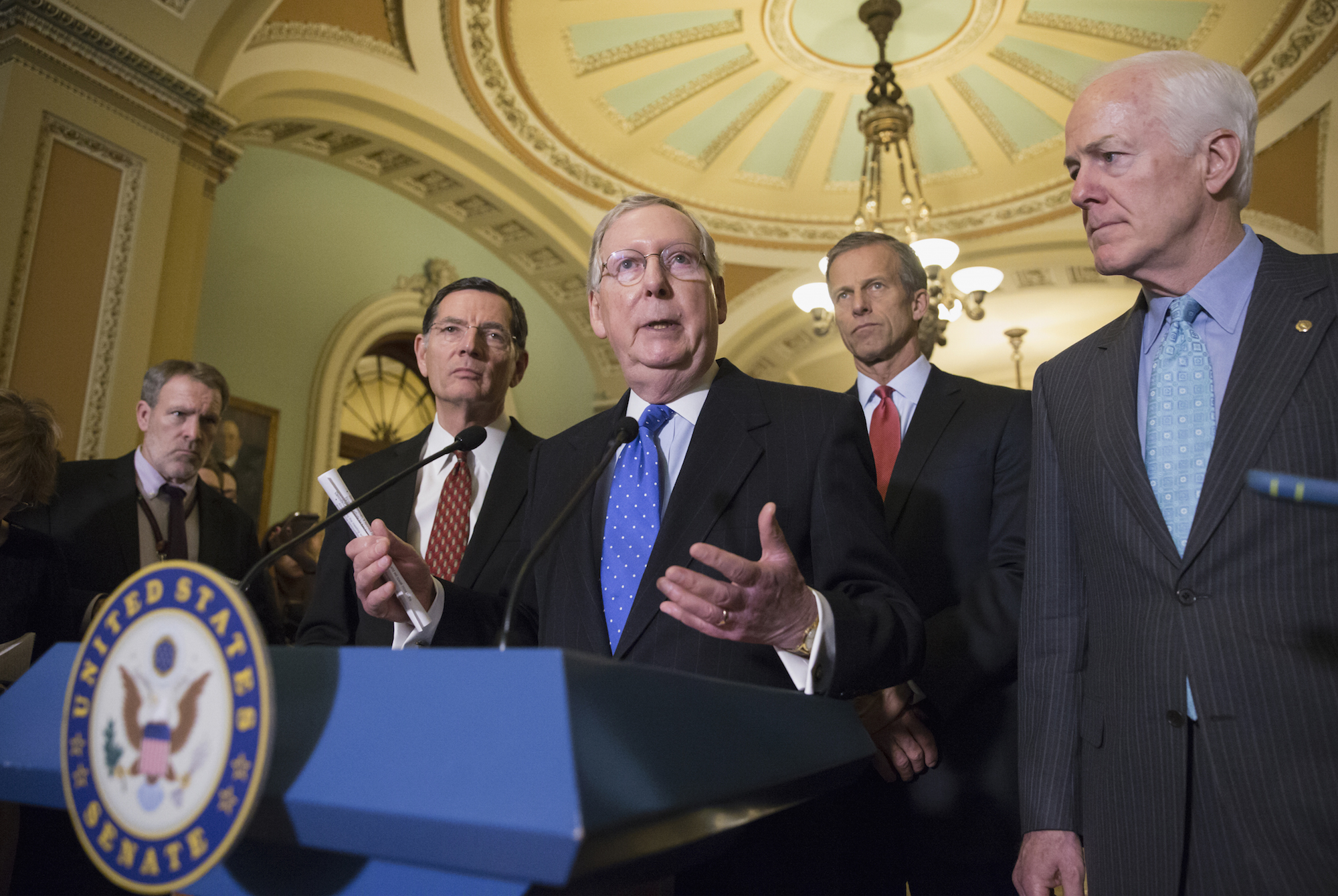
'Republican leaders, from second left, Senator John Barrasso (R-WY), Senator Mitch McConnell (R-KY), Senator John Thune, (R-SD), and Senator John Cornyn (R-TX), speak with reporters on Capitol Hill on March 1. (AP Photo/J. Scott Applewhite)'
A showdown on Capitol Hill over what is potentially one of the most far-reaching and consequential pieces of foreign policy legislation in many years was set up on Friday, September 23, when U.S. President Barack Obama vetoed the Justice Against Sponsors of Terrorism Act (JASTA). The act, which would allow U.S. citizens to sue foreign governments and/or their officials for legal liability regarding the deaths of Americans killed in terrorist attacks on U.S. soil, passed both the Senate and the House of Representatives with unanimous voice votes. Obama’s veto sets up the first potential veto override during his two terms in office.
Despite deep and widespread concern not only in the White House, but also among many national security and diplomatic experts, about the potentially negative consequences of JASTA for the implementation of U.S. foreign policy and military actions around the world, it is going to be extremely difficult for Obama to secure enough support to sustain his veto. The White House insists that, privately, many lawmakers recognize the long-term dangers if the United States, of all countries, abandons the long-established convention of sovereign immunity, whereby states and their officials cannot be sued for their official conduct. Few states have as much to lose by compromising this bedrock of international relations as the United States, with its unique global presence and role.
But the emotional power of the cry for “justice for the 9/11 families,” given that the law is primarily motivated by a desire to allow them to sue Saudi Arabia or its officials for alleged complicity in the September 11, 2001 terrorist attacks, is difficult to politically resist. And the timing, mere weeks before a major national election in which many members of the House and Senate will be directly accountable to the voters, could hardly be worse for the president and all those who recognize the vast potential harm to U.S. national interests that the act might unleash. Simply put, once the principle of sovereign immunity is essentially dispensed with by the United States, the U.S. government and its officials could face an endless series of legal challenges around the world based on any action they have conducted in another country that is deemed illegal. Concern about the impact of the act is not limited to Saudi Arabia. A wide range of U.S. allies, including European states and, quietly, Israel, have reportedly expressed alarm about the long-term consequences for the structure of international relations if Washington takes the lead in scrapping the convention of sovereign immunity.
The legislation appears to be unique in denying the executive branch a binding waiver on what amount to foreign policy decisions. JASTA provides that the secretary of state may request a stay of any such litigation, which a court “may” grant – or, implicitly, may not – if “the United States is engaged in good faith discussions with the foreign state defendant” or other parties. Moreover, the act explicitly provides that the courts alone have “exclusive jurisdiction” over such cases.
If the courts do decide to accept the certification of the State Department about good faith negotiations, then the matter is essentially transferred back to the executive branch on a semipermanent basis. Once a stay is granted, the attorney general can request extensions of this stay, which the courts “shall” grant as long as the State Department certifies that the “good-faith discussions” are continuing with the foreign state. There is no limitation on how many 180-day extensions the court would be obliged to grant once the original stay has been issued.
So, in effect, Congress is attempting to shift a narrow, but very far-reaching aspect of U.S. foreign policy decision making from the executive to the judicial branch in the context of certain litigation. The lack of a binding executive waiver is perhaps the most unusual feature of the legislation. The Jerusalem Embassy Act of 1995, for example, mandated the relocation of the U.S. Embassy to Israel from Tel Aviv to Jerusalem, but allowed for a presidential waiver, which has been consistently exercised by every president since its passage. It is generally accepted that executive waivers in such legislation maintain the separation of powers in which the executive essentially controls foreign policy.
Other instances in which Congress has attempted to bind the hands of the executive on foreign policy matters have generally involved its traditional appropriations power, whereby Congress denies funding for foreign policies it seeks to discourage. A classic example is the three appropriations amendments collectively known as the “Boland Amendment” passed from 1982-84 that prohibited U.S. government assistance to the Nicaraguan “contra” rebels for the purpose of overthrowing the Sandinista government. This legislation was a key part of the context for the subsequent Iran-Contra scandal. But even in cases like that, the traditional separation of powers has been maintained, with congressional attempts to influence foreign policy limited to its control of appropriations.
JASTA does not reflect the traditional understandings of separation of power, and instead introduces a new judicial power unimpeded by executive authority, unless the courts themselves voluntarily refer the matter back to the executive. Moreover, JASTA could, in effect, end up essentially outsourcing sensitive aspects of U.S. foreign policy to plaintiffs’ attorneys who could demand an extraordinary range of information from foreign governments through the discovery process. Plaintiffs’ attorneys would not be constrained by any considerations other than their clients’ interests and other narrow concerns that have nothing to do with the priorities and needs of any country, the general public, or international order and stability.
Foreign countries, including key U.S. allies would, of course, be highly reluctant, if not absolutely unwilling, to expose their sources and methods of information gathering, as well as sensitive information, to discovery in U.S. courts if they are put in such a situation. These countries and their officials could find themselves bogged down in litigation for extended periods of time, which would be an enormous distraction and hindrance to their ability to conduct the day-to-day business of managing their international relations. Similarly, U.S. government officials would be exposed to complementary demands in foreign courts. U.S. diplomats and military officers would need to weigh their own personal legal liability when executing instructions and performing other tasks in the U.S. national interest. If governments and their diplomats have to function without mutually reciprocal sovereign immunity, the diplomatic and military decision-making processes – both collective and individual – and their outcomes could be substantially undermined. Again, no country would be more exposed to, or have more to lose from, such a scenario than the United States.
The White House would ideally like the executive waiver function to be restored to JASTA, but this seems extremely unlikely. A number of initiatives are underway to limit the damage through an amended version of JASTA that could serve as a compromise between the White House and Congress. Such a compromise could also limit damage to the separation of powers by effectively containing the impact of the law in some mutually agreed-upon manner. But it is unclear if any of these efforts will bear fruit given that legislative action will almost certainly take place this week.
JASTA remains a looming threat to the exercise of U.S. foreign policy, as well as relations with Saudi Arabia and, potentially, a long list of other key allies in Europe and elsewhere. Obama not only faces the indignity of his first congressional veto override, the United States stands on the brink of eliminating the very sovereign immunity that protects it, above all other states, from endless litigation about the conduct of its foreign and military policy around the world.
The views represented herein are the author's or speaker's own and do not necessarily reflect the views of AGSI, its staff, or its board of directors.
President Trump has led the United States into an impossible dilemma in which resuming and intensifying the war presents one set of alarming consequences while ending it under current circumstances offers at least as many disasters for Washington.
The Trump administration has positioned the United States at a crossroads between a new regime of containment against Iran or a historic drawdown of U.S. influence in the Gulf and broader Middle East.
Riyadh and Abu Dhabi urged President Trump not to attack Iran, but now that the war is into its second month, leaving the current situation in place would be an unthinkable fiasco for them.
Though they were unsuccessful in preventing the current conflict, and, as expected, have been dragged into the U.S.-Israeli confrontation with Iran, Gulf Arab countries remain crucial to hopes for limiting the war and bringing it to a quick resolution.