Rushin’ to Syria: Riyadh Pledges to Counter Moscow’s Sudden Escalation
The civil conflict in Syria has been a major concern for many Gulf Arab states since the outbreak of the uprising against the Baathist dictatorship of Bashar al-Assad over four years ago. Saudi Arabia, the United Arab Emirates, Qatar, and Kuwait, among others, have been some of Assad’s leading regional opponents and strong proponents of...
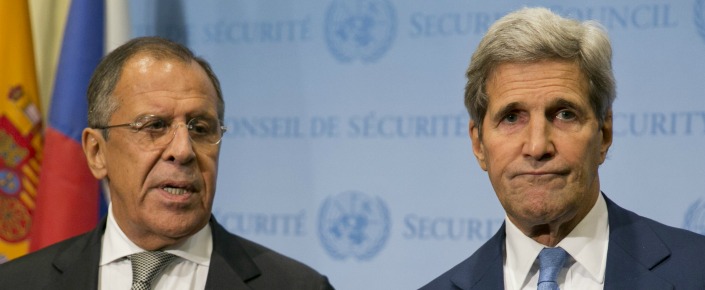
'U.S. Secretary of State John Kerry (R) and Russian Foreign Minister Sergey Lavrov speak to the media after a meeting concerning Syria at the United Nations headquarters in New York on September 30, 2015. (DOMINICK REUTER/AFP/Getty Images)'
The civil conflict in Syria has been a major concern for many Gulf Arab states since the outbreak of the uprising against the Baathist dictatorship of Bashar al-Assad over four years ago. Saudi Arabia, the United Arab Emirates, Qatar, and Kuwait, among others, have been some of Assad’s leading regional opponents and strong proponents of regime change in Damascus. They have therefore reacted strongly to Russia’s escalation in Syria and are among the harshest critics of Moscow’s direct intervention into the conflict by conducting airstrikes against rebel groups and building up Russian ground forces. These developments will likely encourage a deeper engagement by Gulf Arab countries in the Syrian conflict in the coming months.
Saudi Arabia and its allies see Syria, along with Yemen, as the key battlegrounds against rising Iranian hegemony in the Arab world. Moreover there is a powerful moral indignation against the tactics of the Assad regime. His forces are widely blamed for hundreds of thousands of deaths, and millions of displaced Syrian civilians, the large majority of them Sunni Muslim Arabs. This is the overriding context through which the Gulf states view the Syrian conflict and its outcome. These countries have funded both political and paramilitary opposition movements in an effort to promote a change of government in Syria. They have also joined the coalition led by the United States countering the Islamic State in Iraq and the Levant (ISIL), and Saudi and Emirati warplanes have been involved in bombing attacks against targets in Syria as part of that effort. But the Gulf countries have not introduced any of their own ground forces into the conflict, nor are they likely to do so in the foreseeable future. They readily admit to funding nationalist and some Islamist rebels, but deny supporting the al-Qaeda franchise in Syria, al-Nusra Front. On the ground, however, distinctions between rebel groups and their frequently shifting alliances and coalitions are often amorphous, difficult to track, and overlapping.
The anti-ISIL and anti-Assad coalition of Gulf Arab states and NATO powers has taken a strong, unified stance against the Russian intervention (which the Syrian opposition now refers to as an “occupation” of Syrian territory by Russia). Several Gulf countries signed a joint statement along with the United States, Britain, France, Germany, and Turkey accusing Russia of a “further escalation” of the conflict and warning that its actions would promote terrorism and extremism. The statement, which was published on the German Foreign Ministry website, said, in part, “We express our deep concern with regard to the Russian military build-up in Syria and especially the attacks by the Russian Air Force on Hama, Homs and Idlib since yesterday which led to civilian casualties and did not target Daesh.” It continued, “We call on the Russian Federation to immediately cease its attacks on the Syrian opposition and civilians.”
The Russian escalation in Syria puts Saudi Arabia in a somewhat awkward position. The Saudis have been reaching out to Russia for better ties in an effort to widen their support base beyond the traditional intensive reliance on the United States and as an alternative source of trade, weapons sales, and military technology. The most recent effort in that direction was the visit to Moscow in July by a very senior Saudi delegation led by Deputy Crown Prince Mohammed bin Salman. These meetings produced agreements strengthening military and energy ties. However, Saudi Arabia’s strong stance on Syria has left it little choice but to be harshly critical of the unexpectedly aggressive Russian moves. Indeed, Riyadh’s reaction has gone further than most other members of the coalition in warning Moscow of the consequences of its adventure and insisting on the need to counter Russia’s aim of securing the Assad regime.
Saudi Foreign Minister Adel al-Jubeir wistfully recalled the more positive “atmosphere that prevailed two months ago” when he visited Russia, which has dissipated as “all of a sudden Russia stepped up its military role in Syria and announced its political position backing Assad.” He said, categorically, that in Syria, “the solution does not depend on Russia.” Instead, he said, there were two options for the future in Syria. “One option is a political process where there would be a transitional council,” which he called “the preferred option.” Or, he continued, “the other option is a military option, which also would end with the removal of Bashar al-Assad from power. This could be a more lengthy process and a more destructive process, but the choice is entirely that of Bashar al-Assad.”
Jubeir did not outline what a “military option” would look like, or what the specific Saudi role might be. But his formulation suggests a fundamental change in the Saudi approach of trying to secure regime change in Damascus, and indicates that nothing that has transpired so far constitutes a full-fledged iteration of this military option. He noted that Saudi Arabia already supports the Free Syrian Army and other moderate rebel groups, and that such support from Riyadh and elsewhere “will continue and intensify.” Beyond that, he hinted, “Whatever we may or may not do we’re not talking about.”
Saudi Arabia speaks for many of its Gulf Cooperation Council allies on Syria, an issue in which the heterogeneity and division of opinion that is often a hallmark of GCC perspectives is less prevalent. Most of the Gulf Arab states have been strong supporters of the rebellion while opposing extremists, especially ISIL. The strong Gulf support for the Syrian opposition disrupted an emerging but mistaken narrative holding that Arab monarchies, especially in the Gulf, were taking a straightforward “counterrevolutionary” line on the “Arab Spring” uprisings, rather than evaluating each case according to their national interests. The Saudi position, which indicates a willingness to intensify the Gulf engagement in Syria and support for the opposition, comes in the context of the development of a more assertive and proactive regional security posture by Riyadh and a number of its allies including the UAE and Qatar. The most dramatic manifestation of this evolving proactive security doctrine is the Saudi-led intervention in Yemen.
Saudi Arabia and its allies are hedging on their practical response to the Russian escalation. But a more robust Gulf engagement in Syria in the coming months was extremely likely anyway, given the new policy direction being crafted, especially in Saudi Arabia. Moscow’s direct military intervention in the Syrian conflict on behalf of the Assad dictatorship, which is Iran’s most important client in the Arab world, will undoubtedly prompt a reevaluation among Gulf countries. But it is likely to only increase their determination to do as much as possible within the scope of prudence and their capabilities to thwart the Russian goal of maintaining the dictatorship, and instead focus on securing regime change either through a political agreement or a rebel victory.
Gulf countries have few means of directly pressuring Russia. But they will undoubtedly join with Western and other countries in pushing for a strong diplomatic response against the Russian escalation. Moreover, they will probably continue to press, along with others, for the creation of no-fly zones, safe havens for refugees and similar measures. These steps would dovetail with European and border state concerns about the flood of refugees coming out of the Syrian conflict. Refugee safe havens might serve a dual purpose, and, if implemented thoughtfully, could certainly constitute a political and even military blow to both the dictatorship and ISIL. No-fly zones are an even more direct means of denying the regime the full benefits of its air power. In addition to Turkey and the Gulf states, U.S. Democratic front-runner Hillary Rodham Clinton, as well as some Republican presidential candidates, is calling for no-fly zones in Syria. However the presence of Russian warplanes over the Syrian skies and, presumably, enhanced air defenses on the ground, will only strengthen the already established opposition to such measures by the U.S. military leadership. Therefore the United States, which would be indispensable to success, is unlikely to participate in such an initiative under current circumstances.
ISIL remains an alarming wildcard, but the Gulf countries are likely to stick to their guns that only by confronting the dictatorship and ISIL simultaneously can the conflict end and peace be restored to Syria. Saudi Arabia and its Gulf allies will continue to push Washington to recognize that Assad is as much of a threat as ISIL and to therefore take a more proactive role in trying to shape both the nature and the eventual outcome of the Syrian conflict. The Obama administration seems to remain convinced that while the Assad regime has lost all legitimacy and must go, the dangers of the sudden collapse of governance institutions in the country – a lesson derived from bitter U.S. experience in Iraq in the past decade – mean that he must not go precipitously. This viewpoint, which could be sympathetically called complex or uncharitably deemed self-contradictory, has certainly militated against any U.S. policy that directly confronts the Assad regime. Gulf countries and others argue that in effect this approach has meant ceding the field to Assad’s backers such as Iran, Hezbollah, and now Russia.
The GCC countries also point out that relative U.S. inaction on Syria, and its at least perceived disengagement from the region, meant that Washington was not only “taken aback” (as U.S. officials themselves put it) by the new Russian military offensive, but also appears to have been surprised by the recently announced intelligence-sharing agreement Iraq reached with Russia, Iran, and Syria. Riyadh and its allies are sure to note that this is not only another development that strengthens Iran’s hand at the expense of the Gulf states, but that it is harmful to U.S. interests as well. Whether or not a change of heart in Washington takes place, the Gulf Arab counties appear more determined than ever to confront and thwart Iran in Syria. Russia’s direct intervention only raises the stakes. The introduction by the Arab Gulf states of their own ground forces into the Syrian conflict is a remote contingency, but everything short of that now appears to be very much on the table.
The views represented herein are the author's or speaker's own and do not necessarily reflect the views of AGSI, its staff, or its board of directors.
President Trump has led the United States into an impossible dilemma in which resuming and intensifying the war presents one set of alarming consequences while ending it under current circumstances offers at least as many disasters for Washington.
The Trump administration has positioned the United States at a crossroads between a new regime of containment against Iran or a historic drawdown of U.S. influence in the Gulf and broader Middle East.
Riyadh and Abu Dhabi urged President Trump not to attack Iran, but now that the war is into its second month, leaving the current situation in place would be an unthinkable fiasco for them.
Though they were unsuccessful in preventing the current conflict, and, as expected, have been dragged into the U.S.-Israeli confrontation with Iran, Gulf Arab countries remain crucial to hopes for limiting the war and bringing it to a quick resolution.