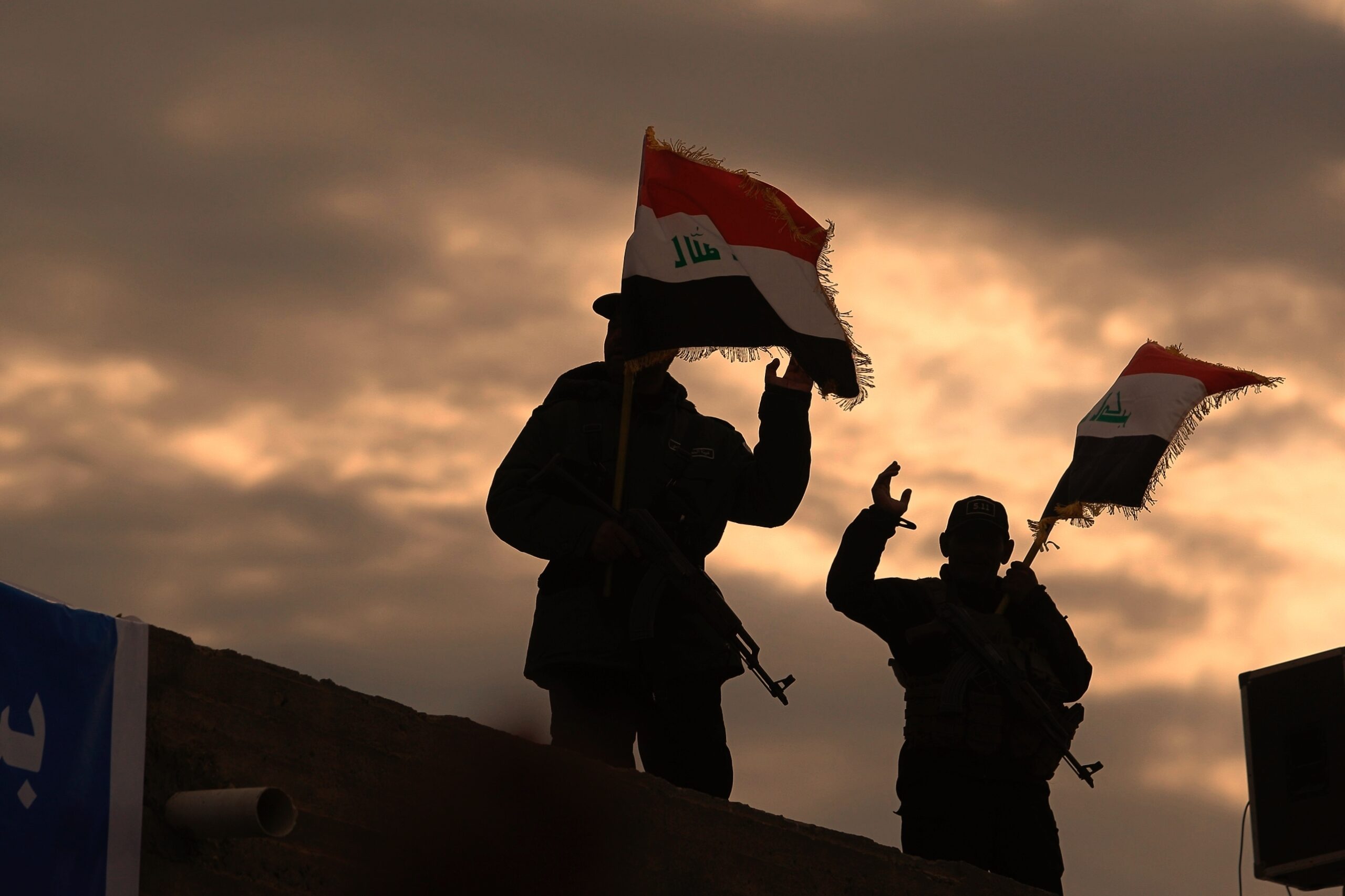
Fighters with the Iranian-backed Popular Mobilization Forces in Iraq wave Iraqi flags during the funeral of PMF leader Abu Mahdi al-Muhandis, Najaf, Iraq, Jan. 8. (AP Photo/Anmar Khalil)
Despite being wracked by one of the world’s most severe outbreaks of the novel coronavirus on top of a preexisting economic crisis, Iran does not appear to have pulled back from its bellicose regional policies. Its network of armed surrogates, particularly the Popular Mobilization Forces in Iraq – and key allies such as the Houthis in Yemen – have maintained and even intensified their aggressive postures in local conflicts. But these groups are not operating in isolation. Rather, they belong to a network of militia groups that, for Tehran, represents its primary regional power projection and national security tool. For Iran’s Gulf Arab neighbors, and much of the rest of the international community, this network of militias that promotes state failure in Arab countries and undermines and usurps the authority of central governments lies at the heart of Iran’s destabilizing and dangerous regional policies.
Iranian government support for foreign militia groups has come under domestic intense criticism via both political and economic protests in recent years. While Tehran’s ability to fund and arm these groups has come at the expense of domestic social spending, particularly on healthcare and education, the regime appears as committed as ever to this strategy. The Trump administration calculated that the “maximum pressure” sanctions campaign imposed after Washington withdrew from the Joint Comprehensive Plan of Action nuclear agreement would force Tehran to curtail these activities. Yet, even after the devastating coronavirus outbreak, the policy persists. This suggests that nothing short of a broad regional agreement or a much deeper regime crisis, if not collapse, will convince Iran to forgo its widespread promotion of armed non-state groups in the Arab world, an important goal for Gulf Arab countries, the United States, Israel, and others.
PMF Escalation in Iraq
The most dramatic example of Tehran’s ongoing commitment to its regional militia network strategy is the recent escalation of tensions between the United States and pro-Iranian PMF groups in Iraq. After a series of tit-for-tat strikes and reprisals almost led to a broader war in 2019 and the beginning of 2020, tensions subsided following the assassination of Qassim Suleimani, commander of the Quds Force, the branch of the Iranian Revolutionary Guard Corps that organizes and oversees the militia network. At the time, it was widely presumed that Tehran and its allied militias in Iraq were not satisfied with the outcome following largely ineffectual reprisals against U.S. targets on January 8. Another round was, therefore, expected.
That may have started with a second rocket attack against U.S. positions in Iraq on March 12. The strike killed two U.S. servicemen and a British medic. The attack was attributed to Kataib Hezbollah, one of the largest and most powerful of the pro-Iranian PMF Iraqi groups. Its leader, Abu Mahdi al-Muhandis, who was viewed as the senior-most official of the PMF groups, was killed in the same January 3 strike that killed Suleimani. Iran’s retaliation on January 8 did not, according to U.S. military sources, result in any U.S. fatalities. The March 12 rocket attack did, however, prompting further U.S. retaliation against Kataib Hezbollah’s weapons facilities.
Kataib Hezbollah’s motivation for further attacks seeking revenge for its slain leader is obvious, but Iran’s greenlight would almost certainly have been required. Tehran’s calculations in providing the go-ahead are rooted in the centrality of the militia network, especially Iraq, to Iran’s national security calculations. With its nuclear program still suspended despite the moribund status of the JCPOA, Iran has two major bargaining chips with the United States and other adversaries, including Gulf Arab countries: its ballistic missile program and its network of sectarian militias. Iran’s reliance on these militia groups for leverage with the United States became clear one year into the maximum pressure sanctions campaign. For the first year, Iran sought to wait the United States out and try to isolate Washington by collaborating with Europe to salvage the nuclear agreement. But when the sanctions began to take an unsustainable toll on Iran’s economy, Iran turned to the “maximum resistance” strategy, which mainly relied on pro-Iranian sectarian militia groups carrying out low-intensity harassment with a degree of plausible deniability.
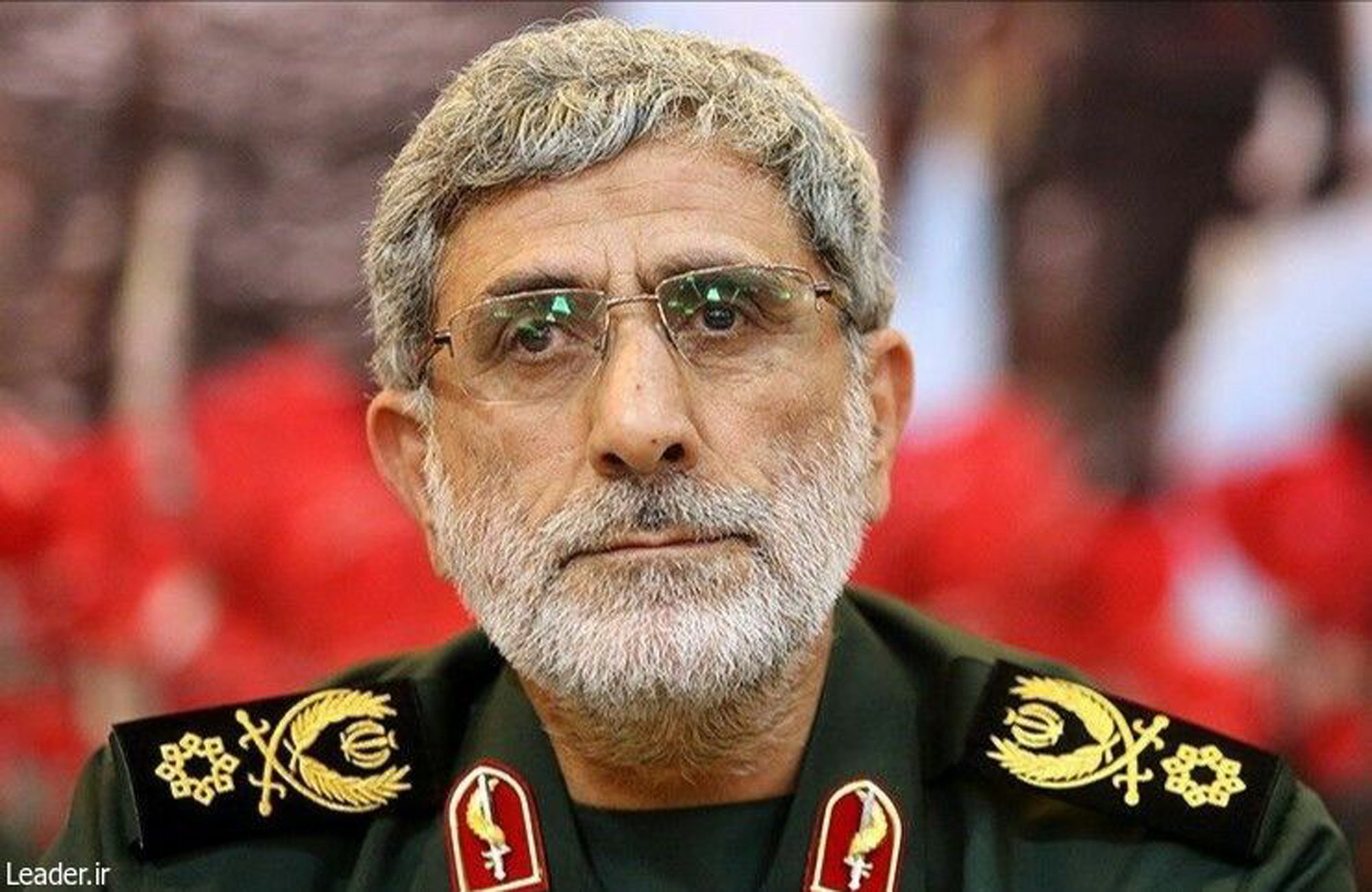
Since the killing of Suleimani and, especially, Muhandis, Iran has faced a crisis regarding the unity of, and its control over, the PMF groups in Iraq. Suleimani’s successor as IRGC Quds Force commander, Ismail Qaani, is far less experienced than his predecessor, not fluent in Arabic, and has proven much less effective in managing these diffuse and unruly groups. Iran probably retains a broad veto on Kataib Hezbollah’s most consequential actions, so the idea that the March 12 attack took place without Tehran’s approval is implausible. But Iran’s full control of the groups appears to have significantly deteriorated.
Moreover, there is evidence of competition for power and tensions within the PMF factions. On February 21, PMF leaders named Abu Fadak al-Mohammedawi, another senior Kataib Hezbollah leader, to serve as al-Muhandis’ successor as head of the PMF’s military network. However, according to Ali Alfoneh a noted Iran specialist and senior fellow at the Arab Gulf States Institute in Washington, “there were at least two other serious candidates for the role from other groups.” Alfoneh concluded: “There is a lot of tension and instability within the PMF.” Hence, he says, Iran’s interests in greenlighting further revenge attacks against U.S. targets. “By continuing operations against the United States, Tehran proves… that killing Suleimani does not deter Iran.” Moreover, he adds, “the groups committing such attacks gain the upper hand in the rivalry within the PMF.” Iran, he suggests, “is probably hoping that these attacks also help to consolidate the new PMF leadership after the killing of Muhandis.” Before the attacks, he says, the PMF groups were in a state of serious disarray.
Iran’s Immediate Goal: Expel U.S. Forces from Iraq
Iraq remains without a confirmed prime minister and its parliament continues to face pressure to expel U.S. forces from the country. The PMF groups are nominally part of the Iraqi government’s security establishment. Therefore, U.S. strikes against their positions and leaders, even in retaliation for PMF attacks aimed at U.S. targets, typically meet with widespread anger. Even Iraqi politicians broadly sympathetic to the West and skeptical about Iran’s intentions feel the need to complain about such counterstrikes. Following the U.S. attacks in January, Iraq’s parliament voted overwhelmingly to expel all foreign forces from the country, in a move widely seen as primarily aimed at the United States. However, the measure was not self-enforcing and merely empowered the prime minister to seek this result. But Prime Minister Adel Abdul Mahdi had already resigned in December as a result of widespread popular protests, and Iraq has not had a confirmed and empowered prime minister since.
Many Iraqi leaders would prefer to see U.S. forces remain engaged in Iraq as a hedge against both the resurgence of the Islamic State in Iraq and the Levant and the expansion of Iranian hegemony. Yet Iran, with its back to the wall economically and further ravaged by the coronavirus, is trying to secure its gains and advantage in Iraq. Alfoneh explains that Iran can afford to continue to push its agenda in Iraq, particularly because the Iraqi government largely pays PMF group expenses on the grounds they are nominally under the control of the government. Meanwhile, Tehran is also losing ground in Syria, where Russia, particularly in the battle against the Turkish incursions in the north, is increasingly asserting its dominance. Iran could not, under current circumstances, afford a repetition of the 2015-17 surge with Russia and Hezbollah in Syria that suddenly shifted the momentum of the war away from the rebels and toward the regime.
Moreover, the coronavirus and economic crisis are apparently chipping away at domestic security and law and order inside Iran. Both at home and abroad, the Iranian regime needs a win, quickly. And it needs to consolidate the new leadership of the PMF. That combination of factors explains the resurgence of attacks against U.S. targets in Iraq. More may follow. In mid-March, a supposedly new pro-Iranian Iraqi sectarian militia group called the League of Revolutionaries claimed responsibility for the recent strikes and vowed further attacks and “martyrdom operations” against U.S. forces and U.S.-related interests in Iraq. In response, the United States has vowed retaliation, is installing new Patriot missile batteries in Iraq, and has consolidated its forces into a smaller number of forward-operating bases.
Iran’s Broader Goal: Removing U.S. Sanctions
The Iranian regime’s medium-term goal, however, remains clawing its way out of the suffocating hole of U.S. maximum pressure sanctions. The Tehran regime believes it needs a military instrument to achieve this, and that it will not be possible without leverage of its own. Far from persuading Iran to abandon such a campaign, additional pressure from the coronavirus appears to have only intensified Tehran’s urgency to liberate itself from sanctions. The oil price war between Russia and Saudi Arabia is deepening Iran’s economic woes. And the coronavirus caps it all off. In short, the Iranian regime faces a perfect storm of internal and external pressures, which constrains its options and undermines its strategic position.
These crises, therefore, have had the opposite effect some Trump administration officials have expected. Rather than persuading Iran of the folly and counterproductivity of its regional destabilization strategy, they may have persuaded Iran of its absolute necessity. This is especially true given that Hezbollah in Lebanon is mostly self-financing, the Houthis in Yemen are probably even more independent, and the Baghdad government largely underwrites the Iraqi PMF groups. If the Gulf Arab countries, the United States and others, such as Israel, hope to end Iran’s policy of supporting sectarian armed groups in neighboring Arab countries, even the heavy pressure Tehran is under with sanctions and the coronavirus is not enough. In fact, it may well be encouraging the Iranian regime to see its support of PMF groups as essential to its defense. Therefore, either much greater pressure or, more plausibly, a new understanding with Iran is needed to achieve that vital aim.
The views represented herein are the author's or speaker's own and do not necessarily reflect the views of AGSI, its staff, or its board of directors.
Policies that prevent Saudi Arabia from pursuing diplomatic normalization and are fueling alienation in large parts of the West seem to reflect a Jewish consensus in Israel.
President Trump has led the United States into an impossible dilemma in which resuming and intensifying the war presents one set of alarming consequences while ending it under current circumstances offers at least as many disasters for Washington.
The Trump administration has positioned the United States at a crossroads between a new regime of containment against Iran or a historic drawdown of U.S. influence in the Gulf and broader Middle East.
Riyadh and Abu Dhabi urged President Trump not to attack Iran, but now that the war is into its second month, leaving the current situation in place would be an unthinkable fiasco for them.