Why Bahrain is Leading Gulf Arab Outreach to Israel
Over the past year, there has been a great deal of speculation about the potential for improved relations between Arab countries, particularly in the Gulf region, and Israel, largely based on a shared perception of the threat from Iran and the need for a more stable regional status quo. Yet, the ongoing occupation of Palestinian...
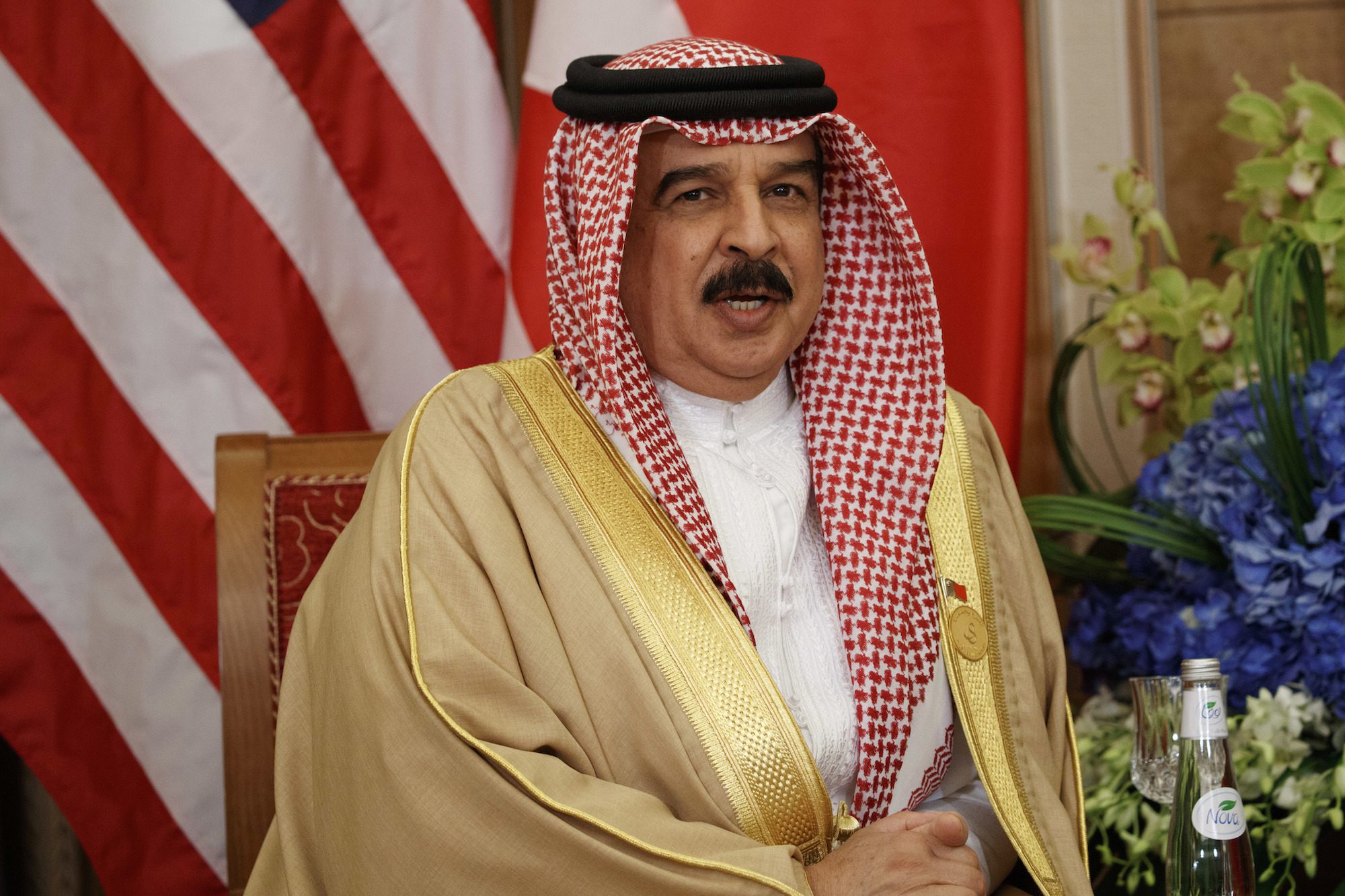
Bahrain's King Hamad bin Isa al-Khalifa speaks during a meeting with U.S. President Donald J. Trump in Riyadh, Saudi Arabia, May 21. (AP Photo/Evan Vucci)
Over the past year, there has been a great deal of speculation about the potential for improved relations between Arab countries, particularly in the Gulf region, and Israel, largely based on a shared perception of the threat from Iran and the need for a more stable regional status quo. Yet, the ongoing occupation of Palestinian territories and decades of Arab-Israeli enmity remain potent obstacles to be overcome. In recent weeks, though, the Kingdom of Bahrain has emerged as the Gulf Arab country most actively pursuing better relations with Israel, both for particular reasons of its own and, presumably, with the blessing of its principal benefactor, Saudi Arabia.
While Bahrain has traditionally been relatively open to contacts with Israel and Israeli officials, until recently its position strongly adhered to the idea that the Israeli-Palestinian conflict, particularly the occupation that began in 1967, would have to be resolved before better formal diplomatic or trade relations could be developed. Still, quiet contacts have been maintained since at least 1994. In September, however, at a multinational event at the Simon Wiesenthal Center in Los Angeles, American rabbis Marvin Hier and Abraham Cooper said that Bahrain’s King Hamad bin Isa al-Khalifa had expressed opposition to the ongoing Arab League economic boycott of Israel and had said that citizens of Bahrain and Israel should feel free to visit each other’s countries without restrictions. Prince Nasser bin Hamad al-Khalifa attended the same conference and toured the overtly pro-Israel Museum of Tolerance, which is closely associated with the Wiesenthal Center, in Los Angeles. Some Western officials have even speculated that there could be the establishment of some formal diplomatic or trade ties between the two countries sometime in 2018.
There are many reasons why Bahrain now seems to be taking the lead in outreach to Israel. Bahrain’s government and mainstream society have long maintained good relations with its tiny but nonetheless influential Jewish community. The community maintains an active synagogue, the only one in a Gulf Arab country. Houda Ezra Ebrahim Nonoo served as Bahrain’s ambassador to the United States from 2008-13, and was the first Jewish woman to represent an Arab country in a senior diplomatic capacity. Since 2015, the Bahraini government has hosted Hanukkah candle-lighting ceremonies to honor the Jewish religious holiday. While this was strongly criticized by the Palestinian militant and Islamist group Hamas, it does not appear to have been particularly controversial in Bahrain.
If shared concerns about Iran’s influence lie at the core of potential improved relations between Gulf Arab countries and Israel, Bahrain has a particular incentive to explore the possibilities. Unlike any of its Gulf Arab neighbors, the entire territory of Bahrain was claimed by Iran several times during the 20th century. And while Tehran does not currently maintain an active claim over Bahrain, it does in effect claim to represent the interests, and even the perspectives, of the Bahraini Shia majority. This is usually an implicit claim, although at times it is more overt. Because of its restive Shia population, some of which has deep historical and cultural ties to Iran, growing evidence of Iranian-inspired subversion in Bahrain, and a history of Iran claiming Bahrain as part of its own territory, Manama perceives a uniquely existential threat emanating from Tehran. Therefore, in addition to its existing strong military relationship with the United States, Bahrain has a particular interest in strengthening the regional bloc confronting Iran, potentially including Israel.
Given the internal political tensions in Bahrain, many constituencies, including those sympathetic to the government as well as parts of the opposition, are likely to be among the most enthusiastic in the Gulf Arab countries regarding the prospects of a more coordinated strategic front against Iran, potentially even including Israel. Strong opposition in Bahrain to exploring the prospects for such a realignment would be found in many quarters, but particularly among Islamists of various stripes. Under the current political circumstances, such objections are unlikely to carry much weight with the government and, if it is being attacked by those critical of the government in general, might actually serve to reinforce the sense that this is a policy worth exploring. At any rate, under current circumstances, opposition in Bahrain to a thaw, with not only international Jewish groups, but also Israel, is likely to be largely either muted or marginalized.
While Bahrain has particular circumstances and concerns that explain why it currently seems to be leading the Gulf Arab effort to explore the potential for improved relations with Israel, Manama is almost certainly not acting strictly alone or merely in its own interests. Since the 2011 Peninsula Shield intervention by Gulf Cooperation Council militaries, particularly Saudi forces, Manama has consistently deferred to Riyadh on most matters of foreign and defense policy. Bahrain’s regional role, therefore, is closely coordinated with Saudi Arabia, which typically defines the parameters within which Manama operates its international relations. Therefore, Bahrain speaks for itself in these matters, but, perhaps, not solely for itself. It is highly unlikely that Manama’s outreach to Israel would be going forward if Riyadh objected to that policy. To the contrary, Bahrain is almost certainly acting on behalf of Saudi Arabia and some of its other GCC allies in taking the lead in exploring the potential for a greater opening to, and dialogue with, Israel.
However, all of the Gulf Arab countries are constrained in their potential dealings with Israel, particularly when it comes to more open and substantive diplomatic, trade, and strategic relations, by Palestinian issues, particularly the occupation. The Arab Peace Initiative, introduced by Saudi Arabia in 2002 and subsequently reaffirmed in 2007 and 2017 by the Arab League, provides a framework for a broad Arab and Muslim normalization with Israel in the context of an Israeli-Palestinian peace agreement. However, where the original conceptualization of the Arab Peace Initiative envisaged regional normalization with Israel as the final stage of an Israeli-Palestinian peace process, a more flexible approach appears to have emerged for a number of Arab countries, including those in the Gulf. A process of concurrence, in which more modest concessions on the part of Israel are matched by similarly modest or limited diplomatic, trade, or strategic openings by Arab countries, now appears possible, albeit with a conflict-ending peace and full normalization still only available at the end of the process.
Bahrain’s outreach to Israel certainly underscores a continuing, and probably increasing, interest in exploring the prospects for better relations, and even potentially a new strategic relationship, between Israel and the Gulf Arab countries. Nonetheless, without any significant progress on Palestinian issues, particularly movement toward ending the occupation, the political space for such a dialogue, let alone rapprochement, will remain limited. Because of this, Israel cannot simply respond to Bahrain and the other Gulf Arab countries bilaterally without quickly encountering a dead end. To build on the present, and perhaps fleeting, opportunity will require not only proactive outreach by Arab countries, most dramatically illustrated by Bahrain’s recent initiatives, but also a practical Israeli willingness to help resolve the Palestinian issue, which remains a highly destabilizing and volatile factor in the Middle East.
The views represented herein are the author's or speaker's own and do not necessarily reflect the views of AGSI, its staff, or its board of directors.
Though they were unsuccessful in preventing the current conflict, and, as expected, have been dragged into the U.S.-Israeli confrontation with Iran, Gulf Arab countries remain crucial to hopes for limiting the war and bringing it to a quick resolution.
After decades of tolerating Hezbollah’s warmaking independence, the current crisis has compelled Lebanese leaders to ban its military activities; this project will do much to determine the reach Iran can maintain in the Arab world.
Though they were unsuccessful in preventing the current conflict, and, as expected, have been dragged into the U.S.-Israeli confrontation with Iran, Gulf Arab countries remain crucial to hopes for limiting the war and bringing it to a quick resolution.
After decades of tolerating Hezbollah’s warmaking independence, the current crisis has compelled Lebanese leaders to ban its military activities; this project will do much to determine the reach Iran can maintain in the Arab world.
Gulf Arab countries urged the United States not to strike Iran, but now that is happening, they are in danger of being sucked into a conflict they cannot control but that will likely reshape their present and future realities.
When quickly debunked rumors in the Israeli media that the UAE was seeking to manage postconflict Gaza were widely welcomed in Israel, it demonstrated both the trust the UAE has built among Israelis but also their lack of understanding of Emirati policies and interests.
On January 8, AGSI hosted a virtual roundtable with its leadership and scholars as they look ahead and assess trends likely to shape the Gulf region and U.S. foreign policy during the coming year.