Unprepared: The Islamic Republic Confronts Fuel Protests
Iran’s leadership has for years downplayed the impact of sanctions on the economy. Now that President Hassan Rouhani and the regime are compelled to make economic adjustments, they are facing predictable public anger and protests for which they were unprepared.
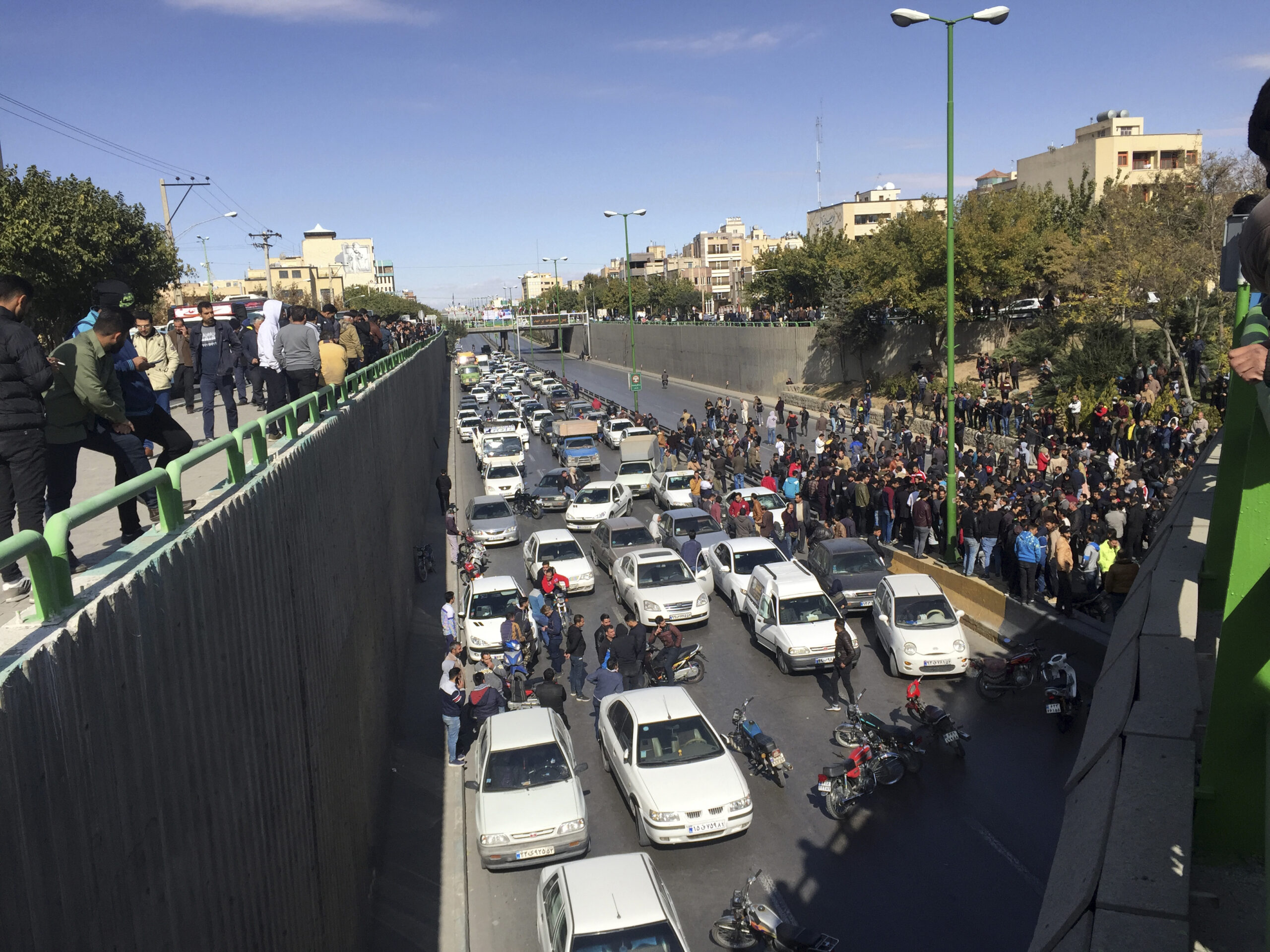
Cars block a street during a protest against a rise in gasoline prices, Isfahan, Iran, Nov. 16. (AP Photo)
The Islamic Republic appears to have been unprepared for the public anger against the government’s November 14 decision to introduce gasoline rationing and price hikes.
Supreme Leader Ayatollah Ali Khamenei has supported the decision, yet is deflecting responsibility by arguing he is not an expert and just follows the decisions of the heads of the three branches of the government. President Hassan Rouhani and his Cabinet ministers are going to great lengths to assure the public that the revenue is earmarked for low income groups, instead of helping the government adjust Iran’s economy to U.S.-imposed sanctions. Members of the ruling elite, who oppose Rouhani and were quick to criticize the decision in public, are now on the wrong side of Khamenei and must either swallow their pride and back the Cabinet’s decision or openly challenge the supreme leader. The Law Enforcement Forces, Basij militia, Islamic Revolutionary Guard Corps, and intelligence services all appear to have been caught off guard by the countrywide protests.
Why wasn’t the Islamic Republic better prepared for the predictable public anger and protests, and what impact is the regime’s unpreparedness likely to have on the public now and in the months to come?
Khamenei’s November 17 commentary on the fuel protests deflected personal responsibility for the unpopular decision yet provided just enough political support to the government to enact the policy. Next, Khamenei condemned arson against banks and public property as “the work of villainous people” guided by the Pahlavi dynasty, which ruled Iran from 1925-79, and the outlawed and exiled Mujahedeen-e Khalq organization. While the protests were endorsed by Reza Pahlavi, Mujahedeen-e Khalq, and most prominently U.S. Secretary of State Mike Pompeo, there is no evidence that the protests were provoked by external actors. Finally, Khamenei demanded that the government ensure that increased fuel prices do not result in a broader hike in prices, which is impossible, since the price of fuel is factored into almost any service and commodity.
Rouhani and his Cabinet ministers and advisors appear just as perplexed by the angry public reaction. Governments in Iran have for years tried, and failed, to reform the subsidy system as part of a sound fiscal policy. Subjected to economic warfare by the United States, the Rouhani Cabinet is further compelled to reduce public expenditure to fill the $25 billion gap in the 2020 budget. In the face of the angry public reaction to the government decision, the Rouhani Cabinet forfeited the potential budgetary gain from the policy and promised to use the savings to increase the basic income of low income groups as early as November 26.
The Iranian president should not expect much public understanding for the initiative. Rouhani’s promise of increasing the basic income of low income groups is just that, a promise, while the increased gasoline price is very real. The public has also reason not to grasp the gravity of Iran’s economic problems. After all, Khamenei, Rouhani, and the entire leadership of the Islamic Republic have for years downplayed the impact of the sanctions regime on Iran’s economy and assured the public of their ability to deal with external economic pressures. Now that Rouhani and the regime are compelled to adjust to the reality of sanctions, they are facing a public psychologically unprepared for this and politically unpersuaded that the regime is facing extreme outside economic pressure. For now, the Iranian public has little patience for what it perceives as the government’s encroachment on entitlements such as subsidized gasoline.
It is not just the public reaction that is causing Rouhani political headaches. It also appears Rouhani is having difficulties persuading the ruling elites of the Islamic Republic of the necessity of adjusting Iran’s economy to U.S.-imposed sanctions and, just as importantly, to take responsibility for unpopular adjustments.
On November 16, Ayatollahs Seyyed Mohammad-Ali Alavi Gorgani and Lotfollah Safi Golpaygani criticized the decision and urged the government to withdraw it to raise gas prices before circumstances deteriorate. On the same day, Major General Mohammad Ali Jafari, former chief commander of the IRGC, attacked Rouhani saying: “When statesmen disregard the people … by increasing the price of gasoline, it is in reality the government itself, which because of its wrong methods and whims, that provokes the people to protest. In doing so, it provides seditionists with an opportunity to take advantage of [the circumstances].”
The most organized opposition to the decision came from within Parliament. On November 16, Hojjat al-Islam Mojtaba Zolnour, parliamentarian from Qom and the parliamentary national security and foreign policy committee chairman, said Parliament “played no part in and [was] not even aware of the surprise move of the Cabinet. In sum, this is an erroneous initiative.” Ali Mottahari, parliamentarian from Tehran, admitted the government has to resort to extraordinary measures under extraordinary circumstances, but criticized the execution of the decision.
Parliament even prepared a double urgency bill calling on the Cabinet to withdraw the gasoline rationing and price increase. It was only after Khamenei’s November 17 speech that the parliamentarians withdrew the bill. Ali Larijani, parliamentary speaker, on November 19 explained that the parliamentarians “after hearing the profound statements of His Excellency, found it requisite to follow the path laid out,” by Khamenei.
Not all parliamentarians were persuaded by Larijani, or for that matter Khamenei: Zolnour unsuccessfully tried to collect enough signatures to provoke a vote of no confidence against Larijani. Mahmoud Sadeqi, parliamentarian from Tehran, resigned in protest against the government’s decision and Parliament’s inaction, as did Mohammad Qasim Osmani from West Azerbaijan province.
Critics of the Cabinet’s decision are now at odds not only with Rouhani, they are also colliding with Khamenei and must make a difficult choice: to stick with their criticism and risk the wrath of the supreme leader or swallow their pride and fall in line. For now, Zolnour appears undeterred in his fight against the decision and so do parliamentarians who resigned or plan to resign in protest of the Cabinet’s sidelining of Parliament in the decision. Now it is up to Khamenei to decide how to deal with individuals, who until recently were among the ruling elites of the regime but now challenge his authority.
Rouhani was likely to face opposition from some members of the ruling elite of the regime under any circumstance, but consulting with the clergy in Qom, the IRGC, and, in particular, Parliament prior to the decision would have saved embarrassment within the regime.
Just as surprising is the lack of preparedness of the Law Enforcement Forces, Basij militia, and IRGC. During the mass protests of December 2017 and January 2018, the Law Enforcement Forces, which had been reformed since its poor performance in suppressing the 2009 anti-regime protests, constituted the first line of defense of the regime against protesters, while the Basij and almost invisible IRGC forces encircled areas affected by protests but did not intervene directly. The Law Enforcement Forces contained the protests and, with the exception of a smaller city where six protesters were killed, there were no fatalities.
In the ongoing protests, Islamic Republic news agencies have reported Law Enforcement Forces, Basij, and IRGC involvement in clashes with the protesters, who have attacked banks and government buildings and blocked streets to shut down traffic. According to Amnesty International, more than 100 protesters have been killed, many more wounded, and several thousand arrested by the security forces. The regime’s security services fared better in cyberspace as they pulled the plug on internet connectivity for the entire country. But the IRGC cannot give up the streets and, on November 18, the IRGC issued a public statement threatening to deal with “continued insecurity and disturbance of the public order in a decisive and revolutionary manner.”
The initial poor performance of the regime in the face of ongoing protests encouraged the public to continue its street level presence. Khamenei’s support of the government was less than convincing, and Rouhani never took it upon himself to explain Iran’s dire economic situation to the public. Mixed signals from prominent members of the ruling elites contributed to the confusion and, for some time, protesters may claim their protest is within the accepted redlines of the regime, just like remarks by certain clerical leaders in Qom or the former IRGC chief commander.
Under such circumstances, the protesters are not likely to be deterred by the IRGC’s warning. This in turn would force the IRGC to intervene to restore order, but its ability to do so depends on the will of the regime to secure its survival at any cost, and the stamina of the protesters themselves.
The views represented herein are the author's or speaker's own and do not necessarily reflect the views of AGSI, its staff, or its board of directors.
The announcement of a new defense-focused free zone in Abu Dhabi emerges at a moment of acute national security concern but relies on an established economic development playbook.
Syria hopes to use the Iran war to deepen its connection to its Gulf Arab partners. Can it compete for inclusion within the regional security order and emerging trade corridors?
Iran may still call itself an Islamic Republic. In practice, however, it increasingly resembles a state in which the military governs from behind clerical robes.
Ayatollah Ali Khamenei was killed in his office in Tehran at age 86, leaving behind a country in ruins and on the verge of civil war and potential disintegration.
Iran is signaling that it will not absorb attacks passively. But whether this strategy ensures the regime’s survival, seals its fate, or accelerates a broader catastrophe will shape the region for years to come.
On January 8, AGSI hosted a virtual roundtable with its leadership and scholars as they look ahead and assess trends likely to shape the Gulf region and U.S. foreign policy during the coming year.