Tehran’s Woes Open Diplomatic Opportunities for Riyadh
Tehran's difficulties, including major unrest at home and in Iraq and Lebanon, could make the Islamic Republic more amenable to a real compromise with its Gulf Arab neighbors.
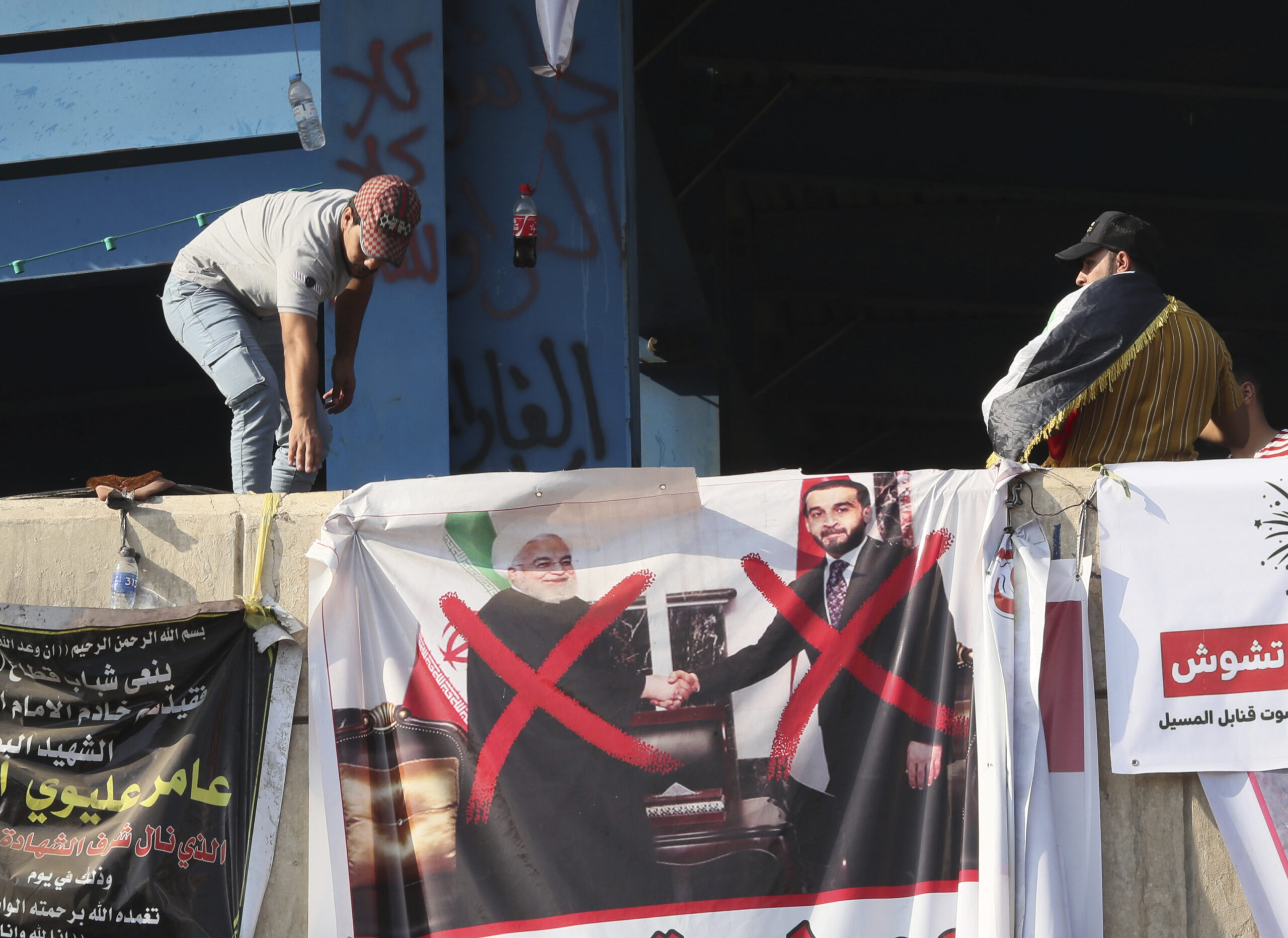
A poster of Iraqi Parliament Speaker Mohammed al-Halbousi, right, and Iranian President Hassan Rouhani, left, hang on a building near Tahrir Square, during ongoing protests in Baghdad, Iraq, Nov. 6. (AP Photo/Hadi Mizban)
Saudi Arabia has begun to explore the potential for easing, or even resolving, a number of long-standing regional confrontations. In Yemen, regarding Qatar, and exploring prospects for bilateral and multilateral talks with Iran, Riyadh is showing signs of a new sense of confidence regarding the potential for new understandings. In part, each of these projects is prompted by a growing sense that these ongoing confrontations have begun to accumulate diminishing returns. And all three initiatives appear to be linked to growing signs that Iran’s fortunes and regional standing are beginning to fray badly. This has led to hopes that Tehran’s difficulties, including major unrest at home and in Iraq and Lebanon, could make the Islamic Republic more amenable to a real compromise with its Gulf Arab neighbors.
For much of the past 15 years, as Iran’s regional fortunes appeared to only go from strength to strength, in large part as an unintended consequence of U.S. policies, Iran has shown more willingness to enter into direct talks on regional arrangements with Gulf Arab countries. Saudi Arabia and the United Arab Emirates, in particular, have generally avoided anything that smacked of far-reaching negotiations with Iran. They have maintained that the Islamic Republic cannot be trusted because of its foundational commitment to export its revolution, and that Iran often behaves like the vanguard of a regional movement that threatens their interests, rather than a “normal” neighboring state.
But the deeper concern has been that Tehran gained undue advantage largely as an unintended consequence of contingent events that were originally unconnected to Iran. From the Saudi and Emirati perspectives, Iran was the primary beneficiary of the 2003 U.S. invasion of Iraq and the earlier ouster of the Taliban in Afghanistan. Moreover, Iran was seen as benefiting from the destabilization of leading Arab republics in the Arab Spring uprisings that began in 2010. And, finally, Iran has been widely viewed as a primary beneficiary of a perceived U.S. disengagement from the Middle East, the Gulf in particular, and the concomitant rise in Russian influence, particularly in Syria. Yet all of these developments were regarded as distortions, rather than reflections, of the actual balance of power in the region and as reversible if not simply unsustainable. Iran had gone from strength to strength for more than a decade, but, it was widely felt in Gulf states, Tehran was also overconfident and overextended, benefiting more from its adversaries’ mistakes than its own achievements.
Therefore, Saudi Arabia has been, in effect, postponing the inevitable dialogue with Iran, hoping to enter into talks that reflect what Riyadh regards as the actual balance of power in the region and that would involve serious compromises rather than an effort by Tehran to get Arab states to effectively acknowledge Iran’s hegemony in large parts of the Arab northern Middle East. That moment may have arrived, given a series of setbacks besetting the Iranian regime.
“Maximum Pressure” versus “Maximum Resistance”
Since the administration of President Donald J. Trump withdrew the United States from the Joint Comprehensive Plan of Action nuclear agreement and instituted the “maximum pressure” campaign against Tehran, there has been a powerful momentum against the fortunes of the Iranian government. The economic sanctions imposed by Washington since May 2018 have badly damaged the Iranian economy. Iran is estimated to be on course for a 9.5% economic contraction in 2019, with only Libya and Venezuela suffering greater economic declines. Iran’s ability to sell its oil has been reduced dramatically, and it is increasingly frozen out of the international, dollar-based economy. The efforts of European governments to encourage their multinational corporations to continue to trade with Iran largely failed due to threats from the U.S. Treasury Department. And the European effort to create a special purpose vehicle to facilitate payments in nondollar denominations has so far proved unsuccessful.
Yet sanctions, no matter how effective, were never likely to produce regime change and, indeed, on their own were not even likely to produce positive policy changes. As long as Iran did not feel that its strategic regional gains were threatened, financial warfare was always more likely to prompt more obdurate policies than lay the groundwork for compromise.
Iran’s Crisis in Lebanon and Iraq
Nonetheless, Iran’s position in the Arab world has been suddenly threatened by widespread and sustained political protests in Iraq and Lebanon. These movements are very different and cannot be conflated. While in neither case is Iran a primary target of the demonstrators, the regional impact of the uprisings directly threatens Iran’s influence in two of the Arab countries in which it is most powerful. Lebanese and Iraqi demonstrators began by condemning their own leaders and pursuing a set of socioeconomic and governance grievances. Yet in both cases, to address these concerns, demonstrators are demanding substantive and even structural changes to the existing political order. This is a profound threat to Iranian hegemony because in Iraq and Lebanon the existing arrangements effectively maximize the potential influence of Iran’s clients and interests.
Therefore, Iran and its local clients, such as Hezbollah and Amal in Lebanon and the Popular Mobilization Forces in Iraq, have increasingly adopted a belligerent attitude toward the demonstrators. All have increasingly denounced the protesters as seditious and disloyal agents of nefarious foreign influence. In Iraq, a brutal crackdown by the state and pro-Iranian militia groups has taken over 320 lives, while Hezbollah and Amal have thus far largely restricted themselves to threats and intimidation. However, the political impact of all of this on Iran’s long-term interests in Iraq and Lebanon can only be extremely negative. A November 19 news dump of hundreds of Iranian intelligence cables illustrating Tehran’s intensive efforts to influence and even control Iraqi domestic politics and policymaking will certainly not help matters.
Iran and its local clients are now much more firmly associated with the corrupt, dysfunctional political order being roundly rejected in both societies and also with the crude, sectarian, and, in the case of Iraq, brutal measures being employed to maintain them. The campaign of repression has the makings of a disastrous turning point in attitudes toward Iran among large parts of the Lebanese and Iraqi populations, including many Shias, that may linger for years. Iran’s influence in both societies seems far more fragile than has been assumed in recent years and Iran was indeed overextended and vulnerable in these Arab countries.
Iran’s Worries in Syria and at Home
Iran’s influence in Syria had appeared to be far less threatened, given its strong alliance with the regime of President Bashar al-Assad and powerful presence on the ground in much of the country. However, recent developments in northern Syria have raised the prospect that other parties, including Russia, Turkey, the United States, and even the Assad regime, might agree to postconflict or deconfliction arrangements that would squeeze Iran out of positions of influence insofar as possible. Russia and the Syrian government still remain dependent on Iran and Hezbollah on the ground in some areas and Iran is continuing to try to build a military infrastructure in key parts of Syria. However, as the postconflict scenario begins to take shape, marginalizing Iran’s role appears to be developing as a common interest for Moscow, Washington, Ankara, and, to the extent possible, Damascus. And Israel has repeatedly demonstrated that it has enforceable redlines about Iranian and Hezbollah activity in Syria and, more recently, parts of Iraq as well. Again, Iran appears to be overextended, including in Syria.
Finally, anti-government protests that have caught fire in Iran in recent days underline the political difficulties besetting the regime. Ostensibly sparked by a 50% gasoline price hike and the imposition of rationing as a result of sanctions, the protests, which have spread to a hundred Iranian towns and cities and resulted in dozens of deaths, actually reflect much more deep-seated discontent. While the protests in Iran, Iraq, and Lebanon differ greatly, the Iranian protests certainly represent a further intensification of the woes of the regime and are the most direct part of the political crisis facing it. The clearest indication of how threatened the regime feels by these protests is the countrywide internet blackout imposed on November 17.
Opportunities for Regional De-escalations
This is the context in which Saudi Arabia seems to be exploring diplomatic options for resolving regional disputes. In each case, the conflicts themselves have generated sufficient incentives to pursue compromise. Yet the regional context in which Iran appears to be struggling is a key factor linking all three initiatives.
The Riyadh agreement Saudi Arabia brokered between the Yemeni government and the pro-secession Southern Transitional Council reflects Saudi interests in stabilizing the situation and extricating itself from what has become a quagmire in Yemen. The UAE has already taken the lead in disengaging, and the agreement demonstrates a Saudi desire to stabilize the situation in the south, presumably as a prelude to further disengagement. Reports that Saudi Arabia has begun a quiet dialogue with the Houthis in recent months add to the sense that Riyadh is looking for a way out of Yemen and may be prepared to compromise with the Houthis, particularly if the Saudis feel Iran is not in a position to take advantage of the postconflict situation in Yemen.
Much the same applies to the boycott of Qatar, which began in June 2017. This, too, is a stalemate, although the costs to Qatar have been more serious than to Saudi Arabia, the UAE, Bahrain, and Egypt. However, Doha has developed effective workarounds that have allowed it to endure the boycott as a “new normal,” with continued U.S. support and the help of Turkey and Iran. Whatever the boycott was supposed to accomplish, therefore, has either been secured or is not going to be secured by these means. There is little cachet in continuing for any of the parties, especially given that, again, Iran is hardly in a position to take advantage of diplomatic openings among Gulf Arab countries and Turkey appears highly focused on events in northern Syria.
The most significant gesture toward a reconciliation within the Gulf Corporation Council is the announcement that Saudi Arabia, the UAE, and Bahrain will be participating in the Gulf Cup in Doha beginning November 26. Given that restrictions on travel and trade are at the heart of the boycott, if this participation involves significant levels of travel and trade it could signal a significant easing of the boycott, which in any event was never total. It did not extend to restrictions on shipments of and trade in energy, nor to GCC military cooperation. Apart from continuous U.S. pressure to heal the rift within the GCC and since little more is likely to be secured by the continuation of the boycott, a key argument for reconciling would be that Iran has been a major beneficiary of the split and, to take advantage of Tehran’s woes, Gulf Arab countries ought to be as united as possible.
Finally, there are indications that Saudi Arabia, like the UAE before it, has for several months been cautiously exploring the potential for dialogue with Iran, albeit indirectly. Riyadh never wanted its own or a U.S. war with Iran. The “maximum resistance” campaign, especially the attacks on Saudi oil infrastructure, has served as a potent reminder of how much all parties stand to lose from a conflict in the Gulf. Given that the most important reservations holding Riyadh back from a serious dialogue with Tehran in recent years now appear to be significantly attenuated, there is all the more reason for Saudi interest in talks.
Indeed, the deeper question is whether reticence will now have transferred to hard-liners in Tehran, who may suddenly be the ones feeling that the time is not right for a dialogue with regional rivals. However, Iran’s political leaders, including President Hassan Rouhani and Foreign Minister Mohammad Javad Zarif, continue to advocate for regional and international dialogue, including via their new Hormuz Peace Endeavor (HOPE), an ambitious program for regional security and cooperation. Whether Iran’s elected leaders are sincere in this agenda, and, more importantly, whether it also has the backing of Iran’s far more powerful unelected leadership in the Supreme National Security Council and Islamic Revolutionary Guard Corps as well as, of course, the supreme leader, remains to be determined. And, of course, the goal of the initiative, as Iran acknowledges, is splitting Washington’s Gulf Arab allies from the United States and securing the removal of U.S. military forces from the region altogether.
Yet, assuming it’s not merely a stunt, the HOPE initiative must be viewed as an opening bid made under increasingly difficult circumstances. There are ample grounds for mutual suspicion, but also clearly a need on all sides to move away from the atmosphere of the zero-sum confrontation that has prevailed in recent years. The stalemate between “maximum pressure” and “maximum resistance” illustrates the dangers of confrontation for both Iran and Saudi Arabia and spurred an evident interest in dialogue on both sides. That, combined with the strategic and political crisis facing Iran, may make Riyadh more willing to engage in dialogue about long-term regional arrangements and Tehran more willing to accept reasonable limitations on its ambitions in the Arab world and strategies that involve destabilizing neighboring states.
The views represented herein are the author's or speaker's own and do not necessarily reflect the views of AGSI, its staff, or its board of directors.
As the September deadline for the U.S. troop drawdown approaches, Iraq’s period of comfortable neutrality is ending, but the country’s policymakers should not rush into unsustainable alignments.
President Trump has led the United States into an impossible dilemma in which resuming and intensifying the war presents one set of alarming consequences while ending it under current circumstances offers at least as many disasters for Washington.
The Trump administration has positioned the United States at a crossroads between a new regime of containment against Iran or a historic drawdown of U.S. influence in the Gulf and broader Middle East.
Riyadh and Abu Dhabi urged President Trump not to attack Iran, but now that the war is into its second month, leaving the current situation in place would be an unthinkable fiasco for them.
Though they were unsuccessful in preventing the current conflict, and, as expected, have been dragged into the U.S.-Israeli confrontation with Iran, Gulf Arab countries remain crucial to hopes for limiting the war and bringing it to a quick resolution.