How Egypt Became the Middle East’s New Energy Chokepoint
Egypt has become the indispensable transit state linking Saudi Arabia's Red Sea infrastructure with global markets. But that strategic importance may also have exposed it to the same risks facing Gulf producers.
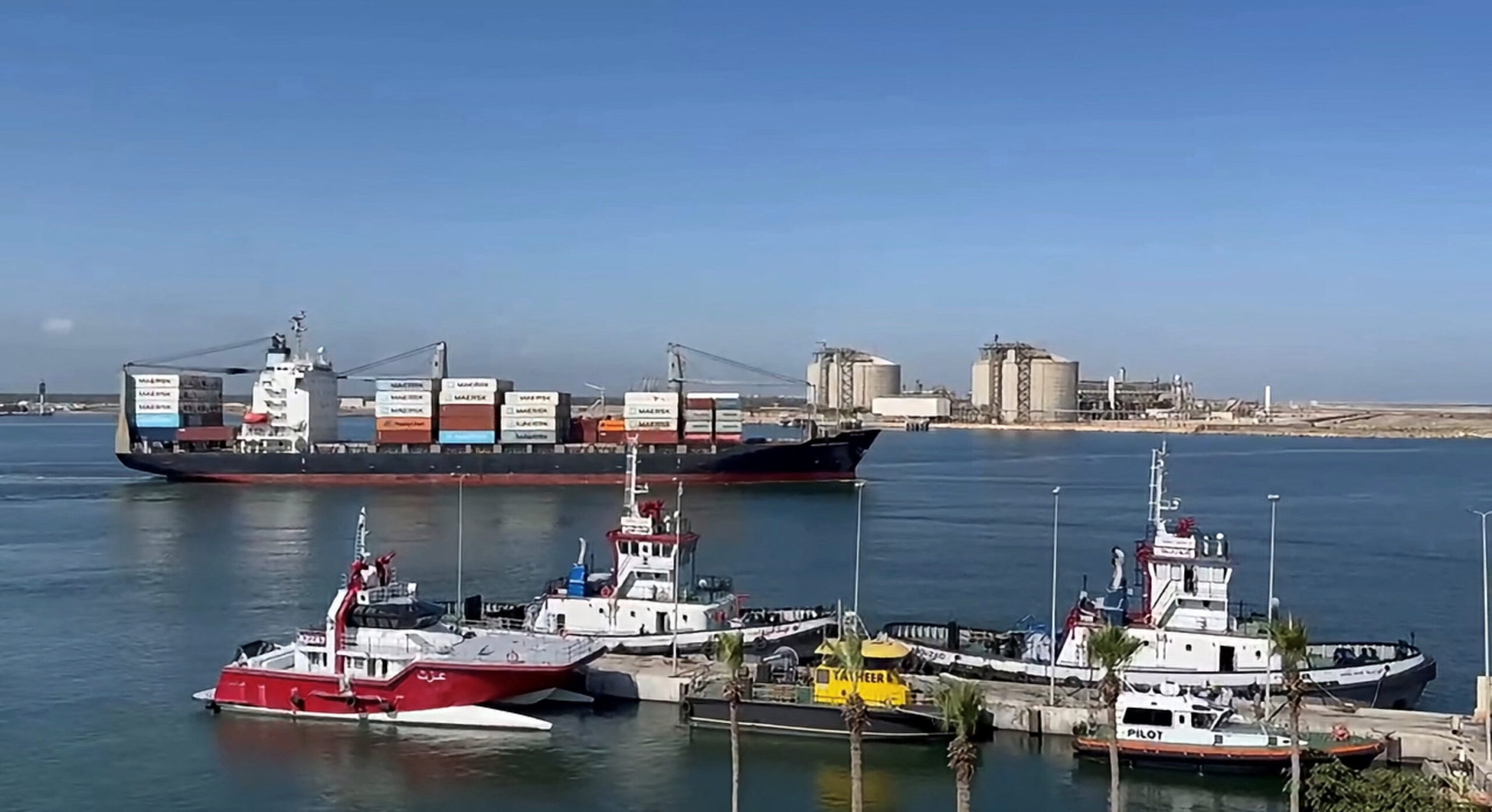
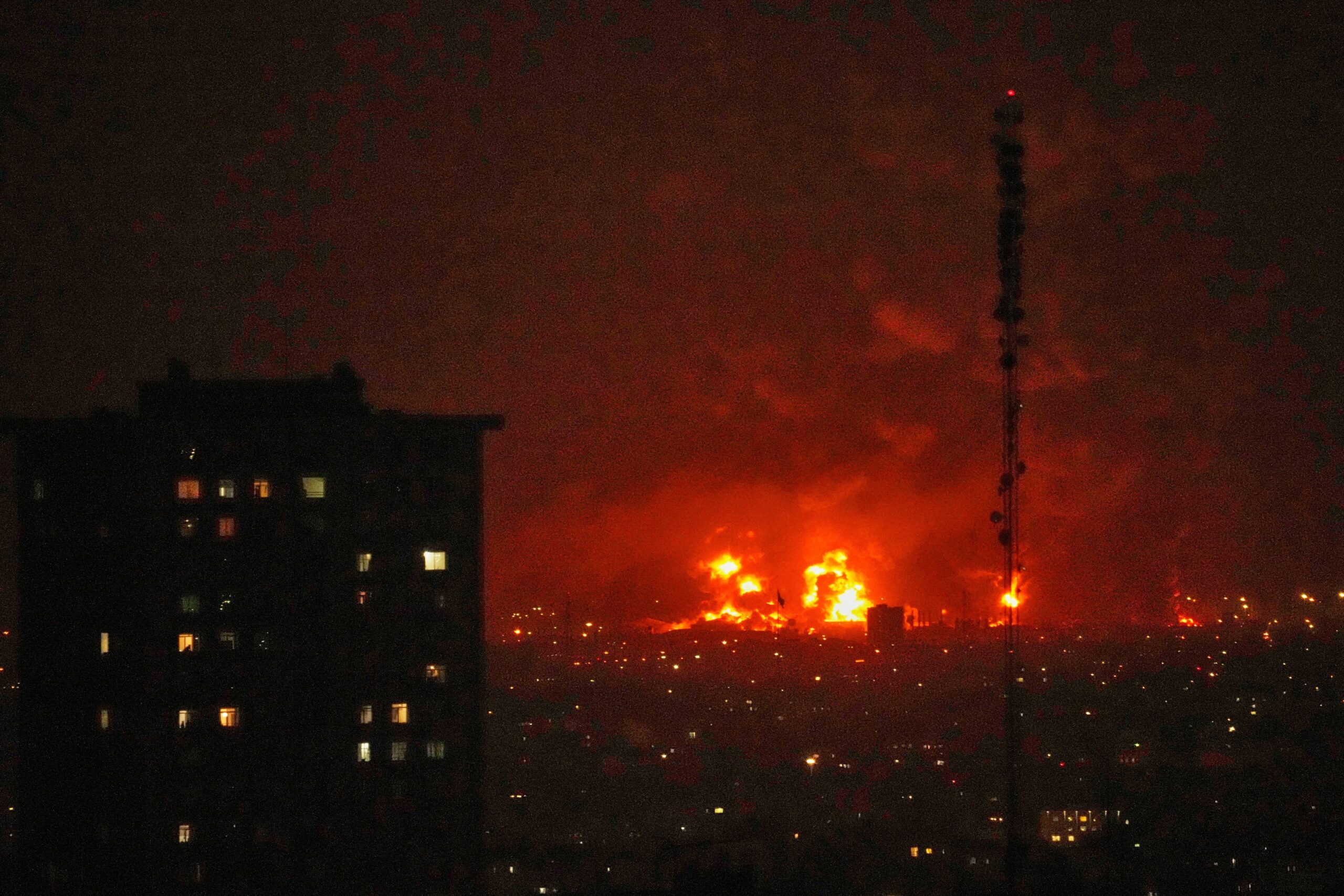
A view of Damietta port in Egypt where a drone attack caused fire on two ships in this undated social media video obtained by Reuters on July 30. (DAMIETTA PORT AUTHORITY/Handout via REUTERS)
The conflict in the Middle East has fundamentally changed Egypt’s role in regional energy security. Until recently, Cairo was focused on reversing declining gas production and restoring investor confidence. But with the Strait of Hormuz effectively closed to maritime traffic since early March and the Bab el-Mandeb increasingly threatened, Egypt has become the indispensable transit state linking Saudi Arabia’s Red Sea infrastructure with global markets. That strategic importance may also have exposed it to the same risks facing Gulf producers. A July 29 drone strike on the eastern Mediterranean port of Damietta marked the first time that Egypt has been targeted and illustrated that vulnerability, even if it did not disrupt traffic through Egypt’s energy corridor.
As conflict disrupted energy flows through the Strait of Hormuz and now threatens shipping in the Bab el-Mandeb, Egypt’s Suez-Mediterranean, or Sumed, pipeline and Sidi Kerir export terminal became indispensable routes for Saudi crude moving from the Red Sea to the global market, while the Suez Canal remains the only practical route for refined products and an important alternative for crude cargoes unable to transit the Bab el-Mandeb now threatened by the Houthis in Yemen.
The February 28 U.S.-Israeli attack on Iran set off a chain of events that has widened the conflict. The blockade of the Strait of Hormuz, which remained open throughout years of confrontation with Tehran, has become the single biggest threat to global energy security. Yemen’s Houthis have now opened another front by targeting shipping in the Red Sea and announcing a blockade on Saudi shipping. At the same time, fighting has spilled into Iraq, where Saudi and U.S. forces struck pro-Iranian militias, while Ukraine has reportedly attacked an Iranian vessel in the Caspian Sea.
The conflict forced Gulf energy exporters to find new routes around disrupted infrastructure, altering the geography of flows as chokepoints came under pressure. Before the current conflict, the geography of Gulf oil exports was well established. The majority of crude oil exports from Saudi Arabia, Kuwait, Iraq, and the United Arab Emirates moved east through the Strait of Hormuz, the world’s most important oil chokepoint. Iran’s effective closure of the strait since early March left a significant volume of oil stranded inside the Gulf. Saudi Arabia’s East-West pipeline had existed as a contingency, but the kingdom had never needed to use it at scale.
The closure of the Strait of Hormuz changed that overnight. Saudi Aramco pivoted rapidly to its East-West pipeline, pumping crude across the peninsula to Yanbu on the Red Sea coast at volumes the infrastructure had never previously handled. Yanbu became the kingdom’s primary export terminal. The Red Sea, not the Gulf, became the artery of Saudi oil exports, which remain at around of some 5 million barrels per day, still below preconflict export volumes.
That pivot worked – until the Iranian-backed Houthis in Yemen resumed attacks on tankers in the Red Ship after announcing a blockade on Saudi ships, forcing Saudi Aramco to divert exports again. Saudi Arabia was exporting record volumes through Yanbu, but getting the oil to market through the northern route will be challenging.
Two principal channels through which Red Sea crude can reach the Mediterranean are through Egypt. The Sumed pipeline, running nearly 200 miles from Ain Sokhna on the Gulf of Suez to Sidi Kerir near Alexandria, and the Suez Canal itself, which provides an alternative route for tankers and the only practical route for refined products. As Saudi crude surged north from Yanbu, Egypt became the indispensable bridge between the kingdom’s Red Sea infrastructure and international markets.
The Houthi blockade on Saudi shipments through the Bab el-Mandeb threatens to severely disrupt the largest Middle East bypass route for the Strait of Hormuz. Saudi Arabia has been exporting higher volumes of crude oil and refined products from the Red Sea since the start of the conflict, most of which goes through the narrow chokepoint. Renewed attacks by Iran on ships in the Strait of Hormuz despite the June 17 framework agreement between Tehran and Washington added to market pressures. Oil prices briefly breached the $100 per barrel mark on July 23 for the first time since May and have been volatile since then.
As market concerns mounted, IEA Executive Director Fatih Birol issued a statement July 21 warning that “the escalation in hostilities affecting the Strait of Hormuz and energy infrastructure in the region increases security of supply concerns and uncertainty over the market outlook. Threats to the Bab el-Mandeb Strait, which has become increasingly important as a route to bypass the Strait of Hormuz, exacerbate these concerns further.”
Originally built in the 1970s as an alternative to the Suez Canal for large crude tankers, Sumed can carry 2.5 mb/d between Ain Sokhna and Sidi Kerir. Previously underutilized, flows have risen by an estimated 150% since the conflict began, leaving the system operating close to capacity. Shipping intelligence provider Kpler estimated that Saudi Arabia was able to increase exports through Yanbu from a baseline average of 750,000 b/d in 2025 to more than 4 mb/d since April. “This sustained outflow demonstrates Saudi Arabia’s operational capacity to bypass 64% of its traditional Mideast Gulf output level.”
Diverting cargoes northward is feasible but poses operational challenges. Crude arriving at Ain Sokhna on tankers from Yanbu is pumped north through the two parallel 42-inch lines to the Sidi Kerir terminal near Alexandria, where it is reloaded onto tankers for delivery to European buyers. What was previously an underutilized alternative route has become a critical artery. Egypt’s petroleum minister, Karim Badawi, said in March that Egypt was ready to facilitate Saudi crude transit at maximum capacity.
The Suez Canal provides a parallel and complementary route. Unlike Sumed, which can only carry crude, the canal handles all cargo types, such as refined product and liquefied natural gas tankers, container ships, and bulk carriers. For Saudi product exports rerouted from Gulf coast facilities to Yanbu, the canal is the only practical northbound route. But it cannot accommodate very large crude carriers, which must partially discharge their cargoes and reload again in the Mediterranean. It does, however, provide a direct link for smaller vessels.
A recent analysis by shipping intelligence provider Kpler found that the combined Sumed-Suez system is technically capable of handling most of Saudi Arabia’s redirected crude and product exports. However, the route would add 30 days to normal journey times to Asia, the main market for Middle Eastern oil exporters, increase costs, and result in congestion at Ain Sokhna.
Damietta’s LNG terminal completes Egypt’s role in the regional energy picture. Originally built as an export terminal for Egyptian gas, it has been repurposed as an import and regasification hub, as domestic gas production has declined amid rising demand for electricity generation.
According to a number of media and maritime intelligence reports, the Energos Winter, which was struck on July 29, is a U.S.-owned floating storage and regasification unit operated by New Fortress Energy that had been providing critical additional import capacity. At least one drone struck the Energos Winter while it was berthed at Damietta. The strike triggered fires that spread to a second vessel, the Gaslog Salem.
The immediate physical damage was contained, but the implications are significant. A day after the attack, the Egyptian Cabinet confirmed that preliminary investigations determined that a drone had caused the fire. The New York Times reported that two Iranian officials privately acknowledged responsibility for the strike and said it was meant to show that Iran had the ability to cause further disruption to shipping and energy supplies if it chose to escalate. But there was no official confirmation from Tehran.
The choice of Damietta is intriguing as it is some distance from the Saudi crude oil transit route that runs through Sumed and Sidi Kerir further west. Damietta is a gas import terminal. If the intent was to disrupt Saudi crude flows, Sidi Kerir or Ain Sokhna would have been the logical targets. The choice of Damietta could be seen as more of a warning shot than an attempt to disrupt crude flows.
Egypt had been one of the few bright spots in the regional energy sector. Improved fiscal terms and efforts to clear arrears had revived upstream investment after years of declining production and waning investor confidence.
That recovery had coincided with Egypt’s emergence not only as a growing eastern Mediterranean gas hub but also an indispensable transit state. The drone attack, whether by Iran or its regional proxies, introduces a risk factor that was not previously present.
The redirection of energy traffic since the start of the conflict has provided some comfort to the market but the result has been that more of the region’s energy flows are being redirected to fewer corridors.
Before the conflict, Gulf energy exports were spread across the Strait of Hormuz for most crude and LNG, East-West pipeline, Bab el-Mandeb, Sumed, and Suez Canal. Today with Strait of Hormuz traffic heavily constrained and the Bab el-Mandeb risky, Egypt’s energy infrastructure carries a disproportionate share of the region’s export flows.
This might explain why Iran targeted Egypt. The Kpler analysis estimated that the combined Sumed-Suez system could technically handle Saudi Arabia’s redirected exports but noted that the binding constraint was the southbound return of empty tankers, which in the most demanding scenarios would exceed historical precedent. Any sustained pressure on that system – through attacks on Sidi Kerir, Ain Sokhna, the canal itself, or the tankers transiting it – would tighten those constraints considerably.
Every stage of this conflict has forced Gulf producers to find alternative routes around disrupted infrastructure. Those alternatives have proved remarkably resilient, but they have also become more exposed. Egypt’s emergence as a critical transit state illustrates both the adaptability of regional energy systems and their growing concentration around a shrinking number of strategic corridors. Whether the Damietta attack proves an isolated incident or the beginning of a broader campaign, it is a reminder that the geography of Middle East energy security is being rewritten in real time.
The views represented herein are the author's or speaker's own and do not necessarily reflect the views of AGSI, its staff, or its board of directors.
The Houthis’ decision to dip their toes into the conflict is a calculated choice based on military capacity, a blueprint, and the need for retaliatory pressure.
The vulnerability of the world's most important energy chokepoint has been laid bare, setting in motion changes that are likely to outlast the conflict.
The Iran war has triggered what energy experts have described as the world’s worst energy crisis. And what is certain is that the prewar energy order will be redrawn.
Abu Dhabi’s departure from OPEC signals that discipline within the group is becoming harder to sustain at a time when the global energy market is facing the prospect of a more volatile and uncertain future.