Saudi Arabia, the UAE, and Qatar are each anchoring a different piece in the rebuilding of Syria’s infrastructure, turning investment and reconstruction into an informal division of labor.
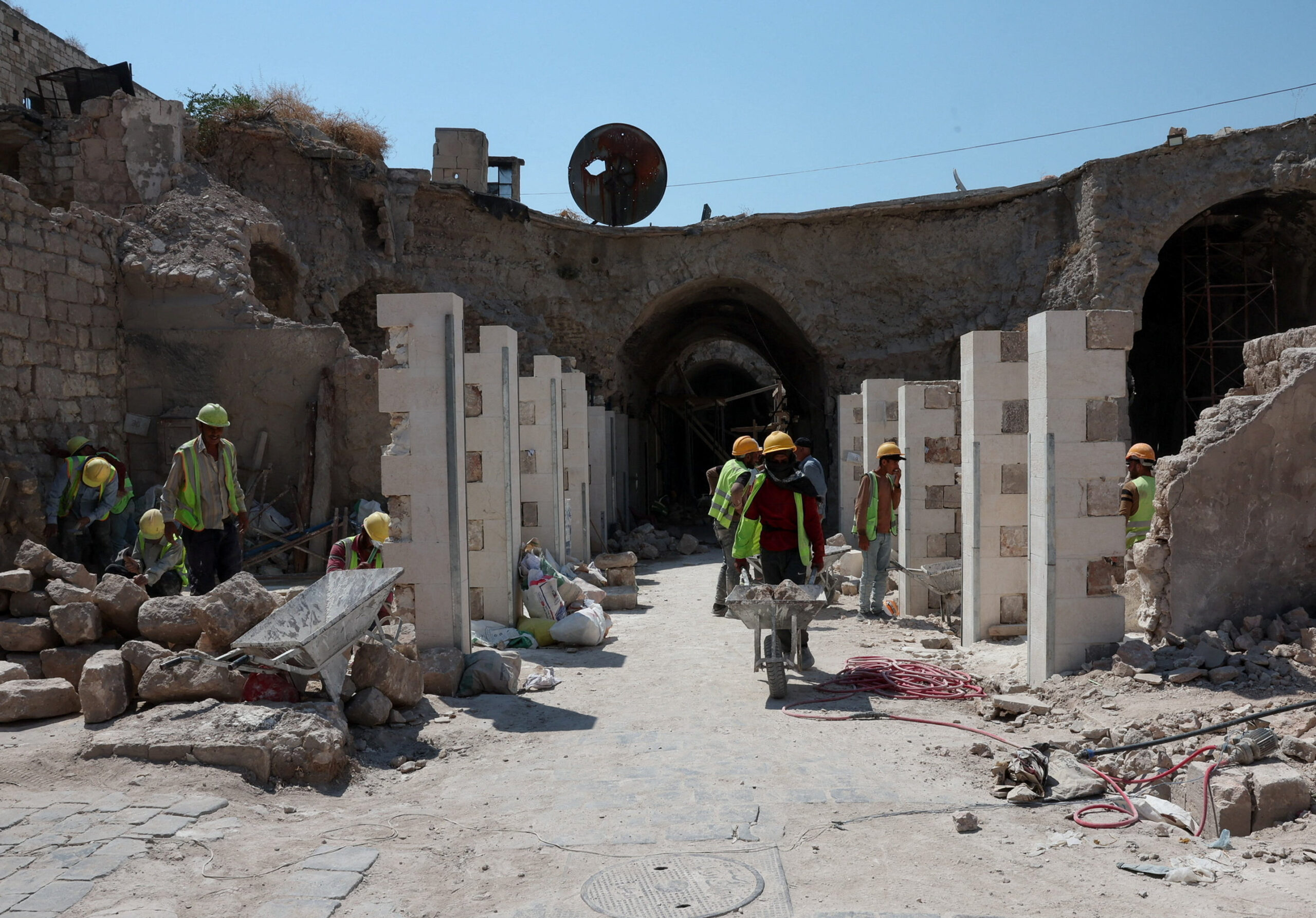
A view shows workers rebuilding destroyed markets in the city of Aleppo, Syria, August 19. (REUTERS/Mahmoud Hassano)
After nearly 14 years of a civil war that destroyed Syria’s villages, cities, and infrastructure, the country’s reconstruction bill is large. According to estimates from the World Bank, Syria needs a minimum $216 billion, with costs potentially as high as $345 billion, after more than a decade of conflict damaged homes, utilities, transport networks, and basic services. Since the fall of Bashar al-Assad’s government in December 2024, Gulf states have taken the initiative to rebuild Syria’s infrastructure, announcing roughly $28 billion in memorandums of understanding since mid-2025. The key element that distinguishes the Gulf effort is the role each state, particularly Saudi Arabia, the United Arab Emirates, and Qatar, is taking in Syrian reconstruction, producing a rough division of labor rather than direct competition over projects. With the news August 24 that the United States has completed the process of lifting the state sponsor of terrorism designation that has been in place for 47 years, actual implementation of these ambitious and detailed investment plans can accelerate in Syria. As long as that designation remained in force, international companies and banks relying on dollar-denominated transactions, including those based in the Gulf, had been wary of moving forward with investment commitments.
Saudi Arabia: Power, Aviation, and Telecommunications
Saudi Arabia has been investing in multiple infrastructure sectors in Syria, positioning itself as the most visible Gulf actor. Already in 2025, Saudi firms made commitments for $6.3 billion in investments in Syria, on the heels of a business delegation to Damascus led by the Saudi minister of investment. On February 7, Saudi Arabia signed $2.8 billion in investment commitments with Syria’s transitional government. The commitments cover two airports in Aleppo, a 4,500-kilometer (about 2,800 mile) fiber-optic project, and a joint-venture airline.
On the energy side, Saudi Arabia’s ACWA Power plans to develop proposals for up to 2.5 gigawatts of renewables and storage capacity, meanwhile Saudi Energy, formerly the Saudi Electricity Company, and its project-development arm have signed separate agreements to produce additional generation capacity. Saudi firms have also taken the lead in the recovery of Syria’s upstream energy through agreements that include drilling, well rehabilitation, field development, and geophysical surveying. This Saudi investment strategy reflects a long-term institutional approach aimed at embedding Saudi firms in Syrian infrastructure planning, supporting the development of regulatory frameworks and technical standards, and fostering a sustainable, mutually beneficial economic partnership.
The UAE: Ports, Free Zones, and Real Estate
The UAE’s investment has been focused on logistics and real estate in Syria. DP World signed a 30-year concession agreement with Syria’s General Authority for Land and Sea Ports in July 2025 to develop and operate the port of Tartous, pledging $800 million to renovate the port’s infrastructure and cargo-handling systems. AD Ports Group has separately taken a $22 million stake in the port of Latakia, giving Emirati firms a foothold in both of Syria’s major Mediterranean ports. In mid-August, a month after President Donald J. Trump announced his intent to lift the state sponsor of terrorism designation, DP World completed delivery of three new Mobile Harbor Cranes to the Tartous port, an important milestone in its investment program for the port of Tartous.
On real estate, Emirati conglomerate Emaar Properties plans to invest approximately $11 billion in Damascus and its surrounding areas along with up to $7 billion in projects on the Syrian coast. Additional Emirati commitments include a planned $50 billion investment by Eagle Hills and potential tourism investment valued at $1.5 billion by Al Habtoor Group. Trade has grown alongside investment: Non-oil trade between the UAE and Syria reached $1.4 billion in 2025.
Qatar: Power Generation and Financial Reintegration
Among Qatar’s largest commitments is rebuilding Syria’s electricity and power plant system. A consortium led by Qatar-based UCC Holding signed a $7 billion electricity deal in May 2025 to build four gas turbine power plants in Aleppo, Deir Ezzor, and Hama, producing a combined 4 GW, along with a 1-GW solar plant in the south.
Qatar has also been a key part of the effort to reintegrate Syria into the global financial system. Qatar National Bank activated card-processing services within days of Visa and Mastercard resuming operations in Syria after a 15-year absence.
Pattern Not Coincidence
The investment and engagement of several Gulf countries in rebuilding Syria’s infrastructure and economy reflect a tacit division of labor and shared view of Syria’s strategic role in the region. Saudi Arabia has taken the lead in aviation and telecommunications while also securing a substantial share of power-generation projects. The UAE has focused on ports, free zones, and large-scale property development. And Qatar has anchored a major share of new electricity capacity and has supported financial-sector reintegration. These Gulf investments reflect the commercial strengths of the country making it: For example, Emirati firms are drawing on decades of port operations and real estate development across the region.
Yet Gulf investment is not enough to rebuild Syria and reintegrate it into the global economy and financial system, given the estimated hundreds of billions of dollars needed for that task. On top of the $28 billion in Gulf bilateral agreements with Syria, Western and multilateral commitments to Syria’s reconstruction total roughly $766 million, including a European Union pledge for 2026-27 and a World Bank grant for electricity transmission. However, there is a notable institutional difference in this financing. International institutions, such as the World Bank, attach procurement standards, environmental safeguards, and anticorruption conditions to their financing, which will slow down actual implementation of such financing. Gulf investors, not held to such requirements and conditions, will be able to move much quickly. The bigger issue is that the sizeable Gulf investment commitments represent only a fraction of the funding needed for Syria. One of the remaining questions is whether the reconstruction of Syria’s economy and infrastructure is advancing faster than regulatory institutions and the courts can keep up.
The division of labor among Gulf investors has produced faster movement on Syrian infrastructure than institutional financing alone would likely have achieved. Whether that division of labor holds as more capital arrives and whether Syria’s transitional government develops the regulatory capacity to manage it will shape how sustainable the current pattern of reconstruction proves to be.
The views represented herein are the author's or speaker's own and do not necessarily reflect the views of AGSI, its staff, or its board of directors.
Joining the Mecca agreement could offer strategic benefits to both Damascus and its existing members while also introducing political and security complications that could test the agreement’s credibility.
When regional actors or great powers ask these days what determines the success or failure of their strategies in the region, they are increasingly discovering that developments in Syria heavily shape the outcome.
New investment deals, mainly from the Gulf states and Turkey, are opening a path for Syrian reconstruction. But the fragile security situation and financial environment remain hurdles for foreign investment.
The war between the United States and Iran revealed the vulnerability of static U.S. bases, while also showcasing Gulf Arab states’ capacity – bolstered with U.S. hardware and training – to intercept most Iranian strikes on their own, raising new questions about U.S.-Gulf security partnerships.