This piece is part of a series about Iranian-backed Shia foreign fighters and their potential impact on regional security dynamics. In the midst of the civil war in Iraq, and as the Islamic State in Iraq and the Levant was threatening the central government in Baghdad, several Iranian-supported Iraqi Shia militias flocked to neighboring Syria...
FILE - This Friday, Nov. 22, 2013 file photo, Iraqi and Lebanese Shiite fighters from a group called the Hussein Brigade use a helmet to draw a sniper into view during clashes between the Sunni-dominated Free Syrian Army and Syrian soldiers loyal to Syria's President Bashar Assad, supported by Iraqi and Lebanese Shiite fighters, in the town of Hejeira, which Syrian troops captured, in the countryside of Damascus, Syria. Aleppo is set to be recaptured by Syrian President Bashar Assad, but the victory will not be Assad's alone. The battle for Syria's largest city has attracted thousands of foreign forces, including Russian soldiers and thousands of fighters from Iran, Lebanon, Iraq and Afghanistan. (AP Photo/Jaber al-Helo, File)
This piece is part of a series about Iranian-backed Shia foreign fighters and their potential impact on regional security dynamics.
In the midst of the civil war in Iraq, and as the Islamic State in Iraq and the Levant was threatening the central government in Baghdad, several Iranian-supported Iraqi Shia militias flocked to neighboring Syria to fight for the survival of the regime of President Bashar al-Assad. The losses suffered by the Iraqi Shia fighters, referred to as the “Heydariyoun,” or Followers of the Lion, a reference to Ali ibn Abi Talib, the fourth caliph and first imam of the Shia, appear to have been limited, which may indicate a restrained military engagement. Nevertheless, their very presence in Syria raises two fundamental questions: First, why did these Iraqi Shias prioritize Syria instead of defending Baghdad? Second, why do Iraqi Shia militias in Syria fight in separate units rather than a unified Iraqi Shia militia? Answers to these questions not only explain the logic behind Iraqi Shia intervention in Syria but also elucidate Tehran’s motives: creation of a multinational Shia foreign legion to reduce Iranian military losses, while preventing the emergence of a national Iraqi Shia force capable of operating independently of the Islamic Republic.
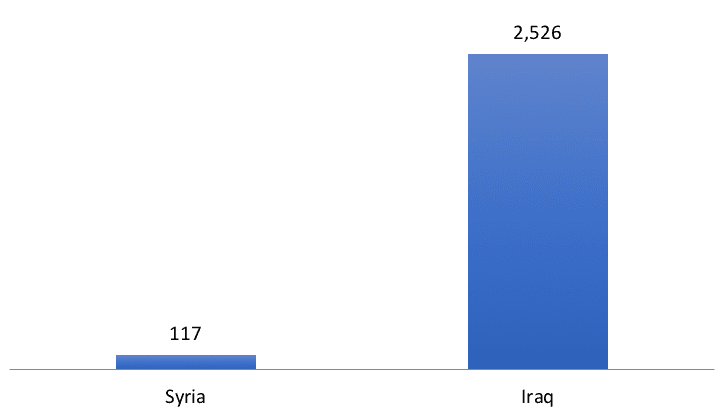
Based on data generated from a survey of funeral services held in Iraq and death announcements released by different Iraqi Shia militias, Shia foreign fighters have suffered 117 losses in Syria. In comparison, 2,526 Iraqi Shias were killed in the fight against ISIL in Iraq. These numbers should be considered a minimum estimate, in part because of the secrecy practiced by some militias, and reflect the scale of the losses in each theater of war rather than an exact number of fatalities.
Iraqi ShiaFighters Killed in Combat in Syria and Iraq, January 2012–August 2018
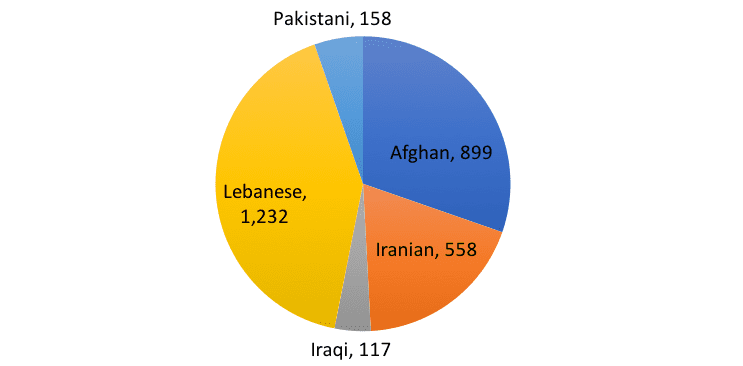
Iraqi Shia militias also appear to have suffered fewer losses in Syria than fighters of other nationalities. For example, 158 Shia Pakistani fighters have been killed and 558 Iranians. While there is no open source information about the number of Iraqi Shia fighters in Syria, their relatively low fatality rate may be an indication of their limited military presence, in comparison with other Shia foreign fighters.
Shia Foreign Fighters Killed in Combat in Syria January 2012–August 2018
The most remarkable feature about the Iraqi Shia militias is their fractured nature: While Afghan, Iranian, Lebanese, and Pakistani nationals are generally organized into militias according to their nationality (with the exception of Iranian officers seconded to other militias), Iraqi Shia fighters in Syria appear to be split into multiple militias instead of a unified national Iraqi Shia militia, as suggested by the Persian language media’s use of the term “Heydariyoun.”
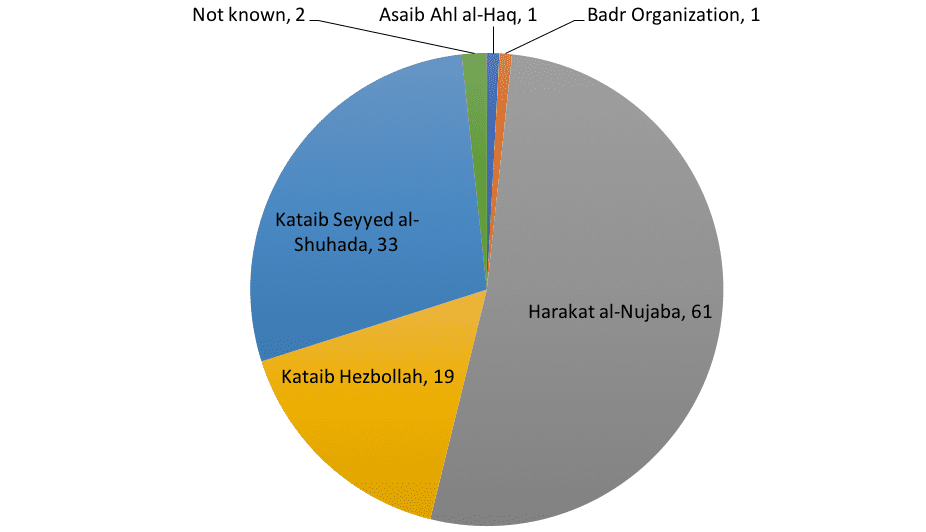
Among these militias, Harakat al-Nujaba, Kataib Seyyed al-Shuhada, and Kataib Hezbollah appear to have suffered the largest losses in Syria, but the data may be misleading due to the preference of other Iraqi Shia militias, for political or strategic military reasons, to conceal their military presence in neighboring Syria.
Iraqi Shia Combat Fatalities in Syria and Militia Affiliation August 2012–August 2018
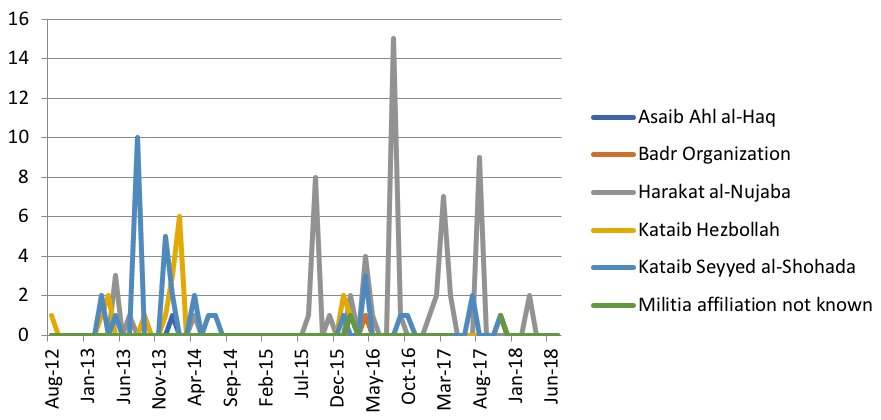
The time of death in combat of the Iraqi Shia fighters provides another indication of the fractured nature of their forces: For example, Asaib Ahl al-Haq militia members have not died in combat at the same time as Harakat al-Nujaba fighters. This indicates they have not participated in joint combat operations.
Iraqi Shia Combat Fatalities in Syria and Militia Affiliation August 2012–August 2018
Iran has a long history of supporting Iraqi militias. From the 1960s to the Algiers Accord in 1975, which temporarily settled a territorial dispute between Iran and Iraq, Tehran provided economic, military, and logistical support to Kurdish insurgents. Iran did so in cooperation with Israel, in an attempt to gain leverage over Baghdad. Following the 1979 Iranian Revolution, which coincided with the Baath regime’s increased repression of Shia political activism in Iraq, and in the course of the Iran-Iraq War (1980-88), the Islamic Republic not only revived the shah’s support for the Kurdish insurgency in Iraq, it also organized the Badr Corps of the Islamic Revolutionary Guard Corps (IRGC), which was composed of Iraqi Islamic Dawa Party and Iraqi Shia prisoners of war, who shifted sides and volunteered to fight against Saddam Hussein’s forces.
The end of the war with Iraq did not bring about the end of the Badr Corps, which continued its stealth existence until it resurfaced as the Badr Organization in Iraq in 2003, after the U.S.-led invasion and overthrow of the Baath regime.
But why would the Badr Organization or other Iraqi Shia militias volunteer for the fight in Syria, when Baghdad itself was threatened by ISIL? One possible explanation is the shared border between Syria and Iraq. With ISIL fighters on both sides of the border, Iraqi Shia militias probably had little choice but to fight the enemy in Syria to prevent ISIL from using its strongholds there to launch operations into Iraq. This doesn’t seem to be the full explanation, however, when considering the limited data available on the place of death of Iraqi Shias in Syria. Among the 31 Iraqi Shia militia members whose place of death in combat in Syria is known, only one was killed close to the Iraqi border, in Deir el-Zour. Two were killed in Damascus, seven in Latakia, and 21 in Aleppo – cities in western Syria, far from the border with Iraq, that ISIL could not have used as launching pads for operations on Iraqi soil.
An alternative, though speculative, explanation is the intra-Shia rivalry in Iraq: A year into the U.S. occupation of Iraq, many former Badr Corps commanders established their own splinter militias and organizations and immediately found themselves in a state of competition for Tehran’s largesse, which could potentially secure them supremacy in Iraq. The military engagement of some Iraqi Shias in different regions of Syria could therefore be an attempt to prove their usefulness to the IRGC. This presence was just enough to get Tehran’s attention and ensure a constant stream of Iranian support, but sufficiently limited as not to reduce their military capabilities in the fight against ISIL – or threaten their supremacy over rivals – in Iraq.
The IRGC and the regime in Tehran at large had their own reasons to welcome both the Iraqi Shia contribution to the war effort in Syria, and the fractured nature of the militias: While the Iraqi Shia military presence helped the Islamic Republic create a transnational Shia legion capable of doing Iran’s bidding in the region, the fractured nature of the Iraqi militias prevented the emergence of a unified Iraqi Shia militia capable of operating independently from Tehran.
The views represented herein are the author's or speaker's own and do not necessarily reflect the views of AGSI, its staff, or its board of directors.
Rival camps within the Islamic Republic are increasingly turning to YouTube for policy debate, but there is a limit to the regime’s tolerance for that debate.
After U.S.-Israeli strikes killed Supreme Leader Ayatollah Ali Khamenei on February 28, Iran’s collective leadership has concluded that the best defense is a good offense.