Evaluating the PIF’s Financial Performance and New Strategic Direction
In its new strategy, the Saudi Public Investment Fund seems to focus more on investment returns and less on asset growth. How this will work in practice is less clear, including what it means for the future of existing projects, such as Neom.
An exposition of The Line by Neom in Riyadh, Saudi Arabia, November 15, 2022. (Eliot Blondet/ABACAPRESS.COM)
The Public Investment Fund is at the center of efforts to grow and diversify the Saudi economy. Since the inception of the first PIF program for 2018-20, the PIF has significantly increased its footprint in the Saudi economy and has become a major investor in global financial markets. It has more than 220 companies in its portfolio and estimates that it contributed 11% of Saudi Arabia’s non-oil gross domestic product in 2025. Assets under management have grown from $223 billion at the end of 2017 to over $900 billion at the end of 2025 making it the seventh-largest sovereign wealth fund in the world according to Global SWF.
The PIF, however, is facing challenges. The rapid growth and high rates of return of earlier years have given way to declining assets and negative returns more recently. The large asset transfers from the government that previously underpinned much of its growth have dried up, and new investments are increasingly financed by debt. Losses on impaired assets have risen, and there remain concerns about the viability of some investments following the recent bankruptcy of LIV Golf and reports of restructuring at the futuristic megacity of Neom. The U.S.-Israeli war with Iran and the recent escalation of attacks on the kingdom by the Houthis have added uncertainty to the investment outlook.
The PIF has published its annual report and financial statements for 2025 and its new strategy for 2026-30. These documents together with information on the PIF’s website and media reporting give important insights into its operations and strategy. Based on this information, five key areas of the PIF’s financial performance and investment strategy are discussed below. The bottom line is that, while the PIF seems to have moved toward an investment strategy that focuses less on asset growth and more on the rate of return, important details about what this means in practice in terms of reprioritizing or shelving existing projects remains unclear.
Mixed Financial Performance in 2025
From a profit point of view, 2025 was a successful year for the PIF. Profits before zakat and income tax more than doubled to $19 billion driven by higher income from banking (its holdings in Saudi Commercial Bank and other banks are consolidated in its financial accounts) and “other” operations (not defined) and lower expenses associated with impaired assets than in 2024.
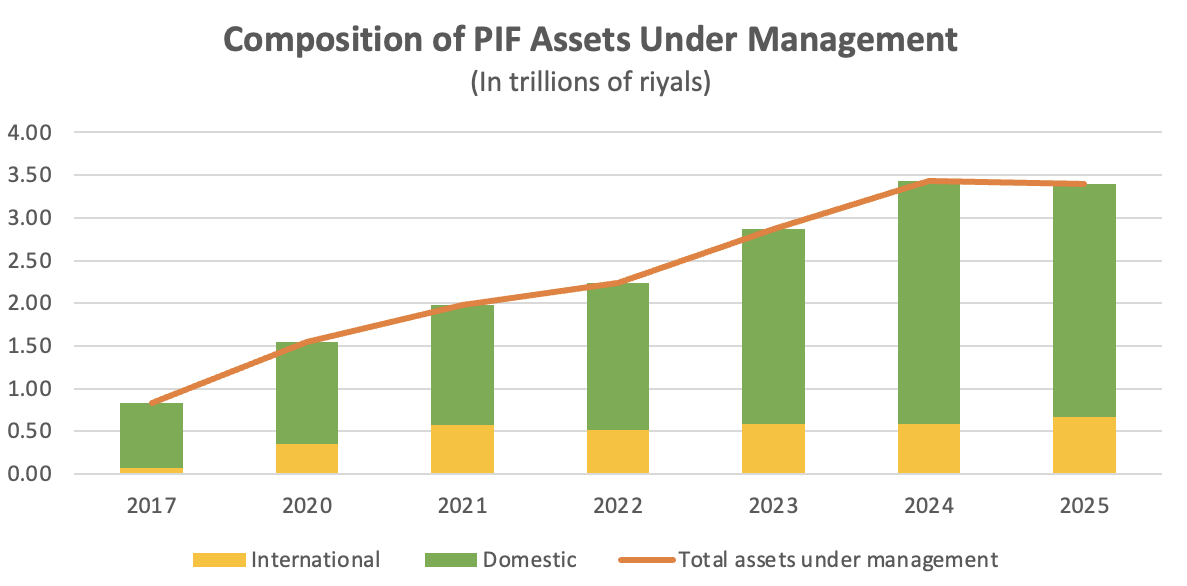
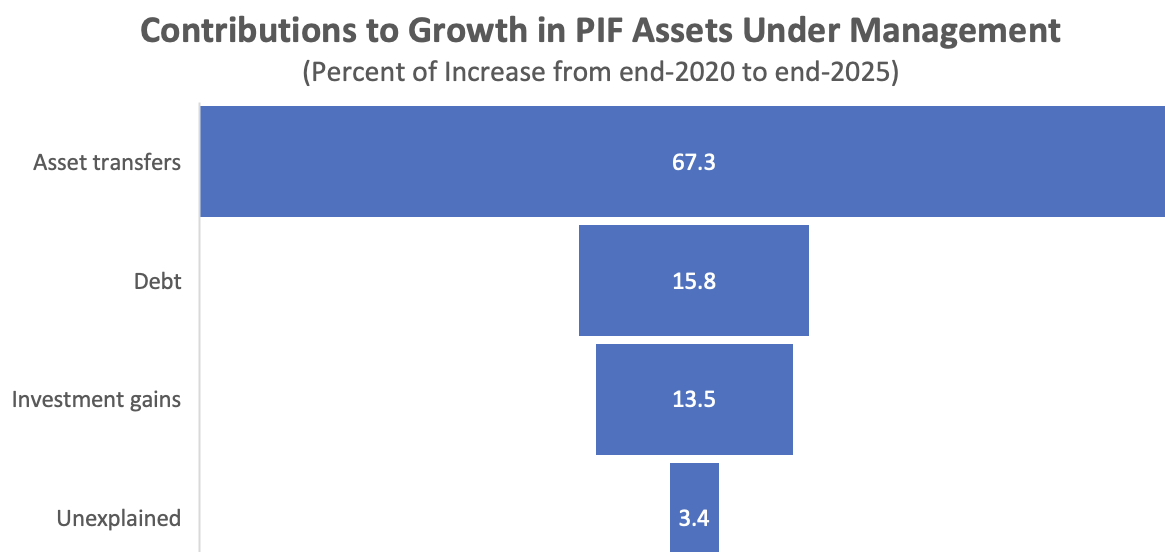
On other metrics, however, 2025 was a less successful year. After more than doubling between 2021 and 2024, the PIF’s assets under management declined by 1% in 2025, from $916 billion to $906 billion. Further, the rate of return on assets under management was -4.4% (author estimate), largely due to the poor performance of the Saudi equity market. The negative return was not fully offset by new investments or incoming asset transfers. Most of the growth in assets under management in recent years has come from the government’s transfer of 16% of Aramco’s equity (valued at around $320 billion) to the PIF.
Source: PIF annual reports
Source: PIF annual reports and financial statements; author calculations
The PIF pared back its holdings of U.S.-listed equities during 2025 from 62 companies with a market value of $27 billion to five companies with a market value of $13 billion (some of the holdings may have been transferred to other PIF portfolio companies and therefore no longer show in the PIF’s regulatory filing in the United States). Despite these sales, the value of the PIF’s international investments rose by 12% in 2025, as global equity markets surged. At the end of 2025, 20% of the PIF’s portfolio was held in international assets compared to 17% a year earlier. By mid-2026, the portfolio of listed U.S. equities had risen in value to $38 billion following a large purchase of SpaceX equity (see below).
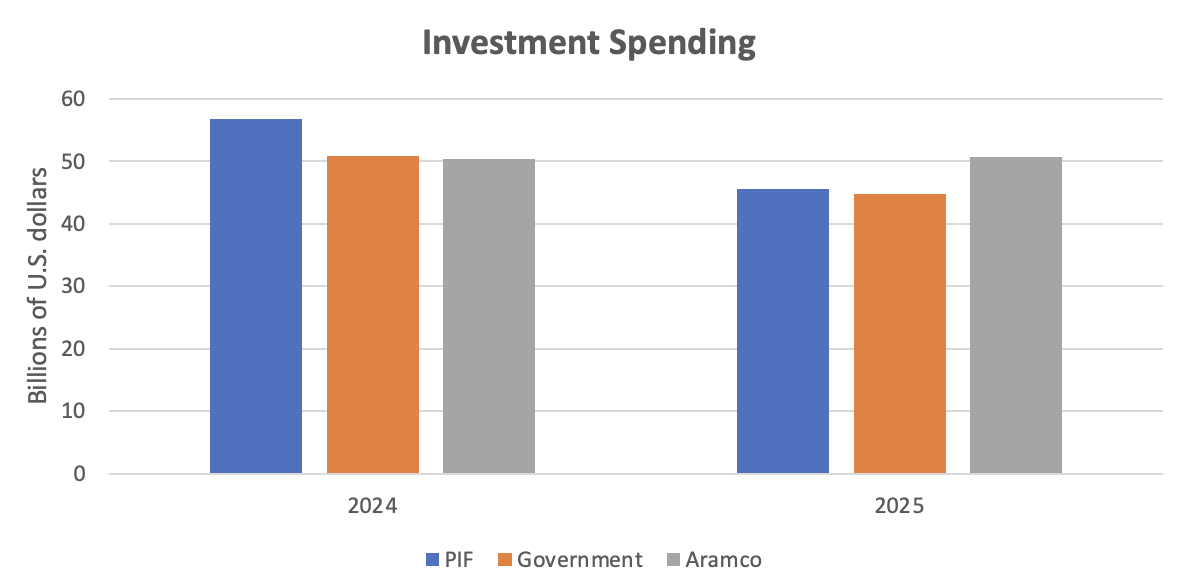
The PIF invested $46 billion in the Saudi economy in 2025. While this exceeded the $40 billion target it had set, it was lower than the $57 billion invested in 2024. The PIF’s annual investments are now similar in size to those of the government and Aramco, emphasizing its importance to the economy. Borrowing (on the nonbanking side of operations) was $26 billion in 2025 compared to $12 billion in 2024. With dividends received declining in 2025, as Aramco reduced its total payout, borrowing exceeded dividends as a source of new financing.
Sources: PIF financial statements; Aramco financial statements; Ministry of Finance Note: Aramco investment spending could include some spending overseas.
Rate of Return Has Declined
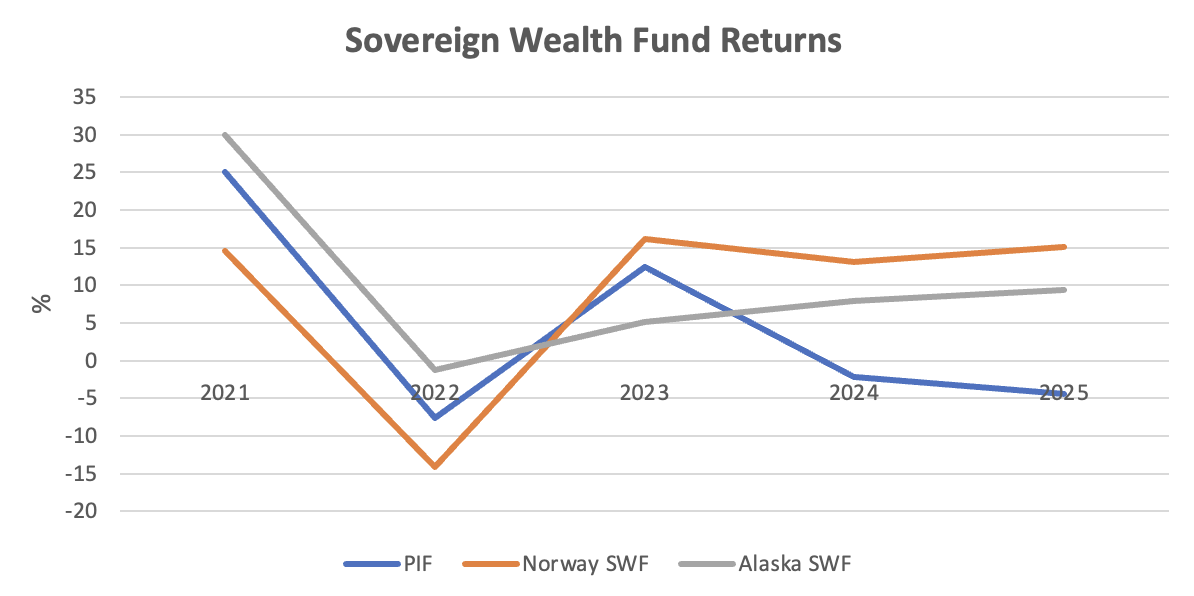
The rate of return on the PIF’s assets under management has been negative in three of the past five years. The average return over this period is estimated at 4.7% per year and was mostly accounted for by a 25% return in 2021. Over the same five-year period, global equity markets have risen by over 10% per year on average, and Norway’s Government Pension Fund Global and Alaska’s Permanent Fund Corporation, which both manage diversified global portfolios, have returned around 9% per year. To put this difference in returns in perspective, if the PIF’s rate of return had been the same as the Norway fund over the past five years, its assets under management could have been $110 billion higher by the end of 2025.
Sources: PIF; Alaska Permanent Fund Corporation; Norway Government Pension Fund Global; author calculations
These sovereign wealth funds could, however, be considered an unfair benchmark for the PIF. First, strong investment returns among sovereign wealth funds are not universal. Singapore’s Government Investment Corporation has returned 3.6% per year over the past five years, while an analysis by Global SWF (reported by Financial Times) found that the PIF’s returns ranked 15th out of 25 sovereign wealth funds during 2015-24. Second, the PIF has a different mandate. While it has some features of a traditional sovereign wealth fund, it also acts as a development institution with a central role in supporting new sectors of the Saudi economy. Consequently, it has around 80% of its assets invested domestically, a much higher percentage than most other sovereign wealth funds, according to the International Monetary Fund. This means that its returns are very dependent on the underperforming Saudi equity market, where price increases have averaged only about 5% per year since 2020. The PIF’s domestic mandate would be expected to lower its returns relative to an investor with a broader international portfolio.
Nevertheless, the domestic focus of the PIF may not explain all of its relatively low returns. A simple 80/20 average of Saudi and global equity price increases would give an average annual return of 6% over the past five years, over 1 percentage point higher than the return of the PIF. This difference may be explained by the fact that parts of the PIF’s domestic project portfolio are still under construction, and hence are not generating a financial rate of return, and that there have been write-downs of assets totaling $32 billion over the past two years.
Uncertainty About Neom
The PIF says that the ambitions for Neom are unchanged. The fact that it has its own ecosystem in the new PIF strategy (addressed below) seems to support this. The PIF’s narrative is that the construction of Neom is being phased with the more immediately commercial aspects of the project being given the highest priority. These priorities are the Neom port, the industrial city of Oxagon, green hydrogen production, and the development of artificial intelligence and data centers. Other parts, including The Line, are a lower priority and will be delivered over a longer period.
Media reports paint a different picture. Based on interviews with and documents provided by current and former Neom employees, announcements by contracting companies working for Neom, and satellite imagery, these reports suggest that a fundamental rethink of Neom has taken place. According to The Wall Street Journal, work on The Line, the Trojena ski resort, and the luxury island resort Sindalah has stopped, and contracts have been canceled because of cost overruns, technical difficulties, and unrealistic planning. Financial Times has reported that a significant redesign of The Line is underway, which will result in a much smaller project; Arabian Gulf Business Insight has reported that Sindalah has significant design problems and is facing an uncertain future; and Reuters has reported that the planned soccer stadium at Neom has been shelved.
The bottom line is that there is still no clear narrative on the current status and future prospects of Neom. The PIF’s narrative and the media reports are not necessarily inconsistent – work could have stopped for the time being and then be restarted in the future, although this would likely raise costs and concerns about how quickly the already built infrastructure would deteriorate in the interim. The lack of clarity about Neom is unfortunate. It is still the PIF’s highest profile project and has become synonymous with Vision 2030.
Big New Investment Commitments
The PIF has made several major investments in U.S. technology and entertainment companies in 2026. It completed the $55 billion purchase of EA Sports in August (together with Silver Lake and Affinity Partners), acquired around $26 billion of SpaceX equity in the June initial public offering, and committed about $10 billion to support Paramount’s takeover of Warner Bros. Elat and Humain, two new companies set up by the PIF, are also entering into investment agreements with global tech and AI companies. Little information is available about the PIF’s domestic investments this year, but it previously said that it plans to increase these to $70 billion a year from 2026 onward.
The new capital committed to EA Sports, SpaceX, and Paramount is likely around $80 billion (the PIF already had equity stakes in the first two companies). These holdings sit within the PIF’s priority investment areas of innovation and entertainment, although it is not clear how the investments will be leveraged to help develop the Saudi economy. The size of the investments relative to the overall portfolio is striking. The three investments combined represent 45% of international assets and nearly 9% of total assets under management (using end of 2025 asset data).
How the new investment is being financed is not clear. Investments for the year could run to $150 billion if the domestic investment target is met. Identified financing is perhaps only half of this total. The PIF should receive around $17 billion of dividends. Borrowing has increased with a $20 billion debt package organized by J.P. Morgan to help finance the EA Sports deal and $9 billion of bonds and sukuk issued so far this year. Memorandums of understanding have also been signed with the U.S. Export-Import Bank and the World Bank. These will potentially provide financing of $15 billion and $9.5 billion, respectively, but are unlikely to have been drawn on yet. At the beginning of 2026, the PIF held $35 billion in its liquid asset portfolio that could have been drawn on to finance investments.
The new investments and the continued robust performance of global equity markets can be expected to result in an increase in the PIF’s assets under management in 2026, although growth will be held back by the continued struggles of the Saudi equity market (down by over 3% so far this year) and potential further impairment charges associated with any changes to the gigaprojects and the bankruptcy of LIV Golf. To the extent that new investments are financed by borrowing, net assets under management (gross assets under management less debt) will increase by less, while the future dynamics of the PIF’s finances will increasingly be determined by the relative rate of return on its investments compared to the cost of borrowing.
The PIF’s New Strategy – What Has Changed?
The new PIF strategy states that the “PIF enters its next phase from 2026 to 2030 with a clear objective: to evolve from rapid scale-building to sustained value creation,” and “it emphasizes integration across strategic ecosystems” and “disciplined capital deployment.” Unlike its predecessor, the 2026-30 strategy does not include explicit numerical targets for assets under management or investments in the domestic economy.
Two of the main elements of the new strategy are a reorganization of assets into three investment portfolios (vision, strategic, and financial) and the establishment of six strategic “ecosystems,” which are defined as “integrated economic systems rather than individual assets or isolated sectors.” The six ecosystems are: tourism, travel, and entertainment; urban development and livability; advanced manufacturing and innovation; industrials and logistics; clean energy, water, and renewable infrastructure; and Neom. The six ecosystems compare to 13 priority sectors under the 2021-25 strategy.
The strategy document, however, is long on generalities and short on specifics and leaves many questions unanswered. No concrete detail is provided on how the PIF’s investment approach has changed or how its priorities have shifted, including whether some of the previous priority sectors are no longer “priorities.” The 13 priority sectors could be subsumed into one of the new ecosystems with little or no change to their investment plans. Given that new priorities have emerged since the 2021-25 strategy was unveiled, such as hosting Expo 2030 and the 2034 World Cup, and other priorities have grown in importance, such as developing the domestic defense sector, clearer enunciation of what is now a priority and what is no longer a priority for the PIF would add clarity to its plans.
As Many Questions as Answers
The new PIF strategy seems to signal a greater focus on investments with clear economic and social returns than in the past. If correct, this would mark a welcome evolution of the PIF’s operations. It is also encouraging that the PIF was willing to publish its assets under management figure for 2025 when it did not meet the target ($1.07 billion) it had set. It could have sought to reach the target via asset transfers or the revaluation of land holdings, but it did not. Together with the absence of numerical targets in the 2026-30 strategy, this supports the view that there has been a shift away from a “growth for growth’s sake” strategy.
Nevertheless, several things give pause for thought. First, the continued lack of clarity about the future of Neom raises questions about how much the PIF’s investment strategy has really changed. Second, large investments in U.S. gaming, tech, and entertainment companies fit squarely within the PIF’s announced strategy but will result in a more concentrated portfolio. This may not be an issue – the investments are a very small share of the country’s overall wealth and represent diversification away from oil – but will make the portfolio more reliant on the performance of a few companies. Third, global interest rates are on the rise, pushing up the PIF’s cost of borrowing and the opportunity cost of its capital deployment. Its rate of return will need to rise to justify its investment approach. Fourth, the economic fallout from the ongoing regional conflict is unclear. At a minimum, investments will need to be reassessed to ensure they will continue to be viable in the eventual postconflict environment. The ability of the PIF to recycle capital by selling mature assets to private investors has also become more difficult in the current environment.
As the saying goes, “the proof is in the pudding.” Ultimately, the success of the PIF’s new strategy can only be judged by the outcomes it achieves in the next few years. Some of the key things to look for are whether its rate of return increases, whether its portfolio companies can help spur economic diversification, and whether it can recycle its capital by offloading more mature portfolio companies to private investors. Success in these areas will bode well for the future of the PIF and Saudi Arabia.
The views represented herein are the author's or speaker's own and do not necessarily reflect the views of AGSI, its staff, or its board of directors.
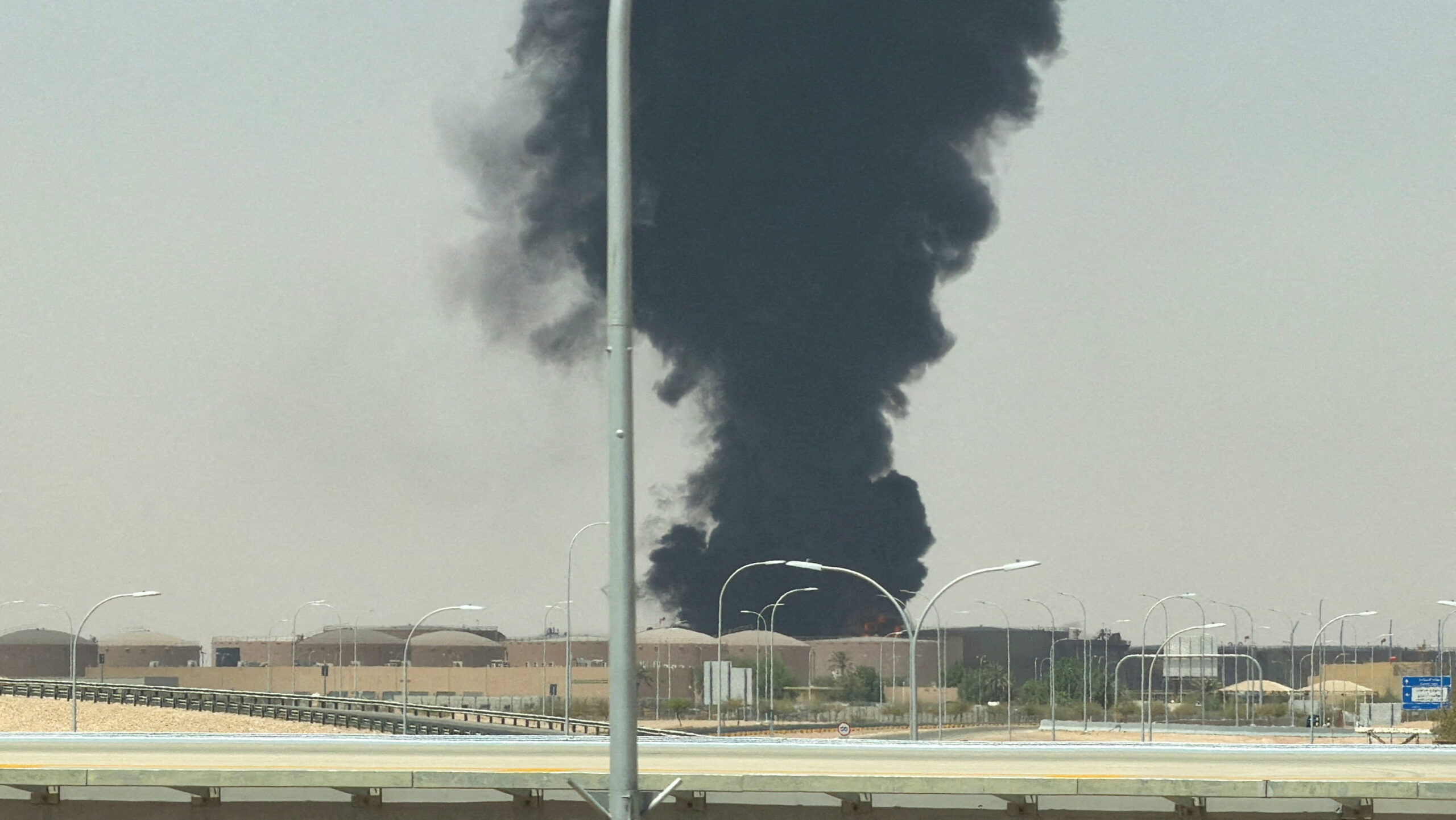
Attacks on the East-West oil pipeline and other targets in Saudi Arabia will result in a larger-than-expected economic contraction in the kingdom this year.
Attacks on the East-West oil pipeline and other targets in Saudi Arabia will result in a larger-than-expected economic contraction in the kingdom this year.
The outbreak of the Iran war has halted the deepening of the economic relationship between the United States and the Gulf countries. While likely temporary, it could take some time before the upward trajectory is restored.
The impact of the Iran war on the Saudi economy has been mitigated by investments in “economic resiliency,” including the East-West oil pipeline, relatively prudent fiscal policy, and the accumulation of a large stock of foreign financial assets.
On January 8, AGSI hosted a virtual roundtable with its leadership and scholars as they look ahead and assess trends likely to shape the Gulf region and U.S. foreign policy during the coming year.