An Arab Expeditionary Force in Syria is Far-Fetched but so is a U.S. Withdrawal
Some ideas never die. Most recently, the Trump administration, reportedly via a phone call from National Security Advisor John Bolton to Egypt’s acting head of intelligence, Abbas Kamel, proposed the creation of an Arab expeditionary force to be deployed to Syria. In the process, the White House was resurrecting a concept that, for decades, has...
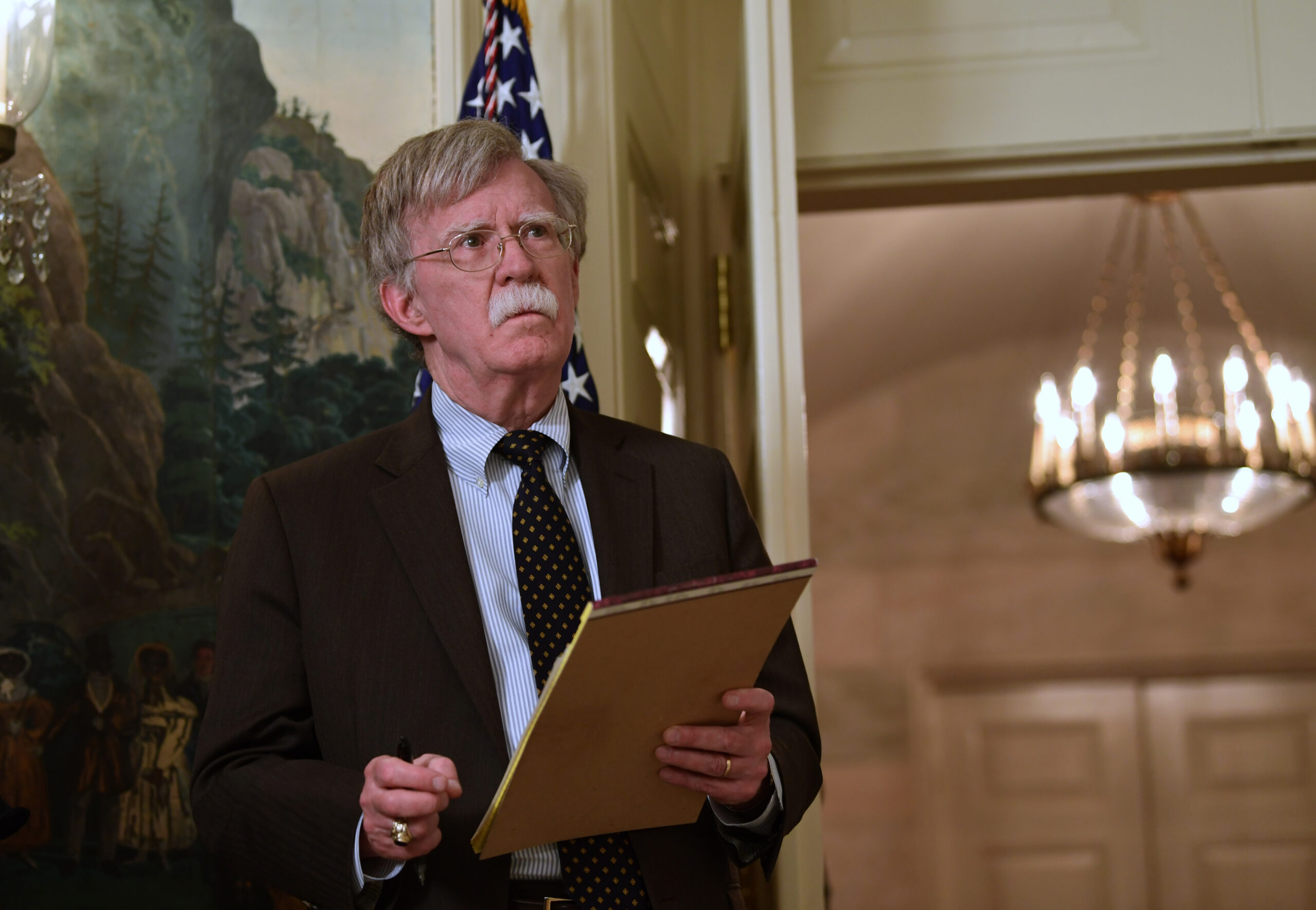
National security adviser John Bolton listens President Donald Trump speaks in the Diplomatic Reception Room of the White House on Friday, April 13, 2018, in Washington, about the United States' military response to Syria's chemical weapon attack on April 7. (AP Photo/Susan Walsh)
Some ideas never die. Most recently, the Trump administration, reportedly via a phone call from National Security Advisor John Bolton to Egypt’s acting head of intelligence, Abbas Kamel, proposed the creation of an Arab expeditionary force to be deployed to Syria. In the process, the White House was resurrecting a concept that, for decades, has surfaced periodically in Middle Eastern discourse only to quickly evaporate and then suddenly re-emerge. The idea of a regional military alliance that can represent collective Arab political and security interests in conflicts dates back to at least the 1950s. But the political will to facilitate its creation has never been sufficient to get past the suggestion phase, and it is unlikely to suddenly emerge now, despite U.S. pressure and the dire straits in which the concept of a collective “Arab national interest” finds itself.
President Donald J. Trump began the conversation by telling the Defense Department to begin preparing for the complete withdrawal of U.S. forces from Syria, on the grounds that the Islamic State in Iraq and the Levant is the only major U.S. interest in the conflict and is virtually defeated. However, just as Trump was calling for this rapid pullout, other U.S. officials were stressing the opposite. The head of U.S. Central Command, Gen. Joseph L. Votel, said that in Syria “the hard part, I think, is in front of us.” Votel was referring to the massive task of postconflict reconstruction in a decimated country, particularly the roughly one-quarter of Syria currently under de facto U.S. control. This reconstruction is essential to avoid a dangerous power vacuum and ensure that ISIL does not reconstitute itself or that a similar jihadist group does not replace it.
But he was also referring to another crucial task confronting U.S. interests in Syria, on which Arab and European partners, as well as Israel, are also strongly focused: the need to prevent Iran and its proxies from dominating this strategically vital region in the wake of the collapse of ISIL and the departure of U.S. forces. Control of the Syria-Iraq border is essential to Tehran’s ambitions to create a militarily secured corridor under its control that can serve as a “land bridge” from Iran to Lebanon and the Mediterranean coast. Iranian-backed forces already control much of the border region on the Iraqi side. What remains to be determined are the post-ISIL conditions and array of forces on the Syrian side of the border, where fighting is ongoing.
This land bridge would potentially be a revolutionary and game-changing strategic development, and would virtually ensure that Iran emerges from the Syrian conflict as a regional superpower in control of a large swath of territory arcing across the northern Middle East. Preventing this is at least as important to the Arab states, Israel, and others as ensuring that ISIL doesn’t re-emerge. And, if Trump is serious about confronting Iran, he could hardly welcome what would be one of the greatest strategic achievements in all Persian history.
However, in the era of Middle East conflict fatigue in the United States, which began during the administration of former President Barack Obama and continues under Trump’s “America first” agenda, getting out of Middle East conflicts, even precipitously, is highly appealing and extremely popular. Trump reportedly told Saudi King Salman bin Abdulaziz in a recent phone call that “you [Saudi Arabia and other U.S. allies] want us to stay [in Syria]? Maybe you’re going to have to pay” for that.
Now, with the Bolton phone call, the conversation has developed beyond financial contributions to possible military ones. On April 17, Saudi Foreign Minister Adel al-Jubeir suggested that Saudi Arabia was considering contributing forces, saying discussions with Washington “on what type of force needs to remain [in Syria] … and where those forces should come from are ongoing.” Such discussions, in general terms, have been ongoing for years.
During the initial phases of the war against ISIL, warplanes from Saudi Arabia and the United Arab Emirates flew numerous missions against ISIL forces. But Saudi and Emirati participation waned after the United States, Turkey, and others began to focus entirely on ISIL and seemed to drop any effort at regime change in Damascus. During the final months of 2015, particularly in the context of the U.S. presidential campaign, there were numerous demands that Gulf Arab countries once again start playing a major role in the campaign against ISIL. In early 2016, Saudi Arabia offered to send ground forces to Syria for that purpose, but Washington stressed that it was asking for more airpower, not troops, from Arab countries and preferred to continue to work with local Kurdish and Arab forces on the ground.
But now, the stakes in Syria are even higher for Riyadh, Abu Dhabi, and others in the Arab world, with Iran poised to consolidate a stunning and historic victory. Still, the obstacles to deploying an Arab expeditionary force are enormous. As in the past, Saudi Arabia’s willingness to participate militarily is contingent on a continued U.S. presence in and, implicitly, leadership of any such stabilization campaign in Syria. Therefore, Riyadh is potentially willing to contribute to a U.S.-led mission, but not to try to replace U.S. forces altogether. Saudi and Emirati forces are deeply engaged in a difficult campaign in Yemen against Houthis in the north and al-Qaeda in the south. Given this ongoing conflict, especially with Houthi missiles continuously being launched at major Saudi cities, it’s unlikely they would be either willing or able to shift their military attention to Syria, or that they would be more successful in that context than they have been in Yemen.
Moreover, the political difficulties are daunting. Egypt does not share the profound alarm of the Gulf countries regarding Iran’s role in Syria, and has grudgingly endorsed the continuation of the regime of President Bashar al-Assad. Therefore, Cairo is unlikely to get involved in Syria, particularly after having avoided any major involvement in the Yemen conflict despite repeated requests from its Gulf Arab allies. Moreover, there are significant political and diplomatic problems if these Arab forces were to be deployed to Syria against the wishes of its government and without any U.N. Security Council mandate. Saudi Arabia has suggested any force contribution must be under the rubric of its multinational “Islamic Military Counter Terrorism Coalition,” but that entity has thus far been structured for intelligence sharing and training, not combat missions. It’s unclear how many coalition partners would be willing to participate in or endorse a military mission in Syria.
Despite these obstacles, this conversation may yet yield some practical consequences. Given the stakes in preventing Iran from consolidating its position in Syria, particularly along the border with Iraq, countries like Saudi Arabia and the UAE might be willing to contribute a small number of forces to a coalition effort. And they might be willing to increase their financial support for such a mission and reconstruction in critical areas of Syria. Certainly, they cannot afford to allow Iran to become a regional superpower; and neither can Washington, if Trump and his advisors take their own rhetoric seriously. So, the creation of a multinational military coalition, led by the United States but with others participating in a modest but expanded degree militarily, and financially, might be a way of undertaking the mission with an “America first” patina of greater burden sharing.
The security contractor Erik Prince, who has strong ties to both the Trump administration and the UAE, has been reportedly promoting the creation of a private army to replace many of the U.S. troops if Washington withdraws. That’s a far-fetched idea, but under the circumstances it might help both sides to reconcile their political imperatives with their military and strategic goals. A major mercenary force in Syria probably won’t emerge, but Trump has made it clear the current arrangement is unsustainable, and proposals for an Arab expeditionary force to completely replace U.S. troops in Syria also aren’t realistic. Yet allowing Iran and its proxies, or another extremist group, to arise in eastern Syria is unthinkable. Despite the obstacles, some creative solution, possibly involving Arab troops in Syria under U.S. leadership, will have to be found.
The views represented herein are the author's or speaker's own and do not necessarily reflect the views of AGSI, its staff, or its board of directors.
U.S. force projection in the Gulf is increasingly relying on artificial intelligence, unmanned platforms, and space technology, using these systems to augment existing military infrastructure.
The significance of Kuwait’s defense pact with Pakistan lies less in any immediate military transformation than in what it reveals about the evolving security landscape of the Gulf.
President Trump has led the United States into an impossible dilemma in which resuming and intensifying the war presents one set of alarming consequences while ending it under current circumstances offers at least as many disasters for Washington.
The Trump administration has positioned the United States at a crossroads between a new regime of containment against Iran or a historic drawdown of U.S. influence in the Gulf and broader Middle East.
Riyadh and Abu Dhabi urged President Trump not to attack Iran, but now that the war is into its second month, leaving the current situation in place would be an unthinkable fiasco for them.
Though they were unsuccessful in preventing the current conflict, and, as expected, have been dragged into the U.S.-Israeli confrontation with Iran, Gulf Arab countries remain crucial to hopes for limiting the war and bringing it to a quick resolution.