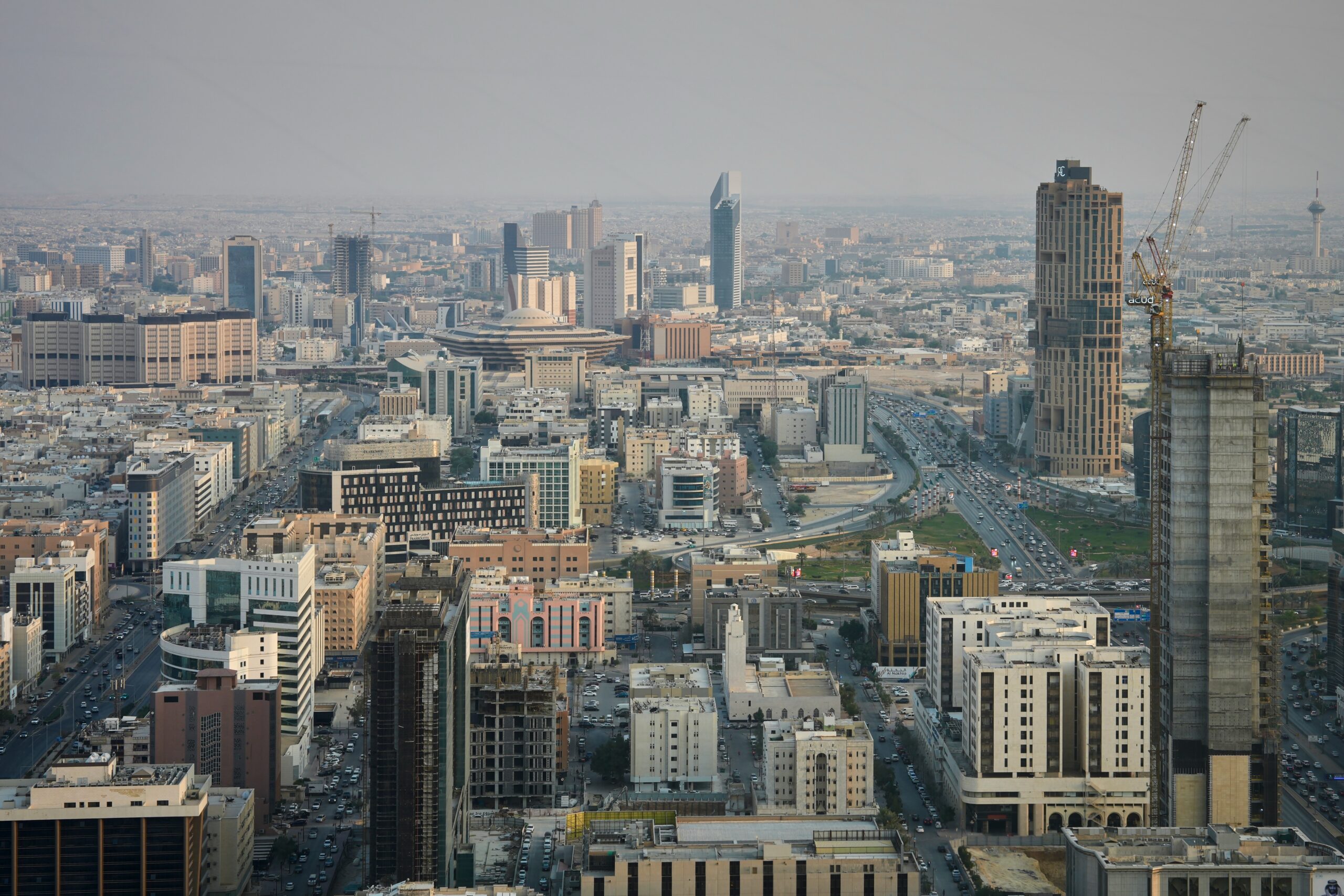
Buildings and construction sites fill the skyline, in Riyadh, Saudi Arabia, October 14. (AP Pjoto/Baraa Anwer)
On February 9, Reuters reported that Saudi Arabia’s Public Investment Fund was preparing to announce a major recalibration of its investment strategy for 2026-30. The revised strategy was expected to scale back some of these initiatives while prioritizing domestic investment sectors. By the time the revamped vision was announced in April, the U.S.-Israeli military campaign against Iran introduced a new set of challenges to Saudi Arabia’s economic transformation, namely, the disruption of shipping in the Strait of Hormuz. Nevertheless, analysts generally argued that the conflict reinforced a transition already underway, while Saudi Arabia’s access to Red Sea ports and the East-West pipeline offered additional protection against disruptions in the Gulf. Together, these advantages appeared to place the kingdom in a relatively strong position to withstand the initial economic shocks of the conflict.
Recent developments, however, have exposed the limits of this resilience. Renewed Houthi hostilities, escalating insecurity around the Bab el-Mandeb strait, and direct attacks on Saudi infrastructure, including deadly attacks on King Khalid International Airport in Riyadh, have placed both pillars of Saudi Arabia’s economic resilience – diversifying shipping routes and building domestic industries – under mounting pressure. The kingdom’s alternative maritime routes are increasingly vulnerable, while the domestic industries now prioritized under Vision 2030 remain dependent on imported technology, international supply chains, foreign investment, and a secure operating environment. The question is therefore no longer simply whether Saudi Arabia can withstand the disruption of the Strait of Hormuz but whether the strategies intended to strengthen its economic resilience can withstand a broader and more geographically dispersed security crisis.
Vision 2030 Revamped and Resilience Amid War
The revamped Vision 2030 was heavily focused on the PIF’s domestic investments as the driver for economic productivity. In particular, it cited six domestic ecosystems: tourism, travel, and entertainment; urban development and livability; advanced manufacturing and innovation; industrials and logistics; clean energy, water, and renewables infrastructure; and Neom. Thus, the focus shifted toward domestic industries, economic security, and long-term “risk-adjusted” financial investments (i.e., higher spending discipline). It was also notable that the PIF had pulled its funding from many high profile commitments overseas.
The outbreak of the war with Iran seemed to reinforce the recalibration already announced in the revamped 2030 strategy. The blockade of the Strait of Hormuz created serious economic challenges for the Gulf Arab states. Yet, despite Saudi Arabia bearing some of these costs, many analysts highlighted the kingdom’s inbuilt capacity to withstand the war and suggested that, if anything, the conflict had reinforced a preexisting planned shift in Vision 2030. Saudi Arabia’s resilience was predicated on its capacity to bypass the maritime choke point in the Strait of Hormuz by rerouting shipping and oil to its Red Sea ports and using land routes, such as the East-West pipeline, to ship oil. The conflict seemed to buttress Saudi Arabia’s reputation as a reliable logistic and transportation hub. Moreover, the kingdom was able to continue hosting tourism, cultural, and sporting events unabated during this period despite the ongoing war, unlike its neighbors. Saudi Arabia even garnered praise from the International Monetary Fund, which noted that exposure to the blockade of the Strait of Hormuz and Iran’s missile attacks on the Gulf states was mitigated in Saudi Arabia’s alternative shipping routes, overseas oil inventories, resilient religious tourism, and the authorities’ institutional capacity.
Renewed Houthi Threat Puts Economic Resilience at a Crossroads
The renewed escalation of hostilities in Yemen starting in July threatened Saudi Arabia’s economic advantages. Indeed, by early September Houthi forces took control of the strategic port city of Mokha as well as the Perim and Hanish islands, effectively gaining physical control of the Bab el-Mandeb strait. This escalated into Houthi attacks on Saudi infrastructure, culminating in a series of attacks on King Khalid International Airport, with one leading to 13 deaths and more than 300 injuries.
These developments hit at the heart of Saudi Arabia’s comparative economic advantage. On the one hand, the Houthi advance has increased the risks around Red Sea shipping routes, which were intended to bypass the Strait of Hormuz. On the other hand, attacks on Saudi airports and other infrastructure threaten the secure domestic environment that the kingdom’s revamped investment relies on. Even as Saudi Arabia shifts toward domestic manufacturing, artificial intelligence, and tourism, these industries are tied inevitably to international supply chains, imported technology, foreign capital, and a secure transportation network.
Vulnerabilities of Domestic Investment Strategy
The Humain project launched by the PIF in May 2025 illustrates the international dependencies pivotal to Saudi Arabia’s domestic investment strategy. Established to develop a comprehensive AI infrastructure encompassing data centers, cloud infrastructure, AI models, and applications, Humain aims to deploy advanced NVIDIA AI chips and has formed major partnerships with international tech companies, including Microsoft, AMD, and Amazon Web Services. AI infrastructure requires sophisticated electrical distribution systems, substations, transformers, backup power systems, and advanced cooling equipment. The PIF has stated that some of this infrastructure, such as server racks, cooling equipment, and power equipment, would be manufactured locally, yet it specifically identified manufacturing as an investment opportunity suggesting that this is still a nascent or prospective local supply chain.
The project itself may eventually reduce Saudi Arabia’s reliance on foreign suppliers, but since the construction and development of this AI infrastructure is still in its early phase, it’s still heavily reliant on internationally imported technology and equipment. Thus, disruptions in maritime shipping as well as international transportation (especially air freight), especially during the construction phase, are likely to cause delays and raise the cost of this project. Even worse are the direct threats to these facilities, energy networks, and personnel, much like the ongoing threats to oil facilities.
Beyond Saudi Arabia’s domestic investment strategy, the tourism, travel, and entertainment sectors that are mentioned as major investment ecosystems in the revamped Vision 2030 are also vulnerable to these ongoing Houthi threats. These sectors rely heavily on the mobility of visitors and perceptions of safety; these perceptions were pivotal in reinforcing the view of Saudi Arabia as a safe haven for hosting investment, entertainment, and cultural events during the initial phases of the Iran war. Continued Houthi attacks on airports and other civilian infrastructure, however, threaten to undermine this perception of Saudi Arabia as a relatively stable and secure destination. The threats discourage visitors, complicate international events, and weaken investor confidence. These disruptions are already apparent and many of Saudi Arabia’s planned entertainment and investment events for this year have been canceled or postponed.
An Uncertain Future
These developments don’t necessarily invalidate Saudi Arabia’s decision to recalibrate Vision 2030. The shift toward domestic investment may well improve Saudi Arabia’s long-term fiscal sustainability, and having an alternative export infrastructure is still advantageous. Unfortunately, neither strategy seems to guarantee protection against regional instability. Saudi Arabia must ultimately confront the reality that the realization of Vision 2030 hinges on a degree of regional stability that may remain elusive, especially given that, in the short term, parties involved in the military conflict with Iran are signaling another round of escalation is on the horizon.
The views represented herein are the author's or speaker's own and do not necessarily reflect the views of AGSI, its staff, or its board of directors.
In its new strategy, the Saudi Public Investment Fund seems to focus more on investment returns and less on asset growth. How this will work in practice is less clear, including what it means for the future of existing projects, such as Neom.
The emir’s move to grant amnesty to members of the opposition is a start on the path to improve executive-legislative relations, but many issues remain unresolved.
Recently, many pieces have been published about the Gulf Arab countries and Israel arguing that: there is a great deal of convergence in the perceptions of both regarding the Iranian threat; there is growing covert security coordination between them against Iran; and the countries have taken modest moves toward the normalization of relations. These pieces...