Gulf Countries May Find Encouragement on Iran in Confirmation Hearings
AGSIW scholars examine statements made by some of the president’s key Cabinet nominees during their confirmation hearings for clues to the new administration’s likely policies on the issues of most pressing interest to the Gulf Arab states.
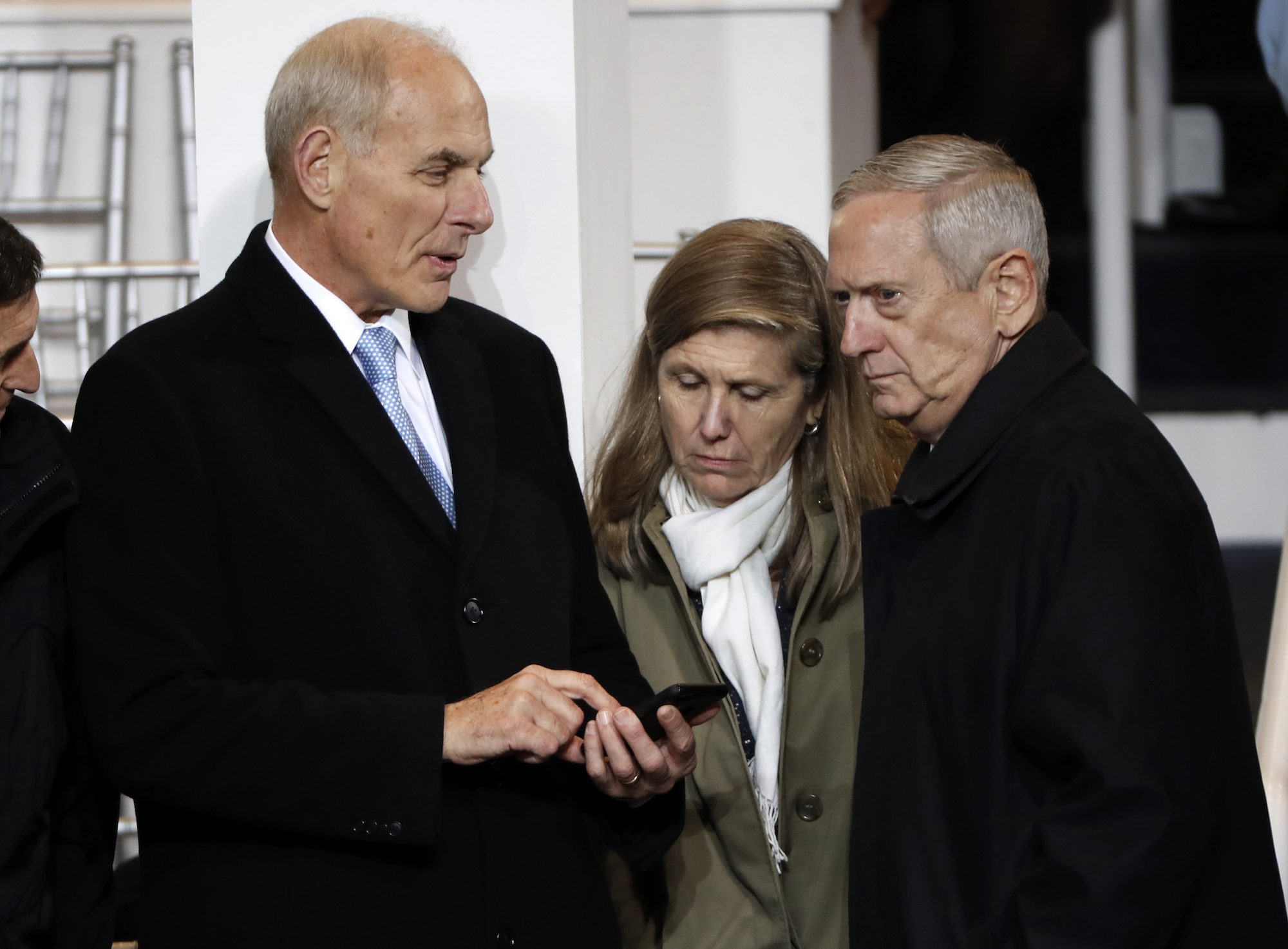
U.S. Secretary of Homeland Security-designate John F. Kelly, left, talks with U.S. Defense Secretary-designate James Mattis as they view the inaugural parade for President Donald J. Trump in Washington, DC, Jan. 20. (AP Photo/Pablo Martinez Monsivais)
On January 20, Donald J. Trump was sworn in as president of the United States. AGSIW senior resident scholars examine statements made by some of the president’s key Cabinet nominees during their confirmation hearings – and by the president himself – for clues to the new administration’s likely policies on the issues of most pressing interest to the Gulf Arab states.
Unlike many others in the United States and around the world, Gulf Arab countries are looking at the administration of President Donald J. Trump with as much anticipation for improvement for their interests as concern about potential changes to traditional U.S. foreign policy. Roughly speaking, Gulf Arab governments have been more comfortable with Republicans than Democrats since the United States emerged as a major player in the Middle East following World War II. Many Gulf policymakers had generally friendly and respectful relationships with former Secretary of State Hillary Clinton, and therefore would not have been alarmed if she had been elected. They certainly shared the broader interest in stability and continuity in U.S. foreign policy she was expected to represent in contrast with President Trump. Yet, the substitution of even an unpredictable Republican for a familiar Democrat is not an entirely unwelcome U.S. power shift in the view of many in the Gulf.
Moreover, these governments do not expect to hear the kinds of concerns about human rights they did from the administration of former President Barack Obama, or a new emphasis on women’s rights that might have been a feature of a Clinton administration. Indeed, a range of Middle Eastern governments, both Arab and non-Arab, are heartened by the notion that Washington might no longer raise these issues much, if at all, under the Trump administration. Moreover, candidate Trump’s emphasis on a mercantile and fiscal ledger sheet relationship with traditional U.S. partners around the world, including NATO allies, does not alarm Gulf Arab governments given the vast amounts of money they have been spending on U.S. arms and other goods and services in recent years. Any exploration of the financial ledger sheet between the U.S. economy and their own will certainly reflect positively on them, especially in strictly monetary terms.
Perhaps the biggest issue upon which Gulf Arab countries are pinning high hopes for the new administration is U.S. policy toward Iran. These governments, particularly in Saudi Arabia, the United Arab Emirates, and Qatar, felt abandoned by the United States in the face of rising Iranian regional influence, particularly during the second Obama term. They had serious reservations about international nuclear negotiations with Iran and significant anxieties about the broader implications of the Joint Comprehensive Plan of Action (JCPOA), and felt that Washington was not sufficiently working to curb the spread of Iranian influence in Syria, Iraq, and other key Arab states. The Obama administration made numerous efforts to reassure Washington’s Gulf Arab partners, with some success, particularly on the JCPOA, but a general sense of disappointment with, and anxiety about, U.S. Middle East policy lingered.
Therefore, many Gulf Arab governments are not sad to see Obama and his team leave the international stage. Moreover, they are heartened by the strongly hostile comments that Trump and many of his key advisors and appointees have made regarding Iran and its regional role. There are several reservations, however, to these hopes. There is a concern that Trump’s version of nationalism and populism – his “America first” outlook – might undermine his administration’s commitment to the global U.S. role and might mean a new isolationism without a strong international component. More specifically, Trump has repeatedly expressed admiration for Russian President Vladimir Putin and suggested Russia could be a partner in the battle against terrorism in Syria. From the point of view of the Gulf countries, especially Saudi Arabia and Qatar, any such policy would essentially put the United States on the side of Iran in Syria, which they view as the crucial battleground in the contemporary Middle East, the outcome of which may shape the regional strategic landscape for the coming decades. Trump’s campaign rhetoric, which was hostile to Iran but sympathetic to Russia, does not add up in the Middle East, where Tehran and Moscow are essentially pursuing the same goals.
The most important relationship between the United States and its Gulf Arab partners is the military one, and therefore the nomination that is most important to the Gulf countries is retired Gen. James Mattis who has already been confirmed as secretary of defense (along with the new secretary of homeland security, another retired general, John Kelly). In his written answers to the Senate Armed Services Committee, Mattis took a tough line on Iran, stating that “Iran is the biggest destabilizing force in the Middle East and its policies are contrary to our interests.” He said U.S. strategy should be to combat terrorism and extremism giving “support [to] responsive governments” and “to checkmate Iran’s goal for regional hegemony.”
Acknowledging that groups like the Islamic State in Iraq and the Levant pose a real threat, he wrote, “Iran, however, has proven to be the primary source of turmoil in the Middle East.” When asked if Iran poses “a shared threat, both to the United States and to Israel,” he said it does but that “I would add also to our Arab partners in the region.” This comment suggests that while the Arab countries might still be an afterthought in Congress, they will not be in the Pentagon under Mattis. Moreover, his tough line on Iran’s threatening posture and the need for a robust U.S. response to it would come as little surprise to Gulf governments. His tenure at the helm of CENTCOM, the hub of the U.S. military presence in the Middle East, was reportedly cut short because his strong stance on Tehran’s misconduct did not sit well with nuclear negotiations that were ongoing at the time. And it has been reported that in 2011 Mattis proposed a direct U.S. military response against Iranian targets because of constant Iranian-directed attacks against U.S. forces in Iraq. The plan was rejected by the White House and Mattis was relieved of his command ahead of schedule as a result of differences on how to deal with Iranian provocations.
The Gulf countries had expressed concerns about the JCPOA during the negotiations, which they eventually supported. But now that the agreement has been reached, they tend to think it should be vigorously enforced rather than unilaterally abrogated as Trump, and Israeli Prime Minister Benjamin Netanyahu, have both at times suggested. In his committee testimony, Mattis appeared to agree with that view, saying that while the JCPOA is “imperfect … when America gives her word, we have to live up to it and work with our allies.” Therefore, Mattis’ position on the JCPOA is highly compatible with that of the Gulf Arab countries, as is his strong stance against Iran’s destabilizing activities, commitment to working with U.S. partners in the region, and belief in using robust forward deployment to prevent conflicts by projecting strength. Indeed, it is hard to imagine a defense secretary who, at first glance at least, would be more in sync with most thinking in the Gulf countries.
Perhaps the most hard-line Trump nominee on the subject of the nuclear agreement with Iran is Representative Mike Pompeo of Kansas, selected to head the Central Intelligence Agency. When nominated, he said “I look forward to rolling back this disastrous deal with the world’s largest state sponsor of terrorism.” But at his confirmation hearing, he told the Senate Intelligence Committee that, “While as a Member of Congress I opposed the Iran deal, if confirmed, my role will change.” He continued that his job would be to oversee the work of professional analysts and “present their judgments to policymakers.” He therefore did not express a change of heart on the agreement, insisting “I stand by the criticism I made of the JCPOA,” but also that he did not anticipate having a major role in deciding its fate. In written answers to committee questions, Pompeo added that Iran “represents a serious threat to U.S. and allied interests” and is “a leading state sponsor of terrorism.” In in his testimony, he asserted that “The Iranians are professionals at cheating,” suggesting he will oversee a skeptical approach to verifying Iranian claims of compliance with the terms of the JCPOA. Pompeo is therefore likely to be seen as an asset by many Gulf policymakers, likely to push a tough line on Iran but apparently pulling back from the idea that it is his role to scrap the JCPOA.
Perhaps the biggest question marks for Gulf countries concern Trump’s nominee for secretary of state, Rex Tillerson. Under his leadership, Exxon Mobil reportedly conducted business with Iran (and Syria) through a European subsidiary, and he additionally developed close ties to Russia and Putin. And he publically expressed a willingness to consider doing direct Exxon Mobil business with Iran because of its vast resources. In his written testimony, though, Tillerson said that “Iran and North Korea pose great threats to the world because of their refusal to conform to international norms.” To respond, he continued, “American leadership must not only be renewed, it must be asserted,” and that “our allies are looking for a return of our leadership.” Certainly the Gulf Arab countries have felt an attenuation of the U.S. role in their region, to the detriment of their interests. And, while it was not clear to what, precisely, he was referring, he noted that “We cannot afford to ignore violations of international accords as we have done with Iran.”
At least two other Trump nominees have made comments that will be considered encouraging for the Gulf Arab countries. The new secretary for homeland security, Kelly, warned in Senate testimony in 2015 that Iran and Hezbollah were seeking to expand their influence in Latin America and that, “As the foremost state sponsor of terrorism, Iran’s involvement in the region and these cultural centers is a matter for concern.” Trump’s nominee to serve as U.S. ambassador to the United Nations, former South Carolina Governor Nikki Haley, agreed with Mattis (and the widespread Gulf view) that trying to scrap the Iran nuclear deal unilaterally is a bad idea and that “what would be more beneficial at this point” is to “see if they [the Iranians] are actually in compliance. If we find that there are violations that we act on those violations.”
These comments reinforce the sense that the Trump administration may take a generally tough line on Iran but not rashly rush to scrap the JCPOA in a manner that plays into the hands of hawks in Tehran. The Gulf countries are in the same boat as all U.S. friends and foes alike: No one knows what to expect from Trump or what his foreign policies will look like. But the recent confirmation hearings and the comments of his nominees, especially on Iran and the JCPOA, will be welcomed in the Gulf as positive indications.
The views represented herein are the author's or speaker's own and do not necessarily reflect the views of AGSI, its staff, or its board of directors.
President Trump has led the United States into an impossible dilemma in which resuming and intensifying the war presents one set of alarming consequences while ending it under current circumstances offers at least as many disasters for Washington.
The Trump administration has positioned the United States at a crossroads between a new regime of containment against Iran or a historic drawdown of U.S. influence in the Gulf and broader Middle East.
Riyadh and Abu Dhabi urged President Trump not to attack Iran, but now that the war is into its second month, leaving the current situation in place would be an unthinkable fiasco for them.
Though they were unsuccessful in preventing the current conflict, and, as expected, have been dragged into the U.S.-Israeli confrontation with Iran, Gulf Arab countries remain crucial to hopes for limiting the war and bringing it to a quick resolution.