Israeli Prime Minister Benjamin Netanyahu, left, speaks as U.S. Speaker of the House Kevin McCarthy, right, reacts during a session of the Knesset, Israel's Parliament, in Jerusalem, Monday, May 1. (AP Photo/Ohad Zwigenberg)
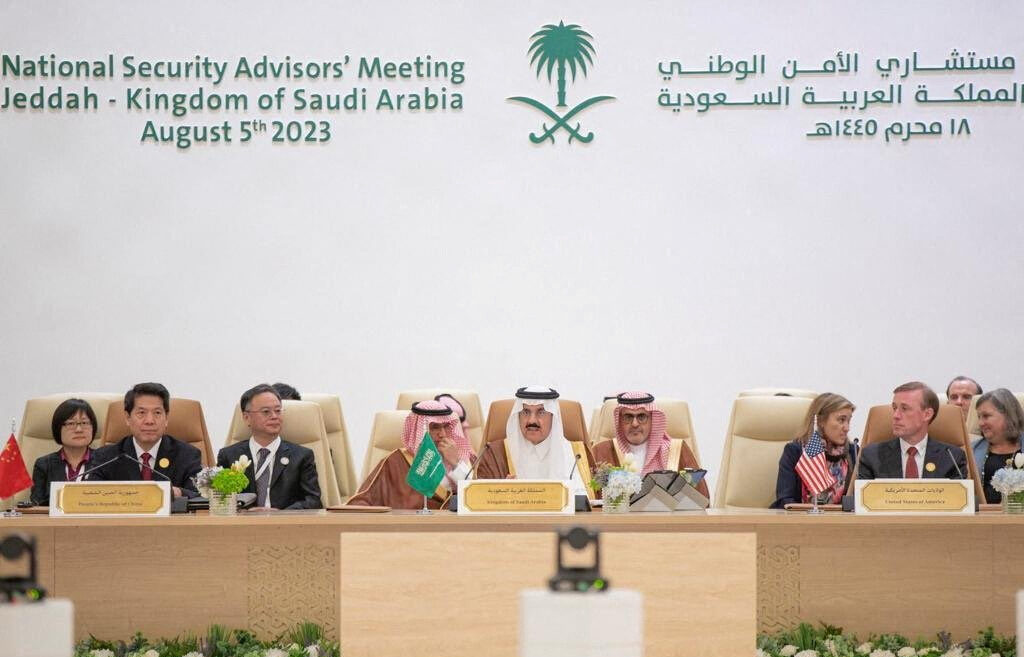
Beginning with a bombshell July 27 commentary by New York Times columnist Thomas L. Friedman, reports have continued to build that the White House is seriously working on developing a triangular grand bargain with Israel and Saudi Arabia that would dramatically reshape Middle Eastern strategic and political realities. Additional reporting by The Wall Street Journal and The Washington Post confirmed that recent trips to Saudi Arabia by Secretary of State Antony Blinken, National Security Advisor Jake Sullivan, and White House Middle East policy chief Brett McGurk involved detailed conversations about possible terms, with The Wall Street Journal reporting that U.S. officials expressed “cautious optimism” that details could be worked out “in the next nine to 12 months.”
However, despite that note of optimism, there is widespread skepticism regarding the prospects for such an agreement. In an August 3 AGSIW webinar, Friedman agreed that doubts are fully justified that an agreement along these lines can be completed at all, let alone before the White House is fully engulfed in President Joseph R. Biden Jr.’s reelection campaign. And the White House has been emphasizing that talks are at an early stage and not as advanced as some reports have implied. In return for normalizing relations with Israel, Saudi Arabia is seeking formal U.S. security guarantees, assistance with a civilian nuclear program, and access to more sophisticated U.S. weapons as well as significant concessions toward the Palestinians in the occupied territories. The obstacles to such a momentous and complex three-way deal are significant, despite the massive potential benefits to all three parties.
Obstacles on the Saudi Side
Saudi Arabia faces a much more complex and riskier set of calculations in normalizing relations with Israel than its Gulf Cooperation Council allies, the United Arab Emirates and Bahrain, did when they signed the Abraham Accords in September 2020. In addition to far more intricate and brittle domestic politics and a potential backlash at home against any such agreement, as the Abraham Accords have been growing more unpopular in the Arab world according to recent surveys, Riyadh must also carefully weigh possible negative impacts on its Arab regional and global Islamic leadership roles. Saudi Arabia’s adversaries, such as Iran and its network of armed militia groups in neighboring Arab countries, led by Hezbollah in Lebanon, or Salafist-jihadist groups like al-Qaeda and the Islamic State in the Iraq and the Levant, would likely take maximum advantage of the ensuing populist dismay among some Arabs and Muslims.
However, Saudi enthusiasm for a formal security relationship with the United States, with guarantees that might be stronger than those afforded major non-NATO allies but not fully equal to the commitments Washington offers its NATO partners, probably makes Saudi Arabia the least problematic of the three potential partners. Indeed, if the guarantees were strong and formal enough, it’s possible they would prove sufficient to overcome any lack of progress on the other two big Saudi asks of Washington on nuclear assistance and a more streamlined process of obtaining the most advanced U.S. weapons. Both issues present challenges on the U.S. side, but if security assurances are sufficiently robust, Saudi Arabia might prove flexible on nuclear support and access to sophisticated weaponry.
However, Saudi Arabia has made it clear in recent years that it will not normalize relations with Israel absent some significant, but unspecified, movement by the Israelis to bolster prospects for a two-state solution, such as strengthening the Palestinian Authority and expanding areas under its control, limiting settlement activity, or committing not to annex any additional occupied Palestinian lands. But such steps may be extremely difficult for the United States and Saudi Arabia to secure from the current Israeli government.
Obstacles on the U.S. Side
The biggest challenge in Washington probably resides in the Senate, which, depending on the scope, would likely need to approve the formal security partnership Saudi Arabia is seeking. Significant opposition can be expected from the progressive left among Democrats and the hard-right Republican faction, both of which harbor strong neo-isolationist impulses. Although approval will not be required by the House of Representatives, in which both tendencies are well represented, passage in that body would be far harder. However, the Senate remains dominated by both left- and right-wing foreign policy centrists, many, like Biden, harboring views shaped by the Cold War.
Presented with an agreement that greatly strengthens Washington’s hand in the Middle East and ties to Saudi Arabia, coupled with Riyadh normalizing relations with Israel, passage in the Senate is likely. Indeed, once senators have protected themselves politically by expressing some reservations, even a super-majority ought to be attainable. This is assuming that the Biden administration makes an all-out effort to rally Democratic support and makes the case that such an agreement would enormously strengthen the strategic posture of the United States and its partners and constitute a significant blow to Iran’s short-term and China’s long-term ambitions in the Middle East.
The bigger question in the Senate would probably center on support for a Saudi civilian nuclear program. Washington is used to demanding a “123” agreement, which goes far beyond the strictures of the Nuclear Nonproliferation Treaty, to provide such support to nonnuclear powers. Critics of any deviation from this norm when it comes to Saudi Arabia will point out that the UAE agreed to such restrictions in 2009. However, this kind of arrangement makes little sense when it comes to Saudi nuclear development.
Uniquely among nonnuclear powers that seek to develop civilian nuclear energy production on a large scale for economic reasons, Saudi Arabia possesses and intends to mine its own uranium. Under a 123 process, it would have to essentially mine that uranium, export it to be processed into usable rods, reimport the rods for use in Saudi reactors, and then export the spent rods again for disposal. This wouldn’t be profitable and makes little sense from a Saudi perspective. Therefore, a modified arrangement involving oversight, but not the pinball-style movement of Saudi raw and enriched uranium or spent rods, is more reasonable. This might be a hard sell in the Senate because of the normative expectation of 123 agreements and suspicions about Saudi Arabia’s supposed nuclear weapons ambitions. Riyadh will therefore likely have to make significant concessions on oversight and other restrictions and commit never to develop its own nuclear weapons program as long as the security agreement with Washington remains in effect. Israel’s views on how far the United States should go to satisfy Saudi demands for help with its nuclear program are also likely to be pivotal.
A similar dynamic might play out in the Senate regarding Saudi access to advanced U.S. weapons. Recent objections have largely been based on the Yemen war, though Saudi Arabia is now seeking a viable exit from the country. Some senators will certainly register objections to Saudi Arabia’s human rights record and the 2018 assassination of Saudi journalist Jamal Khashoggi, but the logic of the deal, which rests so heavily on U.S.-Saudi security cooperation, means that the weapons component would likely be overwhelmingly approved by the Senate, especially with the strong support of Israel and its Jewish American and evangelical Christian backers.
Obstacles on the Israeli Side
By far the biggest obstacle lies on the Israeli side. The conundrum facing Washington and Riyadh is that such an agreement only makes sense, particularly from the U.S. perspective, in a triangular form. A bilateral U.S.-Saudi security treaty would be prohibitively difficult to achieve in Washington politically and wouldn’t provide the transformational, generationally locked in strengthening of the U.S. strategic position that a trilateral agreement would.
In the abstract, Israel faces the lightest lift of all three. All it will likely be asked for is to come somewhat more in line with international law and United Nations Security Council resolutions regarding the occupied Palestinian territories. It won’t be expected to resolve the conflict with the Palestinians or end the occupation, merely to rein in settlement activity – which is prohibited by international law – or commit not to engage in additional unlawful annexation of territory. In addition, Israel, arguably, has the most to gain. This would be the biggest diplomatic breakthrough at least since the 1979 peace treaty with Egypt, and arguably in Israeli history since admission to the U.N. General Assembly, because the normalization of ties with Saudi Arabia would virtually guarantee the eventual diplomatic and commercial normalization of Israel’s relations with the broader Arab and Islamic worlds.
However, the current Israeli Cabinet, led by Prime Minister Benjamin Netanyahu and his largely pro-annexation Likud and several smaller extremist parties, seems unlikely to offer significant concessions on the occupation or toward Palestinians. Some senior Israeli officials have said that any potential moves on the occupation would be minimal and others have suggested that they are flatly out of the question. In a Wall Street Journal commentary advocating for a U.S.-Saudi security agreement similar to the one Washington maintains with South Korea, Israeli Foreign Minister Eli Cohen did not mention the Palestinians or the occupation at all.
Friedman has repeatedly emphasized that one of the main reasons he is enthusiastic about this initiative, though unpersuaded of its prospects, is that it would rupture the current extremist Israeli government as well as maintain dwindling prospects for a two-state agreement. It does seem impossible that the current coalition would be able to make whatever concessions Saudi Arabia would demand on the occupation or Palestinians. The hope is that Netanyahu would eventually form a new Cabinet, possibly in an alliance with centrist politician Benny Gantz.
However, Netanyahu still faces a corruption trial, and his current coalition is committed to so-called judicial reform initiatives that could protect him from potential imprisonment. Such judicial changes would almost certainly not be feasible with a new, more moderate Cabinet. He therefore faces personal as well as political considerations that might restrain such a maneuver even if he concludes that this agreement is viable, reasonable, and a vital national interest. Yet it is by no means certain an alternative coalition without the stridently extremist small parties would produce a government capable of making meaningful concessions to what many Israelis see as an adversary, the Palestinians, with no practical leverage over Israel. Would national morale in today’s Israel sustain any major restrictions on the country’s ambitions in much of the occupied West Bank? It’s questionable that there is any potential governing coalition in the Knesset that would be ready, able, and willing to do that, even to secure one of the most significant diplomatic achievements in the country’s history.
Yet, the security guarantees that Riyadh seeks and strategic benefits that Washington wants both practically depend on Israeli flexibility toward the Palestinians and occupation where none may exist under any practicable governing coalition. Such an agreement is not impossible because, as Friedman noted in his July 27 column, it would be massively beneficial to all three parties. These benefits provide the initiative significant momentum and explain the Biden administration’s bold leap into the dark grasping for it. The biggest question isn’t in Riyadh or Washington. It is undoubtedly in Israel, which may have reached the stage of annexationist ambitions leaving it, at long last, flatly incapable of taking yes for an answer, even from the most influential Arab and Muslim country.
The views represented herein are the author's or speaker's own and do not necessarily reflect the views of AGSI, its staff, or its board of directors.
Riyadh’s prominent role underscores its growing confidence on the world stage and its careful, pragmatic balancing of alliances and relations with key partners.
President Trump has led the United States into an impossible dilemma in which resuming and intensifying the war presents one set of alarming consequences while ending it under current circumstances offers at least as many disasters for Washington.
The Trump administration has positioned the United States at a crossroads between a new regime of containment against Iran or a historic drawdown of U.S. influence in the Gulf and broader Middle East.
Riyadh and Abu Dhabi urged President Trump not to attack Iran, but now that the war is into its second month, leaving the current situation in place would be an unthinkable fiasco for them.
Though they were unsuccessful in preventing the current conflict, and, as expected, have been dragged into the U.S.-Israeli confrontation with Iran, Gulf Arab countries remain crucial to hopes for limiting the war and bringing it to a quick resolution.