Oman’s Economic Reforms Struggle To Keep Pace With Mounting Challenges
The unpredicted fallout from the coronavirus pandemic shortly after the new sultan ascended the throne not only raises the stakes associated with reform implementation but also will test the population’s ability to shoulder new economic burdens.
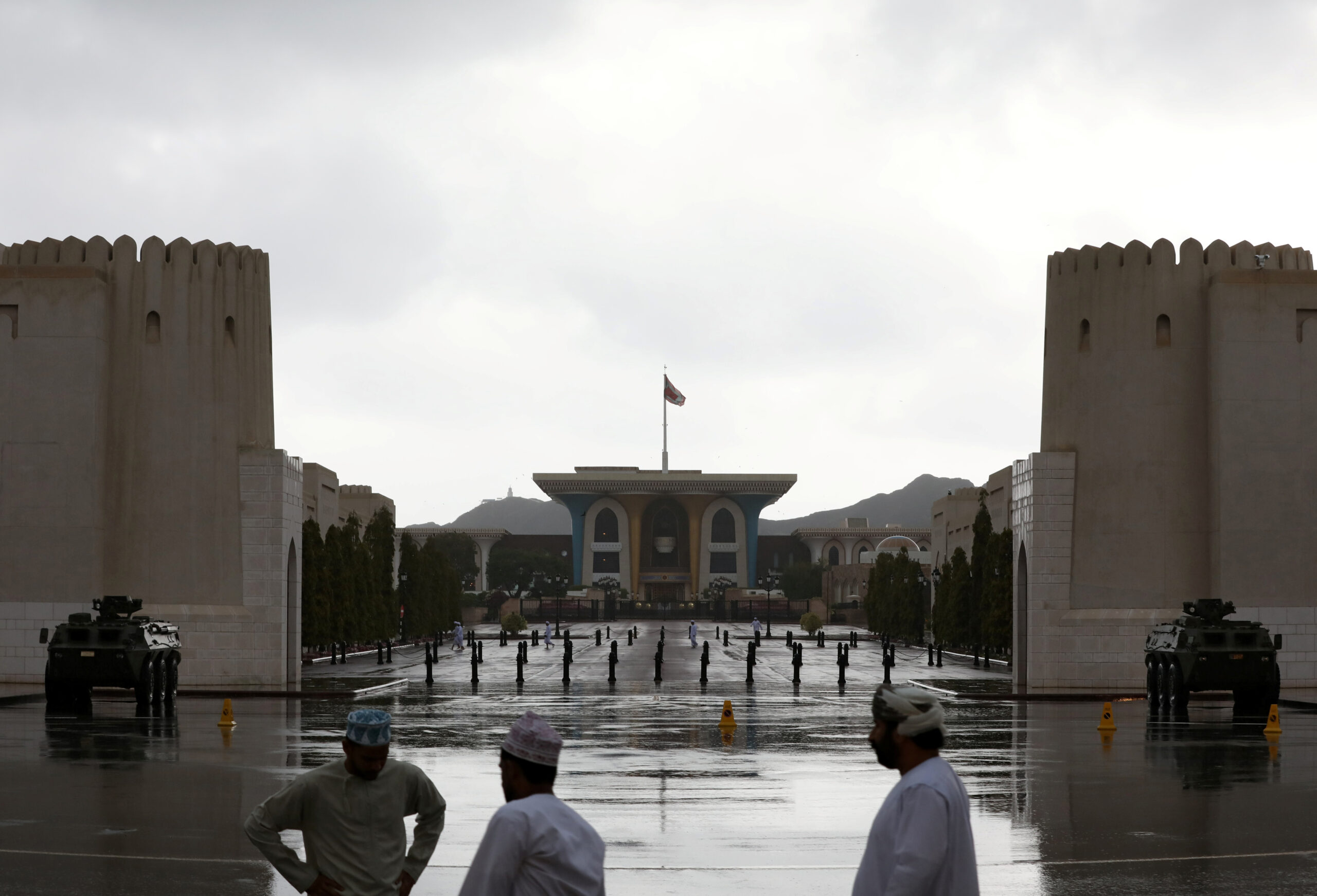
Men stand in front of Al Alam Palace after the death of Oman's Sultan Qaboos bin Said was announced in Muscat, Oman, January 11. (REUTERS/Christopher Pike)
Under the leadership of Sultan Haitham bin Tariq al-Said, Oman’s government has responded to several economic challenges facing the sultanate: strained government finances, a bloated public sector, and inadequate non-oil revenue sources. Yet progress in specific areas of economic reforms has bred new problems – a reflection of the uneven nature of reform processes in Gulf Arab states. The unpredicted fallout from the coronavirus pandemic shortly after Haitham ascended the throne not only raises the stakes associated with reform implementation but also will test the population’s ability to shoulder new economic burdens.
The October 22 approval of a medium-term fiscal balance plan for 2020-24 reflects the sultanate’s urgent fiscal needs. Oman’s projected fiscal deficit for 2020 may reach 20%, despite severe budget cuts earlier in the year and other fiscal consolidation efforts. To help stimulate the economy, Haitham ordered the implementation of development projects worth $963.6 million – an apparent expansion of the June announcement concerning the investment of $780 million in development projects. Earlier in October, Oman’s government hired banks to arrange the country’s first international public bond sale in 2020 to help meet the country’s financing needs.
Oman completed the $2 billion bond sale on October 22, but a mere $3.8 billion in booked orders indicated weak demand. The bond proceeds will not stretch very far. The annual fiscal deficit is expected to range from $10.9 billion to $12.5 billion. Moreover, the government must repay the $2 billion, 1-year bridge loan that it secured in August. Selling bonds also increases Oman’s gross government debt, which soared from around 5% of gross domestic product in 2014 to approximately 60% in 2019. The government debt-to-GDP ratio has hovered around 80% in 2020 and may spike to 130% by 2025, according to Oman’s Ministry of Finance.
The Omani government is taking steps to reduce its public wage bill. In May, Oman’s royal court issued a circular directing government agencies to enforce mandatory retirement thresholds for Omanis working in the public sector and significantly reduce expatriate contracts upon their expiration. The government then set limits on the loan payments that local banks can directly deduct from retirees’ monthly paychecks. A royal decree in August established an Employment Security Scheme to encourage more Omanis to consider private sector careers. The initiative has an initial $26 million grant and is planned for implementation on November 1.
Government measures to reduce expenditures have likewise impacted expatriate workers. Between June and August, the number of expatriate workers employed in the government sector decreased by 16%. A bleak commercial environment led to similar disruptions in Oman’s private sector labor market, with approximately 77,120 expatriates leaving during this three-month period.
In total, around 222,300 expatriates lost their jobs in the first eight months of 2020. Many of these foreign residents and their dependents have left the country or are likely to leave in the coming months, exacerbating an already weakened outlook for consumer spending. Oman’s Ministry of Housing and Urban Planning announced a ministerial resolution easing ownership controls on property for expatriates who have lived in the sultanate for at least two years – a signal of government hopes to retain more established expatriate residents and boost real estate investments.
The Omani government finally formalized plans to implement a value-added tax, part of a 2016 agreement among Gulf Cooperation Council member states. However, authorities will not begin collecting the tax until April 2021, leaving several more months before the government begins receiving revenue. With consumer spending down across the region, VAT revenue is likely to be much lower than if Oman had implemented the tax in 2018 or 2019, like Saudi Arabia, the United Arab Emirates, and Bahrain.
As in other Gulf countries, there will be a multitude of exemptions, zero rating, and carve outs related to the VAT in Oman. These forms of preferential treatment are intended to cushion the tax’s economic impact on citizens and residents but will further reduce total tax revenue. Ultimately, the likelihood of significant societal pushback on the tax is minimal: The eventual introduction of the VAT was expected, and Oman already levies excise and corporate taxes.
As they exhaust economic policy options, Omani officials are weighing the advantages and disadvantages of external support. Oman’s bond prospectus acknowledges that Muscat is in the “preliminary stages” of discussions with neighboring Gulf states for financial assistance. Fiscal support from Saudi Arabia, the UAE, or Qatar may be politicized and threaten Oman’s reputation for neutrality. Oman has also discussed options for coronavirus-related funding from the Multilateral Investment Guarantee Agency and Asian Infrastructure Development Bank.
Economic reform progress in Oman has been a net positive, however marginal and despite the emergence of new challenges. Only time will tell if this pace of two steps forward, one step back is sufficient to keep ahead of Oman’s mounting economic challenges.
The views represented herein are the author's or speaker's own and do not necessarily reflect the views of AGSI, its staff, or its board of directors.
Advancing Oman’s technology initiatives can help the government address economic challenges that have assumed a new degree of urgency following the coronavirus outbreak and oil price collapse.
Oman’s political transition presents the new sultan and his government with a choice to maintain the status quo of economic policy or undertake a deeper, structural transformation of the energy-dependent economy.
Beijing keeps treading carefully around conflict in the Middle East while seeking opportunities to deepen ties with key country partners through a longer-term regional engagement strategy.
The UAE’s decision to halt trade and commercial ties with Iran reflects an exercise in applying carefully calibrated geoeconomic pressure amid an uncertain and evolving geopolitical context.