What’s Behind the Arab Alternative to Trump’s Gaza Proposal
The GCC +2 meeting, followed by the Arab League, has to take Trump's dangerously implausible ideas about Gaza seriously, but Israel won't countenance the Arab states’ alternative.
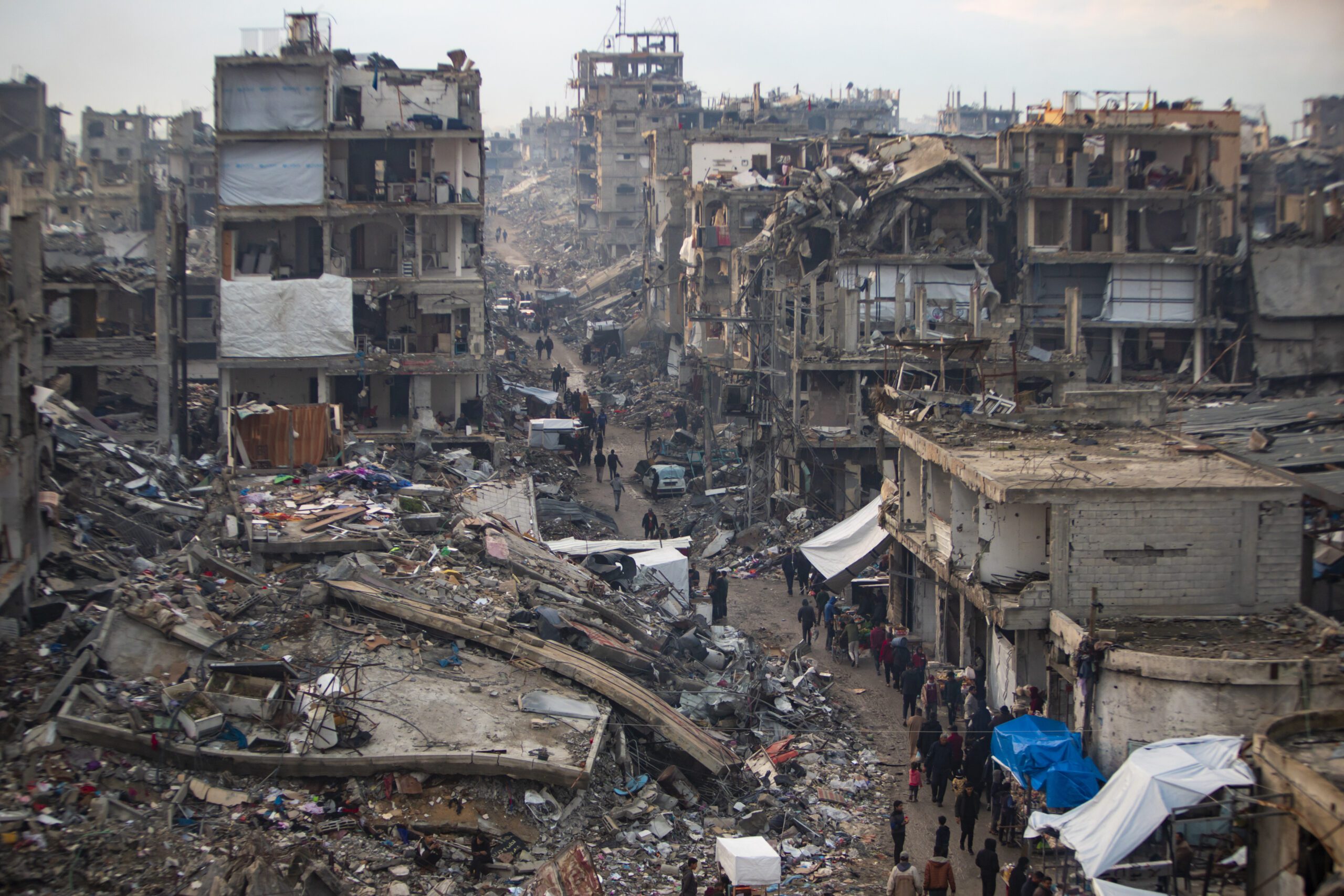
Palestinians walk in the destruction caused by the Israeli air and ground offensive in Jabaliya, Gaza Strip, Tuesday, Feb. 11, 2025. (AP Photo/Jehad Alshrafi)
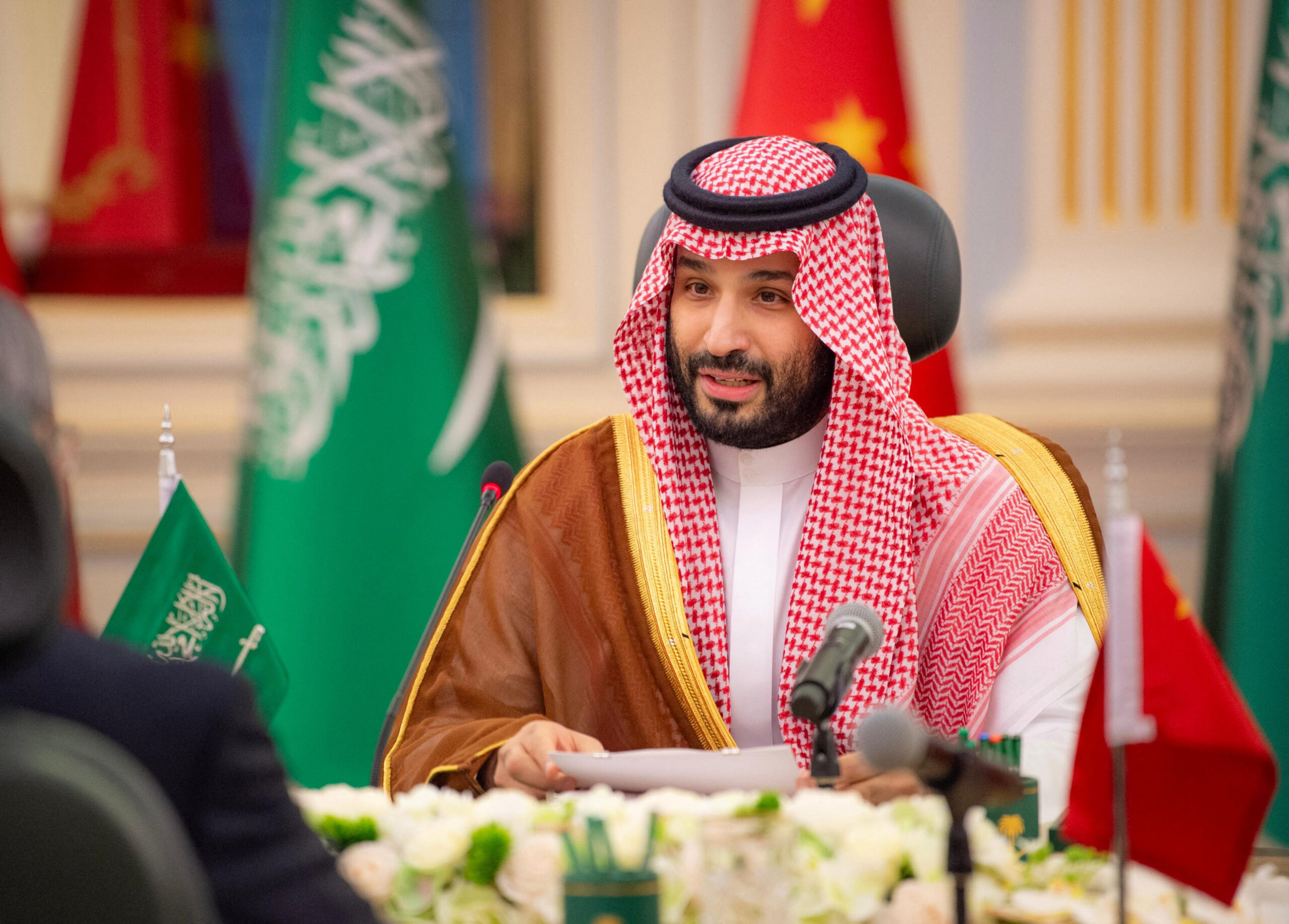
Saudi Arabia hosted a meeting February 21 with all six Gulf Cooperation Council countries plus the crucial additions of Egypt and Jordan to begin crafting a formal Arab response to President Donald J. Trump’s fantastical scheme to redevelop Gaza after removing its 2.2 million Palestinian residents. Trump’s supporters and officials claim that this sudden Arab urgency to respond with an alternative to his Gaza plan is a diplomatic achievement and the real purpose of his radical proposal. However, openness to discussing reconstruction and a “day after” scenario for Gaza has been evident and on the table since at least November 2023, shortly after Israel’s onslaught began following the Hamas-led massacre in southern Israel. Yet whatever the Arab countries come up with at this GCC +2 meeting, or at the March 4 full convening of the Arab League, will not be practicable given Israel’s policies. It won’t be remotely as unachievable as Trump’s idea of creating a “Riviera” after removing millions of Palestinians to places unknown and unavailable, such as in Egypt and Jordan. But the GCC+2 proposal, to be blessed by the Arab League, will nonetheless be anathema to the government of Israeli Prime Minister Benjamin Netanyahu.
Trump’s “plan” is beyond unrealistic because there is nowhere for the 2.2 million Palestinians in Gaza to go. Egypt’s policy flatly refusing the displacement of Palestinians from Gaza into Egypt dates back to the early 1950s. Cairo is not going to change this policy under virtually any circumstances. The other potential destination Trump mentioned, Jordan, already has a huge, and possibly majority, Palestinian refugee population, and it has also taken in huge numbers of refugees from Syria and Iraq. Jordan cannot afford more refugees or a larger Palestinian population. The ultimate fear of the Hashemite kingdom is that the Palestinian national movement will ultimately be displaced onto Jordanian territory, under the cliched but still alarming claim that “Jordan is Palestine.” Palestinians don’t believe that, of course, but there is the danger that they might pursue their nationalistic ambitions next door, if any form of independence in their own country is finally foreclosed by Israel – and mass displacement from Gaza into Jordan, besides sparking significant instability, would certainly greatly accelerate that prospect, which could spell the end of the Hashemite regime.
The collective Arab “no” to Trump’s proposal, that has been organized by Saudi Arabia, has been expressed in different forms but with a striking unanimity. But Arab countries, particularly in the Gulf plus Egypt and Jordan, have felt pressure to craft an alternative vision for Gaza. There is only one ultimate goal that is achievable and plausible, although there are many paths to it: reconstruction. Any Arab plan was always going to involve postconflict stabilization and reconstruction in Gaza, and it’s certainly possible that Trump’s reckless musings about removing the Palestinians from Gaza were intended to get the Arabs to specify exactly what they are willing to expend in terms of reconstruction funding and organization, and even postconflict stabilization forces, to create a more plausible-seeming alternative.
Already the UAE has committed to contributing an unspecified number of security forces for postconflict stabilization, and other Gulf and Arab states may follow suit now. It’s reasonable to expect the GCC countries, Jordan and Egypt, and ultimately the Arab League, to undertake significant expenditures to stabilize Gaza after the war. They will be sanguine in doing so, first, to please the Trump administration and give at least the appearance of taking his bizarre utterances seriously with a supposedly equally serious counterproposal. And, second, they can commit to money and even personnel with a high degree of confidence that this isn’t going to actually be expended in the foreseeable future.
Indeed, even though a real enthusiasm and appetite for reconstruction and postconflict stabilization have been present since shortly after the Gaza war began in October 2023, the reason that nothing serious has been discussed to implement it is that Israel’s policies have blocked any pathway for planning, let alone execution, of such a strategy. From the outset of the war, Netanyahu’s position has been that it was, and remains, “too early” to discuss any aspect of the postconflict planning or reality except to rule out anything realistic. This has been to the immense chagrin of the Israeli military and security establishment and has led to the departure of several of his senior Cabinet colleagues who became fed up with backing a war that appeared to have no articulable political goal beyond the “mighty vengeance” that he vowed on October 7, 2023.
What the Arab states gathering in Riyadh understand, and the Trump administration almost surely also realizes, is that there are only three plausible sources of governance in Gaza. First, the Israeli military could remain in the territory in an open-ended manner, but very few in Israel and its government appear willing to commit to this endless occupation and battling the insurgency that has already proved its ability to inflict painful blows.
Second, the Israelis could allow for the creation of an alternative Palestinian civil administration not connected to Hamas, and run by technocrats, businesspeople, or other capable Palestinians not known for their political connections. However, the right-wing Israeli government appears particularly allergic to this option, because whether it is formally linked to the Palestinian Authority in Ramallah or not, such an alternative would ultimately derive its authority from the Palestinian Authority and the Palestine Liberation Organization. This would inevitably strengthen the hand of both these Fatah-dominated Palestinian entities that are seeking a two-state agreement with Israel and that could end up creating a Palestinian state under favorable circumstances. Blocking any prospects for Palestinian statehood, however, appears to be the paramount goal of the Netanyahu Cabinet, which makes no secret of its commitment to the ultimate annexation of the West Bank and its categorical rejection of Palestinian sovereignty. Therefore, while this alternative civic administration is an otherwise universally popular solution – and the one that will almost certainly be endorsed by the GCC +2 meeting and then by the Arab League – Israel’s opposition can be expected to be vociferous. Only the most intense pressure from the Trump administration could conceivably shift such opposition, and there is, as yet, no sign of that.
The third option is precisely what is happening now, as phase one of the cease-fire nears completion: the return of Hamas control in Gaza. All the countries meeting in Riyadh, except Qatar, will be dismayed by this reality, as will be, presumably, Washington and most of the rest of the world. However, there can be no doubt that the return of Hamas to power in Gaza, at least during the cease-fire, is a deliberate, conscious, and calculated Israeli strategic choice. It should be no surprise that Israel prefers the return of Hamas civic and political power in Gaza to either of the other alternatives. The Israeli military does not wish, and may not be able, to stay in Gaza indefinitely. And Israel, particularly under Netanyahu, has a long history of pursuing a divide and rule policy toward the Palestinians, insisting on keeping Hamas in power in Gaza and the Fatah-dominated Palestinian Authority in control of the small self-ruled areas of the West Bank to split the Palestinian movement between Islamists and secular nationalists, thereby crippling the ability to create a Palestinian state.
Given the deep history of this policy, and its continued strategic centrality to the goal of blocking Palestinian statehood, Israel has engineered a situation in which Hamas is currently crawling out of the rubble and reasserting civil and political authority throughout Gaza on a daily basis without Israeli interference. Israel may prefer to go back to war rather than proceed to phase two and will certainly not want to engage in phase three, which involves systematic reconstruction in Gaza.
More likely, Israel will be satisfied with the return of Hamas control in most of Gaza combined with an ongoing low-level war conducted mostly at a pace and manner of Israel’s choosing – in effect a return to the “mowing the grass” policy of maintaining Hamas control in Gaza while periodically cutting it down to size through small wars of containment. If the people of Gaza must continue to languish without health or education, in intense food insecurity, and living and continuously moving around in piles of rubble, all of that will undoubtedly be construed as a legitimate part of the promised “mighty vengeance.” And precisely this is what Israel is proposing under pressure to come up with some semblance of a plan.
This would appear to be Israel’s strategic choice, and shifting that will take an enormous amount of pressure from Washington. By coming up with a more detailed postconflict stabilization and reconstruction agenda in response to Trump’s impracticable ethnic cleansing proposal, the Arab states may make it easier for the U.S. president to force the Israeli prime minister to back down and accept an alternative Palestinian civic administration. But that’s going to be a very heavy lift, even for the White House. The deep logic of Israel’s divide and rule strategy and the preeminence of preventing Palestinian independence in its strategic thinking and annexation intention make strengthening the hands of the Palestinian Authority and Palestine Liberation Organization anathema to the Israeli right, which has dominated governance in Israel for the past two decades. Even given what Hamas perpetrated October 7, the Israeli right appears more troubled by the possibility of strengthening the secular nationalists of Fatah than by dealing with, and reempowering, Hamas’ Gaza cadres.
So, the Arabs have no choice, given their need to engage seriously with the Trump administration no matter how unserious his nonplan is, but to craft a more detailed collective response for postconflict stabilization and reconstruction, which is almost certain not to be implemented because of Israeli recalcitrance and strategic opposition to strengthening Fatah. The grim reality is that, October 7 notwithstanding, the Israeli right prefers Hamas, which is fanatical, radioactive, and not interested in an independent Palestinian state, over Fatah, which is moderate, serious, and committed to negotiating a two-state arrangement with Israel. And under such circumstances, the GCC +2 and the Arab League can propose money, matériel, and personnel with a great deal of confidence that such commitments will not be called upon to be implemented unless Israel radically changes its policies toward the Palestinians.
The views represented herein are the author's or speaker's own and do not necessarily reflect the views of AGSI, its staff, or its board of directors.
An elusive Gaza cease-fire, a potential collapse in viability of a two-state solution between Israel and the Palestinians, and ratcheting Israel-Hezbollah tensions are key obstacles to the resumption of normalization progress between Israel and Gulf states.
With aid, public criticism, and diplomatic maneuver, Gulf countries are confronting Israel’s military action in Gaza and weighing how bad the situation could get.
President Trump has led the United States into an impossible dilemma in which resuming and intensifying the war presents one set of alarming consequences while ending it under current circumstances offers at least as many disasters for Washington.
The Trump administration has positioned the United States at a crossroads between a new regime of containment against Iran or a historic drawdown of U.S. influence in the Gulf and broader Middle East.
Riyadh and Abu Dhabi urged President Trump not to attack Iran, but now that the war is into its second month, leaving the current situation in place would be an unthinkable fiasco for them.
Though they were unsuccessful in preventing the current conflict, and, as expected, have been dragged into the U.S.-Israeli confrontation with Iran, Gulf Arab countries remain crucial to hopes for limiting the war and bringing it to a quick resolution.