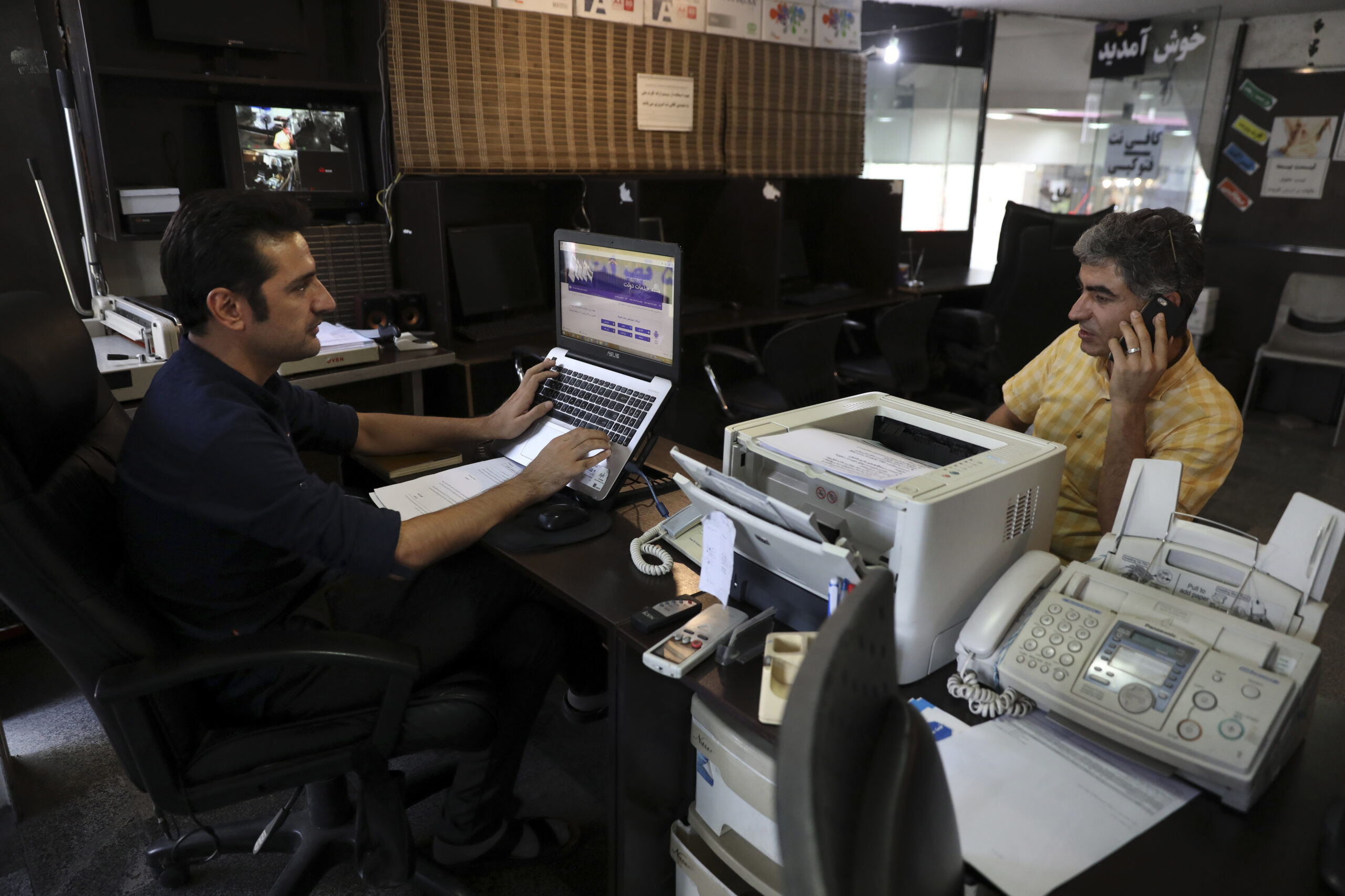
An internet cafe manager, left, works on his computer as a man talks on his cell phone, Tehran, Iran, July 25. (AP Photo/Vahid Salemi)
Iran has been experiencing ongoing countrywide protests. But, three features distinguish the Islamic Republic’s response to these anti-government demonstrations from its reactions to those in the past: a near-total internet and mobile data blackout, promotion of the national intranet, and lack of any government effort to jam foreign Persian-language satellite television and radio broadcasts to Iran. What is the logic behind the Islamic Republic’s differing approaches toward different media, and is the regime likely to repeat this pattern of behavior in the future?
Of Iran’s 83 million residents, 64% have access to the internet, available through the Telecommunications Company of Iran and its subsidiaries. The Telecommunications Company of Iran was “privatized” in September 2009, and 50% plus one share of the company is directly or indirectly owned by the economic arm of the Islamic Revolutionary Guard Corps. Following the IRGC’s purchase of the majority of the shares in the company, Iran’s Passive Defense Organization reportedly experimented with “internet disconnection war games” until at least January 22.
Amid countrywide protests on November 15 against rising gasoline rationing and price hikes introduced the previous day, Iranians began experiencing internet slowdowns; by November 16, there was a near-total internet and mobile data blackout. Within 24 hours, the regime managed to block the country’s inbound and outbound internet traffic, leaving 5% to 7% connectivity reserved for a select group of regime officials, including Supreme Leader Ayatollah Ali Khamenei’s website as well as the IRGC and its online outlets. This was an innovation in comparison with the Islamic Republic’s responses to previous public protests, during which the Telecommunications Company of Iran slowed the speed of the internet but did not shut it down.
Explaining the motive behind the internet blackout, Mohammad-Javad Azari Jahromi, minister of information and communications technology, in a radio interview on November 20 said “abuse of the internet,” made Iran’s Supreme National Security Council “impose certain restrictions in the international internet.” Further explaining the specific reason behind the internet blackout, Brigadier General Ali Fadavi, deputy chief of the IRGC, said in an interview on November 22: “On Friday, when the price of gasoline went up, villains were trying to establish a street-level presence, but they postponed to Saturday because of lack of preparedness. The internet, the instrument of the enemy, led to greater rioter presence at the street level.”
The internet blackout, coupled with the disconnection of mobile phone antennas in areas affected by anti-regime protests, was extremely effective, as protesters had difficulties mobilizing and coordinating their efforts. Absent the disconnection, the regime would have faced larger and better-organized protests. Technologically advanced protesters may have become aware of the scale of the countrywide protests through the U.S. government-supported Knapsack satellite File-Casting technology, also known by its Persian name, Toosheh, which beams data to houses through home satellite systems. But Toosheh is one-way communication – users can receive information, but there is no means to transmit information. The Law Enforcement Forces, Basij militias, and IRGC, on the other hand, communicated through the wireless network.
Simultaneous with the internet blackout, the Islamic Republic promoted its national intranet on all television and radio channels of the Islamic Republic of Iran Broadcasting. It also actively directed the public to use Iranian text messaging systems, such as Baleh, Eitaa, Soroush, Bisphone, Gap, and Igap, which the regime eavesdrops on, instead of more secure non-Iranian text messaging systems that were affected by the internet and mobile data blackout.
Apart from these services, several features of the intranet appear to have worked well, in particular Iran’s banking sector. But Azari Jahromi admitted that the performance of Iranian search engines and GPS-guided services was not satisfactory, but even here, the intranet appears to have worked. According to Mehdi Razmi, an information technology specialist, food delivery companies, taxis, and travel agencies, within 12 hours after the internet blackout, managed to continue their business by shifting to the national intranet.
While the Islamic Republic was busy enforcing the near-complete internet and mobile data blackout, the regime did not attempt to jam foreign Persian-language satellite television and radio broadcasts to Iran, which it has done during previous protests.
Several factors may have affected the decision not to jam those broadcasts. BBC Persian, Voice of America’s Persian service, Manoto TV, Iran International TV, and others, for the most part, do not have the habit of openly and directly inciting the Iranian public to rebel against the central government. The satellite channels, which are barred from having reporters in Iran, depend on members of the Iranian public to feed them with free mobile phone video footage. With the internet blackout, that was no longer possible. Some of these foreign broadcasters, by providing members of the former Pahlavi ruling family of Iran with access to communicate their message to the Iranian public, reinforce the regime’s description of the unrest as a foreign plot led by counterrevolutionary monarchists. But most importantly, those who remain home to watch the news on satellite TV channels cannot simultaneously be present in the streets, which indirectly helps the Islamic Republic’s authorities.
On November 23, Iran’s internet was once again up and running, but the protests provided the government agencies with an opportunity to test drive an internet blackout and the Iranian intranet. The regime is likely to further refine its approach in preparation for future protests and unrest.
The views represented herein are the author's or speaker's own and do not necessarily reflect the views of AGSI, its staff, or its board of directors.
Iran may still call itself an Islamic Republic. In practice, however, it increasingly resembles a state in which the military governs from behind clerical robes.
Iran may still call itself an Islamic Republic. In practice, however, it increasingly resembles a state in which the military governs from behind clerical robes.
Ayatollah Ali Khamenei was killed in his office in Tehran at age 86, leaving behind a country in ruins and on the verge of civil war and potential disintegration.
Iran is signaling that it will not absorb attacks passively. But whether this strategy ensures the regime’s survival, seals its fate, or accelerates a broader catastrophe will shape the region for years to come.
The erosion of the regime’s legitimacy across broad segments of society, combined with the breadth of the 2025-26 protest coalition, raises the possibility that a new confrontation could trigger renewed anti-regime mobilization.
On January 8, AGSI hosted a virtual roundtable with its leadership and scholars as they look ahead and assess trends likely to shape the Gulf region and U.S. foreign policy during the coming year.