Limited Iranian Losses in Iraq Do Not Indicate Lesser Strategic Interest
The Islamic Revolutionary Guard Corps only suffered 43 losses during the fight against ISIL in Iraq. But this is not a sign that Tehran lacks an interest in Iraqi affairs.
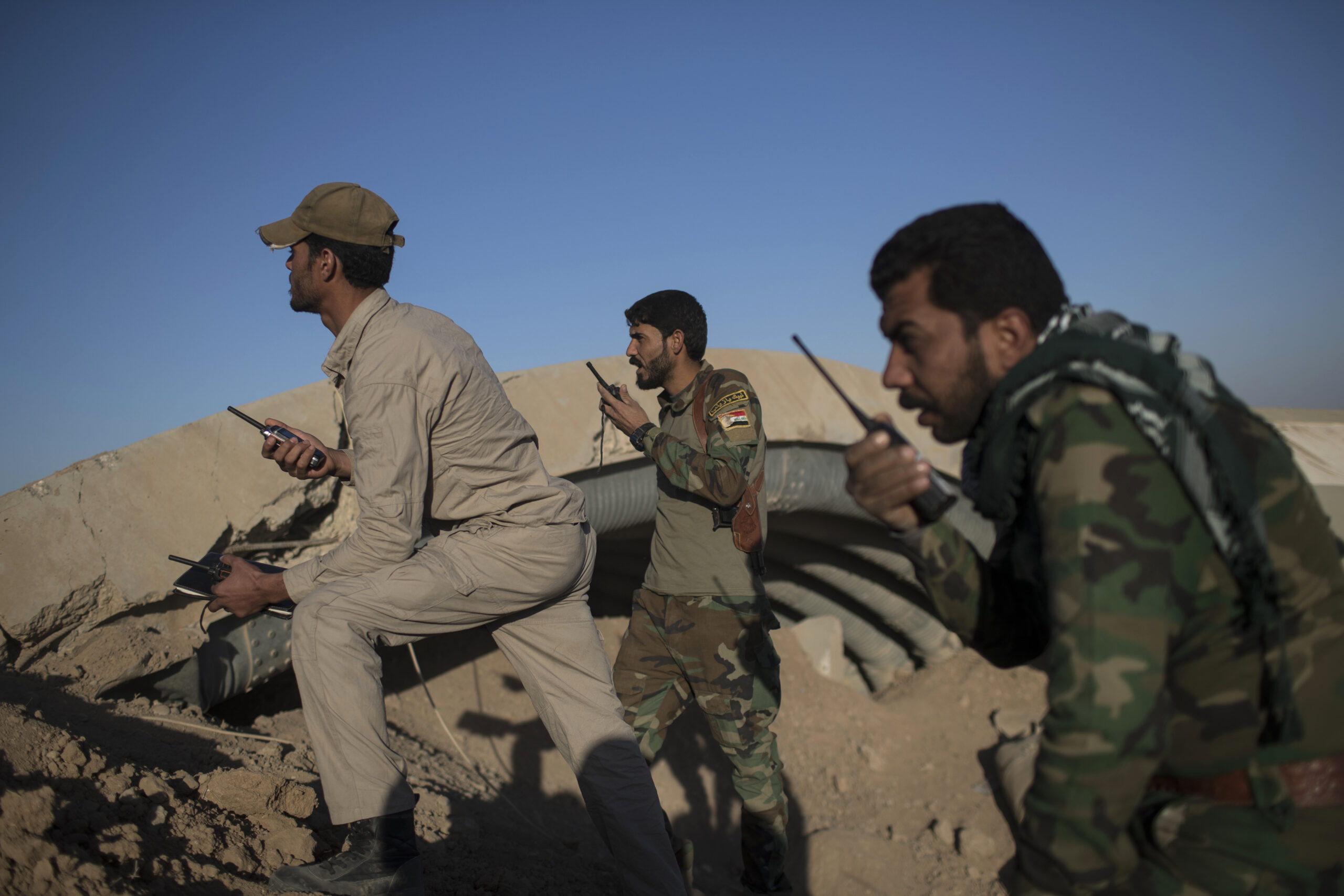
Popular Mobilization Forces look toward Islamic State in Iraq and the Levant fighter positions at the airport in Tal Afar, west of Mosul, Iraq, Nov. 20, 2016. (AP Photo/Felipe Dana, File)
This piece is part of a series about Iranian-backed Shia foreign fighters and their potential impact on regional security dynamics.
The terrible civil war that ravaged Iraq from January 2014 to December 2017 and the fight between Iraqis and the Islamic State in Iraq and the Levant claimed the lives of tens of thousands of Iraqis. The Islamic Revolutionary Guard Corps on the other hand, which took part in the struggle against ISIL and – to the irritation of Iraqi authorities – never forfeits an opportunity to take credit for its defeat, only suffered 43 losses in the entire course of the civil war. Does the low number of IRGC losses in Iraq indicate a limited deployment of those forces, and therefore a lesser strategic interest, in the neighboring country? A closer study of the few Iranian nationals killed in combat in Iraq suggests otherwise: Iraq was certainly not of lesser strategic interest to Tehran, but the differences between the pool of battlefront volunteers in Syria and Iraq resulted in a more limited IRGC presence, and therefore fewer losses, in Iraq.
In total, open source materials identify 561 Iranian nationals killed in combat in Syria from January 2012 to October 2018. In Iraq, however, there is reference to only 43 Iranian nationals killed in combat from April 2014 to October 2017. While open source materials identify a total 2,294 Afghan, Lebanese, and Pakistani combat fatalities in Syria, there are almost no non-Iraqi and non-Iranian Shia foreign fighters reported killed in combat in Iraq – just three Pakistani Zeinabiyoun Brigade members killed in Iraq in 2014.
The significant difference in the pattern of Shia foreign fighter losses in Syria and Iraq is understandable. In Syria, President Bashar al-Assad’s forces were weakened, and the IRGC was in need of manpower and front volunteers. In Iraq, on the other hand, the Iraqi government’s military and security forces, Kurdish Peshmerga forces, and young male Iraqi Shia fighters organized under the umbrella of the Popular Mobilization Forces, which effectively defeated ISIL, pushing it from its last major stronghold in Iraq by the end of 2017.
Further investigation into the rank structure of the deceased Iranians reinforces this conclusion: In Syria, there were 145 officers among the IRGC’s 561 losses. In Iraq, there were 18 officers among the IRGC’s 43 fatalities. In other words, in Syria, to the extent Iran’s losses reflect the deployed forces, the IRGC deployed proportionally more rank and file members in defense of the regime of President Bashar al-Assad. In Iraq, the IRGC deployed proportionally more officers to lead Iraqi front volunteers and several are specifically referred to as IRGC officers seconded to the Iraqi militias. Those individuals include Javad Hosnavi (also known as Jahani) seconded to the Saraya al-Khorasani militia, Mohammad-Hadi Zolfaqari, Ahmad Qanbari, and Ali Khoshlesan, who were all seconded to the Iraqi Popular Mobilization Forces, and Vahid Noumi Golzar, seconded to the Asaib Ahl al-Haq militia.
A related question is how IRGC officers, who for the most part are native Persian speakers, could communicate with the mainly Arabic-speaking Iraqi Shia militia members under their command. The place of birth of Iranian nationals killed in combat in Iraq provides some insight into this: Natives of western provinces, in particular multilingual (Persian, Kurdish, and Arabic) Khuzestan and Kermanshah, are statistically overrepresented among Iranian fatalities in Iraq, which indicates command of languages spoken in Iraq was among the criteria the IRGC used to select servicemen for duty in Iraq.
Iranian Nationals Killed in Combat in Iraq and Place of Birth, April 2014 – October 2017
Data drawn from multiple open sources
Another selection criterion appears to have been service in the extraterritorial operations Quds Force of the IRGC. Of the 43 IRGC combat fatalities in Iraq, 10 individuals were reported to have served in the Quds Force, the branch affiliation of whose losses is usually underreported, and it is also very likely that many among the 25 IRGC members whose branch of service was undetermined also served in the Quds Force. In other words, the IRGC appears to have deployed special operations forces in Iraq to lead the Iraqis rather than IRGC Ground Forces, which appear to have had a more prominent presence in Syria.
Iranian Nationals Killed in Combat in Iraq by IRGC Branch, April 2014 – October 2017
Data drawn from multiple open sources
The Islamic Republic’s limited military engagement in Iraq should therefore not be interpreted as a sign of Tehran’s lesser interest in Iraqi affairs. Rather, it reflected the different needs of the IRGC’s proxies in separate theaters.
The views represented herein are the author's or speaker's own and do not necessarily reflect the views of AGSI, its staff, or its board of directors.
Though they were unsuccessful in preventing the current conflict, and, as expected, have been dragged into the U.S.-Israeli confrontation with Iran, Gulf Arab countries remain crucial to hopes for limiting the war and bringing it to a quick resolution.
After decades of tolerating Hezbollah’s warmaking independence, the current crisis has compelled Lebanese leaders to ban its military activities; this project will do much to determine the reach Iran can maintain in the Arab world.
Ayatollah Ali Khamenei was killed in his office in Tehran at age 86, leaving behind a country in ruins and on the verge of civil war and potential disintegration.
Iran is signaling that it will not absorb attacks passively. But whether this strategy ensures the regime’s survival, seals its fate, or accelerates a broader catastrophe will shape the region for years to come.
The erosion of the regime’s legitimacy across broad segments of society, combined with the breadth of the 2025-26 protest coalition, raises the possibility that a new confrontation could trigger renewed anti-regime mobilization.
Though the Iranian regime is facing increasing pressure from protesters and armed insurgent groups, it is not yet doomed – but without a deal with the United States, the regime is likely headed for a slow collapse.
On January 8, AGSI hosted a virtual roundtable with its leadership and scholars as they look ahead and assess trends likely to shape the Gulf region and U.S. foreign policy during the coming year.