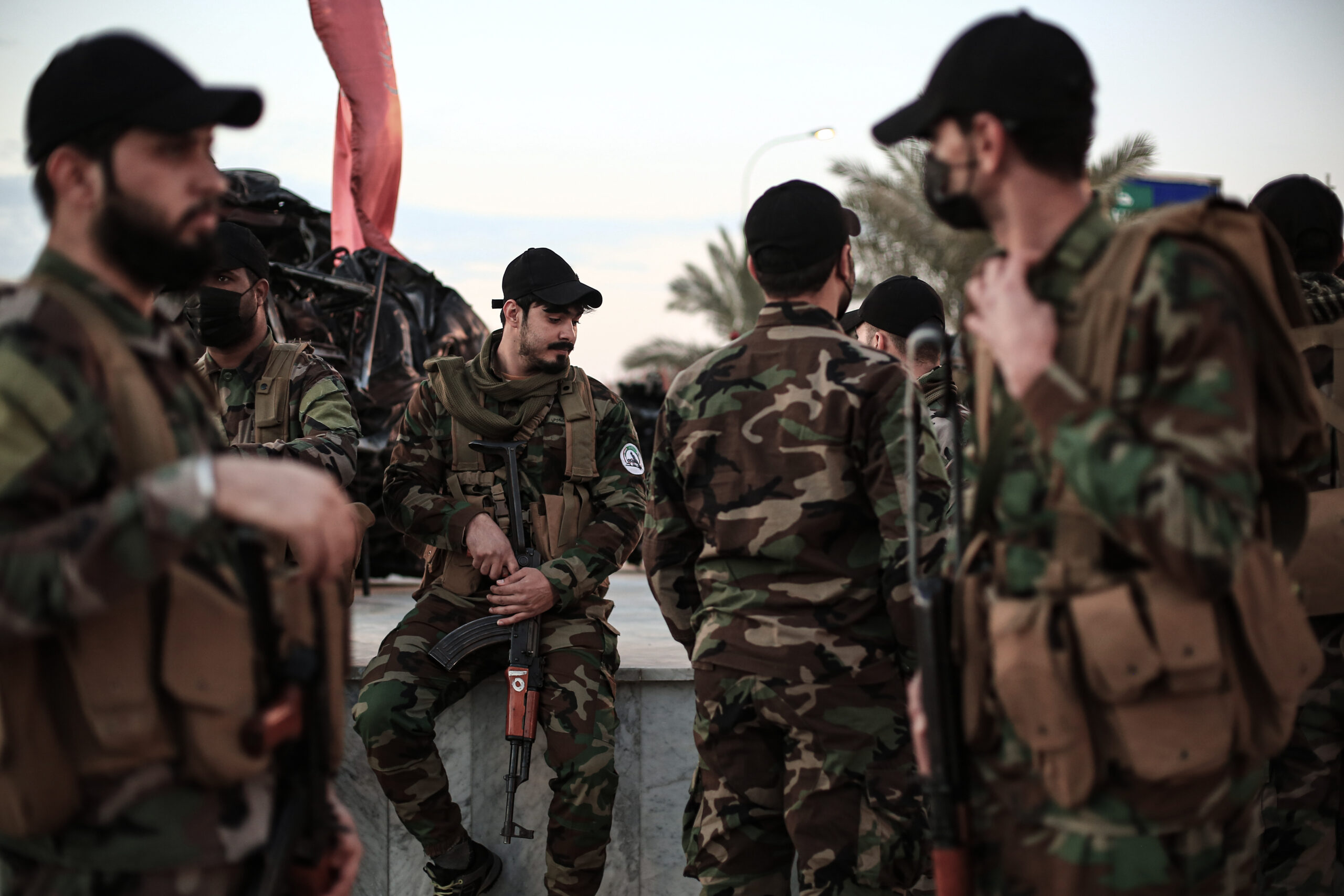
Members of Iraq's Popular Mobilization Forces attend a commemoration ceremony marking the second anniversary of the killing of Iranian military commander and head of the Quds Forces Major General Qassim Suleimani and Iraqi militia commander Abu Mahdi al-Muhandis near Baghdad International Airport, January 2, 2022. (DPA/PICTURE ALLIANCE)
On September 11, Saudi Arabia announced that drones launched from Iraq had struck its East-West oil pipeline, a vital export route to the Red Sea that bypasses the Strait of Hormuz. Baghdad later confirmed the drones’ origin and dismissed the military commander overseeing operations in Iraq’s Maysan province. While no group initially claimed responsibility, the attack is most likely to have been launched by Iran-backed Shia militia groups. Riyadh agreed to hold off on retaliation at Baghdad’s request but reserved the right to respond.
The attack exposed what is at stake with the September 30 deadline for the remaining U.S.-led coalition forces to leave Iraq. Iraqi Prime Minister Ali al-Zaidi had set the same date for disarming Iranian-aligned factions, but the deadline was pushed back to June 2027 just before Zaidi’s departure to the United Nations General Assembly in New York. The withdrawal will deprive those groups of a long-standing justification for keeping their weapons: resisting foreign troops. It will do much less to change the interests that sustain their power. Some of Iraq’s strongest factions receive state funding and political protection while retaining the ability to draw the country into wars its government has not chosen.
Saudi Arabia has already shown that it is prepared to strike inside Iraq. In July, it joined the United States in attacks on bases belonging to the Popular Mobilization Forces, an umbrella of armed groups incorporated into Iraq’s security forces. The PMF said at least 20 members were killed.
Renewed Saudi retaliation could carry a higher price for Riyadh as Houthi attacks add to the pressure on the kingdom. Iraqi factions and the Houthis could threaten Saudi infrastructure from different directions, even without coordinating their operations. That prospect of simultaneous attacks coming from different directions may encourage Saudi restraint, but Baghdad cannot count on it. A promise to prevent further attacks is worth little unless the Iraqi government can enforce it.
The U.S.-led coalition withdrawal follows a timetable agreed upon in September 2024. The agreement set September 2025 as the deadline for ending the coalition’s military mission in Iraq. But it allowed continued support from Iraqi territory for operations against the Islamic State group in Syria through September 2026 and also envisaged bilateral security partnerships. U.S. Central Command has assessed that Iraqi forces can now manage the ISIS threat inside Iraq on their own. While it’s true that Baghdad cannot exert full control over militia factions protected by powerful political patrons, including external actors, such as Iran, countering those militia groups has never been the stated purposed of the U.S.-led coalition’s presence in Iraq, which has been focused on defeating ISIS and supporting Iraqi security forces.
Iraqi law has already notionally placed the PMF within the armed forces and under the control of the commander in chief. However, the PMF encompasses groups with different loyalties. Some of the PMF’s most powerful factions retain ties to Iran or separate Iraqi political organizations and have varying commercial interests. Their access to state resources long predates their formal incorporation into Iraq’s security forces and has helped sustain the autonomy of individual factions from state control. For example, the U.S. Department of the Treasury reported that the Muhandis General Company diverted funds from government contracts and supported the pro-Iranian militia Kataib Hezbollah. Such networks give faction leaders a substantial stake in resisting disarmament. Accepting disarmament and surrendering independent military power would inevitably weaken their hold on contracts, appointments, and patronage.
Zaidi has already encountered the political resistance that enforcement can provoke. In August, special forces reporting directly to him detained Harakat al-Nujaba’s intelligence chief for 48 hours over alleged involvement in drone attacks on U.S. interests. The detention prompted threats of retaliation from the faction and required intervention by senior Shia politicians to defuse tensions. Zaidi will need political backing strong enough to sustain investigations and prosecutions when these legal processes threaten influential groups.
The pressure on Zaidi reflects a long-standing tension between the formal institutions led by the prime minister and the Shia armed groups. This divided authority can endure without the state visibly falling apart so long as a balance holds between the government and these factions. Ministries may operate, elections could still take place, and budgets could pass while armed factions retain the power to override decisions that threaten their interests. For neighboring governments, this creates an uncomfortable choice: Trust Baghdad’s assurances or act against threats themselves, both eliminating the immediate threat and raising the costs for Baghdad of leaving it unaddressed.
Iraq has little economic room for a confrontation with powerful groups in the PMF. The International Monetary Fund projects a 6.8% contraction in the Iraqi economy in 2026. Oil remains the main source of government revenue, but the closure of the Strait of Hormuz has slashed Iraq’s revenue by over 40%. Further attacks from Iraqi territory could invite reprisals against the infrastructure that finances salaries and public services. Higher oil prices offer little prospect of increasing government revenue if Iraq cannot get its crude to market.
To gain control over PMF groups, Baghdad can use the authority it already holds over public funds and military appointments. It can condition access to new funding and equipment on compliance with the lawful chain of command. When there is evidence of commanders ordering unauthorized attacks, the government can place those individuals under investigation and subject to prosecution. Such measures will require agreements among political leaders willing to accept constraints on factions close to them. As the Ministry of Finance seeks to submit a 2027 national budget to Parliament, such agreements can be enshrined in the law. Selective enforcement would leave the underlying system intact.
To encourage the Iraqi government to bring PMF groups more effectively under its control, Washington can apply diplomatic and financial pressure on Baghdad. It can also negotiate continued intelligence sharing, air defense assistance, and counterterrorism cooperation through the bilateral relationship envisioned in the 2024 agreement. For example, conditional military assistance would go to units whose command structures and spending can be verified, and financial enforcement would focus on the companies and intermediaries that fund unauthorized armed activity.
Baghdad can start with the pipeline attack in Saudi Arabia. Removing a provincial commander will mean little if the inquiry stops there. The government needs to establish who ordered and enabled the operation and hold those responsible to account. Otherwise, U.S. and fellow coalition forces will have left Iraq, while armed factions, through their reckless actions, will still be able to pull the country into a war the government has not chosen to fight.
The views represented herein are the author's or speaker's own and do not necessarily reflect the views of AGSI, its staff, or its board of directors.
The war between the United States and Iran revealed the vulnerability of static U.S. bases, while also showcasing Gulf Arab states’ capacity – bolstered with U.S. hardware and training – to intercept most Iranian strikes on their own, raising new questions about U.S.-Gulf security partnerships.
A strong relationship with the GCC acts as a stabilizing force for an inherently fragile Iraqi state. But to maintain this, Iraq needs to pair sophisticated regional diplomacy with assertive control over the nonstate actors operating within its borders.
The U.S.-Israeli attack on Iran has exposed Iraq’s structural fragilities: territorial permeability, economic monoculture, energy dependence, and politically mediated sovereignty.
With the Strait of Hormuz closed and alternative export routes infeasible in the short term, a comprehensive agreement with Erbil can help Baghdad address its critical lack of oil export capability.
The flow of Kurdish oil via the Iraq-Turkey pipeline to the international market after more than two years demonstrates the effectiveness of sustained U.S. diplomacy.
Decentralized governance efforts in the region, while offering promise to societies fractured by years of dictatorship and war, will be messy, inconsistent, and vulnerable to reversal and external manipulation.